Martinique – The Cocoa and Chocolate Village 2025 : a treasure trove of excellence

Cocoa and Chocolate Village 2025

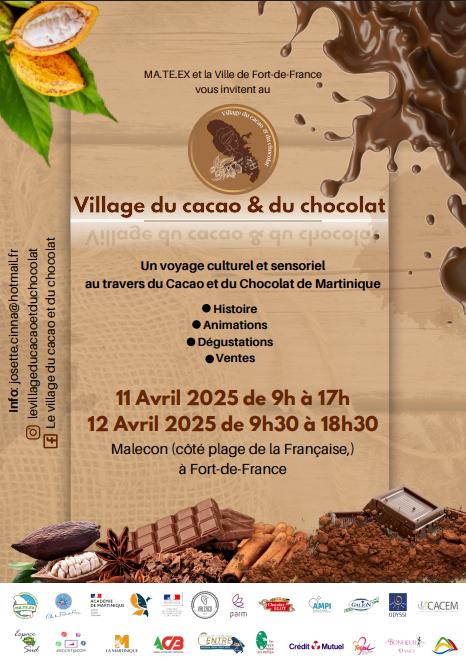
Cocoa and Chocolate Village 2025 was a unique event featuring one of Martinique’s most precious treasures: cocoa. Cocoa and Chocolate Village 2025 was held on April 11 and 12, 2025 at the Malecon in Fort-de-France, and invited all audiences to understand the world of cocoa, from its cultivation to its transformation into chocolate, as well as its rich history and place in Caribbean culture.

Cocoa, the jewel of Martinique

Martinique’s cocoa is renowned for its exceptional quality, the fruit of a unique terroir and ancestral know-how. Yet this treasure remains little-known, both in its history and in its uses. The Cocoa and Chocolate Village 2025, organized by the association Martinique Territoire d’Excellence (MA.TE.EX) in partnership with the City of Fort-de-France, aims to change this by offering a free, accessible and content-rich event. The aim of the Cocoa and Chocolate Village 2025 was clear: to promote cocoa as a cultural, economic and educational driving force in Martinique.

Cocoa and Chocolate Village 2025

The history and cultivation of cocoa in Martinique

Cocoa arrived in Martinique at the beginning of the 17th century, notably in 1615, where it was quickly appreciated at the French Court as a luxury product. Its history is closely linked to the triangular trade, which left its mark on the region. Today, this history is taught in schools, such as the Collège de Rivière-Saint-Louis, where pupils took part in interdisciplinary projects combining history, French and cooking. They made plastic pods, wrote poems and cooked recipes using cocoa and local spices, passing on the cultural richness of cocoa.

The cocoa industry : from pod to chocolate

The path of cocoa to chocolate is a real journey. It all begins with the pod, the colourful fruit that contains the beans of cocoa. These beans are first extracted and then fermented for several days, a process that raises their temperature to 55 degrees, essential for developing the aromas. They are then dried in the sun for around ten days, before being roasted over a wood fire, a step that releases the characteristic flavours of the cocoa.

This painstaking work is carried out by producers grouped together under the umbrella of the Valcaco association, which promotes the value of local cocoa. The final transformation into chocolate requires the addition of ingredients such as sugar, hazelnuts and spices like cinnamon and nutmeg, creating unique flavors.

Cocoa and Chocolate Village 2025

The Karisko association and the ludification of Caribbean heritage

The Karisko association plays an essential role in promoting Caribbean heritage through an educational and participatory approach. Its name, which means “the Caribbean”, recalls 4000 years of daily history. Karisko offers board games, escape games and group activities for all audiences, from children to works councils.

It also owns the Kanawa boat and manages the La Ramée islet, both of which are open to visitors. During the Cocoa and Chocolate Village 2025, Karisko led workshops such as “Merveilleuse Caraïbe” under the Caribbean constellations, offering an immersive experience combining heritage, culture and transmission.

Sustainable agriculture and biodiversity in cocoa farming

Growing cocoa in Martinique is part of an environmentally-friendly approach. A common practice is to combine cocoa trees with banana trees, which conserve water and provide shade and humidity, creating a microclimate favorable to cocoa tree growth. This natural association limits the use of chemicals.

This is complemented by other crops such as coffee and pole-thorn, creating a three-dimensional farm that promotes biodiversity. The droppings of animals such as sheep and chickens are used as natural fertilizers, further strengthening the ecological balance. This sustainable approach is essential to preserving Martinique’s terroir and guaranteeing the quality of our cocoa.

The Cocoa and Chocolate Village 2025 : an educational and festive event

Cocoa and Chocolate Village 2025 was organized around four themes: taste, science, history and fun. The taste section featured tastings and demonstrations by chocolate and pastry makers. The scientific section explained farming techniques and environmental issues. The historical section retraced the history of the cocoa through exhibitions created by students and cultural institutions. Last but not least, the entertainment section offered traditional games, shows and musical entertainment, including a concert by Bèlèrumba Proj’ect. Over 30 schools took an active part, reinforcing the educational and intergenerational dimension of the event.

Cocoa and Chocolate Village 2025

The Cocoa Village, a lever for local development and Caribbean pride

Cocoa and Chocolate Village 2025 was much more than just a gourmet event. It proved to be a real lever for promoting the cocoa. It was also a vehicle for cultural transmission and a driving force for local economic development. By combining ancestral know-how, educational innovation and ecological commitment, this event embodied the richness and pride of the Caribbean. Whether you’re an expert, an amateur or simply curious, the Cocoa and Chocolate Village 2025 rediscovered a treasure that is the heartbeat of Martinique.

Leave a Reply

Your email address will not be published. Required fields are marked *

More articles from RK

Denis Mukwege
EVENT MANAGEMENT
Tolotra

Denis Mukwege: in Martinique, repairing women and the world

In Martinique, the visit of Denis Mukwege gave special weight to the word reparation. From May 2 to 8, 2026, the 2018 Nobel Peace Prize laureate met with residents, healthcare professionals, students and elected representatives to share a common message: treating bodies is not enough if societies leave violence against women in silence. A week to hear a global voice Martinique has not only welcomed a famous doctor. It welcomed a man whose name is linked to one of the great moral struggles of our time. Denis Mukwege, a Congolese gynecologist, has dedicated his life to women survivors of sexual violence in the Democratic Republic of Congo. His struggle earned him the Nobel Peace Prize in 2018, shared with Nadia Murad, for their efforts against the use of sexual violence as a weapon of war. This visit took place as part of the Festival en Pays Rêvé, in an “hors

Read More »
Konbit
HISTORY & HERITAGE
Tolotra

“Konbit”: the Haitian word that turns self-help into a party

In a yard, at the edge of a field or near a house in need of repair, someone calls out. You don’t just lend your arms. They come with their presence, their voice, sometimes a drum, often a dish to share. In Haiti, Konbit doesn’t just mean one-off help. The word tells of a way of living together. It is this force that still runs through the living word today. To say “fè yon konbit”, in Haitian Creole, is to announce that work is being carried out by several people. The simplest translation would be “collective work” or “mutual aid”. But that’s too short a translation. A Konbit implies a call, a response, a reciprocity. Today we help a neighbor prepare his field, tomorrow that neighbor will come and help in turn. Effort circulates. Debt is not accounting. It is social. Working together, but never cold The word is strongly

Read More »
Garifuna language
HISTORY & HERITAGE
Tolotra

Saint-Vincent and the Grenadines – The Garifuna language: Saint-Vincent wants to save it through schools

In St. Vincent and the Grenadines, the Garifuna language could leave the circle of commemorative speeches and enter the classroom more clearly. At the 13th International Garifuna Conference, Prime Minister Dr Godwin Friday called for the language to be taught as an essential subject. The announcement touches a deep nerve: that of an Afro-Aboriginal memory long displaced, but never extinguished. A highly symbolic political statement The choice of location and subject is not insignificant. In Saint-Vincent and the Grenadines, to speak of the Garifuna language is to return to one of the founding territories of this history. This people, born of African and indigenous Caribbean encounters, carries a memory of resistance, exile and transmission that extends far beyond the borders of the city. By placing the school at the center of his appeal, Dr. Godwin Friday isn’t just talking about a program to be added. He refers to education as

Read More »

conTACT RK

we'd love to have your feedback on your experience so far

Join The List

Join our Richès Karayib community!  Sign up for our newsletter.

Want To Maximize Your Business Presence On Riches Karayib?

Complete the form to start the application