
The Kalinagos, also called Caribs by Europeans, are one of the last indigenous peoples of the West Indies to have preserved their cultural identity. Direct descendants of the first inhabitants of the Caribbean islands, they carry a thousand-year-old heritage that profoundly marked the history of the region before the arrival of Christopher Columbus in 1493.
Today, they live mainly on the island of Dominica, where they represent the living memory of pre-Columbian societies in the Lesser Antilles. Their history, marked by fierce resistance to European colonization, sheds light on the profound transformations experienced by these tropical islands over the last five centuries.
Origins and migrations: from Venezuela to the Lesser Antilles
Archaeological and linguistic studies place the origins of the Kalinagos in northern Venezuela. They migrated to the Caribbean islands between the 9th and 14th centuries, gradually settling in the Lesser Antilles archipelago. Contrary to simplistic colonial accounts, they did not brutally expel the Arawak populations already present, but rather assimilated some of them in a slow process.
This hypothesis is supported by the discovery of Kalinagos ceramics on the island of Saint-Vincent, similar to those of Guyana’s Koriabos populations, testifying to their South American affinity. Before the arrival of Europeans, their territory extended from Tobago to Guadeloupe, with more scattered settlements to the north. They left names for their islands, such as “Waitukubuli” for Dominica, meaning “Great is his body”, or “Hairoun” for Saint-Vincent.
Social organization and lifestyle
Kalinago society was characterized by an egalitarian structure, in contrast to the more hierarchical systems of the Taino peoples of the Greater Antilles. Power was distributed according to specific functions – war, religion, navigation – without inheritance or permanence. This decentralized organization contributed to their resistance to colonizers: the death of a chief was quickly compensated for by the emergence of a successor.
Agriculture was at the heart of their existence, with the cultivation of cassava, corn and yams. They practiced sustainable agriculture through a system of crop rotation: after three years of cultivation, the gardens were abandoned to let the land regenerate, once again becoming a collective asset.
Their mastery of navigation was remarkable. They used large canoes carved from gum wood, which enabled them to travel around the islands for trade, fishing and cultural exchange. This favored unity and the circulation of cultural and economic goods between scattered communities.
Spirituality and traditional culture
Kalinago spirituality was based on an animistic system in which every natural element was animated by spirits. Unlike the Tainos, who had an organized pantheon, the Kalinagos had a more direct relationship with these invisible forces. Fire, moon, sun and rain formed the pillars of their creative vision of the world.
Shamans, known as “boyez”, played a fundamental role as intermediaries between the living and the spirits. They practiced healing and conducted rituals, viewing illness as a disorder of spiritual relations rather than a purely biological phenomenon.
A notable feature of this culture was the linguistic distinction between men and women: men spoke a language of Caribbean origin, while women used an Arawak vocabulary, illustrating the complex history of migration and cultural assimilation.
Craftsmanship and know-how
Kalinagos craft skills included basketry, pottery and shipbuilding. They wove baskets, mats and containers from natural fibers such as aroman and cachibou, creating intricate patterns that also served as a means of communication.
Their pottery, made using the colombin technique inherited from the Arawaks, was adorned with geometric decorations and was used for both everyday and ceremonial purposes. The manufacture of gumwood canoes remains one of their major technical feats, reflecting an in-depth knowledge of marine currents.
European colonization: resistance and drama
The arrival of Christopher Columbus in 1493 marked the beginning of a dramatic period. The Kalinagos were slandered by the Europeans, wrongly accused of cannibalism to justify their enslavement. Yet their resistance was constant and effective, thanks in particular to their decentralized social organization and their mastery of guerrilla warfare.
The Saint-Christophe massacre of 1626 was a major tragic episode. Conducted by English and French colonists, it claimed around 2,000 Kalinago victims, with the carnage having its epicenter in Bloody Point. The event forced the survivors to take refuge on more isolated islands, such as Dominica and Saint-Vincent. The population plummeted from 15,000 in 1625 to around 2,500 fifty years later.
Kalinagos today: survival and legacy
Today, the Kalinagos live mainly on a 15 km² territory in Dominica, granted in 1903. This territory is home to between 2,000 and 3,500 residents in eight villages, with their own institutions (elected council, school, dispensary). They elect a chief every five years, thus retaining a form of political autonomy.
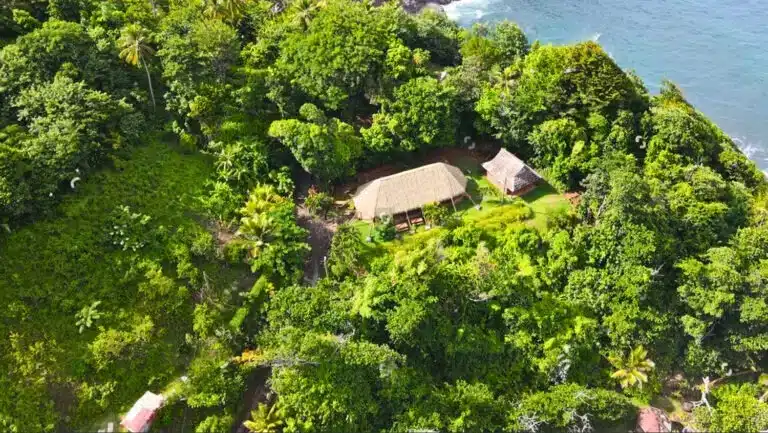
The Kalinago Barana Aute cultural center, inaugurated in 2007, plays a key role in the transmission of ancestral skills (basketry, pottery, wood carving, canoe building). The Kalinago language, long supplanted by English and Creole, is being revitalized, particularly through education of the younger generation. Traditional songs, dances and rituals continue to punctuate community life.
In the face of modernity, the Kalinagos strive to preserve their cultural identity while adapting. Cultural tourism is a growing source of income, but they are careful to control the representation of their heritage. Today, their experience serves as an example for other indigenous peoples in the Americas who are committed to recognizing and safeguarding their heritage.