Dominica – The Valley of Desolation and Boiling Lake: the island’s volcanic wonders

Boiling Lake

Dominica offers the most spectacular adventure in the Lesser Antilles: the hike to the Valley of Desolation and the Boiling Lake. On a 13-kilometre round trip loop, with almost 900 metres of ascent and descent, hikers enter a world shaped by the power of volcanoes. Smokers, bubbling springs and lunar landscapes make for a unique Caribbean experience.

An exceptional volcanic heritage

Located in Morne Trois Pitons National Park, a UNESCO World Heritage site since 1997, the Vallée de la Désolation and Boiling Lake are two of the world’s most spectacular natural wonders. are at the heart of a volcanic territory of rare intensity. Dominica, with its nine active volcanic centers, is one of the most volcanic islands in the West Indies. Its 751 km² surface is the result of millions of years of eruptions linked to the subduction of the Atlantic plate beneath the Caribbean plate, at a rate of around 2 centimetres per year.

The island is dominated by steep slopes and dense forests. The Morne Trois Pitons, culminating at 1,387 meters, gives the park its name. Its rocks, mainly andesitic and dacitic, feed fertile soils covered with lush tropical vegetation. But in the heart of the Valley of Desolation, underground heat and volcanic gases prevent all life from developing.

Boiling Lake
©discoverdominica
Boiling Lake
©discoverdominica

The Valley of Desolation: a timeless landscape

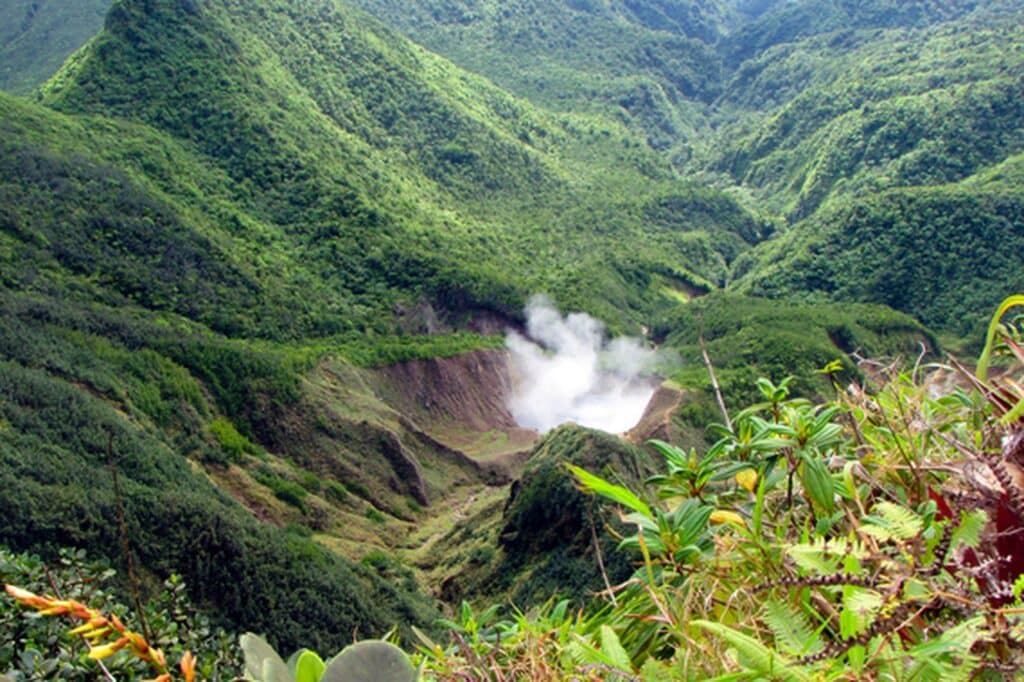
The Valley of Desolation is a volcanic amphitheatre created by the collapse of several craters. In this mineral terrain, geothermal activity is omnipresent: mud pots, hissing fumaroles, hot springs sometimes exceeding 100°C. The gases, a mixture of water vapour, sulphur dioxide and hydrogen sulphide, give off a characteristic rotten-egg smell and create an environment where vegetation is absent.

The scenery is striking: yellow and orange deposits of sulfur and iron oxides, boiling sludge that seems to breathe, plumes of steam rising from the ground. Guides like to demonstrate the power of nature by cooking an egg directly in the boiling water…

Boiling Lake
©discoverdominica
Boiling Lake
©discoverdominica

Boiling Lake: a unique phenomenon

After crossing the Valley of Desolation, the hike leads to Boiling Lake. the world’s second-largest boiling lake after New Zealand’s Frying Pan Lake. Located at an altitude of around 800 metres, it measures almost 60 metres in diameter and over 59 metres in depth. Its blue-grey water is constantly stirred by the heat of volcanic gases rising from underground.

Temperatures at the edges reach between 82 and 91°C. The permanently boiling center remains impossible to measure. Discovered in 1870 by Edmund Watt and Henry Nicholls, the Boiling Lake has fascinated scientists since it was first studied in 1875. Since then, it has undergone spectacular variations: in 1880 and 2005, phreatic eruptions temporarily emptied the lake before it filled up again.

Boiling Lake
©discoverdominica
Boiling Lake
©discoverdominica

A demanding hike

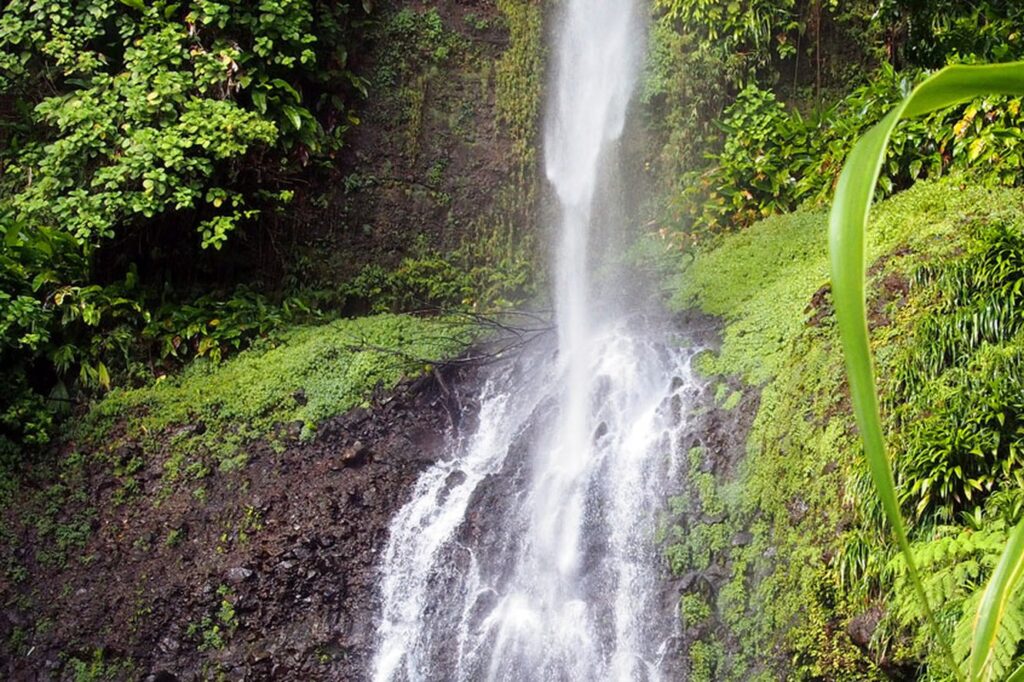
The trail begins at Titou Gorge, near Laudat, at an altitude of 480 metres. After a gradual climb through the rainforest, hikers reach Breakfast River, the first stop before climbing Morne Nicholls, some 965 metres high. The descent that follows leads to the Valley of Desolation, over steep and often slippery terrain. Some sections can be equipped with ropes to secure the passage.

The final stretch crosses the geothermal valley before climbing to the viewpoint overlooking Boiling Lake. . In all, the route requires between 6 and 8 hours’ walking, in sometimes difficult conditions. Good physical preparation is essential, as the effort is well worth the reward: a breathtaking panorama over the Boiling Lake.

Boiling Lake
©discoverdominica

When to go?

The best time to visit is from January to April, during the dry season. Rainfall is less frequent, especially on the coast, and temperatures hover around 28°C. In the mountains, the climate remains humid all year round, but the trails are more practicable in the dry season. Conversely, the hurricane season, from June to November (with a peak between August and October), makes hiking more risky and less enjoyable.

Preserving a fragile site

The Valley of Desolation and Boiling Lake are UNESCO World Heritage Sites. It is forbidden to pick up stones, leave garbage or go off the marked trails. These simple gestures avoid weakening an ecosystem already subject to extreme conditions. Visitors must also respect the local fauna, including the Sisserou parrot, an endemic species and emblem of Dominica.

Boiling Lake
©discoverdominica

Mythical hike across the Valley of Desolation to Boiling Lake is more than a sporting challenge: it’s an immersion in the raw power of the Earth. The landscapes, between lush forests and sulfur-burnt lands, reveal Dominica’s dual identity as an island of greenery and volcanoes. Venturing along this trail, accompanied by a guide, visitors enjoy a rare experience in the Caribbean: walking above the bowels of the planet, in a setting that few other places in the world can offer.

2 Responses

  1. Amazing always wanted to see boiling lake but haven’t gotten to it yet, there is just too much to do in Dominica

Leave a Reply

Your email address will not be published. Required fields are marked *

More articles from RK

Man Mélé
VISUAL ARTS
Tolotra

“Man Mélé!”: Cécile Vernant’s Exhibition at the Senate’s Orangerie

Exhibiting at the Jardin du Luxembourg is often a major milestone in an artist’s career. For artist Cécile Vernant, it is above all an opportunity to connect with the public. From July 17 to 28, 2026, she will present *Man Mélé!* at the Senate’s Orangerie, as part of the Luxembourg Garden Summer Festival. For twelve days, she will personally welcome visitors to this iconic venue at the heart of Parisian cultural life. Selected following the 2026 call for projects, the artist will have 152 m² to showcase her artistic world, where painting, photography, drawing, and ceramics interact freely. After being selected by the Senate, Cécile Vernant reached out to Didier on her own initiative, without having had any prior contact with the company. This choice came naturally: from the brand’s production site, the view takes in the Carbet peaks, a Martinican landscape that runs through her work just as much

Read More »
Saint-Barthélemy
TOURISM
Tolotra

Saint-Barthélemy: 21 km², nearly a century under Swedish sovereignty

When you arrive in Saint-Barthélemy, the first thing you see as you disembark is the name of the capital: Gustavia. Not Sainte-Anne, not Saint-Jean, not a French name. Gustavia. This name marks the beginning of one of the Caribbean’s most unique colonial chapters: that of a French island that became Swedish for nearly a century. A small island long considered unprofitable With an area of 21 square kilometers and a population of 10,660 according to INSEE’s reference population figures as of January 1, 2023, Saint-Barthélemy has a multi-layered history. Christopher Columbus was the first known European navigator to report sighting the island in 1493, during his second voyage. He named it after his brother Bartolomeo. The French established a permanent settlement there in 1648. Philippe de Longvilliers de Poincy, lieutenant general of the American Islands, sent Jacques Gante there with 52 men. Conditions were difficult. There was a shortage of

Read More »
Zouk@Sea by MSC
MARITIME
Tolotra

Zouk@Sea by MSC: 18 weeks of Caribbean music

From December 5, 2026, to April 4, 2027, the MSC World Europa will come alive to the rhythms of Caribbean music with the Zouk@Sea by MSC festival. For its third edition, eighteen weeks of musical entertainment will take place on sailings departing from Fort-de-France and Pointe-à-Pitre, featuring artists, live bands, and DJs from Martinique and Guadeloupe. The lineup brings a variety of Caribbean musical styles aboard an international cruise ship: zouk, compas, Creole traditions, urban music, cadence, dancehall, shatta, soca, and DJ sets. A different lineup every week Zouk@Sea by MSC operates on a simple principle: each week, an artist, band, or DJ performs on the cruise. Departures are scheduled for Saturdays from Fort-de-France and Sundays from Pointe-à-Pitre. The season will kick off on December 5 and 6, 2026, with SOS Kantik and a lineup dedicated to Chanté Nwèl. Silonvan will take over on December 12 and 13, followed by

Read More »

conTACT RK

we'd love to have your feedback on your experience so far

Join The List

Join our Richès Karayib community!  Sign up for our newsletter.

Want To Maximize Your Business Presence On Riches Karayib?

Complete the form to start the application