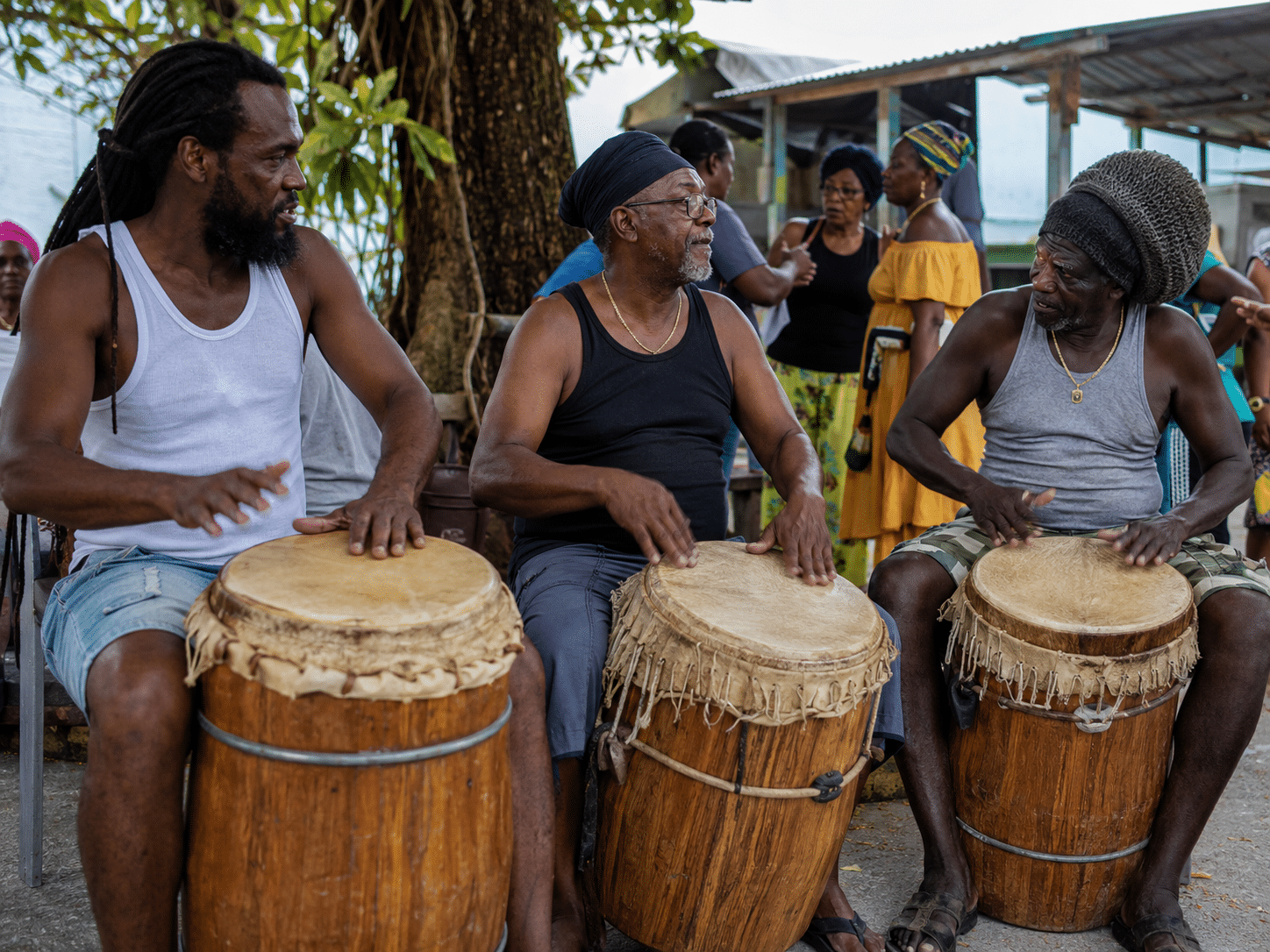
The Jardin d’Eau in Goyave resounded with emotion on Monday, October 27, as a tribute was paid to Hector Poullet. Through the 14ᵉ edition of the On ti zyédou concept, the Département de la Guadeloupe saluted the career of a man who devoted his life to the Creole language and Guadeloupe’s youth. Author of the first Creole-French dictionary, published in 1984, he remains an essential figure in Caribbean linguistic heritage.
A teacher guided by love of his country
Born in Anse-Bertrand, Hector Poullet has long lived between two worlds: that of science, which he studied in mainland France, and that of Guadeloupean culture, which he rediscovered on his return home. His attachment to the Creole language stems from a simple conviction: a people who speak their language rise with it.
As a math teacher, he understood early on that students’ success also depended on recognition of their linguistic identity. It was against this backdrop that he teamed up with Sylviane Telchid, a colleague at Capesterre-Belle-Eau secondary school. Together, they began teaching Creole to troubled youngsters in their spare time, long before the language was recognized by the French education system.

The 1984 dictionary: a turning point
When the first Creole-French dictionary appeared in 1984, co-authored by Hector Poullet and Sylviane Telchid, it marked a cultural revolution. For the first time, Guadeloupean Creole was equipped with a solid academic tool, paving the way for its teaching and institutional recognition.
This dictionary, which has become a reference, has given Creole the legitimacy of a codified, transmitted and studied language. Hector Poullet’s initiative inspired other researchers and teachers to continue this process of linguistic standardization. Even today, his work continues to be cited in school curricula and in numerous works devoted to Creole culture.
Love, courage and transmission
The tribute paid to Hector Poullet recalled the values that guided all his work. First and foremost, the love of Guadeloupe and his youth. His return “back home” after his studies was not simply a geographical return, but a profound commitment to his people.
Then there’s courage. In the 1970s and 1980s, speaking Creole at school was still a contested act. With perseverance, he defended this language that some wanted to silence. Thanks to his work and that of his colleagues, Creole has found its place in classrooms, becoming a recognized option on a par with Latin or German.
He has never ceased to share his knowledge: dictionaries, tales, glossaries, translations of classical works… His approach has always combined scientific rigor with fidelity to popular culture.
A language, a land, an identity
The Jardin d’Eau tribute was not limited to words. Through music, video and personal accounts, the evening revealed other facets of Hector Poullet: the farmer, the gardener, the man attached to the land. In his traditional garden, he grew coffee, vanilla and medicinal plants, continuing in his own way the legacy of his elders.
This anchorage in nature reflects his vision of the world: language is not isolated from the rest, but grows in a soil of gestures, knowledge and memory. Through his stories and writings, Hector Poullet has given Guadeloupean culture back its words and its roots.
Creole, from prohibition to recognition
Hector Poullet’s story symbolizes the slow ascent of Creole from marginal language to heritage language. It wasn’t an easy road: it took convincing, proving and arguing. But by dint of hard work, publications and dialogue, he has succeeded in changing people’s minds.
Today, Creole is taught, written, sung and studied. Every word and every expression that has been rehabilitated bears the imprint of the struggle waged by Hector Poullet and his peers. His 1984 dictionary was not just a linguistic tool: it was a political act, an affirmation of dignity.
A memory to pass on
At the ceremony, teachers, artists and students paid tribute to both the man and the teacher. Readings, songs and testimonials recalled the importance of his work in the education of entire generations. For many, he was the first to make them understand that Creole is not a language of the past, but a space for creation and thought.
This tribute, supported by the Conseil départemental, also serves as a reminder of our collective responsibility to keep the language alive, beyond tributes, in everyday life, in schools and in the media.

A living legacy
Hector Poullet’s legacy goes beyond the academic. He embodies the conscience of a people who have regained their voice. His work, begun over forty years ago, continues to inspire writers, teachers and musicians throughout the Caribbean.
In every Creole word spoken, in every text written, a part of his work remains. Through his humanist vision and patient commitment, he proved that defending one’s language also means defending one’s freedom.
Hector Poullet’s name will remain linked to the rebirth of Creole in Guadeloupe. His 1984 dictionary, his pioneering courses and his numerous publications constitute a living heritage. The Jardin d’Eau tribute did more than pay tribute to a man: it reminded us that a language only exists through those who carry it and pass it on.
Thanks to him, Guadeloupe now speaks with more pride, more awareness, and above all, in its own words.