Quadrille: dance memory and living heritage of the West Indies

Quadrille

In the French West Indies, the Quadrille is more than just a traditional dance. It is a strong cultural marker, a space for transmission and a living testimony to the social history of the Caribbean territories. Practiced for over a century in Guadeloupe and Martinique, this choreographic art illustrates the capacity of Caribbean societies to transform forms inherited from Europe into deeply rooted expressions of identity.

From European salons to West Indies town squares

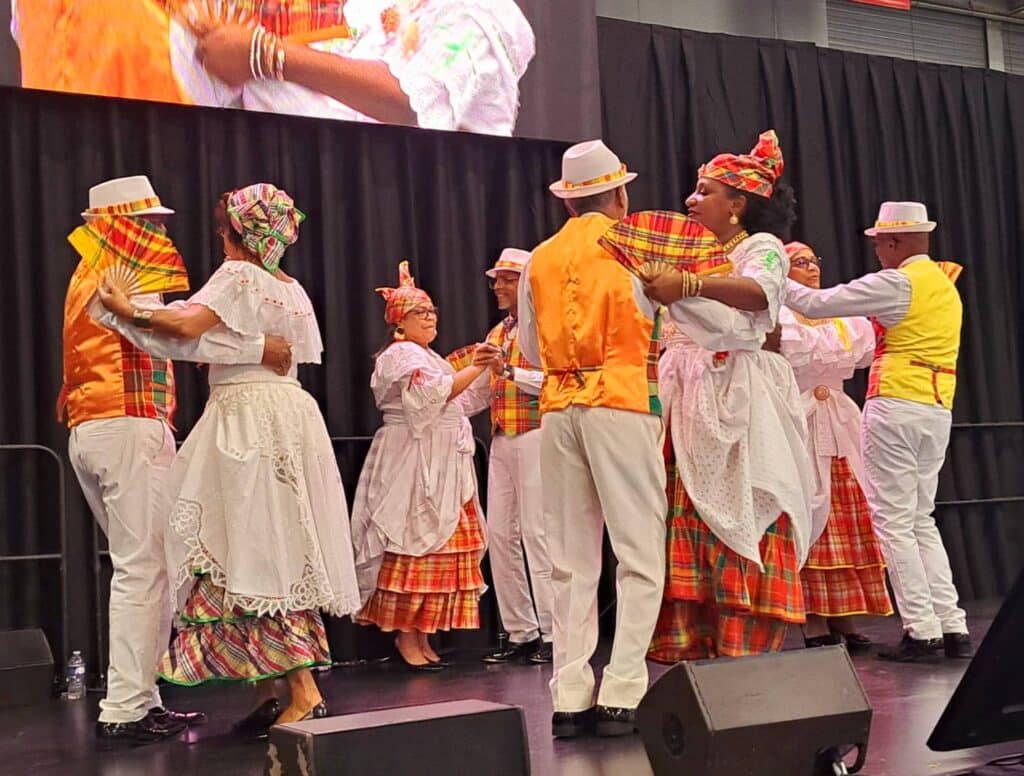
Originally, this dance appeared in European aristocratic salons in the XVIIIᵉ and XIXᵉ centuries. Imported into the French Caribbean colonies during the colonial period, it was initially reserved for the elites of large homes. The rules are strict: four couples arranged in a square perform a succession of codified figures, carried by regular music and a measured tempo.

Over time, this practice moved out of closed circles and into popular spaces. It took root in villages, at community festivals and rural gatherings. This social shift marked a decisive turning point: dance changed function, audience and meaning. It ceased to be a simple form of social entertainment and became a collective moment, anchored in everyday life.

A profoundly Creole transformation

Le Quadrille has never remained static in the West Indies. It has been transformed by contact with local realities, in a gradual process of creolization. The music evolves, integrating violin, drum, chacha or accordion depending on the territory. Rhythms become more flexible, sometimes more intense, and melodies are imbued with Caribbean sensibilities.

Traditional figures – pants, summer, hen, shepherdess, final – keep their original French names, but their interpretation changes. Movements become more expressive, exchanges between dancers more intense, and the relationship with the audience stronger. The result is a lively form, both structured and free in its execution.

Quadrille
©Alfred Desirée (UCV) 2

Words at the heart of dance

One element in particular distinguishes the West Indian Quadrille: the importance of orality. The commander, or leader, announces the figures aloud, often in Creole. This rhythmic speech guides the dancers, structures the choreography and creates a constant link between music and movement.

In the Quadrille oral transmission plays a central role. It enables us to learn without the need for written support, and favors a collective appropriation of knowledge. Dance thus becomes a space of shared memory, where everyone learns by observing, listening and practicing.

Quadrille
©Alfred Desirée (UCV)
Quadrille
©Alfred Desirée (UCV)

A fundamentally collective practice

This dance is based on a simple but essential principle: the group. It doesn’t value individual performance, but coordination and listening to each other. Each dancer occupies a precise place, and the ensemble works only if everyone respects the common framework.

Historically, this collective dimension explains its importance at key moments in social life: weddings, patronal feasts, wakes and rural celebrations. It contributes to community cohesion and reinforces the sense of belonging.

Quadrille
©Alfred Desirée (UCV)

Costumes and heritage aesthetics

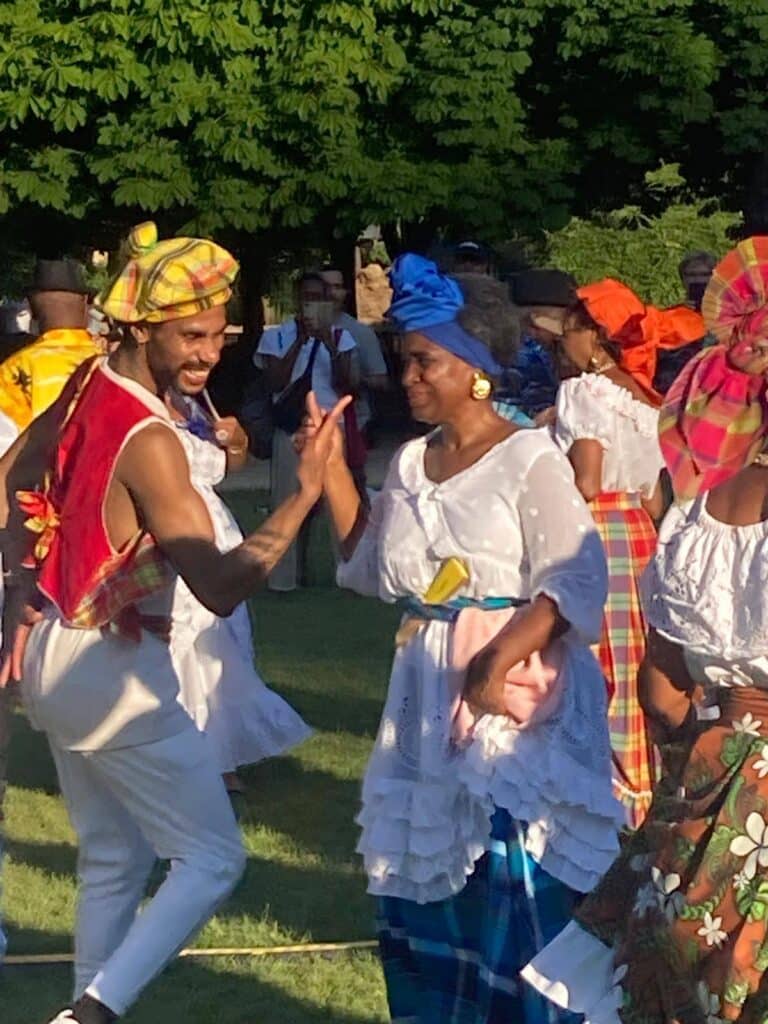
The costumes associated with this tradition play a major role. Women wear long dresses, often with checks or floral motifs, accompanied by elaborate headdresses. Men wear light shirts, dark pants, sometimes vests and hats.

These outfits are not mere ornaments. They contribute to the legibility of the figures, highlight the movements and recall the historical roots of dance in West Indian society.

Quadrille
©Alfred Desirée (UCV)
Quadrille
©Alfred Desirée (UCV)

A living tradition

Today, the Quadrille remains an active practice in Guadeloupe and Martinique. Cultural associations and folk groups ensure that it is passed on, particularly to younger generations. It is presented at heritage events, festivals and cultural events, contributing to the promotion of intangible heritage.

This continuity testifies to its ability to pass through time without losing its meaning. Dance remains a vector of memory, but also a space for dialogue between past and present.

FAQ

This is a traditional dance that originated in European salons, but has been transformed by West Indian societies into a collective practice rooted in Creole culture and community life.

The dance is performed in groups, generally by four couples, under the direction of a commander who announces the figures in a loud voice. Coordination, listening and memory play a central role.

Because it transmits a collective history, combining music, dance and orality, and because it continues to be practiced and taught as an essential element of West Indian cultural identity.

Leave a Reply

Your email address will not be published. Required fields are marked *

More articles from RK

Keisha Bissram
HISTORY & HERITAGE
Tolotra

Keisha Bissram: “Black Cake” Turns a Recipe into a Memory

At Christmas, black cake is a staple on the table. We admire its dark color, its dense texture, and the aroma of the fruit. Yet behind every slice, someone has planned ahead, measured ingredients, waited, and repeated the same steps over and over. With her short film *Black Cake*, Keisha Bissram asks a question: What becomes of a tradition when the woman who kept it alive is no longer there? Keisha Bissram recounts a grieving process that goes beyond the absence of a loved one The film follows Sherry Sankar, an Indo-Caribbean woman grappling with the loss of her mother and profound family upheavals during Christmas. Keisha Bissram does not treat grief as an isolated event. The loss reveals a quiet system: recipes preserved, gatherings organized, tensions absorbed, and traditions upheld—all without us always realizing the effort involved. A mother leaves behind more than just possessions. She may leave behind

Read More »
Vejigantes
HISTORY & HERITAGE
Tolotra

Vejigantes of Loíza: Masks of Afro-Puerto Rican Heritage

As the last weekend of July approaches, Loíza is getting ready to send its masked characters back out onto the streets. Among them, the vejigantes march forward wearing wooden horns and faces carved from coconut shells. Behind their spectacular appearance lies a complex history: that of a Spanish figure that has become, in Puerto Rico, a powerful symbol of Afro-Boricua creativity. A mask shaped by the region A rounded shell, two eye slits, a toothed mouth, and long horns arranged like a crown. The vejigantes of Loíza are instantly recognizable. The material they’re made of sets them apart from those of Ponce, where the caretas are generally made of papier-mâché. . This difference is not merely an aesthetic detail. The coconut ties the mask to the coastal landscape, to the available resources, and to the artisanal craft. The Smithsonian holds several pieces made in Loíza, including a coconut careta attributed

Read More »
Buju Banton
MUSIC
Tolotra

Buju Banton: An iTunes Top 3—What Does This Mean for Dancehall?

With her thirteenth album, “Too Too Bad”, Buju Banton reached No. 3 on the U.S. iTunes Reggae Albums chart. This strong start reflects significant support for the Jamaican artist, though it remains to be seen how long this success will last. On July 17, 2026, Buju Banton released “Too Too Bad,” a 13-track, 35-minute album. Released by Gargamel Music under an exclusive license from VP Music Group, the album debuted at number three on the U.S. iTunes Reggae Albums chart. This chart provides a useful snapshot. It shows that an audience was ready to buy the album right away. However, it does not yet allow us to gauge the album’s total audience or its ability to remain prominent for several weeks. A launch that goes beyond the United States The release of “Too Too Bad” also made an impact on several iTunes reggae charts, notably in Belgium, Canada, the United

Read More »

conTACT RK

we'd love to have your feedback on your experience so far

Join The List

Join our Richès Karayib community!  Sign up for our newsletter.

Want To Maximize Your Business Presence On Riches Karayib?

Complete the form to start the application