In Princes Town, in southern Trinidad and Tobago, the “doubles” were born in 1936 from a simple gesture: a customer asking for a second piece of bread. At the time, Emamool Deen and his wife Rasulan were selling curry chickpeas on a single piece of fried bread, unaware that they were inventing the country’s most iconic street food. Nearly a century later, doubles still tell the story of Indo-Trinidadian heritage through this chickpea sandwich, which has become a national symbol.
A Morning in Princes Town, 1936
At 4:00 a.m., in a courtyard in Princes Town, in the southern part of Trinidad and Tobago, Rasulan Deen lights the fire that will heat the coconut oil. Her husband, Emamool Deen, is boiling the chickpeas that the couple was able to buy by selling a goat, the only possession they had. The year is 1936, and according to oral tradition preserved by several Trinidadian media outlets, Emamool Deen and Rasulan Deen are unwittingly preparing to create one of the Caribbean’s most famous street foods.
Channa and Bara: The Birth of a Name That Became Doubles
The basic idea can be summed up in one sentence. Rasulan Deen fries chickpeas (kabuli channa) seasoned with toasted cumin, turmeric, garlic, and bandhania—a long-leaved cilantro widely used in Trinidad and Tobago cuisine—and then places them on a bara, a fried flatbread. The dish is called channa and bara, sold by Emamool Deen and his wife on the streets of Princes Town. One day, customers asked for a second piece of bread to better hold the chickpea filling. The name “doubles” is said to have originated from this specific custom: two baras sandwiching a single portion of channa.
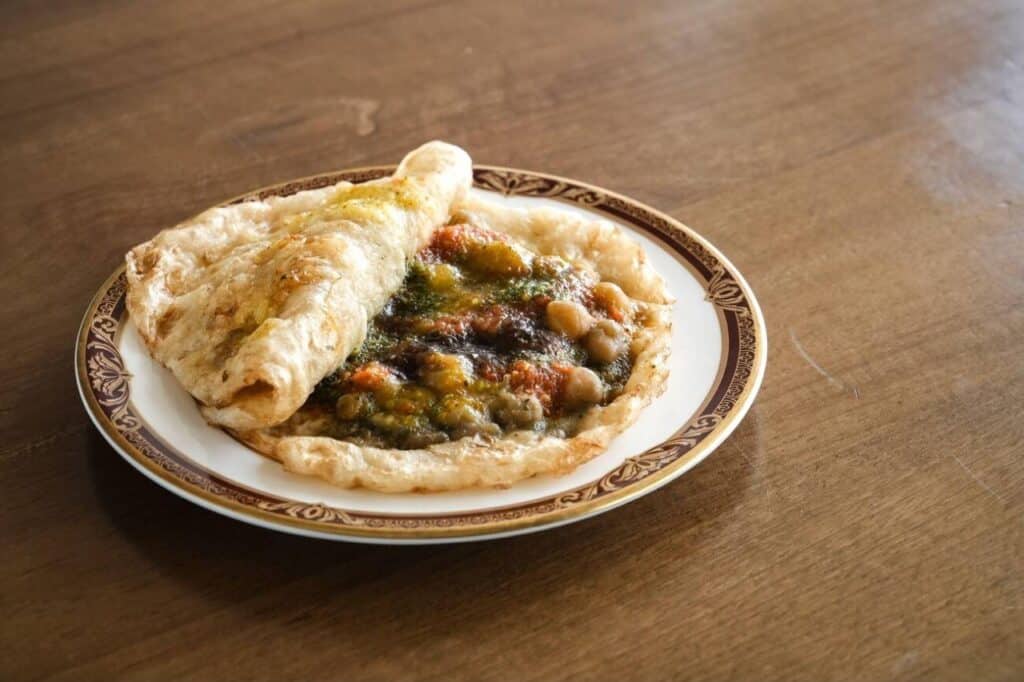
Bara and channa: two recipes that have evolved over time
The bara dough, originally made with flour available in the Deen household, gradually shifted to wheat flour, which was more economical for a couple selling their dish day by day on the streets of Princes Town. The channa, meanwhile, continues to be prepared without becoming a thick curry—a deliberate lightness that leaves room for mango, tamarind, or chili chutneys, added according to the customer’s taste. This basic recipe for doubles, passed down through Trinidadian families, then varies from one doubles vendor to another, with each maintaining their own texture for the bara and their own spice blend.

A street food dish with no official status but one that is, in effect, a national dish
Trinidad and Tobago does not have an officially designated national dish, but “doubles” serve as such in the country’s daily life. Today, they can be found at every street corner in Trinidad and Tobago, sold at dawn by vendors known as “doublesmen” for a few Trinidadian dollars, wrapped in newspaper or wax paper. The dish has also spread beyond Princes Town.
As early as 1938, Asgar Ali, Emamool Deen’s brother-in-law, revived the recipe in San Fernando, in southern Trinidad and Tobago, where his family founded what would become the Ali’s Doubles chain, which is still in business today. Other Trinidadian families would follow suit, to the point where a connoisseur can recognize a good doublesman simply by the texture of his bara. Much like the Jamaican beef patty—a street food that has become a national symbol of Jamaica—doubles demonstrate that a street food can embody a country’s identity without official status.

Trinidad and Tobago's Indian Heritage, from Fatel Razack to the Princes Town Dish
The history of this dish cannot be understood without going back to the arrival of the first Indian indentured laborers in Trinidad and Tobago. On May 30, 1845, the ship Fatel Razack docked in Paria Bay with 225 passengers who had departed from Calcutta—the first in a long series of arrivals that would continue until the early twentieth century.
Recruited after the abolition of slavery to work on Trinidad’s sugarcane plantations, these Indian workers brought with them curry, cumin, turmeric, and frying techniques that still shape the cuisine of Trinidad and Tobago. Nearly a century later, in Princes Town, it was the descendants of this migration—such as the Deen and Ali families—who invented an entirely new dish based on this Indian heritage.
A Trinidadian dish, not a copy of the Indian chole bhature
Some observers draw a parallel between doubles and chole bhature from northern India, a chickpea curry served with fried bread. This connection remains a hypothesis rather than a proven link between the two dishes, which primarily share the same concept—that of pairing a spicy legume with fried bread—without one being a direct derivative of the other. This lack of imitation is precisely what makes doubles so compelling—a fully-fledged Trinidadian creation, born of Indian heritage but shaped by the streets of Princes Town and not imported as-is from India.

The Doubles: A Story Passed Down Between Trinidad & Tobago and Its Diaspora
Doubles have since transcended the boundaries of the Indo-Trinidadian community to become a symbol of national identity shared by all of Trinidad and Tobago, regardless of background. They are a staple of workdays, nights out, and national celebrations, and today they travel with the Trinidadian diaspora as far as New York, Toronto, and London, where doubles vendors continue to sell, every morning, the dish born from a goat that was sold and a loaf of bread that someone decided to split in half.
Just like the soup joumou, the only Caribbean dish recognized by UNESCO, as previously described by Richès Karayib, doubles show how a street food dish becomes a symbol shared by an entire diaspora, much like Trini Bites: Trinidadian Cuisine as Told by Richès Karayib on Long Island. One question remains that the children and grandchildren of “doublesmen” ask themselves today: how to pass on a street move—learned in a Princes Town courtyard at four in the morning—to a generation that sometimes discovers “doubles” on social media before experiencing them on the street.

Doubles are a street food from Trinidad and Tobago consisting of two baras—fried flatbreads—enclosing a filling of curried chickpeas called channa. Sold at dawn by vendors known as doublesmen, doubles are widely considered the country’s most popular street food.
According to oral tradition preserved by several Trinidadian sources, the doubles were created in 1936 by Emamool Deen and his wife Rasulan Deen in Princes Town, in the southern part of Trinidad and Tobago. No contemporary documents confirm this account in detail; it continues to be passed down orally by the families of doublesmen.
Doubles draw on spices and frying techniques brought by Indian indentured laborers who arrived in Trinidad and Tobago beginning on May 30, 1845, aboard the ship Fatel Razack. Their descendants, such as the Deen family, later reinvented these traditions into a street food unique to Trinidad and Tobago, distinct from the original Indian cuisine.