
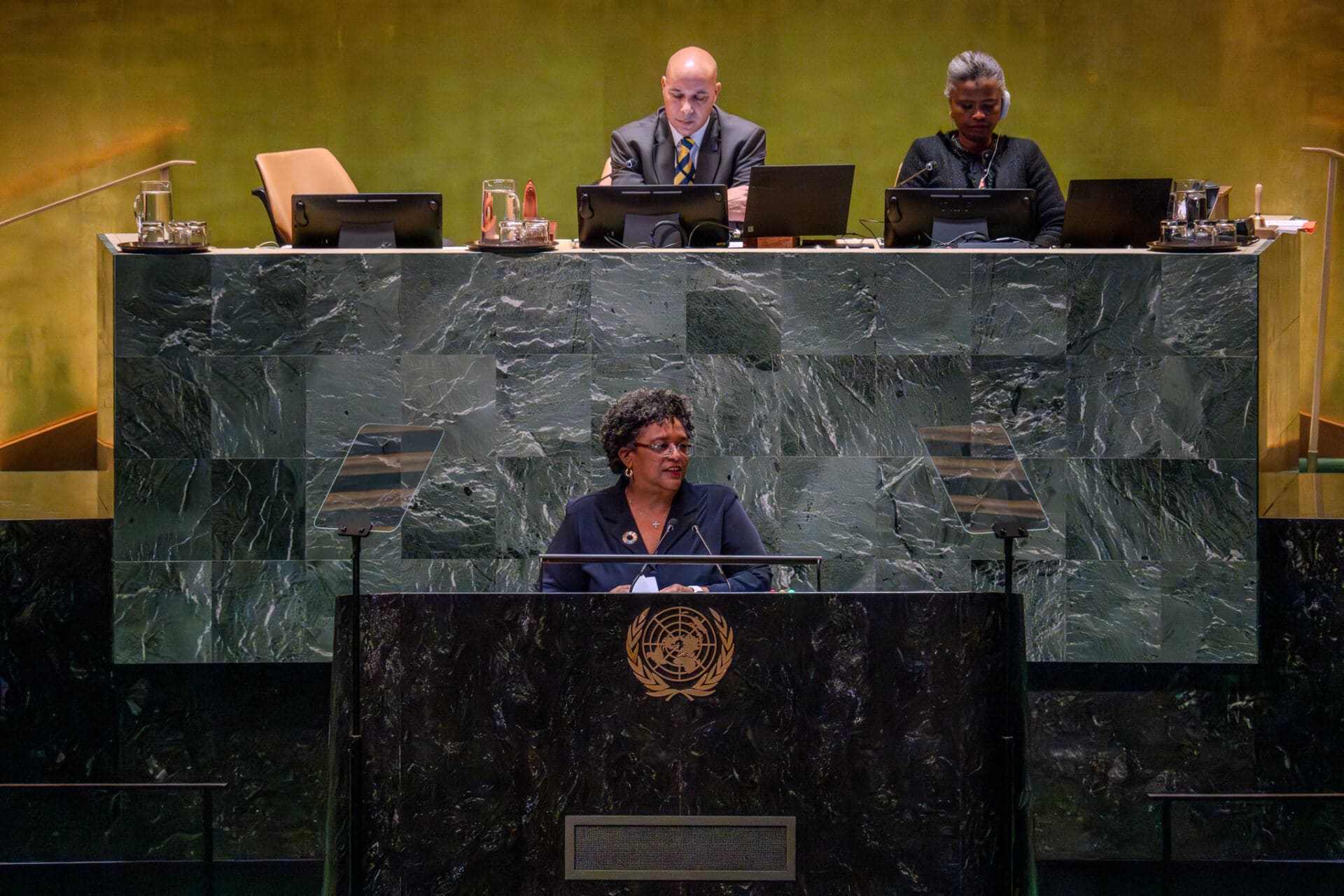
Mia Mottley is included in the 2025 list of 100 most powerful women in the world published by Forbeswhere she appears in 99ᵉ position. Behind this figure lies much more than a ranking. It symbolizes a Caribbean that has ceased to be peripheral to major international decisions, and is now imposing its own priorities, urgencies and vision.
For a region too often confined to the margins of geopolitical debate, this recognition acts as an eye-opener. It shows that power is measured not just by the size of a territory or raw economic power, but also by the ability to influence the rules of the game.
Recognition that goes beyond national borders
The Forbes list does not reward popularity. It identifies women whose influence has a tangible impact on economic, political and societal decisions on a global scale. See Mia Mottley To be included is to recognize that the voice of Barbados – and, beyond, that of the island states – is now audible where the great international balances are discussed.
The first woman to hold the post of Prime Minister of Barbados, she has established itself as a respected interlocutor in international forums. Its leadership is based on a clear approach: naming imbalances, quantifying injustices and demanding structural reforms rather than cosmetic adjustments.

Climate and debt: turning vulnerability into a political force
If the name Mia Mottley circulates with such consistency on the international scene, it’s because she has been able to transform a reality – the islands’ exposure to climatic and financial shocks – into a structured political argument.
Through the Bridgetown Initiative, the Barbados conference was a frontline speech on the need to reform the international financial architecture. The observation is simple: the countries most exposed to the effects of climate change are also those that pay the most for post-disaster financing. Hurricanes, rising sea levels and droughts are not abstract events, but realities that increase debt and weaken economies over the long term.
By putting these issues on the table, she does not advocate a Caribbean exception, but rather a more coherent system capable of integrating climate risk into its financing mechanisms. This ability to link financial technique and human reality is one of the major sources of its influence.
The power of Caribbean women, far from clichés
Recognition for Mia Mottley by Forbes also opens up a wider debate on the power of Caribbean women. For a long time, their leadership has been underestimated, often reduced to roles of mediation or local management. Yet in government, business, regional organizations and civil society, Caribbean women demonstrate a remarkable ability to work in constrained, unstable and exposed contexts.
This leadership is distinguished by its pragmatism endurance and adaptability. This is not spectacular power, but a patient influence built up over time. It is an illustration of this on an international scale: it advances steadfastly, without abandoning firmness, and without watering down the realities it describes.


What this recognition means for the image of the Caribbean
The entry of Mia Mottley in the Forbes 2025 ranking does not instantly transform the global balance of power. But it is helping to change the way the Caribbean is perceived. The region is no longer just a vulnerable space to be protected, but a territory capable of producing ideas, frameworks for reflection and exportable solutions.
It also reminds us that influence is not limited to the capitals of the great powers. It can emerge from islands of less than 300,000 inhabitants, provided they have leaders capable of speaking the language of figures, institutions and human realities.

A lesson in leadership beyond the rankings
Rank 99 is not an end in itself. It marks a stage in a trajectory that goes far beyond a media distinction.
Mia Mottley embodies a way of governing that combines vision, responsibility and political courage.
For the Caribbean, this recognition sends out a clear message: the region can count, not through noise, but through the coherence of its battles and the credibility of its voices. And in this movement, Caribbean women occupy a central place, often discreet, but now impossible to ignore.
FAQ
She is recognized for her influence on the international stage, notably through her advocacy of climate justice and reform of the global financial system. As Prime Minister of Barbados, she brought Caribbean issues to forums where they had previously been marginalized, which explains her presence in the Forbes 2025 ranking.
Mia Mottley’s inclusion in this ranking symbolizes the Caribbean’s ability to influence major global decisions. It shows that island territories are not only vulnerable spaces, but also actors capable of proposing credible solutions to climatic, economic and social challenges.
She exemplifies leadership based on clarity, perseverance and strategy. Her journey highlights the central role of Caribbean women in governance, diplomacy and social transformation, and contributes to strengthening their visibility and legitimacy on the international stage.



One Response