In May 1977, a Cuban dancer took the stage in New York with the Alvin Ailey Dance Theater. In the audience that evening, actor Harry Belafonte watched the performance and would later describe the evening as a significant historical event. This dancer’s name was María Elena Llorente, prima ballerina and ballet mistress of the Ballet Nacional de Cuba. Her career spans fifty years of dance, spent almost entirely with a single company—the one founded by Alicia Alonso in Havana—on an island where, over the decades, classical ballet has become as much a source of national pride as it is an art form.
María Elena Llorente, of the Sociedad Pro-Arte at the National Academy
It all began at the Sociedad Pro-Arte Musical, a school in Havana where young Cuban women learned the basics of classical ballet even before the official founding of the national ballet company. María Elena Llorente then continued her training at the National Ballet Academy under the direction of Alicia Alonso herself, alongside Fernando Alonso, Marta Mahr, Alexandra Fedórova, and José Parés.
This generation of teachers shaped a distinctive Cuban style—both technical and theatrical—that would become the international hallmark of the Ballet Nacional de Cuba. From this school, María Elena Llorente gained technical confidence, stylistic refinement, and an elegance of performance that Cuban critics would recognize throughout her career.
From 1962 to 1976, María Elena Llorente became a prima ballerina
María Elena Llorente joined the corps de ballet in 1962. Five years later, in 1967, she was promoted to soloist, an intermediate rank that allowed her to perform solo variations but did not yet include the major title roles. It would take her another nine years of daily performances before she reached, in 1976, the rank of primera bailarina, the highest position in the hierarchy of the company founded by Alicia Alonso. This slow progression—fourteen years between joining the company and achieving recognition—reflects the demanding nature of the Cuban school, where rank is never granted prematurely but is earned through performance, night after night.
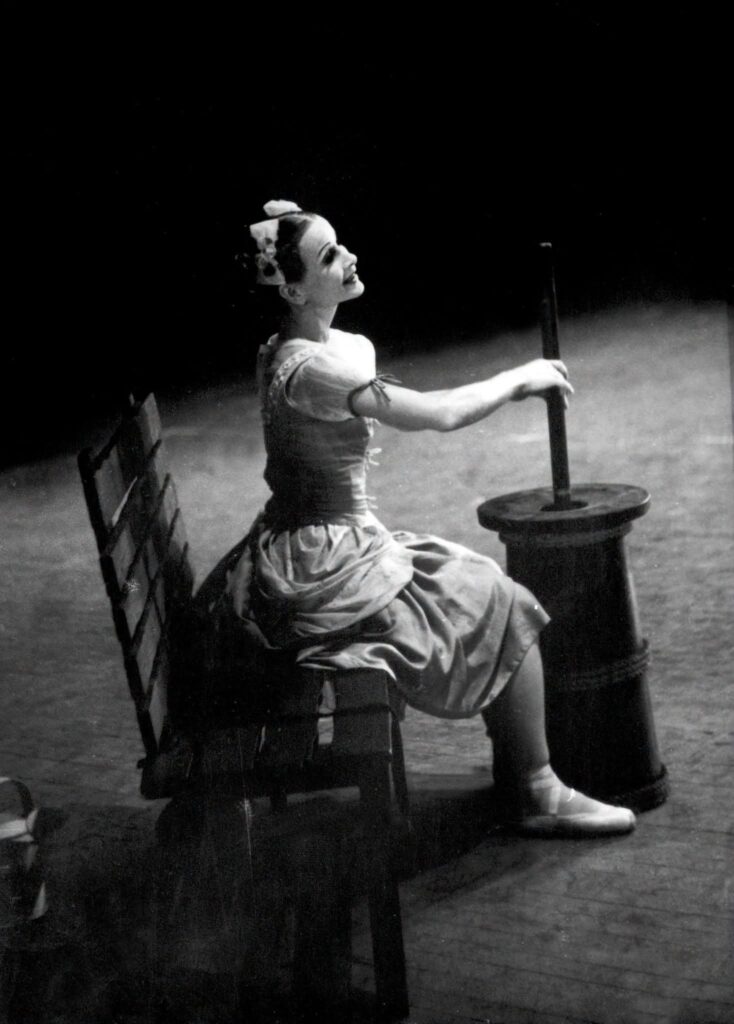
Ofélia, the role that only María Elena Llorente has ever danced
María Elena Llorente’s repertoire includes the great classics: Lisette in *La fille mal gardée*, where she established herself as a leading figure in Cuban ballet; Giselle and Myrtha in *Giselle*; Odette-Odile in *Swan Lake*; Kitri in “Don Quixote,” Aurora and Florina in “Sleeping Beauty,” and Esperanza in “Afternoon of a Faun.” But one role remains inextricably linked to her name alone: Ophelia in the full-length production of “Hamlet” staged by the Ballet Nacional de Cuba.
No other dancer in the company has taken on this female title role since then—a rare occurrence in a repertoire where major classical roles are typically passed down through several generations of ballerinas. The 1977 New York performance with the Alvin Ailey Dance Theater confirmed a level of recognition that extended beyond the island’s borders, at a time when a Cuban tour of the United States was by no means a given. Her career also earned her the bronze medal at the fourth International Ballet Competition in Varna, Bulgaria—one of the most demanding classical dance competitions of her time—followed by the Alejo Carpentier Medal and the Félix Varela Order, First Class.

María Elena Llorente: Passing on the Repertoire After Her Stage Career
María Elena Llorente danced her final performance on October 28, 2002, in “Souvenir.” She did not leave the Cuban National Ballet. Instead, she became a teacher and rehearsal director, tasked with passing on to younger dancers the roles she had performed over four decades, correcting on stage the details of an arm position or a dramatic nuance that only the stage can truly teach.
Her work as an educator took her to the Cuban National Ballet School and then to Spain, where she taught classes in the Valencian Community on behalf of the Alicia Alonso Chair, in turn spreading the legacy of the school that had trained her. In 2015, the Cuban government awarded her the National Dance Prize, a recognition of a long career spent entirely within a single company, from her entry into the corps de ballet to her patient transmission of the repertoire.
María Elena Llorente died on September 21, 2026, in Havana, at the age of 80. She leaves behind a repertoire that other dancers continue to perform on Cuban stages—the very same Havana where she had made her debut—and the memory of a New York evening when a Cuban role was enough to win over Harry Belafonte. What remains, on the stage in Havana, is the role of Ofélia, which has no successor, and the question of who, one day, will dare to take it on.

María Elena Llorente was a prima ballerina and ballet mistress with the Ballet Nacional de Cuba; she joined the company in 1962 and was promoted to the rank of prima ballerina in 1976. She died on September 21, 2026, in Havana, at the age of 80, after dedicating fifty years to that single company.
She played Lisette in “La fille mal gardée,” Giselle and Myrtha in “Giselle,” Odette-Odile in “Swan Lake,” Kitri in “Don Quixote,” and Aurora in “Sleeping Beauty.” She remains the only dancer with the Ballet Nacional de Cuba to have performed the role of Ophelia in the full-length version of “Hamlet.”
She received the Cuban National Dance Award in 2015, the bronze medal at the Fourth International Ballet Competition in Varna, Bulgaria, the Alejo Carpentier Medal, and the Félix Varela Order, First Class.