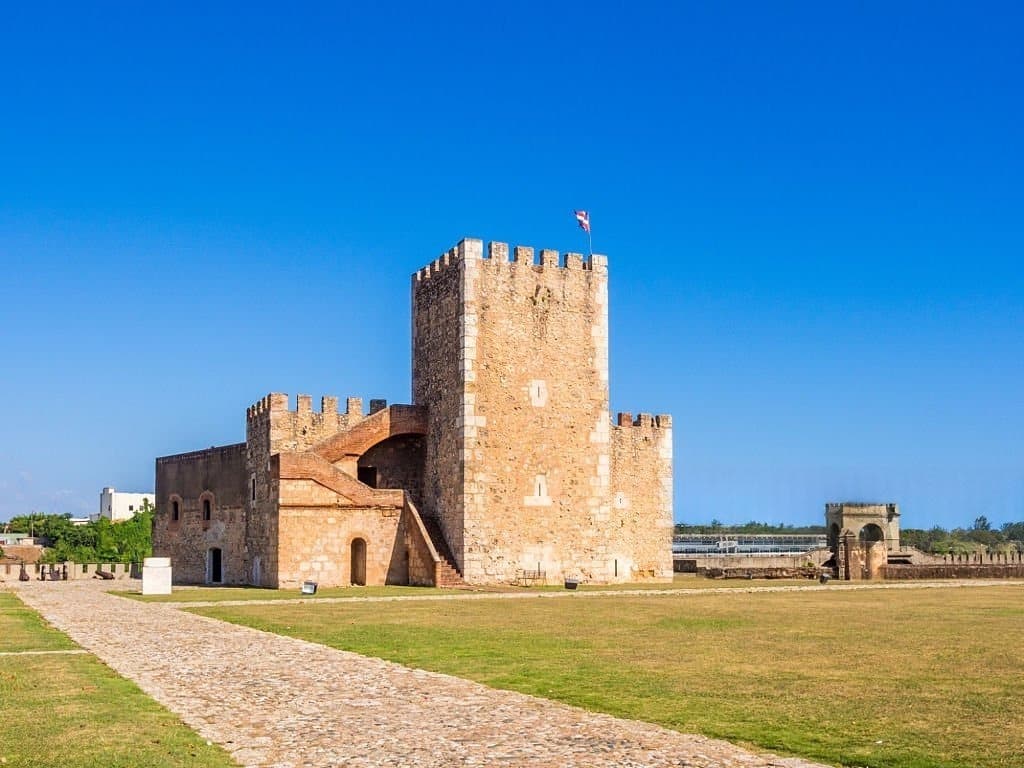
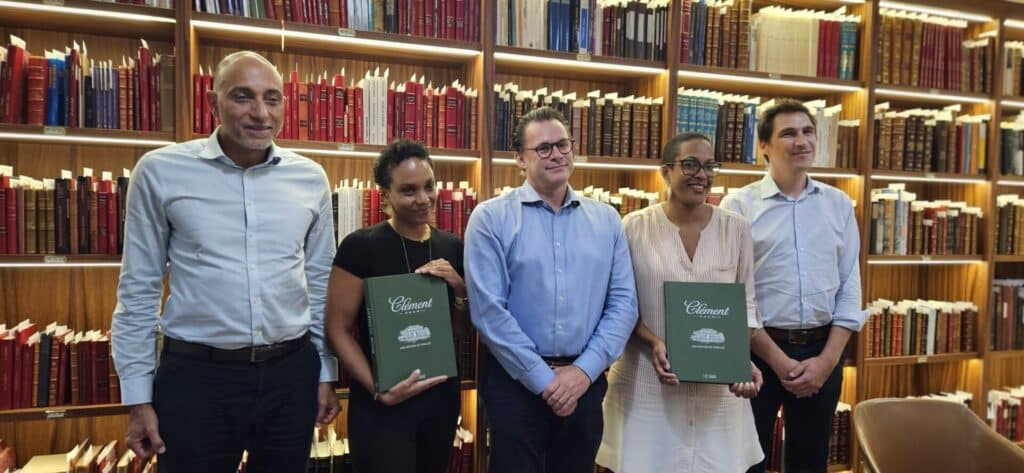
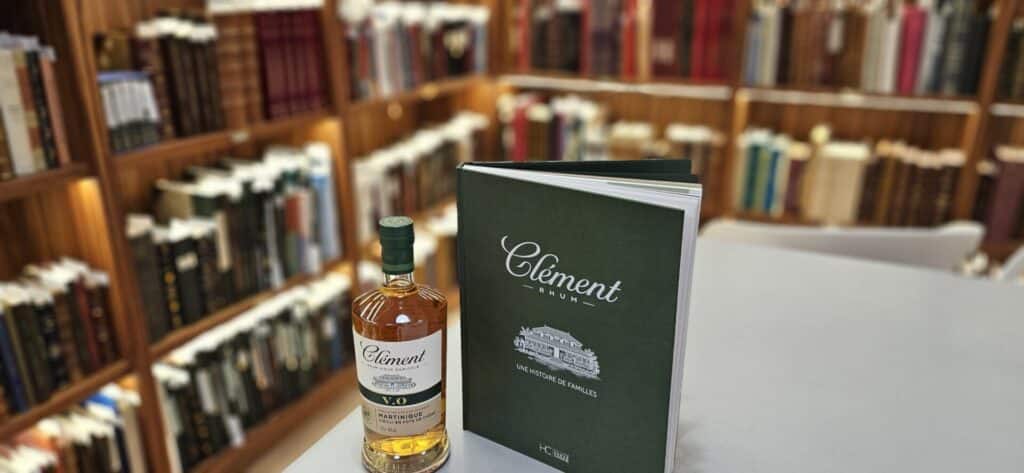
On January 21, 2026, in the library of the Clément dwelling, Rhum Clément unveiled much more than a book and a bottle. It was 150 years of Martinique history being told, passed on and reinvented.
When time becomes a manifesto
Some stories can’t be told in a hurry. The Rhum Clément is one of them. Four years in the making. Attics searched, cellars explored, family albums unearthed. Descendants of the Clément family found in the four corners of the world to tell their stories, to pass on this oral memory that was in danger of dying out.
“We were shocked to discover that we didn’t have much of an archive after all,” confides Grégoire Gueden, GBH’s Rum Business Manager. “We had to go and see the descendants, see the still-living players in this story, get them to talk with the microphone, write, transcribe.”
The result: “Rhum Clément: A family story” with an S. Because it’s not just one lineage, but several Martinican families who have succeeded one another in the destiny of this company founded in 1887.
Homère Clément: more than a name, a figure
It all starts with one man. Homère Clément. No ordinary industrialist, but a doctor deeply involved in society. In 1887, he bought three estates from the court. These lands became Habitation Clément. The main road in Le François bears his name. It’s no coincidence.
His son Charles then took over the reins, developed rum ageing and opened up the company to international markets. He built the brand while remaining deeply rooted in the region. Member of the Coderum, an advocate of Martinique rum, he organizes great evenings at the Habitation. He spreads the word.
Then came the third Clément generation, before, in 1987-1988, the family decided to sell the company on one non-negotiable condition: that the Clément name be preserved, and that the site and brand continue to live on.
This is the family Hayot family, through the GBH group, takes up the torch. And there’s no clean slate here. On the contrary: the Hayot family is committed to continuity. The Habitation remains the Habitation Clément. The name lives on. The site grows, is embellished, but without ever denying what was built.
A book that refuses to stand still
“We didn’t want this book to be a static history book, because that’s not interesting enough,” explains Grégoire Gueden. “We wanted it to be alive, like the company.”
The book doesn’t just recount the past. It speaks of the present: the 100 employees who keep the Rhum Clément today, in all professions: production, marketing, finance, sales. He talks about the Habitation Clément, a historic monument that receives 250,000 visitors a year. He talks about the Fondation Clément and its partnership with the Grand Palais, enabling 30,000 schoolchildren in Martinique to see works by Caribbean and European artists.
He also talks about the symbolic moment when Aimé Césaire planted a short barrel on the site, a powerful gesture of unity in Martinican society. And he pays tribute to the bartenders around the world – from Sydney to Tokyo, from New York to London – who make Clément rum shine in their creations.
“In twenty or thirty years’ time, I hope that another team will come along and add to this fifty-page book, so that the story can continue,” hopes Grégoire Gueden.

A new bottle, three years in the making
While the book was taking shape, another project was moving forward: redesigning the bottle of Clément old rum. Three years in the making. Every detail thought through.
“As one of Martinique’s ambassadors, we felt it was important to own our own bottle shape,” explains Edlynn Bethel, marketing manager.

The new bottle is sleeker and more modern. The weight of the glass has been reduced by 23% as part of an eco-responsible approach. Dry materials such as ink and paper have been sourced to reduce environmental impact.
But above all, a symbolic revolution: Clément’s emblematic green at last appears on the bottle of old rum. This green is the link between sugar cane, white rum and aged rum. The continuum is now visible.
“We have the color green, symbolizing the Clément brand, which appears on this bottle for the first time,” emphasizes Charles Larcher, Managing Director of Rhum Clément. “It was very important for us to ensure that there was a continuum between sugar cane, white rum and aged rum.”
The bottle is also designed with bartenders in mind: slimmer, with a better grip for technical mixology gestures. Because the Rhum Clément is “the agricultural rum brand most involved in mixology worldwide”, according to Charles Larcher.
Martinique's excellence as a project
What’s striking about this double announcement: book and bottle, is the coherence of the project.
Rhum Clément embodies the historic transition of Martinique rum: from a quantitative approach at the end of the 19th century (Saint-Pierre, 1902, 35 distilleries, the world’s largest rum market) to an approach of qualitative excellence with the AOC in 1996.
“If Clément rums can be found in 80 countries around the world, it’s mainly thanks to our aged rums and the know-how we’ve acquired over the last century”, says Charles Larcher. A century of ageing, handed down from cellar master to cellar master.
Rodolphe Hayot, CEO of GBH, sums up this philosophy: “Rhums Clément, Habitation Clément, so many assets that give GBH the opportunity to contribute to what it is most attached to, a territory proud of its heritage. We’re very attached to the development and transmission of what is Martinique’s know-how.”

Glocal: locally anchored, globally oriented
There is a term that is often used by the managers of Rhum Clément. Rhum Clément : glocal. To be both deeply rooted in the region and resolutely international.
Le Rhum Clément has created the Ti punch Cup about fifteen years ago, bringing in international bartenders to meet Martinique’s bartenders. The brand helped set up a mixology school with the UMIH (Union des Métiers et des Industries de l’Hôtellerie) in Dillon. It trains, transmits and structures local know-how.

While exporting to 80 countries. While being present in the world’s greatest bars. And making Martinique shine at every tasting.
“Every time we take this step, we’re promoting a part of Martinique’s heritage,” insists Charles Larcher.


The British look: educate to seduce
Nick Gillett manages Mangrove Global Ltd, the importer and distributor of Rhum Clément in the UK.
“For Clément, if you are a professional in the drinks trade, so you are a sommelier, a bartender, a mixologist, then Clément is well known, it’s well liked, it’s in their hearts, it’s in their minds. For the consumer, it’s a newer product.” (For Clément, if you’re a professional in the beverage industry, so a sommelier, a bartender, a mixologist, then Clément is well known, well liked, it’s in their hearts, it’s in their minds. For the consumer, it’s a newer product).

The UK is a molasses rum market. So why is Rhum Clément ? “Clément has the terroir, it has the history, it has the professional team that make it.
Clément is a standard for the category.” (Clément has the terroir, he has the history, he has the professional team that makes it. Clément is a standard for the category.)
The conclusion is clear: “Rum, Clément and Martinique are intertwined. They are one of the same. Every time a UK consumer opens a bottle of Clément, they are looking into Martinique.” (Rum Clément and Martinique are intertwined. They’re one and the same. Every time a UK consumer opens a bottle of Clément, they are looking into Martinique.) Every bottle opened in London is a window onto Martinique.

Time as philosophy
Perhaps what sets Clément apart is his acceptance of the long view.
The time of the growing cane. Time for harvesting. Time for aging. “A glass of aged rum consumed in Japan or the United States will have been produced three years earlier,” notes Charles Larcher.
Four years to write a book. Three years to create a bottle. A century of ageing expertise. 150 years of corporate history.
Four years to make a book. Three years to create a bottle. A century of ageing expertise. 150 years of company history. As Grégoire Gueden puts it: “Family is about time. Family means transmission. That’s what makes a family business so lucky.” No race to the number of the month. Just this obsession with passing on what has been received, enriching it.
A bottle, a page turned
The new bottle has been available since January 21 from the Habitation Clément boutique. It will be available in supermarkets from the following Monday. Other references in the rhum vieux range will follow progressively throughout the year.
The book has been available since January 1st in bookshops throughout France, at Fnac, on Amazon, in bookshops and supermarkets in Martinique, and of course at the Habitation boutique.
Two objects. The same ambition: to tell the story of Martinique. Not as a postcard, but as a land of excellence, transmission and pride. A territory that produces, exports and shines – without ever denying its roots.
“Each bottle is an ambassador for Martinique and for the best that Martinique has to offer,” concludes Grégoire Gueden. 150 years later, the story continues. And it’s now written in a book and a redesigned bottle. Two objects that say the same thing: Martinique never ceases to amaze.
The book “Rhum Clément : Une histoire de familles” is published by Éditions Hervé Chopin.
The book traces 150 years of Rhum Clément history, from the founding of the Habitation in 1887 to the present day. It highlights several generations of Martinican families, their legacy, their cultural commitments and their role in the international recognition of agricultural rum.
The new bottle symbolizes a renaissance: a slimmer design, a 23% reduction in the weight of the glass, the choice of more responsible materials and the appearance of the brand’s emblematic green on the aged rum. It embodies an environmental approach, a continuum between cane, white rum and aged rum, and improved ergonomics for bartenders.
The book is available in bookshops in France, at Fnac, on Amazon, in Martinique and at the Habitation Clément boutique, as well as via Éditions Hervé Chopin. The new bottle of Clément old rum has been on sale at Habitation Clément since January 21, and will gradually be available in supermarkets.