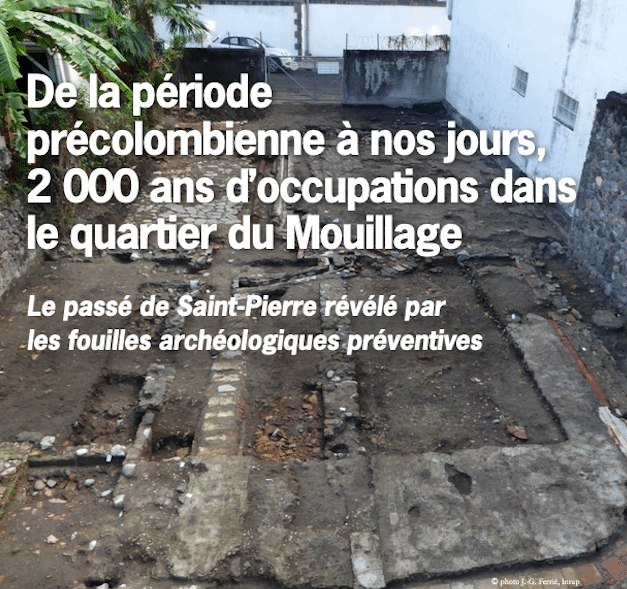
From pre-Columbian times to the present day, the Mouillage district of Saint-Pierre has a history spanning almost 2,000 years. Since December 2025, a preventive archaeological excavation has been carried out on rue Dupuy, ahead of a private development, by the Institut national de recherches archéologiques préventives (Inrap), as prescribed by the State via the Direction des affaires culturelles (DAC) of Martinique. Work will continue until March 2026.
Covering an area of around 300 m², in the immediate vicinity of Saint-Pierre Cathedral, this excavation documents the evolution of the Mouillage district from the second half of the XVIIᵉ century to the destruction of the town in 1902, while revealing much earlier levels of occupation. The remains uncovered enable us to retrace the major stages in the urban organization and human occupation of this strategic sector, marked by ongoing transformations linked to the town’s economic, religious and social history.
A district shaped by urban and port history
From the second half of the XVIIᵉ century, the installation of the Dominican order gave lasting structure to the area, with the foundation of a parish church and cemetery. In the XVIIIᵉ century, the Mouillage district underwent a phase of development and densification directly linked to the boom in port activity and trade, reinforcing its central role in the organization of Saint-Pierre.
Urban development continued in the 19thᵉ century, until the city was destroyed in 1902. Excavation of the plot, located in the immediate vicinity of the cathedral, revealed numerous remains documenting these different phases of evolution. Walls, floors, basins and a water management system comprising supply and drainage pipes testify to the existence of a bourgeois dwelling in the XIXᵉ century.
The underlying remains show a succession of building redevelopments and reconstructions. Some of these transformations may be linked to natural disasters, such as earthquakes or cyclones, which have punctuated the history of the area and influenced the evolution of the buildings.


Native occupation below historical levels
In addition to historical periods, this site also offers the opportunity to study the remains of underlying Amerindian occupations. Archaeologists have uncovered a level containing an abundance of archaeological material, including ceramics and stone objects, testifying to an ancient human presence.
These remains are interspersed between two eruptive deposits from Montagne Pelée, dated to 60 BC and 1300 AD. The data collected enriches our knowledge of Saint-Pierre ‘s pre-Columbian past, and sheds valuable light on the continuity of human occupation in this area well before the colonial period.
An open day for the general public
In order to share these discoveries with the public, an open house day is organized:
- – Saturday, February 7, 2026
- – 9 a.m. to 12 p.m. and 2 p.m. to 5 p.m.
- – Access: 5 rue Dupuy, Saint-Pierre
- – Tours depart every hour (last tours at 11 a.m. and 4 p.m.)
- – Guided tours by Inrap archaeologists
- – Free admission
- – Suitable footwear recommended
This initiative is part of an approach to scientific mediation and the transmission of knowledge to as many people as possible.
In addition, a class from Louis Philemond-Montout will take part in an educational tour of the worksite on Thursday January 29 at 8:30 a.m.This visit illustrates the importance of raising awareness of archaeology and local history among schoolchildren.

A structured scientific and institutional framework
The excavation is conducted under the scientific responsibility of Dominique Le Bars, archaeologist at Inrap. Prescription and scientific control are ensured by the DAC of Martinique, and more specifically by its archaeology department, guaranteeing compliance with scientific and heritage requirements.
A public institution under the supervision of the French Ministries of Culture and Research, Inrap is involved in the early stages of land development projects. Every year, it carries out around 1,800 archaeological diagnoses and more than 200 excavations on behalf of private and public developers, both in France and overseas. Its missions extend to the analysis and scientific interpretation of excavation data and the dissemination of archaeological knowledge to the general public.
The archaeological dig is taking place in Saint-Pierre, in the Mouillage district, more precisely at 5 rue Dupuy, in the immediate vicinity of the cathedral. This strategic sector will enable us to document the city’s urban and human evolution over nearly two millennia.
The Saint-Pierre archaeological dig covers a wide chronology, from pre-Columbian Amerindian occupation to the destruction of the town in 1902. The remains unearthed bear witness to both the colonial period and much earlier phases of occupation.
Yes, an open house will be held in Saint-Pierre on Saturday, February 7, 2026. The public will be able to take part in guided tours of the worksite, supervised by archaeologists, to gain a better understanding of the discoveries and methods used in the archaeological dig.