El Yunque, Puerto Rico’s rainforest worth a visit

El Yunque

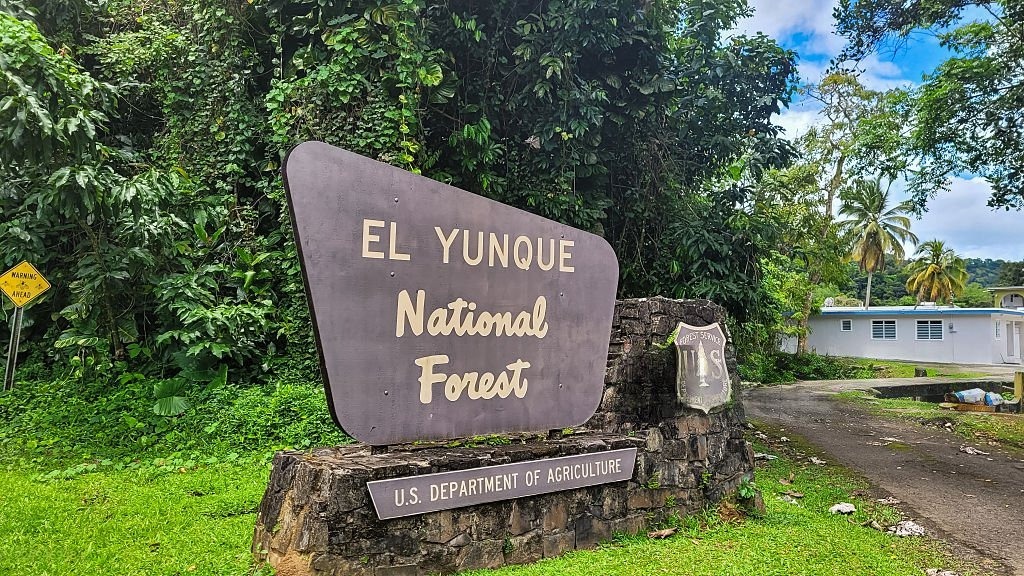
In the northeast of Puerto Rico, El Yunque offers a very different face from the seaside island often promoted. Here, the road climbs up to a humid, wooded relief crossed by mountain rivers. It is the only rainforest massif in the U.S. National Forest System. It extends over eight municipalities and covers just over 110 km², making it a relatively small area, but one of remarkable biological richness.

El Yunque

El Yunque, a natural site in a class of its own in Puerto Rico

Talking about El Yunque is not talking about Puerto Rico as a whole, but about a specific, clearly identified place, with its geography, climate and history. This precision makes it a strong subject both editorially and SEO-wise. The massif is located in the Sierra de Luquillo, with an altitude that climbs to over 1,000 meters. Over this gradient, the average annual temperature varies from approximately 25 to 19°C, while annual rainfall ranges from around 2,000 to 5,000 mm. This combination explains the density of vegetation, the constant presence of water and the impression of freshness that marks the visit.

El Yunque
El Yunque
El Yunque
El Yunque

A forest where water, relief and climate shape the landscape

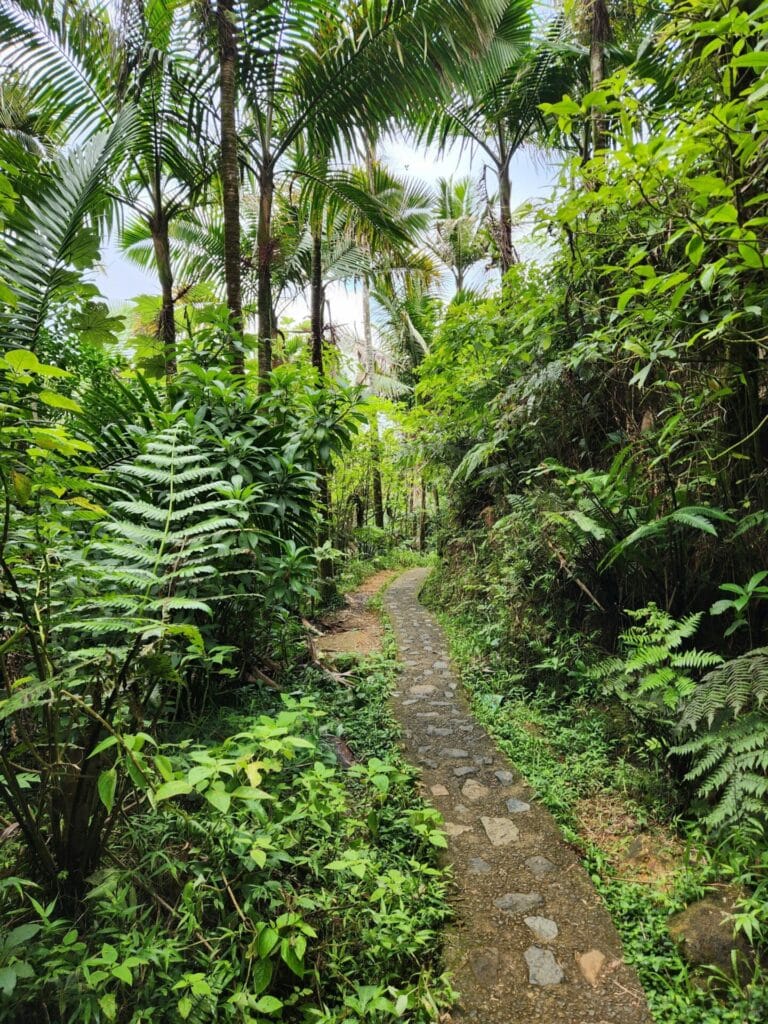
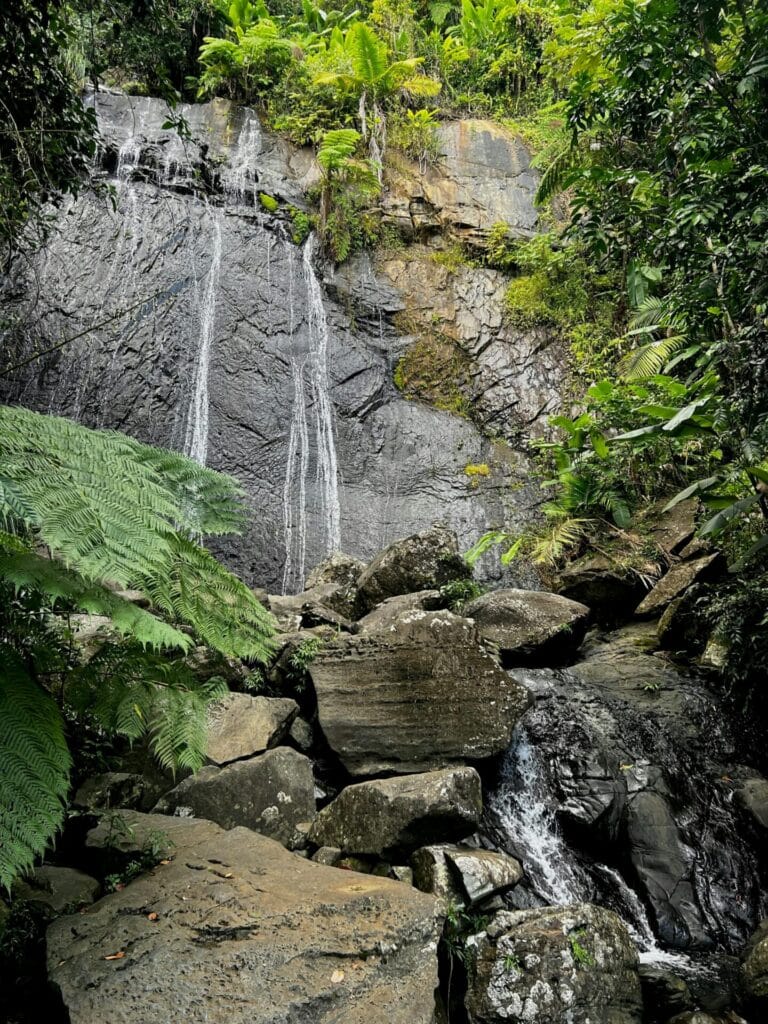
El Yunque is more than just a closed, uniform forest. Relief plays a central role. The slopes capture the moisture carried by the trade winds, nourishing the soils and feeding the rivers, some of which remain among the island’s best preserved. This setting gives rise to a succession of landscapes: very wet undergrowth, unobstructed views of the mountains, fast-flowing streams, natural pools and waterfalls that are accessible depending on which sectors are open to the public. The result is an experience that is more inward, more plant-based and often quieter than the major coastal sites.

El Yunque
El Yunque
El Yunque
El Yunque

El Yunque and its exceptional biodiversity

One of the great attractions of El Yunque is its biodiversity. Official data indicate that the forest is home to 13 of the 17 species of coquí recorded in Puerto Rico. This small amphibian is much more than a curiosity: it’s part of the island’s sonic identity. The site is also home to 97 species of birds, including 45 migratory species, as well as numerous species of reptiles, freshwater fish, shrimp and invertebrates. Among the most symbolic species is the Puerto Rican parrot, which has been closely associated with conservation efforts in the area for decades.

El Yunque
El Yunque
El Yunque

The coquí, El Yunque's signature sound

For many visitors, El Yunque is as much about seeing as hearing. The song of the coquí accompanies the wetlands and immediately reminds us that this forest is not simply a place for strolling, but a living environment where each species occupies a precise place. This is also what gives the site its strong identity in the face of other destinations more focused on the coast.

El Yunque

A long history of protection and research

El Yunque owes its reputation not only to its scenery. Its institutional history is equally important. In 1876, King Alfonso XII of Spain proclaimed a 10,000-hectare forest reserve in the Luquillo mountains. Today, this decision makes it one of the oldest protected forest reserves in the Western Hemisphere. In 1903, Theodore Roosevelt established the Luquillo Forest Reserve, the future nucleus of today’s El Yunque. Over time, the site has also become a major area for scientific research, to the point of being one of the most studied tropical forests in the world.

El Yunque
El Yunque
El Yunque

Why is El Yunque so attractive?

The site attracts visitors for several reasons. Firstly, there’s the promise of an easily identifiable, world-famous tropical rainforest. Then there’s the diversity of possible experiences: walking, observing vegetation, discovering waterways, reading the mountain landscape, a more concrete approach to Puerto Rican biodiversity. Last but not least, it still receives little in-depth treatment in French-language content, even though it has a strong international reputation. It is precisely this discrepancy that makes it a relevant subject to work on.

El Yunque

Access to the site requires checking the latest conditions. Entry via the recreational corridor on PR-191 North in Río Grande is free and does not require a reservation at present, but use remains regulated due to limited parking and ongoing work. Several trails remain closed, including La Mina Trail, Big Tree Trail and Baño de Oro Trail. The trail to El Yunque Peak is open only as far as Los Picachos, the rest remaining closed for safety reasons.

El Yunque National Forest is located in northeastern Puerto Rico, mainly in the municipalities of Río Grande and Luquillo. The massif belongs to the Sierra de Luquillo and is about 45 minutes’ drive from San Juan. This location makes it an accessible excursion while offering a radically different environment from the capital, with its mountainous terrain and much wetter climate.

El Yunque is the only example of tropical rainforest within the U.S. National Forest System. This makes it both a rare and much-studied site. Its ecological richness is based on a combination of factors: altitude, high rainfall and habitat diversity. Over a relatively compact area, it concentrates several types of forest and a large number of endemic species, which clearly distinguishes it from other natural areas in the region.

A visit to El Yunque includes hiking trails, mountain rivers, natural pools and several viewpoints over the massif. Some areas offer access to waterfalls, while others offer a more gradual immersion in the forest. The site also features a visitor center, with educational information on the fauna, flora and history of the area. Depending on the area opened up, the experience can vary from an accessible stroll to a more strenuous hike.

Yes, we strongly recommend that you check the access conditions before visiting the site. Access to the site is restricted due to the limited number of parking spaces available and the fact that some work is still in progress. Not all trails are permanently open, and some areas may be temporarily closed for safety reasons. Consult the official information to avoid unpleasant surprises and optimize your itinerary on site.

El Yunque can be visited all year round, but conditions vary from season to season. As the forest is humid by nature, showers are frequent, even in the so-called dry season. The months from December to April generally offer more stable conditions, while the period from May to November can be rainier, with an increased risk linked to the hurricane season. In all cases, we advise you to bring suitable footwear, water and clothing to cope with the humidity.

Leave a Reply

Your email address will not be published. Required fields are marked *

More articles from RK

St Maarten Carnival 2026
EVENT MANAGEMENT
Tolotra

St Maarten Carnival 2026: 55 years on an island split in two

In Philipsburg, carnival is about much more than costumes and concerts. It shows an island divided between two histories, two administrations and the same popular energy. For its 55th anniversary, St Maarten Carnival 2026 gives Sint Maarten the opportunity to show what the Caribbean does best: transforming a local festival into a marker of identity. A carnival that’s more than just a party St Maarten Carnival 2026 began on April 10 and continues until May 5, with Philipsburg as the focal point. In the streets, locals aren’t just watching a parade go by. They recognize families, neighborhoods, groups, sounds, food stands, faces that have returned for the occasion. Carnival is not just a decoration. It’s part of the way Sint Maarten tells its story. This year’s event carries a special weight. St. Maarten Carnival 2026 marks the 55th edition of the biggest cultural event on the Dutch part of the

Read More »
Viengsay Valdés
DANCE
Tolotra

Cuba – Viengsay Valdés: Alicia Alonso’s heiress

When Alicia Alonso passed away in October 2019, the Ballet National de Cuba, which Alicia Alonso had founded in 1948 and directed for seven decades, was orphaned. Only one person has been entrusted with the responsibility of following in her footsteps: Viengsay Valdés. Now 49, she leads one of the world’s most respected ballet companies. She does so from Havana, a city in crisis, with resources that no comparable institution in Europe or the United States would accept. The challenge is from another time. But Viengsay Valdés holds her ground. Demanding Cuban training Born in Havana in 1976, she began dancing at the age of 9 at the Alejo Carpentier elementary ballet school, before continuing her training at the Cuban National Ballet School, one of the most prestigious in the world, free and open to all Cuban children by audition. It was here that she encountered the world of Alicia

Read More »
Eric Williams
MUSIC
Tolotra

Shenseea and Daddy Yankee bring the Caribbean to FIFA World Cup 2026

Shenseea and Daddy Yankee at FIFA 2026: the announcement goes beyond a simple musical release. With “Echo”, Jamaica and Puerto Rico enter the sound universe of the next World Cup together. Behind this track, a part of the urban Caribbean finds a new place in one of the planet’s most popular events. One FIFA title, two Caribbean voices On April 28, 2026, FIFA announced the release of “Echo”, the third single from the official FIFA World Cup 2026 album. The track brings together Shenseea, a Jamaican artist associated with contemporary dancehall, and Daddy Yankee, a major Puerto Rican reggaeton figure. FIFA points out that the track is one of a series of musical releases designed to accompany the build-up to the tournament. This announcement goes beyond the framework of a collaboration between two well-known artists. It brings two Caribbean territories, Jamaica and Puerto Rico, face to face, united in a

Read More »

conTACT RK

we'd love to have your feedback on your experience so far

Join The List

Join our Richès Karayib community!  Sign up for our newsletter.

Want To Maximize Your Business Presence On Riches Karayib?

Complete the form to start the application