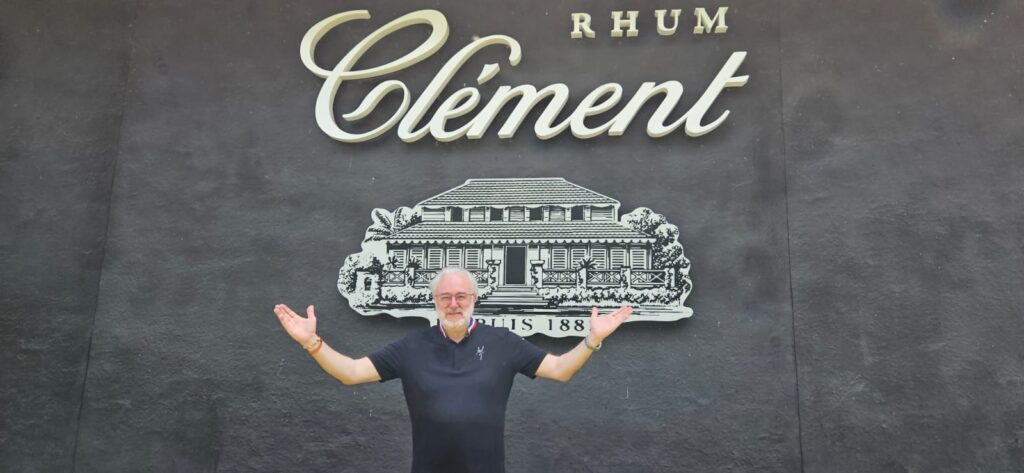
Philippe Faure-Brac had never visited Habitation ClĂ©ment before. World’s Best Sommelier 1992, member of the Meilleurs Ouvriers de France with honorary status since 2015, he came to Martinique to look at rhum agricole from its very place of production: the cane, the cellars, the bottling and the tasting.
A first visit to Habitation Clément
At Habitation ClĂ©ment, in Le François, this visit had a special significance. Philippe Faure-Brac was already familiar with ClĂ©ment rums, their quality positioning and their universe. He had also contributed to the book Rhum ClĂ©ment, une histoire de famille, bringing his insight into the house’s aromatic precision, balance and tradition of excellence.
But he lacked the experience of the place. That of the light, the temperature, the atmosphere of the winery and the exchanges with the teams. “The first time in Martinique? I was going to say finally,” he confided, recalling that he had been hoping for years to immerse himself in Martinique’s rum culture.
This visit, organized by ClĂ©ment rums, brought together two worlds: that of French sommellerie and that of Martinique’s rum heritage. Two different worlds, but united by the same requirement: to understand what a product says about its territory.
From cane to bottle, precision is the guiding principle
The day began with an immersion in the production process. Philippe Faure-Brac visited the bottling line used for JM and ClĂ©ment rums. He saw a process he described as “extremely precise”, supported by an industrial tool where “everything is controlled, monitored and optimized”.
This precision is not a detail. On the site, 2 to 3 million bottles are bottled. Teams monitor the actual degree of alcohol, the apparent degree, the obscuration, the buffer tanks, the regulation tank and the first bottle out of the filler. The tolerance indicated during the visit is very tightly controlled: for a rum displayed at 50 degrees, the actual degree may be between 49.7 and 50.3.
This rigor gives rum a different interpretation. Behind the festive image of ti-punch or planteur, there is a set of controls, gestures and technical decisions. For Philippe Faure-Brac, bottling represents the last finishing touch before marketing, but it can only be understood by going back to the origin: sugar cane.
He spoke of blue and red canes, symbolically cut, tasted, chewed, to grasp what the raw material can already carry. Beyond the sweetness, he believes there are vegetal, woody notes and aromas that can be found in the final product, after fermentation and ageing.
Martinique's agricultural rum as a territorial identity
One of the highlights of the meeting was Philippe Faure-Brac’s take on Martinique’s agricultural rum. For him, the appellation d’origine contrĂ´lĂ©e is not just an administrative rule. It reflects a history, a culture, a geology, a climatology and a precise process.
He insists on one essential idea: a rum produced in Martinique will not taste the same as a rum produced elsewhere, even on another island. This difference is not just a marketing ploy. It’s based on a typicity that is recognized, controlled and validated by accredited tasting commissions.
This is where the news goes beyond the simple visit of a great name in sommellerie. It’s a reminder that Martinique’s rhum agricole is a local product. It carries the memory of sugar cane, the history of the sugar mill, the work of the cellars and the patience of ageing.
When rum enters the world of gastronomy
Philippe Faure-Brac also defends a gastronomic approach to rum. He does not deny its role in cocktails. On the contrary, he points out that this festive image is part of its identity. But he opens up another avenue: that of table tasting. He imagines an old rum with cheese or certain desserts. He also evokes a white rum served very cold, almost frosted, whose texture becomes more oily, greasier, and which could accompany smoked fish. This sommelier’s eye allows us to take rum out of its single use, without cutting it off from its history.
The challenge is clear: to show that great Caribbean spirits can be thought of with the same precision as great wines or eaux-de-vie. Not to freeze them in an elitist discourse, but to better show their depth.
A heritage to respect and pass on
At the end of the discussion, Philippe Faure-Brac reiterated a simple idea: spirits are a product to be respected. It must be consumed in moderation, but also with precision, gourmandise and care. This phrase perhaps sums up the meaning of his visit. AtHabitation ClĂ©ment, rum is more than just a drink. It becomes a living heritage, linked to a place, gestures, teams and culture. “A great drink, as is the case here, brings people together,” he emphasized.
With this visit, Rhums ClĂ©ment continues its dialogue with the great names in tasting. And Martinique is once again reminding us that its agricultural rum is not just an export product: it’s a way of telling the world about a territory.
Philippe Faure-Brac came to Martinique at the invitation of Clément rums to discover Habitation Clément, its production site, cellars, bottling line and teams. The visit was important because, although he was already familiar with Clément rums and had contributed to the book Rhum Clément, une histoire de famille, he had never before visited this Martinique heritage site.
Philippe Faure-Brac is particularly impressed by the strong identity of Martinique’s rhum agricole. According to him, this uniqueness comes from the territory, the sugar cane, the climate, the geology, the know-how and the framework of the appellation d’origine contrĂ´lĂ©e. He insists that a rum produced in Martinique cannot taste the same as one made elsewhere, because it bears the stamp of its place of origin.
Philippe Faure-Brac defends a gastronomic interpretation of rum. He reminds us that rum has a festive dimension, particularly in cocktails, but it can also be enjoyed in other ways. For example, he suggests pairing an old rum with cheese or dessert, or a white rum served very cold with smoked fish. His view shows that Martinique rum can find its place in specific tasting experiences, in the same way as other great spirits.