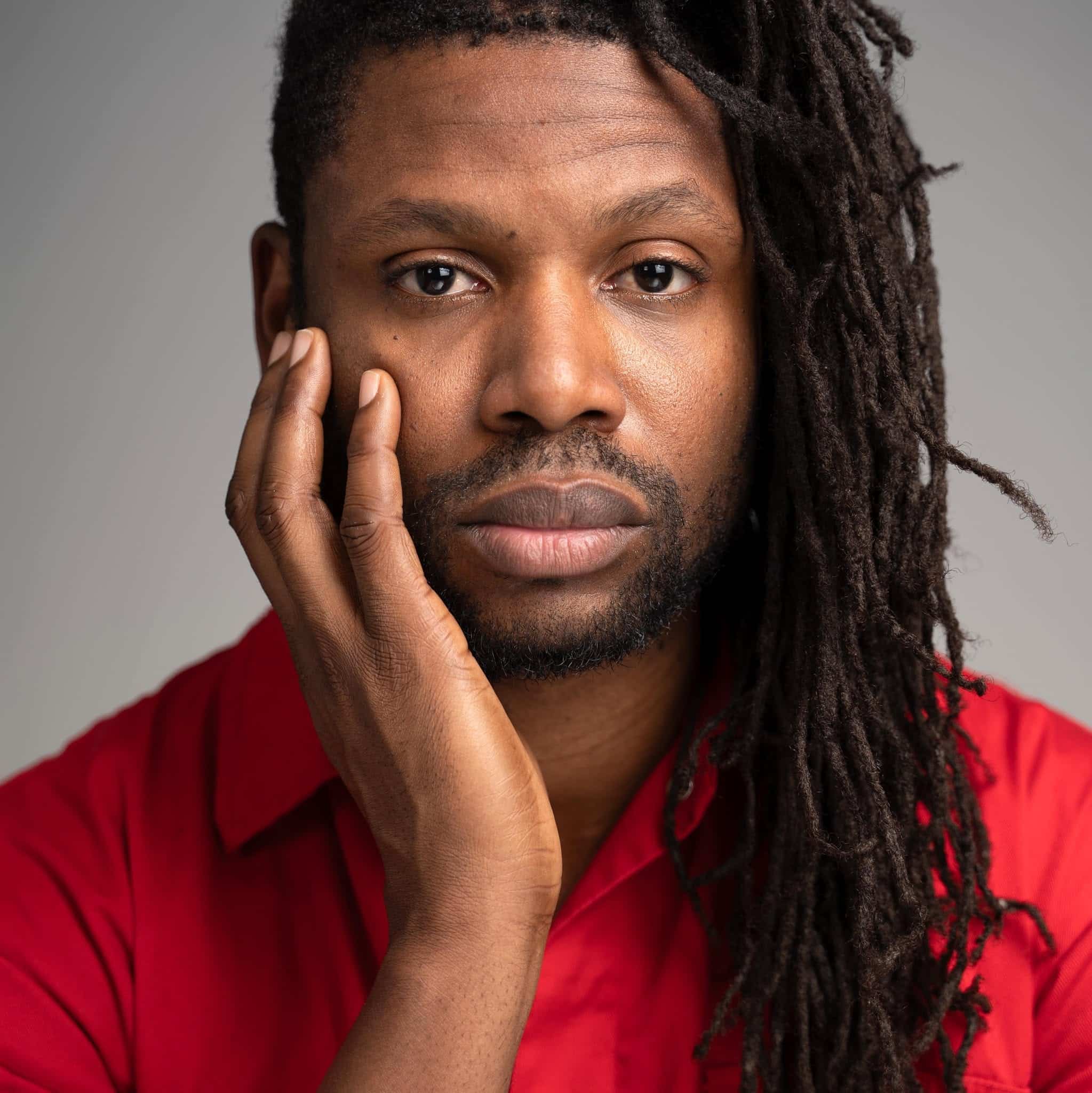
At the Senate Orangery, Man Mélé! took on a dimension that Cécile Vernant could not have fully anticipated before the doors opened. As the days went by, the exhibition became a space for encounters, conversations, and exchanges between artists and visitors. Surrounding the artworks, discussions revolved around Martinique and nature, but also memories, cultures, and sensibilities from far beyond the island.
The calm before the crowd arrives
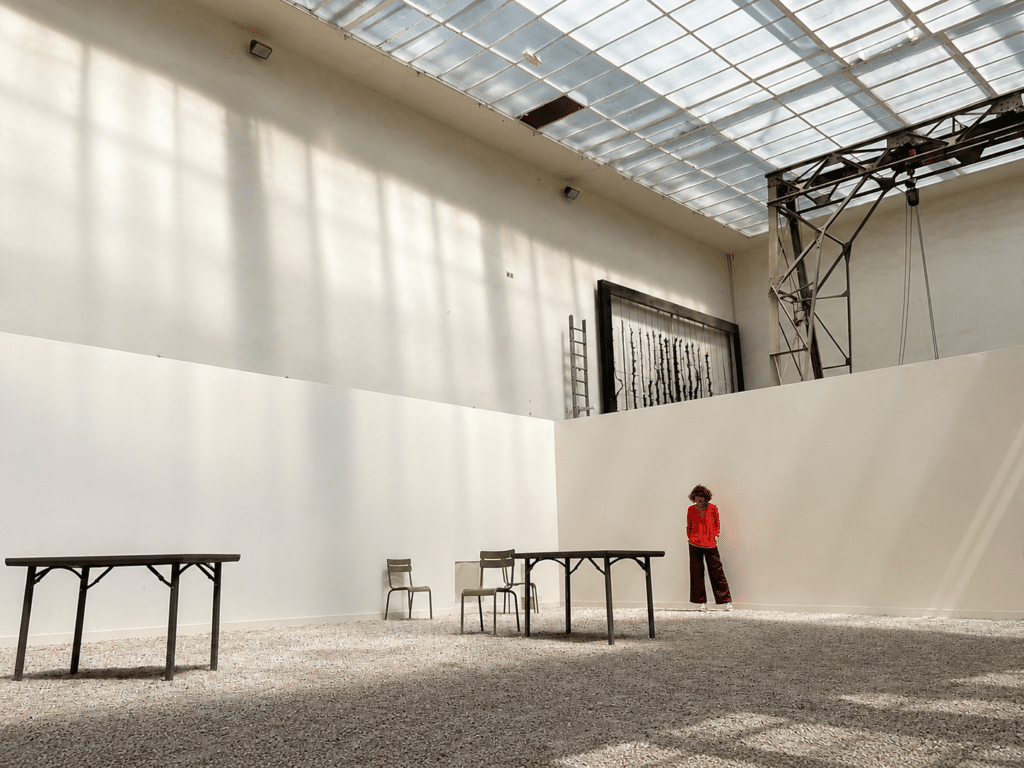
Every morning, Cécile Vernant arrived before the park opened at 11 a.m. The garden was quiet. She would pass joggers, watch the tai chi groups among the chestnut trees, and enjoy the scent of the flowers. She loved this “calm before the storm.” A few hours later, the atmosphere would change. Cécile Vernant estimates that the Orangerie, which is about 600 m², could accommodate up to 400 visitors at its peak over the course of three to four hours. The busiest day reportedly drew 1,000 visitors.
The three rooms were separated by partitions, but their layout naturally encouraged visitors to move from one space to another. She also estimates that about 80 percent of the visitors were foreigners during that period.
Three artists, three worlds, one nature
Cécile Vernant shared the Orangerie with Anne Morgann and Shingiiiiii. Each artist presented a solo exhibition as part of a collective project. Nature was their common thread. With Shingiiiiii, a connection emerged around volcanoes: Mount Pelée for her, Mount Fuji and the volcanoes of Hawaii for him. This connection also resonated with her use of Japanese art paper in her photographs and her “mutant” prints.
With Anne Morgann, the conversation centered more on light and the boundary between figuration and abstraction. Every morning, Cécile Vernant would go to see her works; “L’Heure d’or” had become a ritual. The two artists encouraged and advised one another, and sometimes directed visitors to the other’s gallery.
An exhibition that changes with the light
Under the glass roof, the light changed as the hours passed. At times, rays of light streamed through the windows and brought the artworks to life. Before the exhibition, Cécile Vernant had observed the room at different times of the day. She then adjusted the placement of certain paintings to suit the light. In recent days, she has created an “Atelier” space, featuring several works placed on the floor. The ceramics were arranged in fishing nets, a reference to the seine net and the catch brought ashore. This arrangement also allowed her to evoke the collective and heritage aspects of this practice.

Visitors at the Heart of “Man Mélé!”
Certain encounters left a particularly deep impression on Cécile Vernant. A ninety-year-old visitor, a former painter in Montmartre, approached a painting and sniffed it. He then claimed that it had been varnished a year earlier. His intuition was correct. She repeated the experiment with other works, with the same precision. A little girl, five or six years old, settled down in front of a 10 × 10 cm painting and seemed unwilling to leave it. Touched by her attention, Cécile Vernant decided to give it to her.
Another highlight: a young Brazilian opera singer performed an opera aria a cappella in front of Anne Morgann’s paintings. The scene deeply moved the artists, bringing some of them to tears.
When Martinique Comes Up in Conversation
Among the many discussions sparked by *Man Mélé!*, certain encounters left a particularly deep impression on Cécile Vernant. The Caribbean diaspora, in particular, played a unique role in these conversations. Visitors living in Paris, the Paris region, or even further afield came with their own memories and their own connection to the Caribbean.
A woman from Martinique living in New York came with her daughter, while a Haitian visitor, drawn in by the title he’d spotted on the poster, quickly steered the conversation from the paintings to other Caribbean references: djon djon, Tabou Combo, and Haitian Troubadour. Cécile Vernant also recounts that some visitors who had previously visited Martinique shared their memories of the island with her, while others discovered it through her artwork.
When "Man Mélé!" Takes on Its Full Meaning
Shortly before the exhibition, Cécile Vernant had to deal with several unexpected issues. A large ceramic mural, intended for “Man Mélé!”, broke during the May earthquake while it was drying on the floor.
In Paris, she then created a work on paper based on a one-of-a-kind, ever-changing print. Since she couldn’t find a frame that fit its dimensions, she simply pinned it to the wall, unframed. These setbacks gave rise to the title Man Mélé! a very concrete meaning: “I’m in a pickle,” one of the meanings Cécile Vernant attributes to the expression. It was as if, almost in spite of herself, the reality of the exhibition had ultimately brought the title to life.
What Cécile Vernant Takes Away from *Man Mélé*!
Word of mouth spread naturally. Former clients returned with friends, other visitors spread the word about Man Mélé! to those around them, and some connections continued even after the exhibition ended. From this experience, Cécile Vernant values most of all the connections she made, the support she received, and the trust this selection instilled in her. As a self-taught artist, she is committed to preserving what guides her work: the freedom to create without trying to conform to others’ expectations or giving up on her own desires.
Man Mélé! is the exhibition curated by Cécile Vernant at the Orangerie du Sénat in Paris. There, the artist has created a world inspired by Martinique, nature, light, and her interactions with the public.
According to Cécile Vernant, attendance peaked at around 400 visitors in three to four hours. The busiest day saw up to 1,000 visitors.
Martinique features in several aspects of Cécile Vernant’s work, notably Mount Pelée, the senne fishing net, nature, and interactions with visitors connected to the island and the Caribbean diaspora.