“Man Mélé!”: Cécile Vernant’s Exhibition at the Senate’s Orangerie

Man Mélé

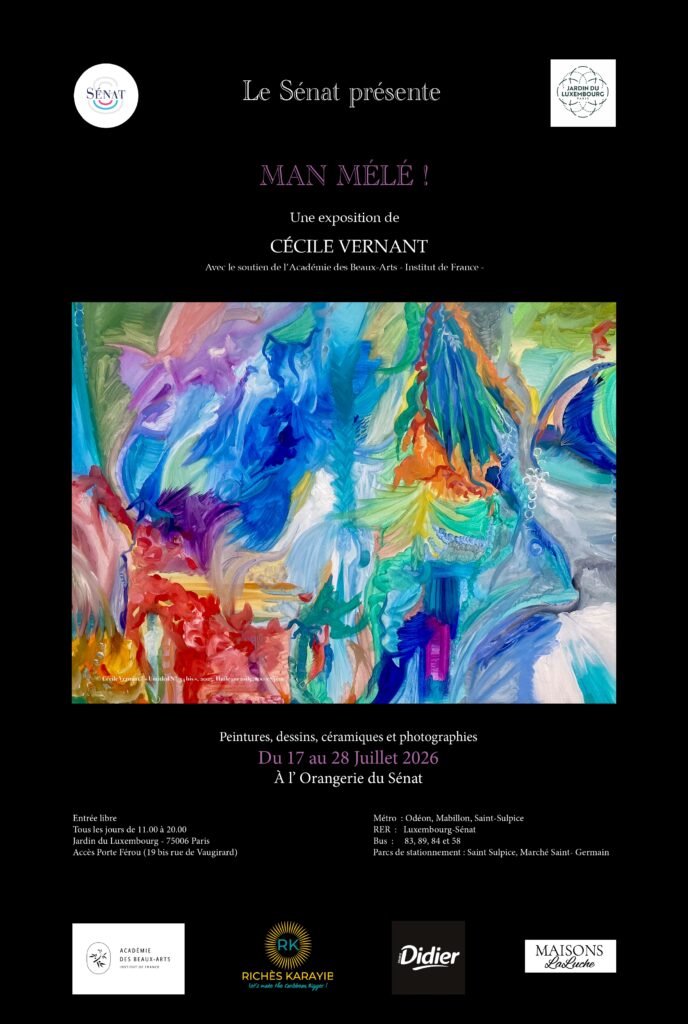
Exhibiting at the Jardin du Luxembourg is often a major milestone in an artist’s career. For artist Cécile Vernant, it is above all an opportunity to connect with the public. From July 17 to 28, 2026, she will present *Man Mélé!* at the Senate’s Orangerie, as part of the Luxembourg Garden Summer Festival. For twelve days, she will personally welcome visitors to this iconic venue at the heart of Parisian cultural life.

Selected following the 2026 call for projects, the artist will have 152 m² to showcase her artistic world, where painting, photography, drawing, and ceramics interact freely. After being selected by the Senate, Cécile Vernant reached out to Didier on her own initiative, without having had any prior contact with the company. This choice came naturally: from the brand’s production site, the view takes in the Carbet peaks, a Martinican landscape that runs through her work just as much as Mount Pelée does. She also received a creative grant from the Académie des Beaux-Arts – Institut de France, awarded by artist members of the academy. This recognition deeply moved her: “I literally cried with joy,” she confides.

Man Mélé

Man Mélé!, Multiple States in a Single Title

You can’t reduce Man Mélé! to a single translation. In Martinican Creole, the expression captures the nuances of emotion: it can mean “I’m frustrated” when faced with choosing from dozens of works, but also “I’m overwhelmed,” “I’m in love,” “I’m torn,” or even “I’m spellbound.” To officially introduce the exhibition, the artist ultimately chose this last phrase: “I’m spellbound!”

This sense of enchantment has its roots in Martinique, the land of his childhood and the emotional wellspring of his entire body of work. The island is present everywhere: in the softness of the morning light, the memory of rain on tin roofs, the intertwining vines, abandoned buildings, and even the inner landscapes nourished by memory.

Paintings, drawings, photographs, and ceramics interact there “without any hierarchy.” The works engage in a dialogue with one another like so many visual “exquisite corpses,” following an intuitive logic in which each creation gives rise to the next. Cécile Vernant embraces an instinctive practice, fueled by automatic writing, spontaneous drawing, and free modeling, building on the experiments she discovered during her high school years in Fort-de-France.

From “Luco” to the Martinique of My Childhood

With Untitled Luco V, from the collection Caribbean Childhood, Cécile Vernant weaves a dialogue between Paris and Martinique. The “ti points, ti croix” that run throughout the work pay homage to Ms. Mible, her art teacher at Bellevue High School in Fort-de-France. She was a teacher who encouraged her students to prioritize boldness, emotion, and the present moment, always ready to support her students and bring out the potential in each of them.

The title also echoes “Luco,” the affectionate nickname Parisians have given the Jardin du Luxembourg. It’s the artist’s way of bringing together the place that hosts Man Mélé! and the formative memories of her creative journey. Presented with a bright red mat, the work builds a delicate bridge between several intimate landscapes.

Man Mélé
Luco V, 2026, mixte sur pp noir, 28x47, 300 non encadré

Untitled Luco V This is not an isolated case, by the way. The titles of these works shift freely between French, Creole, Spanish, and Portuguese. La Perla reflects this linguistic fluidity, which is fueled as much by travel and the languages she has studied as by the music that accompanies the artist in her creative process.

Man Mélé
La Perla, 2026, tirage mutant, 07 + 3 EA, jet d’encre pigmentaire sur Awagami 125 g et acrylique, 20 × 20 cm. © Cécile Vernant

A painting that doesn't reveal itself at first glance

Untitled No. 49 summarizes several characteristics of Cécile Vernant’s work. In it, the artist depicts a blurred boundary between sky and earth, a cut-off tree stump, the rabbit from *Alice in Wonderland* sitting with its paws dangling in midair, a campfire from a Western, a hill, and even waterfalls. These are all forms that gradually emerge, reminding us that every viewer’s gaze can bring forth a different story.

Man Mélé
Untitled N° 49, 2025, huile et acrylique sur toile, 100 × 73 cm. © Cécile Vernant

At the outset, the artist never knows exactly which direction the canvas will take. The rhythm of the brushstrokes and the degrees of dilution guide the composition. The work is then set aside: Cécile Vernant observes it, walks around it, and may even turn it over before continuing her work. Crisp incisions, gradients, texture sometimes worked with the fingers, and localized varnishes thus multiply the levels of perception. Depending on the area, these varnishes evoke rain, a rock made slippery by water, or even the movement of a current on the surface.

This approach sheds light on what the artist calls “deconstructing figuration.” In the absence of an immediately recognizable landscape, no single interpretation is definitively imposed. The vertical format of Untitled No. 99 is part of this same exploration, drawing inspiration from vines, the natural landscape of northern Martinique, and certain architectural forms, without ever confining the work to a single interpretation.

Man Mélé
Untitled N° 99, 2025, acrylique sur toile, 100 × 40 cm. © Cécile Vernant

Reinterpreting the image, letting the material transform the work

The two versions of the Caribbean illustrate how Cécile Vernant constantly reinvents her own creations. The first was photographed in overcast light; the second, in bright sunlight, before being reworked with acrylic paint directly on Japanese paper. Light, material, and manual intervention thus bring forth two evolving landscapes from a single image.

Man Mélé
Caraïbes, 2026, tirage mutant N° 01/07 + 2 EA, 20 × 20 cm © Cécile Vernant
Man Mélé
acrylique sur Awagami 125 g, N° 02/07 + 2 EA, 20 × 20 cm. © Cécile Vernant

Japanese paper plays a key role in this transformation. Its fibers showcase the artisans’ craftsmanship and reveal what the artist calls “the soul of the paper.” In The Gates of Paradise, this medium also connects to a more personal story. Following the sudden passing of a loved one, Cécile Vernant returned to the visual arts, using the materials left behind by that person—materials she continues to use today. In her ceramic work, she also creates impressions of objects that belonged to people she loved. For the artist, these traces give the work “a kind of soul” and perpetuate a connection that transforms and travels as it moves from one home to another.

However, this connection to Japan did not begin with that trip in 2007. As a child, the artist would receive postcards depicting snow-capped Mount Fuji and imagine that snow could also cover Mount Pelée. His stay in Japan reinforced these intimate connections between islands, volcanoes, cyclones, and the invisible bonds that unite the departed with the living.

Man Mélé
Les portes du Paradis, 2026, jet d’encre pigmentaire sur Awagami 55 g, 01/03 + 1 EA, 58 × 46 cm. © Cécile Vernant

From mutant species to “Mega Kiki” microformats

Her ceramics reflect this passion for transformation and invention. In her work, Cécile Vernant brings to life hybrid forms inspired by the marine world. The recurring presence of corals stems from a childhood memory: after cyclones, she would collect fragments found along the shoreline in her bedroom, so they wouldn’t be left alone. In her creations, these elements become imaginary species, somewhere between underwater fauna and fantastical creatures.

Man Mélé
Corail murène caramélisée, « Saisons des pluies », 2025, faïences émaillées, 21,5 × 12 × 7 cm. © Cécile Vernant

The set design for *Man Mélé!* will also play on changes in scale. The microformats in the series Mega Kiki, some measuring as little as 12 × 12 cm, will be displayed alongside large-format works. This is a way of inviting visitors to constantly shift their perspective, by stepping closer or taking a step back. Fishing nets and colorful ropes will also punctuate the exhibition route.

Man Mélé
Corail murène caramélisée, « Saisons des pluies », 2025, faïences émaillées, 21,5 × 12 × 7 cm. © Cécile Vernant

An exhibition open to all visitors

While Cécile Vernant fully embraces her place within the contemporary art world, she is wary of discourses that confine works to a single interpretation. For her, personal experience must always have its place.

This conviction took hold as she met more people. At a previous exhibition, a visitor refused to enter, claiming he knew nothing about art. “That’s just as well—neither do I,” she replied, before inviting him to explore the works. Another visitor, who had achromatopsia, described the paintings not in terms of color but in terms of sensations of warmth. These experiences remind the artist that there is no such thing as good or bad taste, but rather a multitude of sensibilities.

Man Mélé
Balata, 2026, 20x20cm, 05+2EA
Man Mélé
Bananes corail poissons dentelles rouge et rose
Man Mélé
Untitled 28-V-26, 2026, Huile et acrylique sur toile, 50x50 cm[1]
Man Mélé
Untitled N° 28-V-26 bis

Recognition of Cécile Vernant ’s work extends beyond France’s borders: her photography Paradise for Fishermen has been selected for an international group exhibition in Crete, scheduled for July 2026. The artist will be present every day at the Senate’s Orangery to share her artistic vision and interact with visitors.

What will everyone see in *Man Mélé*!? Cécile Vernant prefers to leave the answer open. For the artist, a work of art never reveals itself fully: it is discovered, felt, and reinvented through the eyes of the viewer.

Untitled N° 28-V-26 bis
Untitled Luco XIII, 2026 90x30cm huile, pastel à l'huile et acrylique sur toile
Man Mélé
Untitled N° MQ3, 2026, 60 x 20 cm, Huile et acrylique sur toile
Man Mélé
Untitled N° OSC2, 2025, Acrylique sur carton entoilé, 55 x 46 cm
Man Mélé
Zouk love à l'abri des regards indiscrets

Practical information

Man Mélé ! will take place from July 17 to 28, 2026, at the Orangerie du Sénat in the Jardin du Luxembourg in Paris. “Man Mélé!” will be open daily from 11 a.m. to 8 p.m. Admission is free through the Férou gate at 19 bis rue de Vaugirard in the 6th arrondissement.

Cécile Vernant’s exhibition *Man Mélé!* will be held from July 17 to 28, 2026, at the Orangerie du Sénat in the Jardin du Luxembourg in Paris. It will be open daily from 11 a.m. to 8 p.m. Admission is free through the Férou gate at 19 bis rue de Vaugirard in the 6th arrondissement.

“Man Mélé!” will feature paintings, drawings, photographs, and ceramics by Cécile Vernant. In this exhibition, the artist will create a dialogue among various media, formats, and artistic languages, exploring themes of Martinique, memory, childhood, and the transformation of landscapes. The exhibition will feature, among other works, mutating prints, vertical works, imaginary ceramics, and the microformats from the series Mega Kiki.

For Cécile Vernant, “Man Mélé!” has several meanings. The expression can convey the idea of being annoyed, thrown off balance, in love, spellbound, or confused. The artist particularly emphasizes the idea of being spellbound to express her attachment to Martinique and the emotions that run through her work.

Leave a Reply

Your email address will not be published. Required fields are marked *

More articles from RK

Man Mélé
VISUAL ARTS
Tolotra

“Man Mélé!”: Cécile Vernant’s Exhibition at the Senate’s Orangerie

Exhibiting at the Jardin du Luxembourg is often a major milestone in an artist’s career. For artist Cécile Vernant, it is above all an opportunity to connect with the public. From July 17 to 28, 2026, she will present *Man Mélé!* at the Senate’s Orangerie, as part of the Luxembourg Garden Summer Festival. For twelve days, she will personally welcome visitors to this iconic venue at the heart of Parisian cultural life. Selected following the 2026 call for projects, the artist will have 152 m² to showcase her artistic world, where painting, photography, drawing, and ceramics interact freely. After being selected by the Senate, Cécile Vernant reached out to Didier on her own initiative, without having had any prior contact with the company. This choice came naturally: from the brand’s production site, the view takes in the Carbet peaks, a Martinican landscape that runs through her work just as much

Read More »
Saint-Barthélemy
TOURISM
Tolotra

Saint-Barthélemy: 21 km², nearly a century under Swedish sovereignty

When you arrive in Saint-Barthélemy, the first thing you see as you disembark is the name of the capital: Gustavia. Not Sainte-Anne, not Saint-Jean, not a French name. Gustavia. This name marks the beginning of one of the Caribbean’s most unique colonial chapters: that of a French island that became Swedish for nearly a century. A small island long considered unprofitable With an area of 21 square kilometers and a population of 10,660 according to INSEE’s reference population figures as of January 1, 2023, Saint-Barthélemy has a multi-layered history. Christopher Columbus was the first known European navigator to report sighting the island in 1493, during his second voyage. He named it after his brother Bartolomeo. The French established a permanent settlement there in 1648. Philippe de Longvilliers de Poincy, lieutenant general of the American Islands, sent Jacques Gante there with 52 men. Conditions were difficult. There was a shortage of

Read More »
Zouk@Sea by MSC
MARITIME
Tolotra

Zouk@Sea by MSC: 18 weeks of Caribbean music

From December 5, 2026, to April 4, 2027, the MSC World Europa will come alive to the rhythms of Caribbean music with the Zouk@Sea by MSC festival. For its third edition, eighteen weeks of musical entertainment will take place on sailings departing from Fort-de-France and Pointe-à-Pitre, featuring artists, live bands, and DJs from Martinique and Guadeloupe. The lineup brings a variety of Caribbean musical styles aboard an international cruise ship: zouk, compas, Creole traditions, urban music, cadence, dancehall, shatta, soca, and DJ sets. A different lineup every week Zouk@Sea by MSC operates on a simple principle: each week, an artist, band, or DJ performs on the cruise. Departures are scheduled for Saturdays from Fort-de-France and Sundays from Pointe-à-Pitre. The season will kick off on December 5 and 6, 2026, with SOS Kantik and a lineup dedicated to Chanté Nwèl. Silonvan will take over on December 12 and 13, followed by

Read More »

conTACT RK

we'd love to have your feedback on your experience so far

Join The List

Join our Richès Karayib community!  Sign up for our newsletter.

Want To Maximize Your Business Presence On Riches Karayib?

Complete the form to start the application