On September 24, Trinidad and Tobago celebrates its 50th anniversary as a republic. In 1976, fourteen years after gaining independence, the country replaced the British crown with a fully national presidency. Fifty years later, this day tells the story of a nation that has chosen to govern itself and that continues to grapple with what that autonomy truly means.
On September 24, 1976, inside the Parliament building in Port of Spain, Sir Ellis Clarke took the oath of office. He no longer swore allegiance to a distant monarch, but to Trinidad and Tobago itself. He was no stranger to the public eye. A native of Port of Spain, he had won a scholarship to study mathematics at Saint Mary’s College before studying law in London and being called to the bar at Gray’s Inn.
Returning to the country in 1941, he rose through the ranks of the colonial administration, eventually becoming Attorney General on the eve of independence, then Governor General in 1972. On that day, he became the first president of the newly formed Republic, elected unanimously by an electoral college comprising both houses of Parliament.
An oath that changes its recipient
The Republic has existed, in law, since August 1, 1976, the date the new Constitution took effect. But it is September 24 the day the first Parliament convened under this new Constitution that the country celebrates each year as Republic Day. The Constitution is the culmination of a process that began in 1971, when a constitutional commission chaired by former Chief Justice Sir Hugh Wooding.
Including, among others, Philip Telford Georges, Mitra Sinanan, and Michael de la Bastide, was tasked under the government of Eric Williams with rethinking the Constitution inherited from independence. Its report, submitted in 1974, proposed a unicameral assembly an idea that Parliament rejected in order to retain its two chambers.
The changes that took place in 1976 had less to do with the institutions themselves than with their source. The governor general, who represented the Queen, was replaced by a president of the Republic head of state and commander-in-chief, chosen by the people of Trinidad and Tobago. The Prime Minister remains at the head of the government, and Parliament retains its two chambers, but the allegiance sworn by public officials is no longer that of a colony to its mother country.
Sir Ellis Clarke had made it a matter of civic duty as much as of constitutional law, emphasizing what the new oath meant for every citizen. He served two terms until 1987, before declining a third term when the government changed. Seven presidents have succeeded him since then.
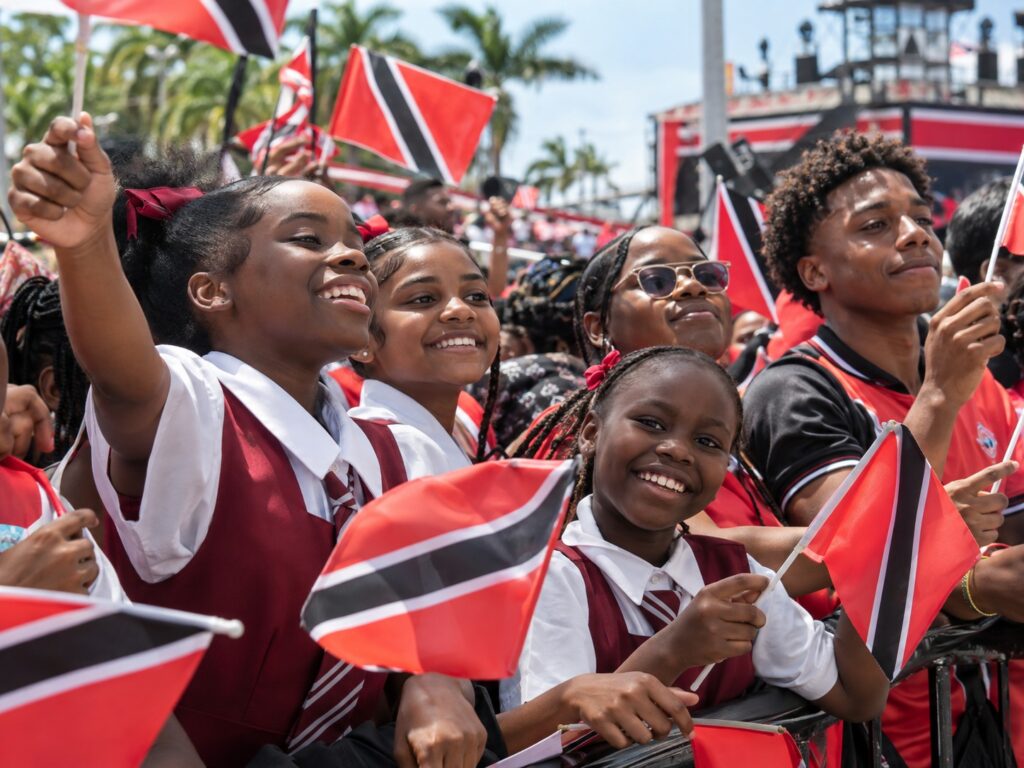
The 50th Anniversary of the Republic of Trinidad and Tobago, Still a Work in Progress
Fifty years later, this story is more than just a memory from the archives. The current president, Christine Kangaloo, who has been in office since 2023, joined First Gentleman Kerwyn Garcia this summer to inaugurate an exhibition tracing the major milestones of the presidency, titled “50 Years, One Republic: Moments that Shaped a Nation,” which is open to the public at the President’s House.
She described the attainment of republican status as the final step toward full national autonomy, noting that this autonomy must give every citizen a seat at the national table. On September 27, a few days after the national holiday, a steelpan concert featuring the Republic Bank Exodus Orchestra is set to close out the jubilee celebrations on the lawns of the President’s House, with the country’s iconic instrument taking center stage as a tribute to the Republic it has helped make known around the world.

Republic Day, incidentally, has not always been a fixed date on the national calendar. Removed from the list of public holidays between 1999 and 2001 to make way for Spiritual Baptist Liberation Day, it was not reinstated until 2002, proof that this celebration of the Republic has, too, been a subject of debate. On the evening of September 24, as she does every year, the president presents the nation’s highest honors, including the Order of the Republic of Trinidad and Tobago.
But the 50th anniversary also raises a less formal question—one that Prime Minister Kamla Persad-Bissessar recently posed before the United Nations: How does a small, sovereign country hold its own in a world of power dynamics without giving up on cooperating with its neighbors to address threats that know no borders? Fifty years after Sir Ellis Clarke’s oath of office, the Republic of Trinidad and Tobago still sees itself as a work in progress.


The Republican Constitution took effect on August 1, 1976, but the country celebrates Republic Day every September 24, the date on which the first Parliament convened under the new constitution.
Sir Ellis Clarke, a former governor-general and attorney general, became the first president of the Republic on September 24, 1976, after being unanimously elected by the parliamentary electoral college.
President Christine Kangaloo opened the exhibition “50 Years, One Republic” at the President’s House, followed on September 27 by a steelpan concert featuring the Republic Bank Exodus Orchestra.