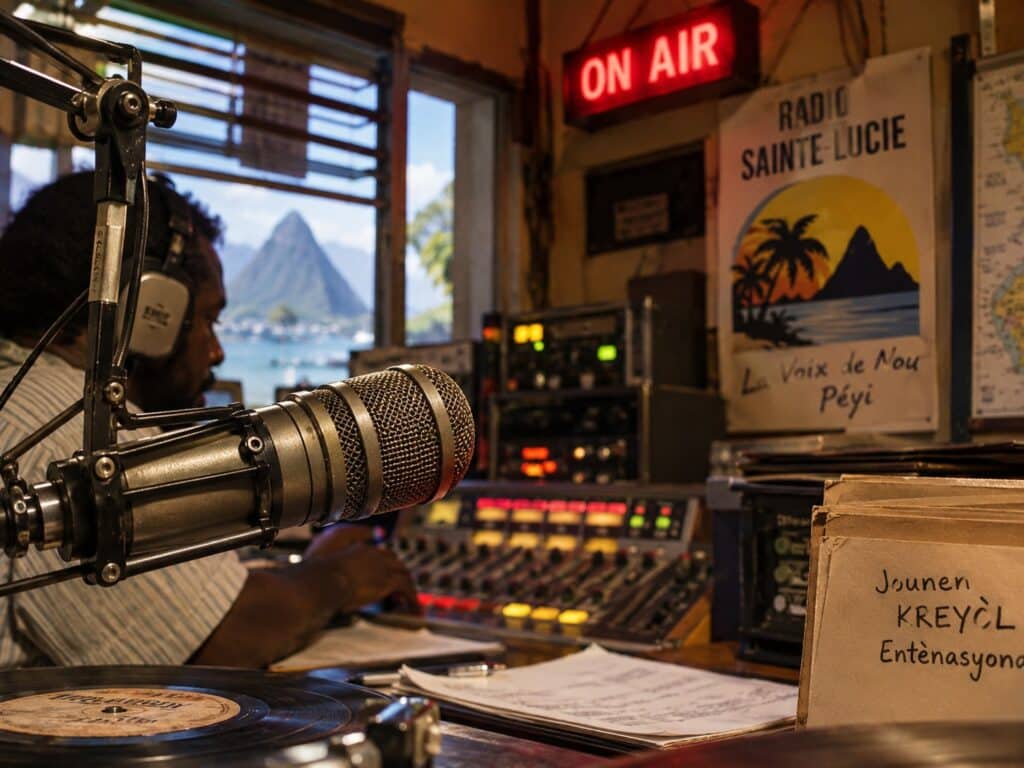
Every October 28, International Creole Day appears on calendars once again. Behind the date lies a story more beautiful than just another annual event. It began on the radio in Saint Lucia in 1983, the day an island decided to speak Kwéyòl on the air.
Radio St. Lucia opens its airwaves to Kwéyòl, the Creole language that St. Lucians speak in their daily lives. The programs flow one after another for hours on end. For two hours, the station broadcasts live from DBS Radio in Dominica, the neighboring island, which is also a Creole-speaking island. Earl Huntley, creator of the show “Radio-a se sanou,” is interviewed. Voices travel from one island to the other over the airwaves. It is the first International Creole Day.
The gesture is by no means insignificant. As early as 1980, during a national consultation in Saint Lucia, Lawrence Carrington observed that the rejection of Creole went far beyond the issue of the media. Going on the air was, in itself, a response.
From the studio to the village
The following year, the festival moved out of the studios. In 1984, it was held in Mon Repos, a small village on the east coast. It opened with a Mass in Kwéyòl, celebrated by Father Patrick Anthony, founder of the Folk Research Centre. Traditional singer Sesenne Descartes was honored. In 1985, the event moved to Fond Assau, in the northeast of the island, with a theme that summed it all up: “Kwéyòl, an lang, an pèp, an mòd lavi.” A language, a people, a way of life.
Starting in 1985, coordination was taken over by the Folk Research Centre. International Creole Day has become a permanent fixture on the Saint Lucian calendar. It has even given rise to an entire month, Mwa Éwitaj Kwéyòl (Creole Heritage Month), which extends the celebration of Jounen Kwéyòl. What began as a radio broadcast has become a village tradition, and then a season-long celebration.
Who established International Creole Day?
Neither a decree nor a large organization. A network of islands, Bannzil Kréyol. Creole-speaking territories that have decided to communicate with one another and act together, including Saint Lucia, one of the founding members. Their idea can be summed up in just a few words. To defend the language, showcase Creole culture, and keep it alive as a language of communication. October 28 became the shared date. International Creole Day then spread to other places. It took root in Haiti, the Seychelles, Mauritius, Martinique, Guadeloupe, French Guiana, and Réunion, and then in the diasporas of Paris, London, Montreal, and New York.
One Creole, Many Creoles
There isn’t just one Creole language, but many. The Kwéyòl of Saint Lucia is not spoken the same way as the Creole of Martinique, Haiti, or the Seychelles. They share a history, not a dictionary. In Haiti, Creole has been an official language since 1987. International Creole Day celebrates this entire family of languages, with their distinct accents, words, and sources of pride.
October 28, island by island
The day is celebrated differently in different places. In Saint Lucia, Jounen Kwéyòl is held on the Sunday closest to October 28. This year, it was on the 25th. In Dominica, October is Creole Month, leading up to Independence Day on November 3. In Martinique, the Bannzil Kréyol association and Yves-Marie Séraline’s OMDAC long championed International Creole Day before it expanded into a week, then a month, Creole Month, which has been observed since 2001.
The 17th International Symposium on Creole Studies is also being held there from October 26 to 30. In mainland France, Mois Kréyol is celebrating its tenth edition, from September 22 to December 6. Same date, a thousand ways to experience it, and one thing in common: the language you hear at home, at the market, and on the radio.

After October 28
That leaves the question raised by writer Raphaël Confiant. He fears that the day will devolve into “commemorationism” and that, the very next day, “the defense and promotion of the Creole language will fall by the wayside.” On October 29, who is still writing, teaching, and disseminating in Creole? Perhaps that is the real question raised by International Creole Day.

Frequently Asked Questions
It takes place every year on October 28. It has been held since 1983, when it was launched in Saint Lucia as a radio link between Creole-speaking islands.
It was launched by Bannzil Kréyol, a network of Creole-speaking islands of which Saint Lucia is a founding member. Its goal is to promote the language, showcase Creole culture, and keep it alive as a language of communication.
It is celebrated in Haiti, Saint Lucia, Dominica, Martinique, Guadeloupe, French Guiana, the Seychelles, Mauritius, and Réunion, as well as among the diasporas in Paris, London, Montreal, and New York. In Saint Lucia, it is known as Jounen Kwéyòl and is held on the Sunday closest to October 28.