Caribbean – MAGHIC 2 propels maritime energy transition with FARWIND Energy

MAGHIC 2

The MAGHIC 2 project, launched in March in Pointe-à-Pitre with the support of the INTERREG Caribbean program, marks a decisive step in the development of a low-carbon maritime sector adapted to the realities of the Caribbean.

At a time when climate issues are calling for far-reaching changes, the Caribbean is asserting its determination to become a pilot region for sustainable maritime transport. It is against this backdrop that FARWIND Energy, a start-up committed to decarbonizing maritime transport, is coordinating the MAGHIC 2 project, with the aim of structuring a genuine industrial and scientific sector around vele propulsion and hydrogen in the region.

Financed with €2.2 million in ERDF funds via INTERREG Caribbean, MAGHIC 2 embodies an alliance between technological innovation, academic research and regional ambition.
Innovative marine propulsion tested under real-life conditions

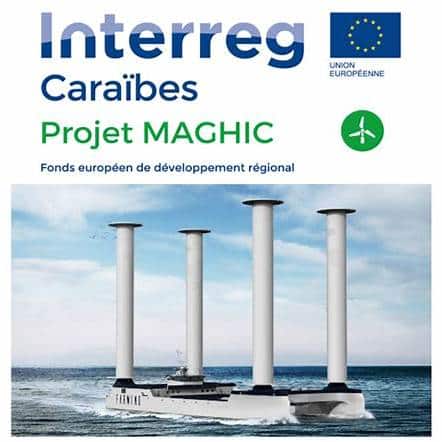
At the heart of the MAGHIC 2 project, the rotor sail developed by FARWIND Energy promises a significant reduction in COâ‚‚ emissions, up to 40% less fuel for ships. This technology, proven in severe maritime environments, opens up concrete prospects for more responsible shipping, in line with European climate objectives and those of the IMO.

But MAGHIC 2 goes further: the project also explores innovative hydrogen storage solutions, both on land and at sea, capable of holding between 10 and 100 tonnes, with reduced land impact. A response to the logistical and energy challenges specific to island geography.

A Caribbean research and industry network to support the transition

One of the project’s strengths lies in its ability to create a regional dynamic around skills and knowledge. FARWIND Energy brings together a network of leading academic institutions:

  • Caribbean Maritime University (Jamaica)

  • University of Trinidad and Tobago

  • Centro Nacional de Investigaciones Cientificas (Cuba)

  • Universidad Autonoma de Campeche (Mexico)

These establishments will focus their work on the service life of materials and the adaptation of solutions to the specific climatic and maritime conditions of the Caribbean.

On the industrial side, SARA (Société Anonyme de la Raffinerie des Antilles) is joining the project to promote technology transfer and strengthen local skills. The ambition is clear: to structure a sustainable regional ecosystem around low-carbon marine propulsion and the hydrogen industry.
MAGHIC 2
MAGHIC 2

A strategic vision for Caribbean energy sovereignty

By consolidating a base of regional skills and leveraging appropriate technologies, MAGHIC 2 sets the Caribbean on the path to an ambitious and coherent maritime energy transition. The project is helping to build energy sovereignty to enhance the competitiveness and resilience of Caribbean territories.

“This project illustrates an integrated approach combining innovation, industrialization and scientific cooperation, and represents a major step forward for more sustainable shipping,” says Arnaud Poitou, President of FARWIND Energy.

Launched in Guadeloupe, MAGHIC 2 is helping a smarter, bolder Caribbean emerge, capable of inventing its own answers to global energy challenges while making the most of its natural resources, know-how and strategic position.

Leave a Reply

Your email address will not be published. Required fields are marked *

More articles from RK

Philippe Faure-Brac
NEWS
Tolotra

Philippe Faure-Brac at Habitation Clément: Martinique rum as seen by a great sommelier.

Philippe Faure-Brac had never visited Habitation Clément before. World’s Best Sommelier 1992, member of the Meilleurs Ouvriers de France with honorary status since 2015, he came to Martinique to look at rhum agricole from its very place of production: the cane, the cellars, the bottling and the tasting. A first visit to Habitation Clément At Habitation Clément, in Le François, this visit had a special significance. Philippe Faure-Brac was already familiar with Clément rums, their quality positioning and their universe. He had also contributed to the book Rhum Clément, une histoire de famille, bringing his insight into the house’s aromatic precision, balance and tradition of excellence. But he lacked the experience of the place. That of the light, the temperature, the atmosphere of the winery and the exchanges with the teams. “The first time in Martinique? I was going to say finally,” he confided, recalling that he had been hoping

Read More »
Boiling Lake
TOURISM
Tolotra

Boiling Lake: 92 °C, 63 m wide, the 2nd largest bubbling lake in the world

Just 8 kilometers east of Roseau, the capital of Dominica, it’s a three-hour walk from Laudat to Boiling Lake. Three hours of humid forest, desolate valley, soil-heated rocks and sulfurous fumes. At the end of the path, a 63-metre-wide pool. Inside, the water bubbles almost continuously, with temperatures measured up to 91.6°C at the edges. It’s the second largest bubbling lake in the world. A rare phenomenon in a UNESCO park The world’s first is Frying Pan Lake in New Zealand’s Waimangu Valley. But the Dominican Boiling Lake is in a class of its own. Firstly, because it can only be reached on foot, after a demanding hike. Secondly, because it is part of a national park that has been a UNESCO World Heritage Site since 1997: Morne Trois Pitons National Park. This makes it one of the most singular geothermal phenomena protected in a world-renowned natural site. A flooded,

Read More »
Tourisme 3.0
TOURISM
Tolotra

Tourism 3.0: Jamaica wants to keep its tourist wealth

At the Montego Bay Convention Centre, the image speaks for itself. Local entrepreneurs showcase their products, hotel representatives circulate, meetings follow one another. Behind these rapid exchanges, one question weighs heavily: when tourism makes money, how much really stays in Jamaica? This is at the heart of Tourism 3.0, the new direction championed by Jamaica’s Minister of Tourism, Edmund Bartlett. At the Tourism Enhancement Fund’s 11th Speed Networking Event, he set out a clear ambition: to make tourism a more direct driver for Jamaican producers, artisans, manufacturers and suppliers. Tourism that no longer just wants to attract Jamaica knows how to welcome visitors. But the challenge is no longer just to fill hotels or increase arrivals. The real challenge is to retain more value in the territory. Edmund Bartlett has recognized a structural weakness: a large proportion of the goods and services consumed by the tourism industry are still imported.

Read More »

conTACT RK

we'd love to have your feedback on your experience so far

Join The List

Join our Richès Karayib community!  Sign up for our newsletter.

Want To Maximize Your Business Presence On Riches Karayib?

Complete the form to start the application