Gaston Monnerville, born on January 2, 1897, in Cayenne, French Guiana, served as President of the French Senate from 1958 to 1968. To this day, he remains the only Black president of a chamber of the French Parliament, a position he attained after a career as a lawyer and later as a member of the Resistance during the Occupation. In 1962, Gaston Monnerville publicly opposed General de Gaulle over the reform of the method for electing the President of the Republic, a confrontation that has gone down in the history of the Senate.
Gaston Monnerville vs. de Gaulle: The 1962 Scene
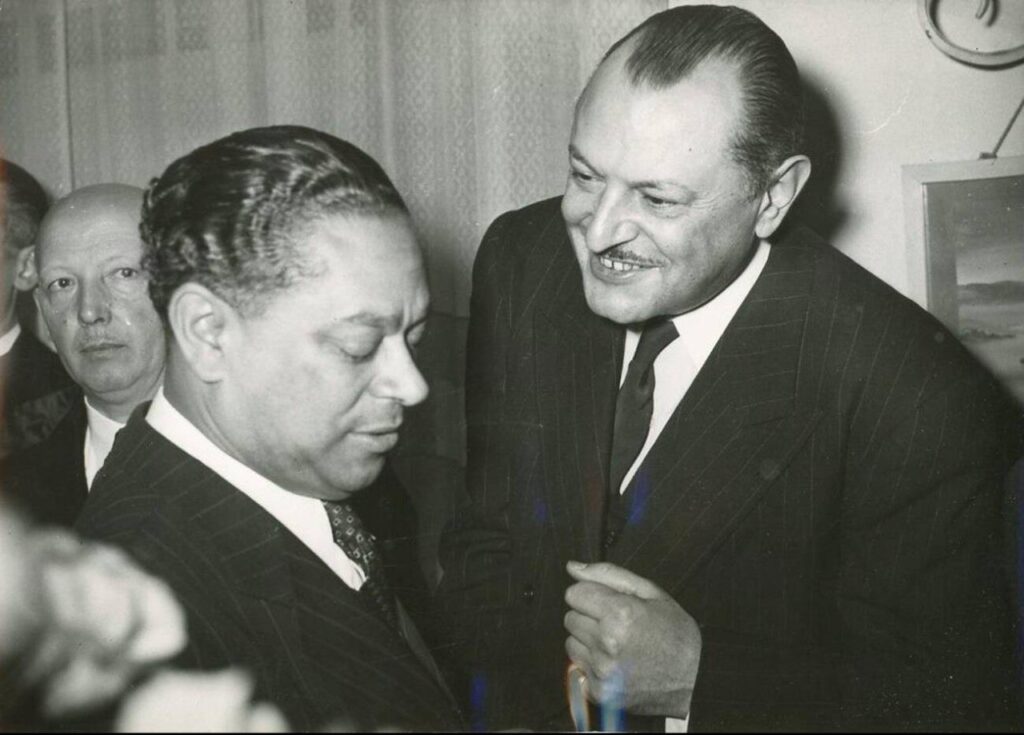
On October 9, 1962, Gaston Monnerville addressed the Senate from the rostrum at the Palais du Luxembourg in Paris. The President of the Republic, Charles de Gaulle, had just announced a referendum to elect the president by direct universal suffrage, relying on Article 11 of the Constitution rather than the amendment procedure provided for in Article 89. Monnerville denounced this decision before the senators. According to several consistent accounts of that session, he addressed General de Gaulle with a phrase that has remained famous in the Senate: “No, Mr. President of the Republic, you do not have the right—you are taking it.”
A few days earlier, in late September 1962, during a speech in Vichy, he had already announced his intention to vote “no” and described General de Gaulle’s move as abuse of office.” This term would leave a lasting mark on the debates of the nascent Fifth Republic. On October 1, 1962, despite this open confrontation with the executive branch, the senators re-elected Gaston Monnerville as President of the Senate. The referendum was held a few weeks later, and the reform was ultimately adopted by the French people.
From Cayenne to Toulouse: A Family That Believes in Education
Gaston Monnerville was born on January 2, 1897, in Cayenne, French Guiana, the son of Marc Saint-Yves Monnerville and Marie-Françoise Orville. His mother had already lost two children when, in 1912, she agreed to send Gaston Monnerville and his brother Pierre to study in metropolitan France, thousands of kilometers away from French Guiana. He then enrolled at Lycée Pierre Fermat in Toulouse, France. This family decision—a true sacrifice for the time—paved the way for him to study law.
On his mother’s side, he has roots in Martinique. His maternal uncle, Saint-Just Orville, served as mayor of Case-Pilote, in Martinique. This connection would remain a constant throughout his life. During the Resistance, he chose the pseudonym “Saint-Just” specifically as a tribute to his uncle from Martinique.
A Guyanese lawyer admitted to the Paris Bar
Gaston Monnerville earned a bachelor’s degree in literature and then a doctorate in law from the University of Toulouse in 1921, with a dissertation on unjust enrichment. He was admitted to the Toulouse Bar in 1918 and to the Paris Bar in 1921. He then joined the law firm of César Campinchi, where he worked for eight years. In 1931, he successfully defended Guyanese defendants in the Galmot case, a defense that brought him recognition beyond the legal community.

From the Cayenne City Hall to the Resistance under the name Saint-Just
Gaston Monnerville was elected to the National Assembly as the representative for French Guiana in 1932 and was reelected in 1936. In 1935, he also became mayor of Cayenne, in French Guiana. From 1937 to 1938, he served twice as Under-Secretary of State for the Colonies in the final governments of the Third Republic.
When World War II broke out, Gaston Monnerville volunteered for the Navy on September 7, 1939. He served as a judicial officer on the battleship Provence during the Battle of Mers-el-Kébir on July 3, 1940. After being demobilized, he joined the Resistance. From December 1942 to September 1944, he commanded F.F.I. resistance fighters in Auvergne under the pseudonym Saint-Just. This service earned him the 1939–1945 War Cross and the Resistance Rosette.
Twenty-two years as president of the upper house
Following the Liberation, Gaston Monnerville was appointed by the Resistance to the Consultative Assembly on November 7, 1944. He was elected to the Council of the Republic on December 15, 1946, and became its president on March 14, 1947. Following a contested election in French Guiana, he was elected senator for the Lot department in November 1948, a position he held until 1974. In 1958, with the adoption of the new Constitution of the Fifth Republic, the Council of the Republic became the Senate, and he became its first president.
Gaston Monnerville remained president of the Senate until 1968, having served for twenty-two years at the head of the upper house of the French Parliament, including his tenure as president of the Council of the Republic. At the same time, he served as president of the Lot General Council from 1951 to 1970 and was mayor of Saint-Céré, in the Lot department, from 1964 to 1971. No other Black president has since led a chamber of the French Parliament.

A Story Yet to Be Told
In 1974, the then-President of the Senate, Alain Poher, appointed Gaston Monnerville to the Constitutional Council, where he served until 1983. He also published his memoirs in two volumes titled *Témoignage*, as well as a book dedicated to Georges Clemenceau. He died in Paris on November 7, 1991, shortly before his ninety-fifth birthday.
Thirty-five years after his death, the Senate still devotes an entire section to Gaston Monnerville in its official history. Born in French Guiana, of Martinican descent on his mother’s side, and the leader of the French Senate for twenty-two years, he lived through the Resistance, decolonization, and one of the greatest institutional conflicts of the Fifth Republic. His life story raises a simple question for the Caribbean today: How many other life stories of this magnitude remain to be told?

Gaston Monnerville was a lawyer and politician born on January 2, 1897, in Cayenne, French Guiana. He served as President of the French Senate from 1958 to 1968, after having served as President of the Council of the Republic from 1947 to 1958. To this day, he remains the only Black president of a chamber of the French Parliament. Gaston Monnerville died in Paris on November 7, 1991.
Gaston Monnerville deemed General de Gaulle’s decision to have the election of the President of the Republic by direct universal suffrage adopted by referendum—pursuant to Article 11 of the Constitution—rather than following the amendment procedure provided for in Article 89, to be illegal. He described this move as “abuse of office” in a speech in late September 1962, and then reaffirmed his opposition in the Senate on October 9, 1962.
Yes. Gaston Monnerville’s mother, Marie-Françoise Orville, had roots in Martinique. Her maternal uncle, Saint-Just Orville, served as mayor of Case-Pilote, in Martinique. Gaston Monnerville chose the pseudonym “Saint-Just” during the Resistance as a tribute to his uncle.