
Haiti – Rhum Barbancourt: a gold medal for Haitian excellence

Rhum Barbancourt

Rhum Barbancourt heritage and know-how

Since 1862, Rhum Barbancourt has embodied rare Haitian know-how, rigorously handed down from generation to generation. Founded by Dupré Barbancourt, the distillery is based on a distillation method inspired by cognac, using exclusively pure sugarcane juice, unlike rums produced from molasses. This structural choice gives Rhum Barbancourt an aromatic richness and finesse recognized by professionals the world over.

Now run by Delphine Nathalie Gardère, the company remains true to its DNA, while incorporating contemporary standards of quality, sustainability and distribution. The story of this rum is that of an emblematic product that embodies Haitian resilience, precision and artisanal excellence.

A controlled manufacturing process from start to finish

The Gold Medal awarded to Rhum Barbancourt in 2025 crowns a rigorous production process. Every stage – from chemical-free cane cultivation by 3,000 local growers to final bottling – is carried out on the Plaine du Cul-de-Sac site. The cane juice, or vezou, is rapidly crushed, then fermented for 48 to 72 hours before being distilled in three columns.

Aging takes place in Limousin oak barrels, repaired on site, giving this rum a unique complexity. The use of bagasse to produce steam and electricity reflects a real commitment to the environment. This energy autonomy, coupled with rigorous resource management, gives Rhum an exemplary stature in the world of spirits.

Rhum Barbancourt
©Rhum Barbancourt
Rhum Barbancourt
©Rhum Barbancourt
Rhum Barbancourt
©Rhum Barbancourt

International recognition and a distinguished track record

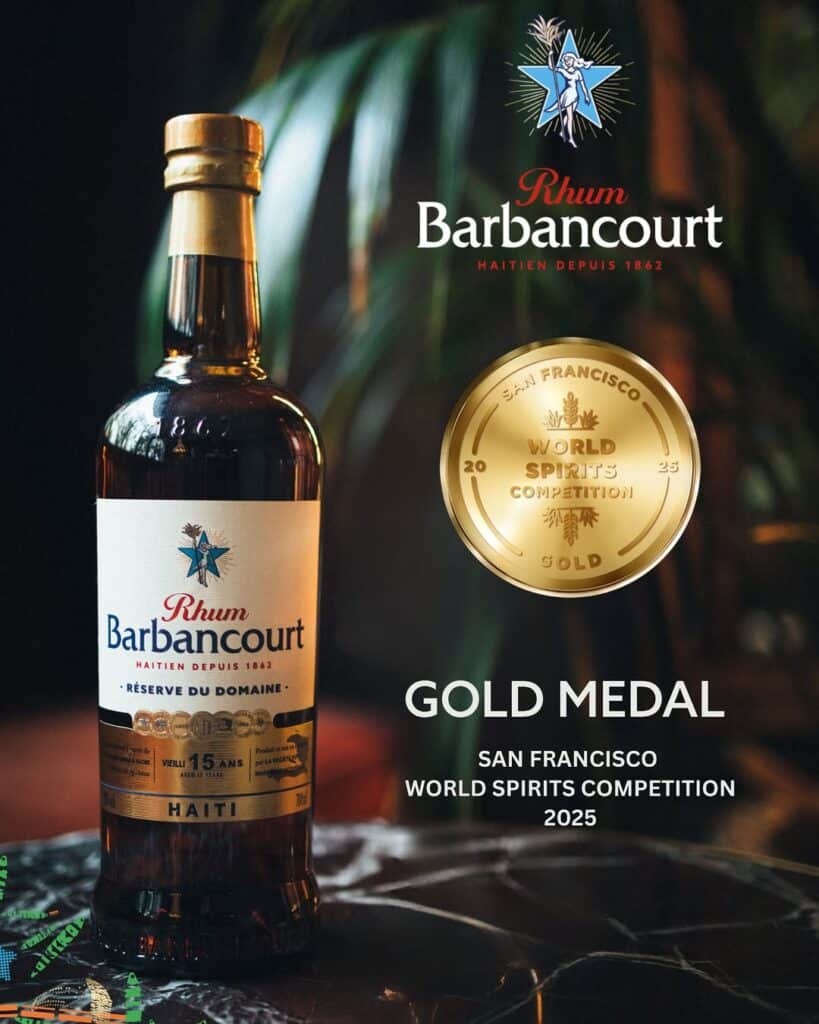
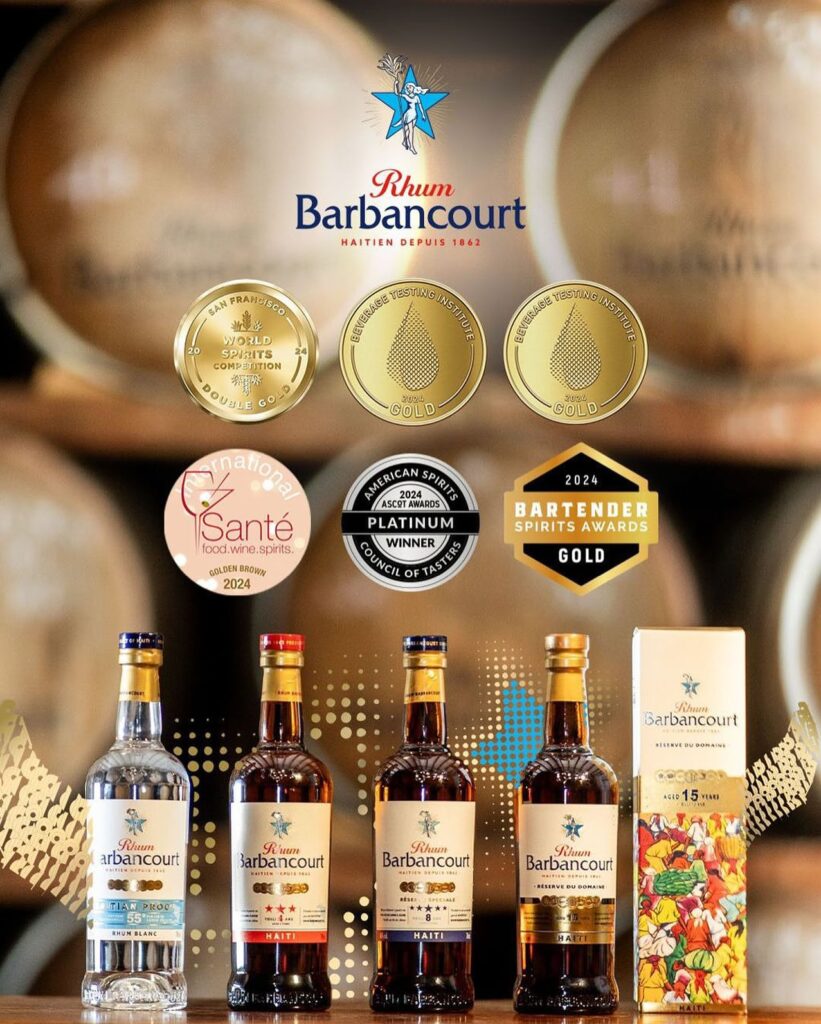
Rhum Barbancourt has won more than 52 awards since 1883. In 2025, two new awards confirm this trajectory: a double Gold Medal for the Haitian Proof White Rum awarded by The Fifty Best in New York, and another for the Reserve du Domaine 15 ans at the San Francisco World Spirits Competition.

These awards are no accident: they are the result of a blind tasting conducted according to a strict protocol by panels of experts. It shone through with its clear aromas, silky texture and balance. The Gault & Millau guide awarded the Réserve du Domaine 94/100, praising its structure, persistence and the precision of its woody, vanilla and spicy notes.

Rhum Barbancourt
©Rhum Barbancourt
Rhum Barbancourt
©Rhum Barbancourt

Sensory Methodology: An Objectivized Assessment

For international competitions, Rhum Barbancourt is tasted without any indication of origin or brand, ensuring an impartial assessment. Temperature control, palate neutralization, sealed samples: every variable is under control. The Haitian Proof White Rum seduced with its floral and citrus notes, while the Réserve du Domaine 15 ans impressed with its intensity and length on the palate.

These ratings confirm that it stands out not only for its organoleptic characteristics, but also for the consistency of its vintages, reflecting a know-how rooted in the Haitian terroir.

A Structuring Economic and Cultural Impact for Haiti

Rhum Barbancourt’s success extends beyond the gastronomic sphere. With over 500 direct employees and thousands of partner farming families, the distillery plays a key role in the national economy. In 2021, its method of production was listed as part of Haitian Cultural Heritage, testifying to the importance of its identity.

This international recognition is also a lever for local development and a symbol of national pride. It illustrates that a home-grown product, crafted with rigor and respect, can compete with the world’s greatest houses without denying its roots.

Rhum Barbancourt
©Rhum Barbancourt
Rhum Barbancourt
©Rhum Barbancourt
Rhum Barbancourt
©Rhum Barbancourt

The Fifty Best and the BTI: Quality references

The recent distinctions for Rhum Barbancourt by The Fifty Best and the Beverage Testing Institute (BTI) are not anecdotal. These institutions are renowned for their scientific rigor, impartiality and exacting standards. The BTI, founded in 1981, evaluates products according to a standardized grid, with professional juries taking into account only the intrinsic quality of the product.

The fact that it regularly features in their top rankings is a testament to excellence based on technical mastery, transparency and integrity.

A strategy for the future combining Tradition and Excellence

Rhum Barbancourt is not resting on its laurels. Its current strategy is based on premiumizing its cuvées, opening up to new markets, and continually adapting to international standards, without compromising its identity. This demanding positioning is based on a triptych: quality, sustainability and transmission.

Efforts to reduce the environmental footprint, train young local talent and invest in equipment modernization bear witness to a clear vision shared by management and all staff. In this way, Rhum Barbancourt is both a pillar of the past and a forward-looking player.

Rhum Barbancourt, awarded a new Gold Medal in 2025, is more than just an exceptional product: it is the living illustration of a mastered heritage, a sublimated terroir and a collective commitment. For Haiti, this international recognition confirms that a demanding craft can become an economic engine and a source of cultural influence. For the world of spirits, Rhum Barbancourt remains a benchmark whose legitimacy is based on longevity, rigor and authenticity.

Leave a Reply

Your email address will not be published. Required fields are marked *

More articles from RK

Caribbean Telecommunications Union
NEWS
Tolotra

Caribbean Telecommunications Union: French Guiana Builds Its Digital Bridge

Since joining the Caribbean Telecommunications Union, French Guiana has established its place as a French territory in the Americas that looks toward the Caribbean, the Amazon, and Europe all at once. This choice may seem technical. Yet it speaks to something deeper: for French Guiana, regional integration is not just about politics or airplanes. It’s also about networks, data, businesses, and everyday life. A membership that goes beyond telecommunications The Caribbean Telecommunications Union is a regional organization dedicated to the development of information and communication technologies in the Caribbean. By joining this network as an associate member, French Guiana is entering a forum where connectivity, cybersecurity, digital governance, and infrastructure are discussed. The formal membership agreement was signed in Port-of-Spain, Trinidad and Tobago, following ministerial approval during ICT Week 2025 in Kingston, Jamaica. This is a significant development: French Guiana is now one of the territories associated with an organization

Read More »
Man Mélé
VISUAL ARTS
Tolotra

“Man Mélé!”: Cécile Vernant’s Exhibition at the Senate’s Orangerie

Exhibiting at the Jardin du Luxembourg is often a major milestone in an artist’s career. For artist Cécile Vernant, it is above all an opportunity to connect with the public. From July 17 to 28, 2026, she will present *Man Mélé!* at the Senate’s Orangerie, as part of the Luxembourg Garden Summer Festival. For twelve days, she will personally welcome visitors to this iconic venue at the heart of Parisian cultural life. Selected following the 2026 call for projects, the artist will have 152 m² to showcase her artistic world, where painting, photography, drawing, and ceramics interact freely. After being selected by the Senate, Cécile Vernant reached out to Didier on her own initiative, without having had any prior contact with the company. This choice came naturally: from the brand’s production site, the view takes in the Carbet peaks, a Martinican landscape that runs through her work just as much

Read More »
Saint-Barthélemy
TOURISM
Tolotra

Saint-Barthélemy: 21 km², nearly a century under Swedish sovereignty

When you arrive in Saint-Barthélemy, the first thing you see as you disembark is the name of the capital: Gustavia. Not Sainte-Anne, not Saint-Jean, not a French name. Gustavia. This name marks the beginning of one of the Caribbean’s most unique colonial chapters: that of a French island that became Swedish for nearly a century. A small island long considered unprofitable With an area of 21 square kilometers and a population of 10,660 according to INSEE’s reference population figures as of January 1, 2023, Saint-Barthélemy has a multi-layered history. Christopher Columbus was the first known European navigator to report sighting the island in 1493, during his second voyage. He named it after his brother Bartolomeo. The French established a permanent settlement there in 1648. Philippe de Longvilliers de Poincy, lieutenant general of the American Islands, sent Jacques Gante there with 52 men. Conditions were difficult. There was a shortage of

Read More »

conTACT RK

we'd love to have your feedback on your experience so far

Join The List

Join our Richès Karayib community!  Sign up for our newsletter.

Want To Maximize Your Business Presence On Riches Karayib?

Complete the form to start the application