
Industry, Identity and Culture: Martinique faces the Challenges of Revolution 4.0

industry 4.0

Martinique, rich in history and dynamism, must now embrace digital transformation to strengthen its position in the Caribbean and beyond. Industry 4.0 not only represents a technological revolution, but also a unique opportunity to enhance local know-how, modernize our infrastructures and open up new prospects for the region’s young talent and businesses.

In this dynamic, the Lycรฉe Polyvalent Joseph Zobel, alongside AMPI, the Prefecture of Martinique, the Collectivitรฉ Territoriale de Martinique (CTM) and BPIFRANCE Antilles-Guyane, is playing a central role in supporting this transition. Through its commitment and strategic partnerships, notably with the Caribbean Maritime University (CMU, Jamaica), this project places Martinique in a fast-changing industrial and technological ecosystem.


By focusing on innovation, training and regional cooperation, Martinique is asserting its ambition to become a key player in Industry 4.0 in the Greater Caribbean.

Digital transformation doesn’t change the nature of things, but the way we use them. Professor Ibrahim AJAGUNNA, from the Caribbean Maritime University (CMU, Jamaica), illustrated this idea by explaining that music is still music, but what has changed is the way we listen to it.

The same is true for industry: skills and know-how remain essential, but tools are evolving. The Industry 4.0 era does not replace human expertise, it transforms it by enriching it with connected technologies, artificial intelligence and real-time data analysis.

Martinique needs to rethink its industrial model to take account of these changes, while at the same time promoting its identity and local know-how.

Industry 4.0 in Martinique: a strategic challenge

Industry 4.0 is based on the integration of new technologies to improve the management and maintenance of industrial equipment. The aim is to reduce downtime, optimize production and boost competitiveness.

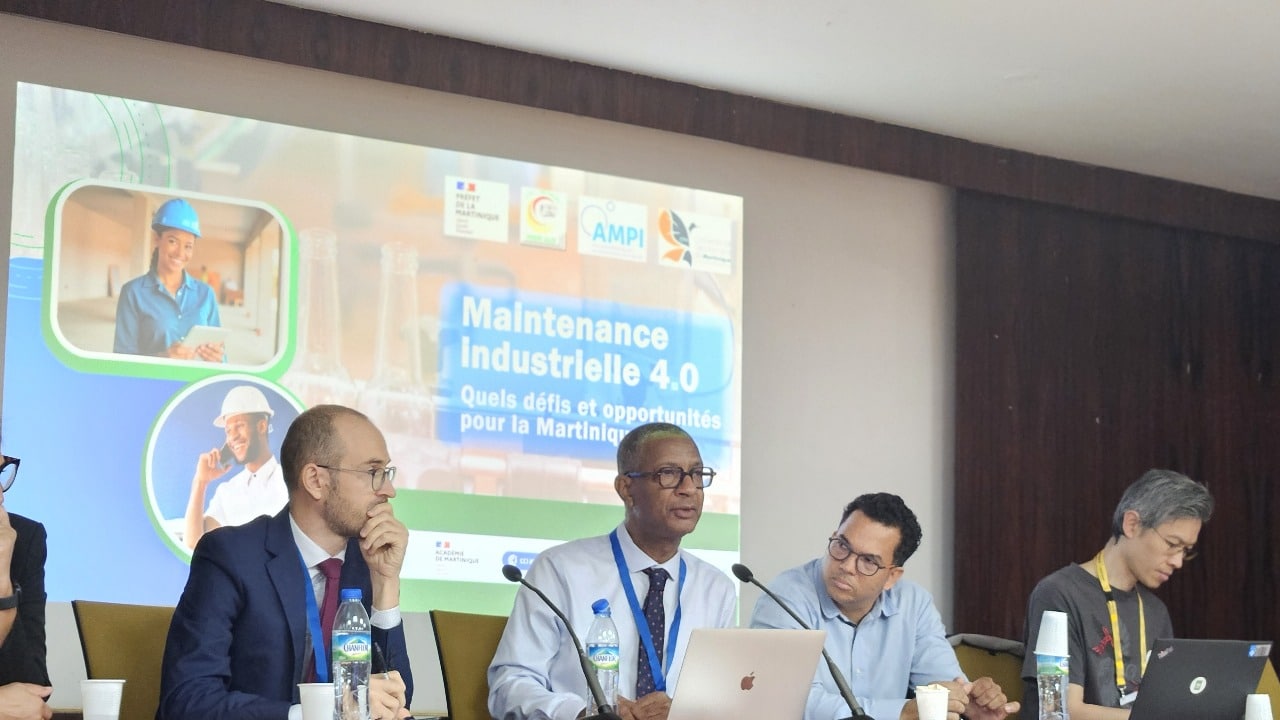
At the symposium, Bastien Mรฉrot, Sous-prรฉfet du Marin, emphasized that industrial modernization is a priority to ensure the sustainability of Martinique’s industrial sector. Sandra Casanova, Chairwoman of the CTM’s Territorial Logistics Strategy, Research and Innovation Policy Commission, stressed the importance of regional collaboration and the development of synergies with the Caribbean.

For Martinique, this transition is based on three major strategic axes:

  • Strengthen industrial and digital infrastructures to modernize production and maintenance processes;
  • Develop appropriate training to prepare young people for the new demands of the job market;
  • Facilitate Martinique’s integration into the Caribbean industrial ecosystem, by encouraging regional and international collaborations.

The partnership with the Caribbean Maritime University (CMU, Jamaica) illustrates this desire for openness and cooperation with other territories.

industry 4.0
Bastien Mรฉrot (Sub-prefect of Marin)
industry 4.0
Sandra Casanova (Territorial councilor, CTM)

The challenges of industrial maintenance 4.0 in Martinique

Training and skills adaptation

One of the major challenges of this transition is the lack of skilled manpower to support this technological change.

Henri Guillose, principal of the Lycรฉe Joseph Zobel, stressed the need to make young people aware of new trades:

“We need to make young people aware of the maintenance professions, train them in new technologies and show them that this is a sector for the future.

The partnership with the Caribbean Maritime University (CMU, Jamaica) is designed to offer training adapted to technological developments, and to provide students with regional and international opportunities.

industry 4.0
Henri Guillose (Principal of Lycรฉe Zobel)

Digital sovereignty and data protection

With the rise of connected technologies, industrial data protection is becoming a crucial issue.

Vincent Thavonekham, CEO of FactoVia and IoT 4.0 expert, warned of cybersecurity risks:

“Martinique needs to develop its own digital infrastructure to ensure technological autonomy and avoid cyber attacks. We mustn’t put all our eggs in one basket and depend solely on external infrastructures.”

To achieve this, several solutions are recommended:

  • Development of local data centers to limit dependence on foreign infrastructures;
  • Data security and implementation of protection protocols ;
  • Sharing digital resources between companies and institutions.
industry 4.0
Vincent Thavonekham (CEO FactoVia, IoT 4.0 expert, FrenchCARE ambassador)

Technological integration and investment

The adoption of new technologies requires substantial investment to modernize our industrial facilities.

According to Bernard RIERA, University Professor at Reims:

“Artificial intelligence and predictive maintenance are essential levers for optimizing industrial performance.”

To overcome this obstacle, we need to mobilize appropriate financing and support local businesses in this digital transition.

industry 4.0
Bernard RIERA (University Professor, Universitรฉ de Reims Champagne-Ardenne)

Opportunities and Benefits of Maintenance 4.0

Optimizing industrial performance

Thanks to 4.0 technologies, it is possible to anticipate breakdowns, reduce maintenance costs and improve business productivity.

Real-time data analysis and artificial intelligence enable faster, more efficient and more cost-effective maintenance.

A lever for economic competitiveness

According to Sandra Casanova, Martinique must take advantage of Industry 4.0 to accelerate its integration into regional value chains.

Professor Ibrahim AJAGUNNA, from the Caribbean Maritime University, emphasized that Martinique has a strategic role to play in developing appropriate skills and building on regional cooperation.

industry 4.0
Professor Ibrahim AJAGUNNA (Deputy to the President, Caribbean Maritime University - CMU, Jamaica, special guest)

A lever for economic competitiveness

According to Sandra Casanova, Martinique must take advantage of Industry 4.0 to accelerate its integration into regional value chains.

Professor Ibrahim AJAGUNNA, from the Caribbean Maritime University, emphasized that Martinique has a strategic role to play in developing appropriate skills and building on regional cooperation.

Development of appropriate digital infrastructures

Industrial modernization also relies on the deployment of high-performance networks, including 5G and secure cloud platforms.

In the final round table, Roland Ratenan, Managing Director of NASDY, and Miguel MONDESIR, Director of Digital and High-Speed Broadband at the CTM, discussed the challenges of digital infrastructures and possible solutions for improving connectivity and pooling resources.

industry 4.0
Roland Ratenan, manager of NASDY
industry 4.0
Miguel Mondรฉsir director of digital and ultra high-speed broadband at the CTM

Martinique must not be a mere spectator of the industrial revolution underway, but a leading player. Industry 4.0 is a tremendous opportunity for transformation, not only to modernize our infrastructures and strengthen our competitiveness, but also to build an ecosystem where innovation and Caribbean identity meet.

Thanks to strategic partnerships between institutions, companies and training centers, this project is paving the way for an increase in the skills of our young people, the development of a more sustainable industry and greater integration within the Greater Caribbean.

The era of digital technology and industrial innovation must be a chance for Martinique to assert its leadership, develop its potential and build a more connected, efficient and resilient economy. Together, let’s seize this opportunity to take Martinique into the future, with boldness and ambition.

Industrie 4.0
Maintenance Industrielle 4.0
industry 4.0
Hervรฉ Lelarge (Regional Manager, Antilles-Guyane, BPIFRANCE)
Industrie 4.0
Philippe diser (host)
industry 4.0
Mr Marceline (President of AMPI)

Leave a Reply

Your email address will not be published. Required fields are marked *

More articles from RK

Citadelle Henri
HISTORY & HERITAGE
Tolotra

Haiti – Citadelle Henri: a Haitian bastion at the heart of Caribbean history

Citadelle Henri. The name sounds like an affirmation. That of a territory, a people and a region that, at the beginning of the XIXแต‰ century, chose to stand up to empires. Dominating northern Haiti at an altitude of over 900 metres, the Citadelle Laferriรจrebetter known as the citadel Henriremains one of the most powerful monuments in the Caribbean. Beyond its monumentality, it embodies strategic thinking, conquered sovereignty and a message addressed to the Atlantic world. A founding historical context for Haiti and the Caribbean It was born in the immediate post-war period of Haitian independence (1804). At the head of the Kingdom of the North, Henri Christophe between 1805 and 1820, erected a defensive system unrivalled in the region. The aim was clear: to prevent any return of the colonial powers, particularly France, and to secure a sovereign black state in the heart of the Caribbean. In a Caribbean region

Read More ยป
Stephen Cat Coore
MUSIC
Tolotra

Jamaica – Reggae legend Stephen Cat Coore dies aged 69

Stephen Cat Coore died at the age of 69, leaving the Caribbean bereft of one of its most consistent and demanding artisans. Guitarist, singer, composer and co-founder of the group Third World, he embodies a singular trajectory in the history of Jamaican music: that of a creator who chose continuity, rigor and thoughtful openness rather than rupture or effect. His death is not just that of a renowned musician. It marks the loss of a cultural landmark, of a man who knew how to think of reggae as a space for dialogue between Caribbean heritage and the global circulation of sounds. A musical heritage steeped in Jamaican history Stephen Cat Coore was born in a Jamaica where music was already structuring the collective narrative. Son of Bunny Ruggs, a member of the Maytals, he grew up in the shadow of a heritage shaped by ska, rocksteady and the first expressions

Read More ยป
Karen VIRAPIN
AIR
Tolotra

Karen VIRAPIN: Air Caraรฏbes’ first female CEO from the French overseas territories

Appointed Deputy CEO in January 2026, Karen Virapin becomes the first woman from the French overseas territories to reach this level of governance withinAir Caraรฏbes. A major development for the airline, but also a strong signal for the Caribbean air transport sector. Beyond the symbolism, this appointment raises a central question: what concrete impact could it have on governance, social dialogue, the regional network and service quality? An appointment that reflects continuity, but not stasis Having been with the company for fourteen years, Karen Virapin is no parachute. A former Director of Human Resources, Karen Virapin has been involved in all the company’s structural transformations: organizational changes, workforce growth, adaptation to the economic and social constraints of the airline industry. Her appointment to the position of Managing Director is therefore a logical step in the company’s continuity. But continuity does not mean standstill. In a sector as exposed as air

Read More ยป

conTACT RK

we'd love to have your feedback on your experience so far

Join The List

Join our Richรจs Karayib community! ย Sign up for our newsletter.

Want To Maximize Your Business Presence On Riches Karayib?

Complete the form to start the application