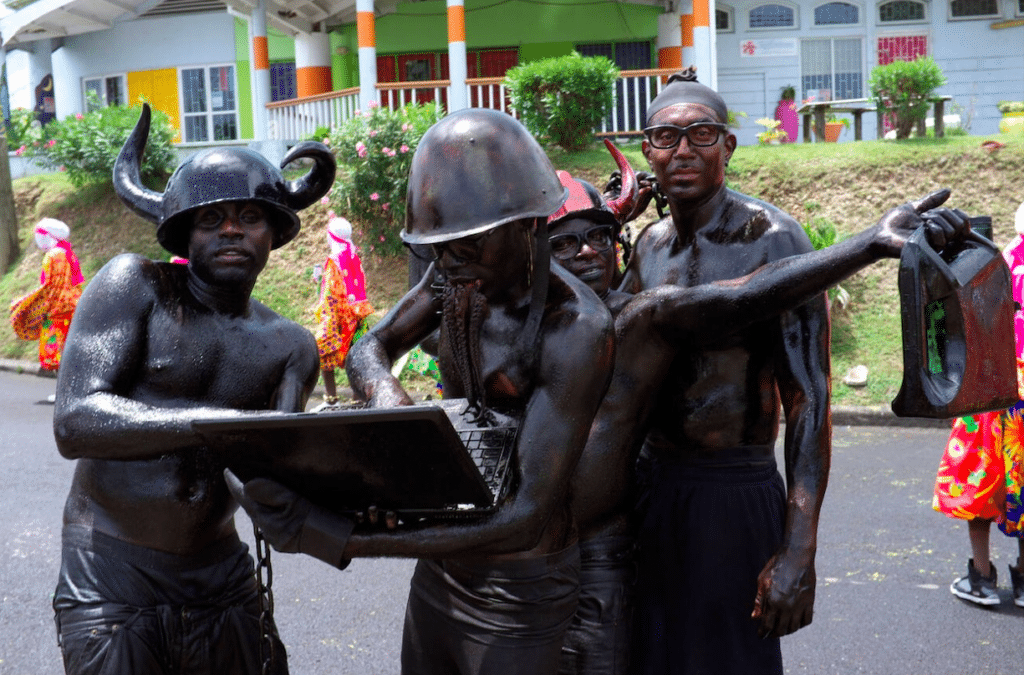
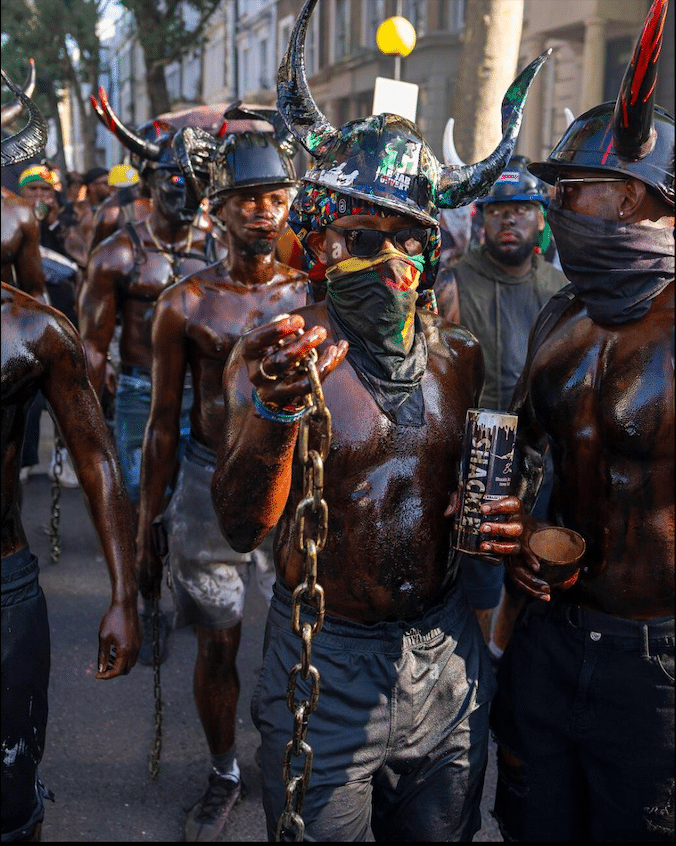
In Grenada, carnival is expressed first and foremost through the body, rhythm and density of the street. When silhouettes are covered in black oil, chains echo on the asphalt and the crowd moves in unison in the morning gloom, the Jab Jab is a must. More than a carnival character, he is a collective presence, a form of expression deeply rooted in the island’s social and cultural history.
In 2026, this emblematic figure will regain its centrality on the occasion of two major events: Carriacou Carnival (Kayak Mas) in February and Spicemas, Grenada’s national carnival in August. Understanding the Jab Jab allows us to read these events not as mere festivities, but as structuring moments of Grenadian identity.
The Jab Jab: a historical and symbolic construction
The term Jab derived from the word “diable” in French-influenced Creoles, should not be interpreted literally. In Grenada, it does not refer to a religious figure. It’s part of a colonial history marked by the stigmatization of black bodies, perceived as threatening, unruly or subversive.
His aesthetic is a reversal. Black, applied to the skin in the form of oil or paint, erases visible social distinctions. The horns and chains, far from being decorative, recall a history of domination, while at the same time subverting it. What was once an instrument of constraint becomes a sign of affirmation. The body, put forward without artifice, once again becomes a space for language.
J'ouvert: the moment when Jab Jab becomes fully incarnate In Grenada
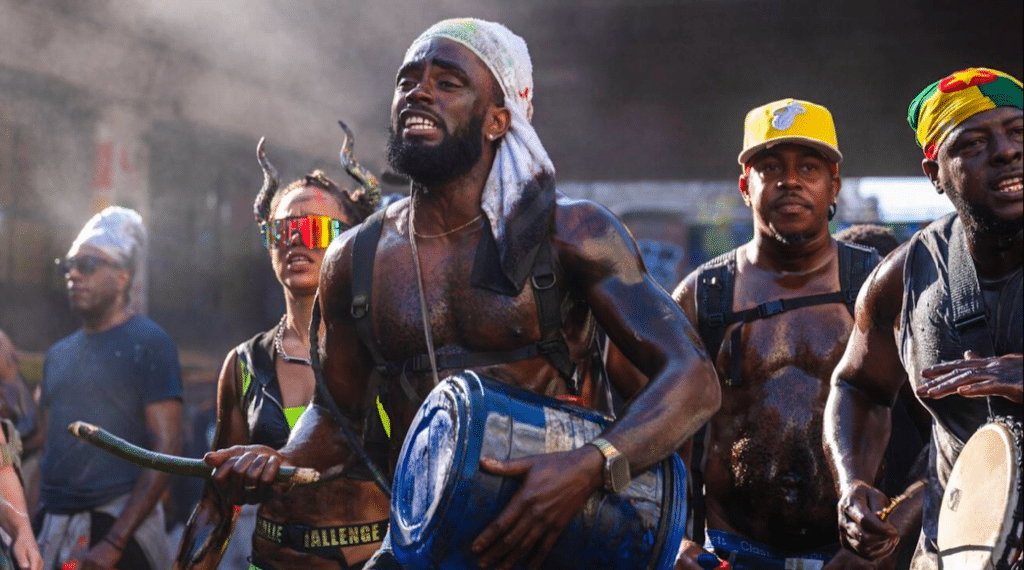
In Grenada, it finds its most intense expression in the J’ouvert, the inaugural moment of carnival, which takes place at dawn. This choice of time is not insignificant. The transition from night to day marks a break, a threshold, a space where ordinary norms become blurred. The Grenadian J’ouvert is characterized by a dense collective progression, punctuated by percussion, chanting and the continuous movement of the crowd. It appears as a living mass, inseparable from the street and those who pass through it. It’s not an organized parade, but a collective dynamic in which experience takes precedence over staging.
It’s at this moment that Grenada’s Carnival asserts its Caribbean uniqueness: a festival rooted in the lived experience, before any visual or spectacular dimension.
A contemporary reading
It continues to speak in the present tense. It is neither frozen nor folklorized. It reflects a Grenadian way of conceiving carnival as a space of historical continuity.
Three dimensions still structure its scope today.
Collective memory.
Jab Jab assumes the heritage of the past without simplifying it. References to confinement, constraint and resistance are visible, audible and embodied.
Occupying public space.
The body becomes a political tool in the truest sense: it occupies the street, transforms the city and temporarily redefines the uses of urban space.
The strength of the collective.
In Jab Jab, the individual takes a back seat to the group. Energy comes not from an isolated performance, but from a shared movement, extended over time.

2026: Carriacou Carnival, another scale of Jab Jab
February 2026, Carriacou Carnival also known as Kayak Mas opens the archipelago’s carnival season. On this island to the north of Grenada, carnival retains a very community-based dimension, with local traditions playing a central role. It often takes a more restricted form, more closely linked to the island’s social dynamics. It coexists with other emblematic expressions, specific to Carriacou, which bear witness to the internal cultural diversity of the Grenadian state.
Kayak Mas thus offers a complementary reading of Jab Jab: less massive, but deeply rooted, revealing the plurality of carnival practices within the same territory.
Spicemas 2026: Jab Jab at the heart of the national carnival
August 2026, Spicemas is the highlight of the Grenadian cultural calendar. More extensive, more structured, this national carnival nevertheless remains true to its fundamentals. It retains a central place, notably during the J’ouvert on Carnival Monday.
It’s at Spicemas that Jab Jab reaches its peak. The concentration of participants, the physical intensity and continuity of movement give this moment an almost organic dimension. The contrast with the Tuesday parades, devoted to more elaborate costumes and staging, underlines the complementary nature of Grenadian carnivalesque registers.

Jab Jab as the main theme of Grenadian carnival
Through him, Grenada affirms a conception of carnival that goes beyond mere celebration. It’s a living culture, capable of linking the past to the present, the intimate to the collective, the local to the national.
In 2026, between Carriacou Carnival and Spicemas Jab Jab appears as a common thread. It crosses territories, links generations and structures the carnival calendar. Above all, it reminds us that, in the Caribbean, carnival is also a space for transmission, where history is told through the body and movement.
For those seeking to understand Grenada beyond the expected images, it offers an essential key to understanding the city. A demanding, dense, yet profoundly revealing key to Grenada’s cultural identity.
This carnival figure has its roots in the island’s colonial history. Its aesthetic, based on black, chains and the body in motion, refers to a collective memory transformed into cultural and festive expression.
During Grenada’s national carnival, it is mainly expressed during the J’ouvert, a central moment when the street becomes a space for collective gathering, marked by strong physical and symbolic intensity.
Carriacou Carnival has a more local, community-based approach, while Spicemas has a broader, national dimension. Both events, however, share a common cultural and historical backbone.