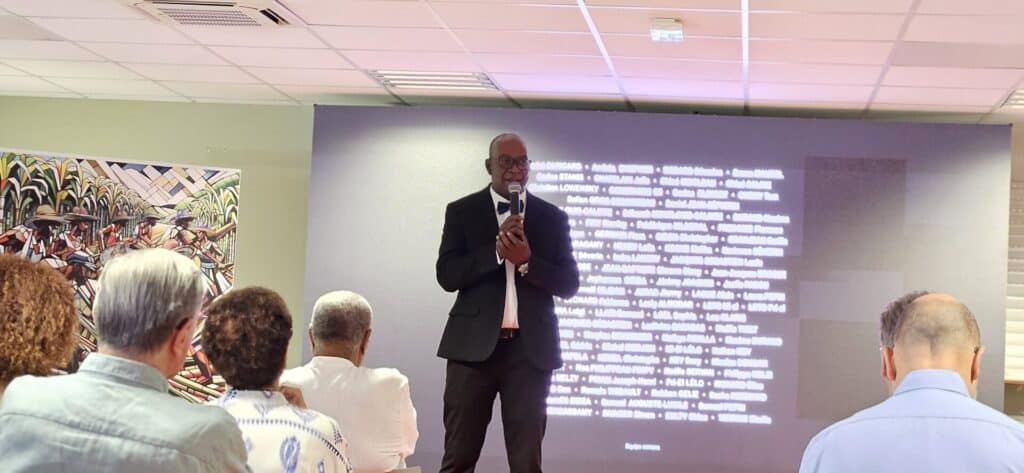
In Martinique, some mornings take on a special dimension. At the Mission Locale du Nord de Martinique ( MILNORD ), a simple welcome over a local breakfast turned into a time for collective reflection, combining cinema, youth and territorial responsibility. The first part of the day served as a reminder of just how powerful a lever culture can be in supporting young people, restoring their self-confidence and opening up prospects in areas where career paths sometimes seem fragile.
When cinema sheds light on the invisible fractures of youth
What is immediately striking about Les Fractures Invisibles is the accuracy with which it looks at situations that many will recognize. The film, of real artistic and narrative quality, shows how, sometimes, a single split-second decision can change the course of an entire life. Through the character of Danny, a young boy caught in the web of bad company and false friendships, the story questions the trust placed in those we believe to be close, and the muted violence of social jealousy.

His sister’s character, played with sensitivity by Axelle Renée, mirrors the harassment and social pressure suffered by young people from families perceived as “successful”, where everything seems to be going well. The film also takes a subtle look at generational conflict, embodied by a rigid father who projects onto his son a future he has not chosen: that of imposed medical studies, totally at odds with the artistic and manual sensibilities of the young man, who is more attracted to painting or mechanics.
Les Fractures Invisibles recounts profoundly human realities, both ordinary and universal, that we encounter on a daily basis in our territories. And while the story is one of hardship, it also reminds us of something essential: the strength of the family bond, capable of withstanding adversity and rebuilding itself. Already a seven-time award-winner, the film also highlights the emergence of new talent, such as young actor Lenny Michanol who had no initial training as an actor, but came to light thanks to a short training course offered by the Mission Locale. Concrete proof that audacity, support and daring to try can open up unsuspected paths.
La Mission Locale du Nord de Martinique: making culture a tool for integration
In addition to the film, the morning highlighted the central role of MILNORD and its teams, as well as the vision conveyed by Jean-Michel Loutoby director and producer of the film Les Fractures Invisibles. Through his commitment, he defends an approach that goes beyond the traditional framework of support, placing culture and artistic expression at the heart of the levers for youth integration and emancipation.


Through film, but also thanks to its own web TV hosted by young people, MILNORD creates concrete spaces for expression, where words flow freely and talents can be exercised in real-life situations. In this way, the image becomes an educational tool in its own right: a medium for dialogue, reflection and awareness-raising, enabling young people to recognize themselves in stories close to their own experience, to put words to their experiences and to imagine other possibilities.
This approach reminds us of an often underestimated fact: supporting young people is not just about guiding them towards a job or training, it’s also about helping them to rebuild their lives, regain confidence and believe in their own abilities.
In this sense, MILNORD is a key player in the area’s human development, capable of linking social integration, cultural expression and economic future, while giving young people the means to become actors in their own narrative.
Believe in yourself, dare to try: the meaning of this morning session
The discussions that followed the screening extended this collective reflection. They reminded us that supporting young people is a decisive step in their careers, particularly when it comes to restoring their self-confidence. Helping young people to believe in themselves, to dare to try, to break out of their self-censorship, is often the first victory.

This morning was a powerful illustration of the fact that talent exists, sometimes where we least expect it, and that sometimes all it takes is a benevolent framework, a different perspective and sincere encouragement to get the ball rolling. It is precisely in this key phase that Mission Locale plays its role to the full: supporting, reassuring, encouraging and enabling young people to explore their possibilities.
Culture, youth and territory: a collective responsibility
This first part of the day at MILNORD has made one thing clear: there can be no sustainable development without human development. By placing culture and the cinema at the heart of its actions, Mission Locale reminds us that the future of a region is also built by listening to, passing on and trusting its young people.
For public, economic and cultural players, the message is clear: investing in young people means investing in the stability, creativity and future of Martinique. And sometimes, a film, a discussion and a shared morning are enough to open up new paths.
In Martinique, cinema enables young people to recognize themselves in stories close to their own experience, to put words to their experiences and to regain confidence. By becoming actors or technicians in audiovisual projects, they develop skills, self-esteem and the ability to project themselves into the future, beyond the conventional pathways to integration.
Mission Locale du Nord de Martinique uses culture as a complementary lever to social and professional support. Through projects such as the film Les Fractures Invisibles or its web TV, it offers young people concrete spaces for expression, encouraging emancipation, empowerment and personal reconstruction.
Because there can be no sustainable development without human development. In Martinique, investing in culture and youth contributes to strengthening social cohesion, revealing local talent and preparing a generation capable of playing an active role in the region’s economic, social and cultural development.