Merengue: the rhythm that tells the story of the Dominican Republic

Merengue

Merengue, the living legacy of Dominican culture, brings together music, dance, memory and identity. Every November 26, the people of the Dominican Republic dedicate a national day to it, reminding us of the importance of this rhythm that accompanies moments of collective joy as much as intimate moments. But behind its solar energy lies a rich, deeply Caribbean history, which continues to evolve and assert itself on the international scene.

A popular symbol turned cultural heritage

Before it became a UNESCO World Heritage Site, Merengue was already the heartbeat of the country. You can hear it at village parties, carnivals, family gatherings or Santo Domingo clubs. A few gliding steps are all it takes to get into the dance: its accessibility explains its popularity and its ability to bring together all generations.

Over time, it has established itself as a marker of identity. In the diaspora, it has become an intimate link with the island: a shared piece of memory that takes us back to the streets, the voices and that unique way of celebrating life.

Merengue
ยฉMinisterio de Cultura de la Repรบblica Dominicana, 2012

Where does Merengue come from? A history of encounters

Its history takes root in the XIXแต‰ century in the Cibao countryside. From the outset, this rhythm has been distinguished by its multiple influences.

  • – African heritages, visible in the percussion, the body anchoring and the importance of rhythm.
  • – European influences, inspired by ballroom dancing, reinterpreted by local musicians.
  • – Indigenous traces, in the way daily life is told and in the use of instruments from ancient island traditions.

Long considered too rural by the elites of the time, Merengue gradually spread thanks to urbanization and new means of communication: radios, cabarets, modern orchestras. In the XXแต‰ century, it became a respected genre, adopted in schools, balls, official events and major national celebrations.

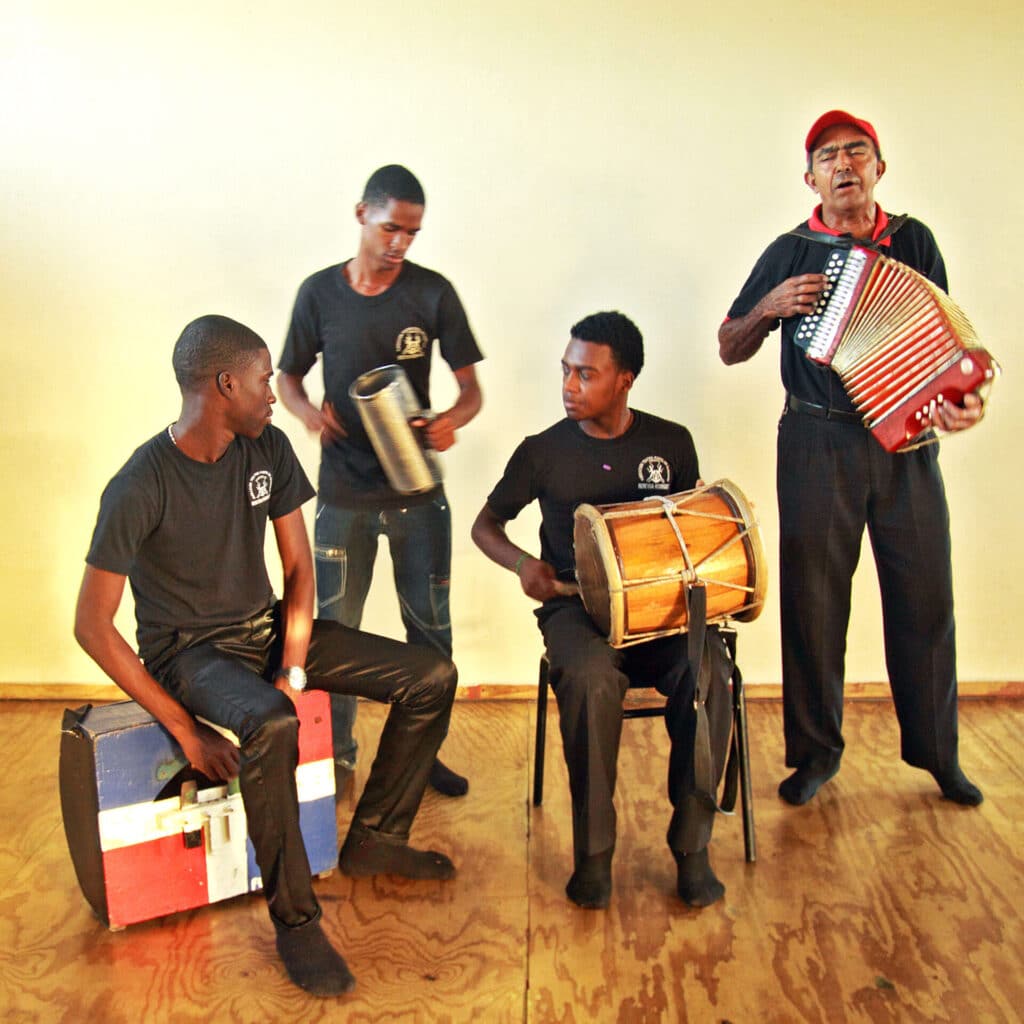
Tambora, gรผira, accordion: the sound soul of Merengue

Merengue can only be fully understood by listening to its flagship instruments, each of which has its own story to tell.

The tambora

This two-skinned drum, inherited from African traditions, sets the pulse of the piece. Its continuous rhythm immediately incites the listener to dance.

La gรผira

A metal cylinder rubbed at regular intervals, the gรผira gives the rhythm its characteristic texture. It is one of Merengue’s most recognizable signatures.

Merengue
ยฉMinisterio de Cultura de la Repรบblica Dominicana, 2012

The accordion

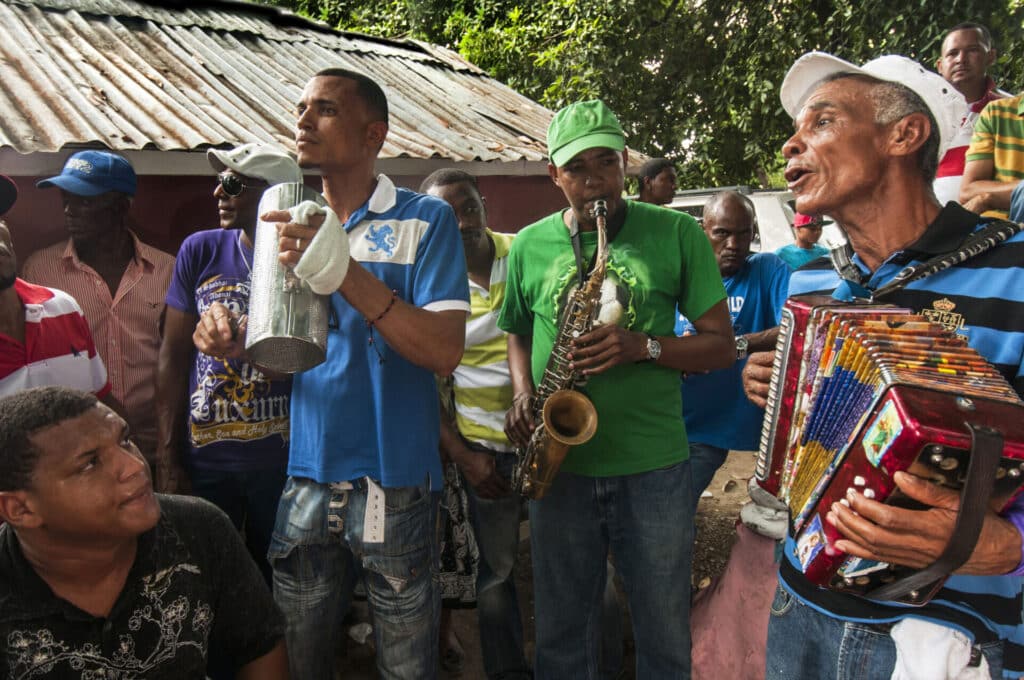
Introduced by European settlers, it carries the main melody. Its rapid, light phrases give the genre its singular vitality. As orchestrations evolved, saxophones, electric bass and keyboards were added to the original trio, modernizing Merengue without altering its essence.

Merengue
ยฉMinisterio de Cultura de la Repรบblica Dominicana, 2012

A living heritage, handed down from generation to generation

It was passed on informally: family celebrations, religious celebrations, community gatherings. This mode of transmission has shaped a living heritage, continually reinvented.

Today, many artists are fusing it with pop, urban or electronic influences, without breaking with the traditional structure. This ability to evolve while preserving its foundations explains not only its cultural importance in the Dominican Republic, but also its impact on the rest of the Caribbean. The fact that Merengue has been declared a UNESCO World Heritage Site has helped to highlight this dynamic: Merengue is not set in stone. It breathes, adapts and exports.

Merengue
ยฉMinisterio de Cultura de la Repรบblica Dominicana, 2012
Merengue
ยฉMinisterio de Cultura de la Repรบblica Dominicana, 2012

National Merengue Day: a tribute that transcends borders

Every November 26, the streets of Santo Domingo and the country’s main cities come alive with free concerts, dance workshops, tributes to the pioneers of the genre and special broadcasts.

Traditional orchestras rub shoulders with new generations of artists, offering a complete panorama of the evolution of Merengue.

The Dominican diaspora also plays an essential role. In New York, Miami, Madrid or Montreal, community events are organized to celebrate this day, reminding us that it is part of the cultural expressions that travel with their peoples.

In this way, National Day is not just a local celebration: it embodies the enduring attachment of a worldwide community to a rhythm that has become a symbol of identity.

Merengue
ยฉMinisterio de Cultura de la Repรบblica Dominicana, 2012
Merengue
ยฉMinisterio de Cultura de la Repรบblica Dominicana, 2012
Merengue
ยฉMinisterio de Cultura de la Repรบblica Dominicana, 2012

A rhythm that tells the story of an entire country

Merengue is more than just festive music. It’s a language that expresses a way of understanding the world, an intimate relationship with joy, sharing and memory. It tells the story of a people, its migrations, its struggles, its celebrations.

Thanks to its roots in everyday life and its ability to bring people together, it remains one of the Dominican Republic’s strongest cultural expressions. Its energy, recognizable from the very first bars, bears witness to a culture that lives, breathes and crosses generations.

FAQ

Merengue has its origins in the XIXแต‰ century in the Cibao countryside, where African, European and native influences mingle.

Because it embodies the country’s cultural identity, accompanies major celebrations and reflects the social history of the Dominican people.

The tambora, gรผira and accordion form the sound basis of Merengue, to which saxophones, bass and keyboards have now been added.

Leave a Reply

Your email address will not be published. Required fields are marked *

More articles from RK

Eric Williams
MUSIC
Tolotra

Shenseea and Daddy Yankee bring the Caribbean to FIFA World Cup 2026

Shenseea and Daddy Yankee at FIFA 2026: the announcement goes beyond a simple musical release. With “Echo”, Jamaica and Puerto Rico enter the sound universe of the next World Cup together. Behind this track, a part of the urban Caribbean finds a new place in one of the planet’s most popular events. One FIFA title, two Caribbean voices On April 28, 2026, FIFA announced the release of “Echo”, the third single from the official FIFA World Cup 2026 album. The track brings together Shenseea, a Jamaican artist associated with contemporary dancehall, and Daddy Yankee, a major Puerto Rican reggaeton figure. FIFA points out that the track is one of a series of musical releases designed to accompany the build-up to the tournament. This announcement goes beyond the framework of a collaboration between two well-known artists. It brings two Caribbean territories, Jamaica and Puerto Rico, face to face, united in a

Read More ยป
Eric Williams
HISTORY & HERITAGE
Tolotra

Trinidad & Tobago – Eric Williams, the historian who led Trinidad and Tobago to independence

In Port of Spain, history was never just a matter of archives. It was also told in public squares, in schools, in family conversations, where a colonial society was looking for the words to think differently about itself. Eric Williams understood the power of storytelling very early on. Before becoming head of government, he made history an instrument of collective lucidity. A historian before the head of government Born in Port of Spain on September 25, 1911, Eric Williams grew up in a Trinidad still part of the British colonial order. His schooling took him to Queen’s Royal College, then to Oxford University, where he obtained his doctorate in 1938. This passage through one of the great institutions of the imperial world gives his work a special significance: he knows the codes of British academia, but uses them to interrogate the history of empire from the perspective of the Caribbean.

Read More ยป
Sa sa pรฉ foutew
HISTORY & HERITAGE
Tolotra

Martinique – “Sa sa pรฉ foutew”: the Creole formula powered by Netflix carried by Bandi

With Bandi, a 2026 Netflix series set in Martinique, eight episodes have taken a Martinican Creole expression far beyond its native territory. “Sa sa pรฉ foutew” means much more than “What’s it to you? It’s a way of setting a limit, sometimes with humor, sometimes with firmness, but always with an element of identity. Three words, one border Three Creole words, one question, and one attitude. When the Bandi series arrived on Netflix in 2026, it brought with it a phrase that many Martiniquais recognize: “sa sa pรฉ foutew”. For some, it’s pride. For others, it’s a silent victory. For all those who know what these words mean in a conversation, it’s a moment that counts. Literally, the phrase can be translated as “what’s it to you?” or “what’s it got to do with you?”. But the translation always gives us away. In reality, “sa sa pรฉ foutew” functions like

Read More ยป

conTACT RK

we'd love to have your feedback on your experience so far

Join The List

Join our Richรจs Karayib community! ย Sign up for our newsletter.

Want To Maximize Your Business Presence On Riches Karayib?

Complete the form to start the application