
The port of Jarry Guadeloupe has taken a major strategic step forward with the arrival of three new-generation XL gantry cranes. Delivered on June 30, 2025 aboard the vessel CY Interocean II, this equipment symbolizes much more than a simple technological leap: it marks the territory’s concrete entry into a logic of performance, logistical sovereignty and energy transition, at a time when global maritime flows are becoming increasingly complex, tense and geopolitically sensitive.
A spectacular and highly strategic manoeuvre
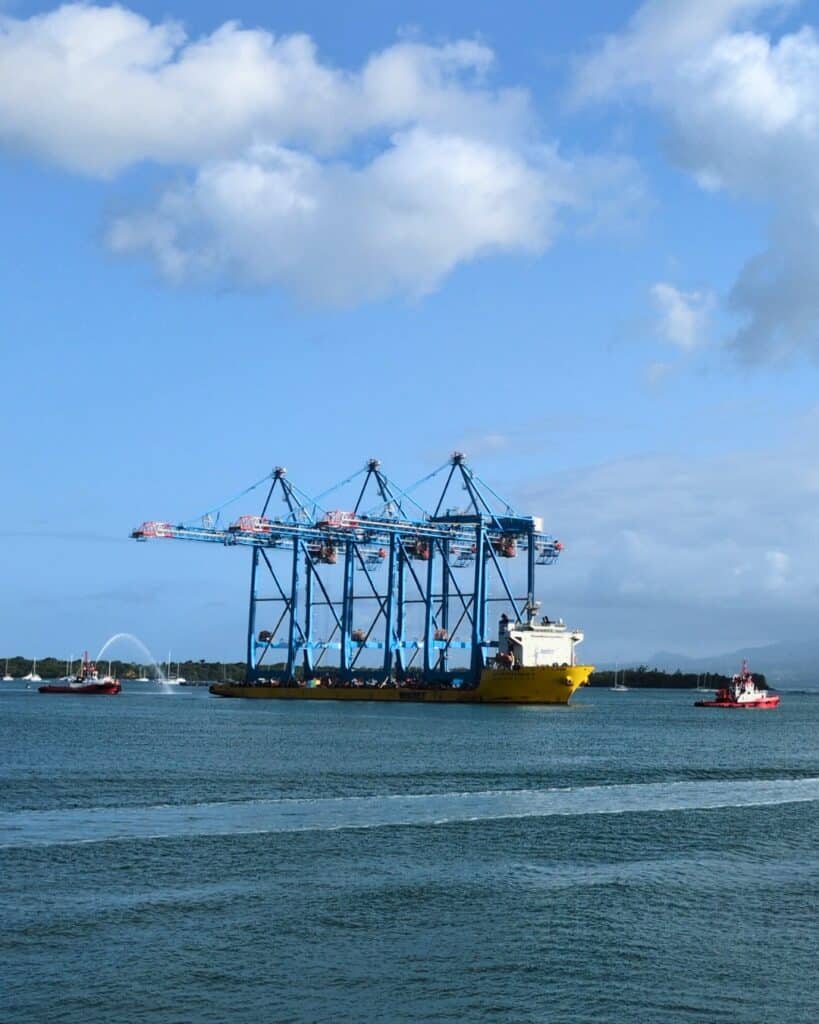
The convoy set sail from Cobh, Ireland, on June 15. Fifteen days later, a massive and impressive silhouette appeared on the horizon of the Grand Port Maritime, attracting the attention of professionals and citizens alike. On the deck of the CY Interocean II, three blue Liebherr gantry cranes, welded to the hull, ready to be unloaded in a high-precision logistical operation.
This maneuver, programmed without interrupting the flow of goods, demonstrates a technical mastery rare in the French West Indies. For port stakeholders, this operation marks a decisive step in the transformation of the port of Jarry Guadeloupe, considered to be the economic lung of the archipelago.
A technical upgrade to meet the challenges of maritime traffic
Manufactured by the German Liebherr group, these gantry cranes have a reach of 30 meters and can lift up to 75 tons in twin-lift mode, i.e. two heavy containers simultaneously. This level of performance meets a necessity: the constant evolution of maritime traffic, with ships that are ever longer, taller, heavier, and often more respectful of environmental standards. For the port of Jarry Guadeloupe, this move upmarket means it can absorb the expected increase in tonnage, while reducing ship handling times.
Handling rates will be optimized, logistics lead times reduced, and operational capacities enhanced. This is a concrete turning point, awaited for several years by freight operators and carriers, but also by companies dependent on the fluidity of supplies.
A measurable impact on the local economy and logistics organization
This acquisition represents an investment of 40 million euros, partly financed by the Guadeloupe Region via ERDF funds to the tune of 7.2 million. It is one of the most structuring logistics projects of the decade. The port of Jarry Guadeloupe, which already generates 2,300 direct jobs and 7.7% of local wealth, is seeing its infrastructure strengthened to support local industries. It’s not just about quays and cranes: it’s about a global reconfiguration of flows, storage, transit times, the cold chain and customs security.
It also means upgrading the skills of our teams, with technical training for materials handlers, outlets for young people in logistics, and opportunities for local subcontractors. Behind the figures, hundreds of career paths can be triggered or consolidated.
Food sovereignty and economic resilience: a vital challenge
The Port of Jarry Guadeloupe handles almost 99% of the goods consumed in the region. This includes foodstuffs, building materials, medicines, fuel and capital goods. In other words, even a temporary interruption in port activity would have a direct impact on the daily lives of Guadeloupeans.
Boosting capacity, facilitating stopovers and improving infrastructure reliability means guaranteeing real logistical sovereignty in the face of climatic hazards, health crises or geopolitical tensions. The current modernization program is in line with this rationale: to protect the region through the robustness of its infrastructures, and to avoid excessive dependence on external logistics platforms.
An ecological transition based on action, not rhetoric
The three gantry cranes delivered at the end of June are also part of a drive to gradually decarbonize shipping. Designed to accommodate new-generation ships with lower CO₂ emissions, they are part of the Port of Jarry Guadeloupe ‘s alignment with the National Port Strategy 2021-2050 and the Multiannual Energy Program. The objective is clear: to move away from coal by 2026, promote the arrival of alternative fuels (biomass, biofuels) for EDF, and integrate shore-side electrical connection solutions.
In addition to gantry cranes, bulk silos, storage areas and energy flows are being reorganized to move towards a sustainable port model. In a global context of transition, Guadeloupe does not intend to remain on the quayside.
Setting course for the Caribbean: regional ambitions and a transshipment hub
The modernization of the port of Jarry Guadeloupe is not just a local emergency. It is also part of a regional repositioning strategy. With these new capacities, the Port of Jarry Guadeloupe aims to once again become a major player in transshipment in the Caribbean, capturing part of the traffic between North and South, between Latin America, the Lesser Antilles and the United States. According to internal projections, container traffic is expected to grow by +9% between now and 2028.
But to achieve these objectives, it’s not enough to have equipment. We also need to offer fast, reliable and competitive ports of call. The three XL gantry cranes, by significantly reducing call times, could be a decisive lever in winning the confidence of the zone’s major shipowners and logistics operators.
A logistics turn around to meet the challenges of tomorrow
This modernization project is neither a simple infrastructure refresh nor a mere announcement. It reflects a political, economic and environmental commitment to making the port of Jarry Guadeloupe fit for the 21st century. It’s a strategic choice with a strong territorial impact: for families, who will see their supplies secured; for young people, who will gain access to new technical trades; for companies, who will be able to rely on a high-performance logistics chain.
It’s also a message to the Caribbean: Guadeloupe is investing, innovating and intends to play its full part in the regional maritime economy, not just as a recipient of containers, but as a logistics player in its own right.