There are objects that transcend their primary function to become epoch markers. The bottle of agricultural rum unveiled by the Longueteau distillery for its 130ᵉ anniversary belongs to this rare category. Priced at 130,000 euros, this unique creation is neither a feat of pricing nor an ostentatious display of luxury. It tells a long story, rooted in Guadeloupe, where rhum agricole becomes a cultural language, a family memory and an affirmation of Caribbean know-how on the international stage.

A distillery at the heart of Guadeloupe's history
Founded in 1895 in Capesterre Belle-Eau by Henri Longueteau, the Longueteau distillery was built on a principle that has remained constant: to produce agricultural rum from cane grown on its own estate. This complete mastery, from the land to distillation, has shaped a singular identity in the Caribbean rum landscape, where agriculture is not a decoration but the foundation of production.
Over the generations, the Longueteau distillery has weathered economic, industrial and regulatory changes without breaking with its business model. Family management has favored continuity, productive investment and the transmission of knowledge, rather than growth disconnected from the region. This managerial stability explains the consistency of Longueteau rums, recognizable by their aromatic precision and their strong agricultural roots.
Even today, the family’s governance is in line with this long-term approach. Recent strategic choices – valuing old stocks, demanding blends, symbolic projects – are part of a heritage approach to rhum agricole, where the past is never static, but constantly reinterpreted.

A bottle as cultural manifesto
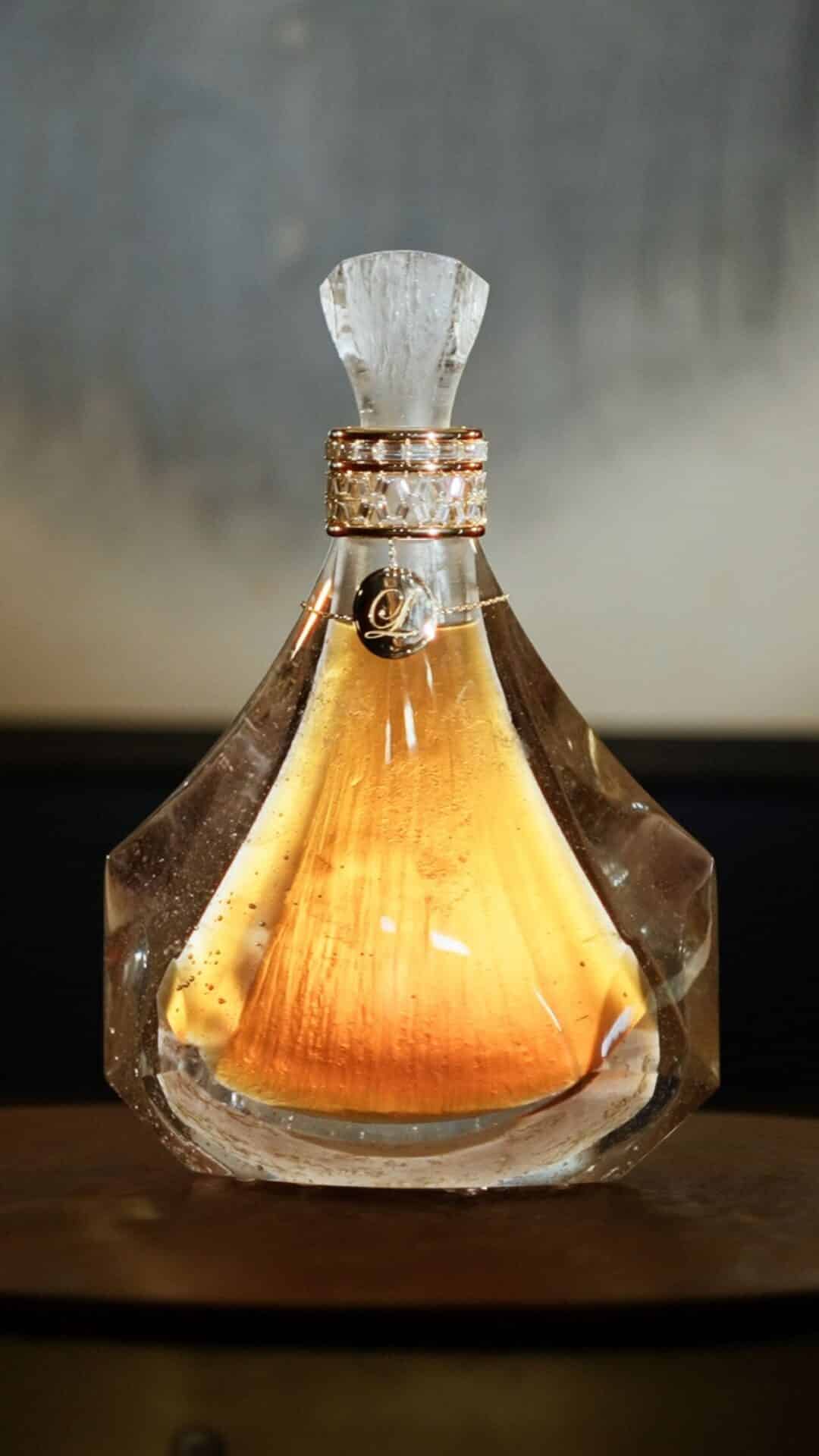
The bottle designed for this anniversary is not a decorative object. It acts as a manifesto.
Inspired by sugar cane, he places the raw material at the center of the work.
Inside, a shape evokes the first passage between the mills, when the fibers release the juice.
This founding gesture, rarely featured in the world of luxury goods, becomes here a symbol of agricultural work and transformation.
Gold and diamonds are not used to disguise the product’s origin.
They reflect a recognition that agricultural rum, long confined to utilitarian or festive uses, is now recognized as a vehicle for culture, memory and value.

Rum meets jewelry
To give substance to this vision, the Longueteau distillery has teamed up with the Odace jewelry house. The dialogue is not limited to the packaging. The neck of the bottle is set with a hand-crafted ring of 113 grams of gold and 34 carats of laboratory-grown diamonds, integrated with precision and balance.
Working the glass represented a major technical challenge. The inner core, distinct from the bottle, required several attempts and lengthy firing cycles. Thermal constraints, capacity standards, a standardized neck: every detail was thought through to ensure that the object remained functional while assuming its status as a work of art.
The choice of Paris as the venue for the sale places this creation in a symbolic space where haute joaillerie, collectors and luxury institutions meet.
130,000 euros: what this price really means
This price not only sanctions material scarcity. It recognizes the value of accumulated time. The rum in the bottle was distilled in 1940 by Henri Longueteau. Perfectly preserved, it testifies to the rigorous heritage management of stocks, already mobilized in previous commemorative blends.
In the world of wine, cognac or watchmaking, this type of recognition has existed for a long time. Agricultural rum has only recently achieved this status. This creation marks a clear repositioning: Longueteau rum is also becoming a collector’s item, conveying a sense of history and transmission.
What this means for the Caribbean
Beyond the bottle, the message is structuring. It asserts that Caribbean territories can produce ultra-luxury objects without denying their identity. It reminds us that excellence is not born of imitation, but of loyalty to a mastered heritage.
For the region’s young craftsmen, producers and designers, this initiative opens up a concrete prospect: that of a luxury that is rooted, demanding and internationally recognizable. Through this project, the Longueteau distillery is demonstrating that agricultural rum can interact with contemporary codes of prestige without losing its original meaning.


This award reflects the uniqueness of the bottle, the complexity of its hand-crafted manufacture, the use of precious materials and, above all, the rarity of the agricultural rum it contains, distilled in 1940 and preserved in the historic reserves of the Longueteau distillery.
The Longueteau distillery can look back on 130 years of family tradition and agricultural expertise. This anniversary project is part of the continuity of the company’s heritage, highlighting the know-how passed down from generation to generation, without breaking ties with the Guadeloupe region.
It repositioned rhum agricole as a cultural and collectible product, capable of interacting with the international codes of luxury without denying its Caribbean identity or its agricultural roots.