With this third episode, *Stories of Caribbean Cinema* moves into the 1980s. The first two installments covered Cuba, Jamaica, Trinidad and Tobago, and Guadeloupe, from the 1960s through the emergence of Caribbean cinema. This time, two films made in the same year take radically different directions. In Jamaica, *Children of Babylon* explores romantic, sexual, and racial relationships with unusual freedom. In Guadeloupe, *Live Free or Die* draws on several centuries of history centered on the legacy of Commander Ignace.
This article is the third installment in a series of ten. Two installments have already been published, and seven more will follow in this chronology of Caribbean cinema.
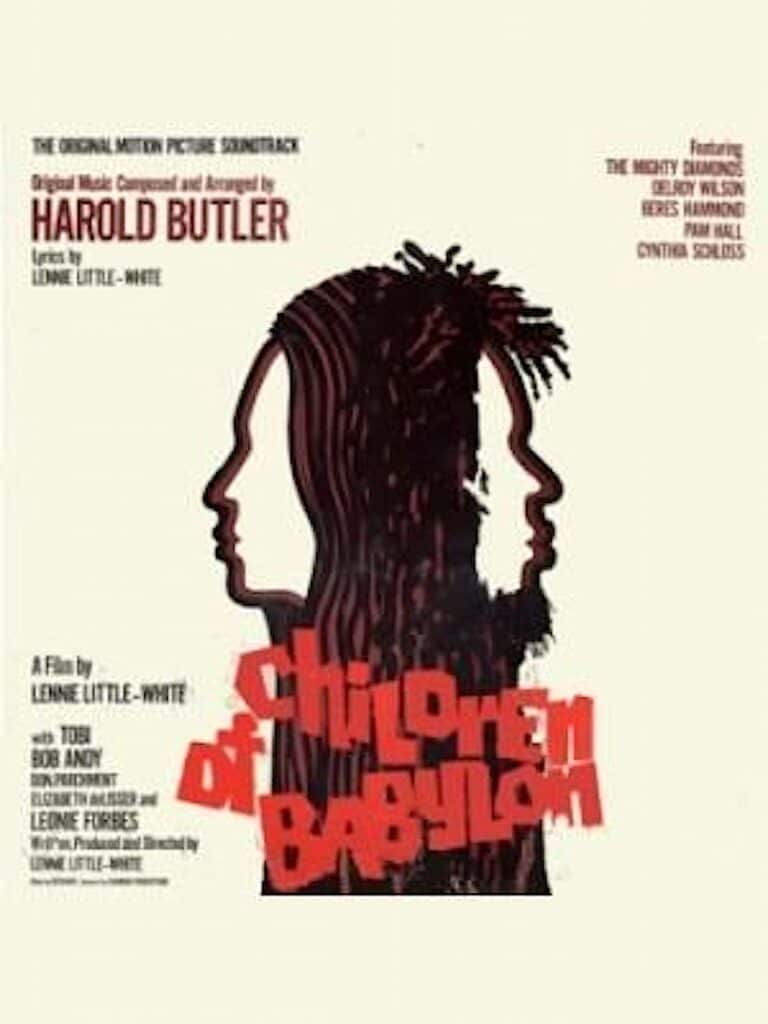
1980: JAMAICA – "CHILDREN OF BABYLON", BY LENNIE LITTLE-WHITE
This film is unique in Jamaican cinema and, more broadly, in Caribbean cinema as a whole. Far from the social deprivation of Kingston’s ghettos, in a villa in the countryside (complete with a swimming pool, champagne, and a gourmet buffet), we follow the adventures of Rick and Penny—a Black man and a white woman—as they discuss art (he’s a painter) and sexuality (she’s conducting research on the subject among rural women—whom we never see on screen).
The film is structured as a “closed-door” drama: a single setting and time counted down on a calendar. The two protagonists experience a passionate romance marked by multiple sexual encounters, parallel to those of a strangely silent maid and Luke, a Rastafarian henchman, who maintain the villa. This film embodies the free-spirited tone of the rise of erotic cinema as well as the emergence of pornographic movie theaters in the 1970s.
Nevertheless, it stands out in Caribbean cinema, where depictions of the sexual act remain rare, with foreplay (kissing, in particular) or the moment afterward often taking center stage, just as nudity is almost always partial—at least in the early decades of these cinematic traditions. Here, however, the nudity is full-frontal, particularly as part of a comedic gag, in a beach scene where, while swimming naked, the couple finds themselves temporarily without clothes after they are stolen by mischievous children.
Two “romantic” threesomes will complicate the plot, all under the curious gaze of the servants: Rick with Penny and another white woman—a situation that will tear the couple apart—and then Penny with Luke, the Rastafarian employed by Rick.
As we’ve seen, in addition to the issue of sexuality, there is a surprising freedom of expression regarding interracial couples (“domino couples,” as they’re called in Guadeloupe and Martinique), in a sexuality liberated from the drama of the colonial past. This is a breakthrough that other Caribbean film industries have yet to achieve—particularly those of Guadeloupe and Martinique—where a certain modesty still prevails.
1980: GUADELOUPE – LIVE FREE OR DIE, BY CHRISTIAN LARA
Live Free or Die is one of four films Christian Lara shot in just two years. This timeless courtroom drama features characters from various historical periods taking the stand, such as Christopher Columbus, Victor Schoelcher, Pèdre (one of the first slave rebels in Guadeloupe), and the Napoleonic general Richepanse, to determine whether or not Commander Ignace’s legacy should be restored.
This debate refers to the “Guadeloupe War” of 1802—namely, three weeks of fighting between Napoleonic troops sent to reestablish slavery following the first abolition of 1794 enacted by the First Republic, and those who resisted the reinstatement of slavery—namely, in addition to Ignace, the famous Colonel Delgrès, the mulatto woman Solitude (who was at one time considered for induction into the Panthéon), and Marthe-Rose.
Her impassioned testimony clearly highlights the important role women played in this resistance. The narrative structure adopted reveals an important characteristic of Caribbean cinema: the past is irrevocably part of the present, and the present is (almost) always intertwined with the past, in a circular or “spiral” conception of time that differs from the Western linear conception (the famous timeline).
The director, grandson of Guadeloupe’s first Black historian, Oruno Lara (with *Guadeloupe in History* in 1921), will revisit this historic event in *Sucre amer* (1998), an unofficial remake of *Vivre libre ou mourir* (once again featuring the excellent actor Robert Liensol, who had previously appeared in *Coco la Fleur, Candidate*), and the historical reenactment 1802, the Guadeloupean Epic (2002), which highlights the character of the mulatto woman Solitude in a surprising battle sequence by the river pitting Guadeloupean women against Napoleonic soldiers. Christian Lara has made this period in history the major defining moment (to date) of Guadeloupean cinema.

About the Author
Guillaume Robillard holds a Ph.D. in film studies; he is a professor and researcher, a documentary filmmaker, and a specialist in Caribbean cinema and artistic production. He is the author of two books: *Conquest of Space and Time: Caribbean Cinema (Éditions Jannink, “Hypothèses d’Art,” 2023) and Decolonial Cinema: Characters in Caribbean Cinema (Presses Universitaires des Antilles, “Arts et Esthétique,” 2024).