Omara Portuondo, born in Havana in 1930, turned 96 on October 29, 2026. Her album Eternamente Omara has been nominated for the 2026 Latin Grammys, which will be held on November 12 in Las Vegas. It all began in 1945, when a teenage girl stepped in to replace a dancer at the Tropicana.

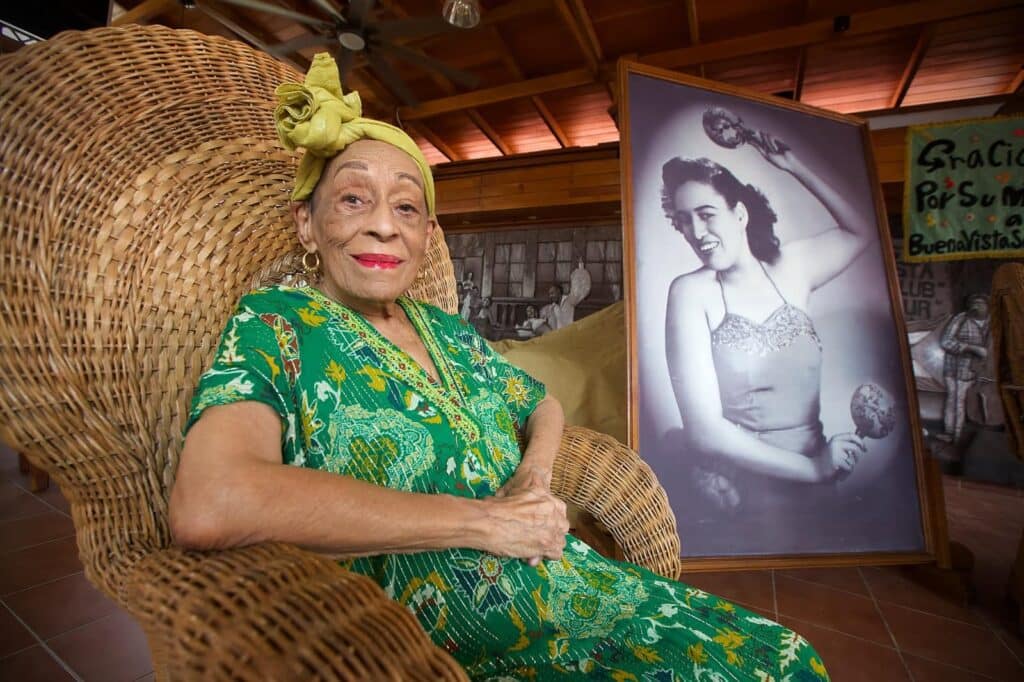
Omara Portuondo, wearing a green headscarf, sits in a wicker armchair in front of a large portrait of her as a young woman
Surrounded by photographs of her career. © Omara Portuondo

In 1945, Omara Portuondo replaced a dancer at the Tropicana

One evening in 1945, a dancer was missing from the Tropicana cabaret in Havana. Omara Portuondo was fifteen years old. Her sister was already dancing at the cabaret. She was shy and embarrassed to show her legs. Her mother insisted, assuring her that one day, thanks to her art, she would represent her country all over the world. The teenager stepped onto the stage. The stand-in for the evening had just made her debut, and she would soon be singing.

Cayo Hueso, a Baseball-Playing Father and a Spanish Mother

Omara Portuondo Peláez was born on October 29, 1930, in Cayo Hueso, a neighborhood in Havana. Her father, Bartolo Portuondo, was an Afro-Cuban baseball player. Her mother came from a wealthy Spanish family. Their relationship was frowned upon, and when they met on the street, they had to pretend not to know each other. At home, however, everything was different. Her parents sang duets. They couldn’t afford a record player, so the little girl learned the melodies by listening to them.

Filin, the Cuarteto d’Aida and the Split in Miami

In the 1940s, Omara Portuondo switched from dancing to singing. She joined Loquibambia, a filin group (the word comes from the English “feeling”), alongside the blind pianist Frank Emilio Flynn. This current of Cuban song is nourished by jazz. She was nicknamed “la novia del filin,” the fiancée of filin. In 1952, the Cuarteto d’Aida was formed around pianist Aida Diestro. Omara sang in the group alongside her sister, Elena Burke, and Moraima Secada. Chico O’Farrill wrote the arrangements. The quartet toured the United States and Europe beginning in 1957. At the Tropicana, the young woman sang on stage with Nat King Cole.

Four singers in long ruffled tulle gowns pose on stage in a black-and-white archive photograph
The Cuarteto d’Aida, archive photograph. © Omara Portuondo

In the early 1960s, the quartet was performing in Miami when the crisis between Cuba and the United States broke out. Her sister remained in Florida. Omara returned to Cuba. In 1967, she launched her solo career and went on tour with the Aragón Orchestra throughout Western and Eastern Europe. Dancer Carlos Acosta describes her as a legend in Cuba.

Buena Vista Social Club, a duet with Compay Segundo in 1996

In 1996, at Egrem Studios in Havana, Omara Portuondo recorded her own album in the same building as the musicians brought together by Ry Cooder. She was asked to sing “Veinte años” with Compay Segundo. At first, she was surprised by the idea of a love duet with him. The Buena Vista Social Club soon took her to major venues. In Wim Wenders’ film, Ibrahim Ferrer wipes a tear from his face during “Silencio.” Carnegie Hall in New York welcomed her in 1997. In 2000, Buena Vista Social Club Presents Omara Portuondo was released.

The accolades and honors continue. In 2019, the Latin Recording Academy presented Omara Portuondo with its Award for Musical Excellence. In 2020, she recorded Mariposas during the pandemic. In 2022, on her 92nd birthday, she performed at Carnegie Hall with Natalia Lafourcade. In 2023, her album Vida won the Latin Grammy for Best Traditional Tropical Album.

Omara Portuondo, in a red cap, holds the Latin Grammy trophy for Best Traditional Tropical Album 2023 for the album Vida
The 2023 Latin Grammy for the album Vida. © Omara Portuondo

Eternamente Omara, an Album Nominated for the 2026 Latin Grammys

Today, Omara Portuondo sings on Eternamente Omara, produced by pianist Roberto Fonseca and recorded at Ojalá Studios in Havana. She says the idea came about during a tour with Fonseca’s band. Guest artists began joining the project in 2024. Silvio Rodríguez sings “Demasiado,” Nathy Peluso sings “Quizás, quizás, quizás,” Pablo López sings “Noche de ronda,” and Angélique Kidjo sings “Guantanamera.” The album is nominated in the same category, alongside Gilberto Santa Rosa, Los Tri-O, Leoni Torres, and Dayhan Díaz.

Omara Portuondo, in a green headband, sits in a wooden armchair holding the vinyl of the album Eternamente Omara
The vinyl of the album Eternamente Omara. © Omara Portuondo

On November 12 in Las Vegas, one question remains unanswered

The ceremony, broadcast live on Univision, will take place on Thursday, November 12, 2026, at the MGM Grand Garden Arena in Las Vegas. On Facebook, Omara Portuondo wrote that if the album won, she would feel deeply satisfied. She also confides: “In these complicated times, we don’t know where we will be.” She affirms that she has never abandoned her people—the ones who recognize her. She also thanks the original musicians of the Buena Vista Social Club. More than eighty years after her first night at the Tropicana, the singer from Cayo Hueso still has her sights set on the stage. One question remains: Whose voice will carry on this filin repertoire after her?

Omara Portuondo, seated in a white armchair, sings into a microphone on stage in a golden gown and matching headscarf
In concert, seated on stage. © Omara Portuondo

Frequently Asked Questions About Omara Portuondo

Omara Portuondo is 96 years old. She was born on October 29, 1930, in Cayo Hueso, a neighborhood in Havana, Cuba.

Her album Eternamente Omara has been nominated in the Best Traditional Tropical Album category. The album was produced by Roberto Fonseca.

The ceremony will take place on Thursday, November 12, 2026, at the MGM Grand Garden Arena in Las Vegas, United States.

Filin, derived from the English word “feeling,” is a genre of Cuban music influenced by jazz. Omara Portuondo is known as “la novia del filin.”

In Antigua and Barbuda, the CHOGM 2026 (Commonwealth Heads of Government Meeting) is bringing restorative justice back to the forefront of the debate. Philip J. Pierre, Prime Minister of Saint Lucia and current chair of CARICOM, is calling for a dialogue that goes beyond expressions of regret regarding slavery.

From November 1 to 4, 2026, Commonwealth leaders will gather in St. John’s, Antigua and Barbuda. On the agenda for this 28th meeting are trade, investment, and climate resilience. But behind the diplomatic exchanges, one question looms large in the discussions: How can we acknowledge the consequences of the transatlantic slave trade without limiting ourselves to mere words?

The Commonwealth has 56 member states, including several Caribbean nations directly affected by the history of British colonization. For Philip J. Pierre, who is leading the Saint Lucian delegation, the issue extends beyond the borders of his island. He also carries the expectations of the member states of the Caribbean Community ( CARICOM), which have for years been calling for a collective response to the injustices inherited from slavery.

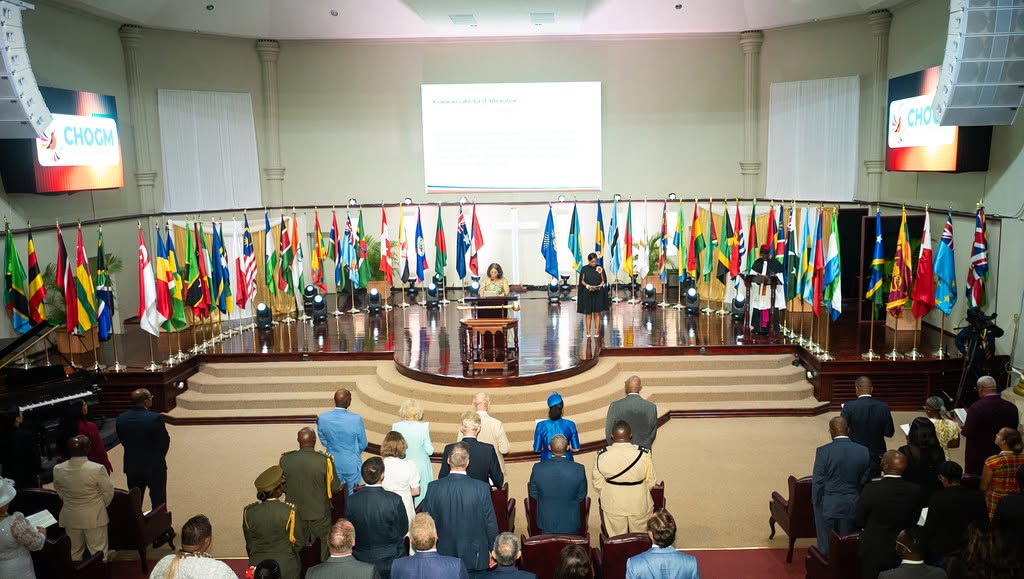
CHOGM 2026 hall decorated with the flags of Commonwealth member states, with participants standing
CHOGM 2026 hall in Antigua and Barbuda, with the flags of Commonwealth member states © Antigua and Barbuda CHOGM 2026

CHOGM 2026: Philip J. Pierre Speaks on Behalf of CARICOM

On October 31, on the eve of the summit’s opening, Philip J. Pierre issued a statement on behalf of CARICOM. He welcomed the British government’s willingness to engage in a structured dialogue with the countries concerned and to consider issuing a formal apology.

This openness is important, but in his view, it is not enough. CARICOM refuses to allow reparations to be ruled out from the outset of the discussions. It believes that historical responsibilities also extend to states and institutions, beyond the generations directly involved. Pierre’s message echoes a long-standing demand by Caribbean governments. Acknowledging the past must pave the way for a discussion of its consequences, which are still visible in the region’s societies.

Why CARICOM Won't Settle for Apologies

Restorative justice is not limited to compensation. CARICOM is guided by a ten-point plan that links historical recognition to concrete needs. It includes, among other things, official apologies, initiatives in health and education, the restitution of cultural heritage, and rehabilitation measures. It also addresses debt and financial compensation.

The Commonwealth Secretary-General holds up a publication on small states in front of the flags of member countries
The Commonwealth Secretary-General presents the publication on small states at CHOGM 2026 © Antigua and Barbuda CHOGM 2026

Cultural heritage holds a special place here. The artifacts, archives, and traces of societies shaped by slavery are not merely witnesses to the past. Restoring or highlighting them can help convey a history that has long been told from an external perspective. CARICOM calls for the injustices suffered by Indigenous peoples to be taken into account. For CARICOM, full reparations require examining the various legacies of colonization without conflating them.

A British overture—but what concrete progress has been made?

At the 2026 CHOGM, the British position has shifted on one point. London accepts the principle of a structured, time-bound dialogue conducted in good faith with the parties concerned. This openness is reflected in the communiqué issued during the summit. However, it does not amount to an official apology—which has already been offered—nor to an agreement on compensation. The British government has shown itself to be open to discussing a form of apology, while maintaining its opposition to financial reparations.

Family photo of Commonwealth leaders on stage in front of the CHOGM Antigua and Barbuda 2026 screen, November 1 to 4
Family photo of the leaders gathered at CHOGM 2026 in St. John’s © Antigua and Barbuda CHOGM 2026

On November 3, Charles III also addressed the transatlantic slave trade during the opening ceremony. The king expressed his deep sadness over this past, but did not offer a formal apology. Between the royal speech, the British government’s position, and Caribbean expectations, the disagreement therefore remains very real. The announced dialogue is a step forward, not a resolution.

A matter of memory that concerns the entire Caribbean

The debate is not limited to relations between Saint Lucia and the United Kingdom. It concerns the way Caribbean societies teach their history, preserve their memories, and view their relationships with former colonial powers. For the region, the restitution of heritage, the passing down of family stories, and the acknowledgment of the social consequences of slavery all raise the same question: Who can tell this story, and with what means?

Group of guests laughing and greeting each other on the pitch of a stadium in Antigua and Barbuda during CHOGM 2026
Warm exchanges on the pitch of the stadium in St. John’s during CHOGM 2026 © Antigua and Barbuda CHOGM 2026

CHOGM 2026 opens a dialogue, though it does not guarantee reparations. It remains to be seen whether the announced discussions will make it possible to transform this recognition into concrete commitments, defined in consultation with the affected peoples.

Four stilt walkers in colorful costumes on the pitch of a stadium in Antigua and Barbuda during CHOGM 2026
Stilt walkers on the pitch of the stadium in St. John’s during CHOGM 2026 © Antigua and Barbuda CHOGM 2026

Frequently asked questions

CHOGM stands for Commonwealth Heads of Government Meeting. The 2026 meeting will take place from November 1 to 4 in St. John’s, Antigua and Barbuda. It brings together Commonwealth leaders to discuss major economic, climate, and political issues.

CARICOM believes that the consequences of slavery and colonization continue to affect Caribbean societies. Its ten-point plan calls for, among other things, an official apology, educational and health measures, the restitution of cultural heritage, and financial compensation.
The United Kingdom has agreed in principle to a structured dialogue with the parties affected by transatlantic slavery. However, it has not announced any agreement on financial reparations. The British government remains opposed to this form of compensation.