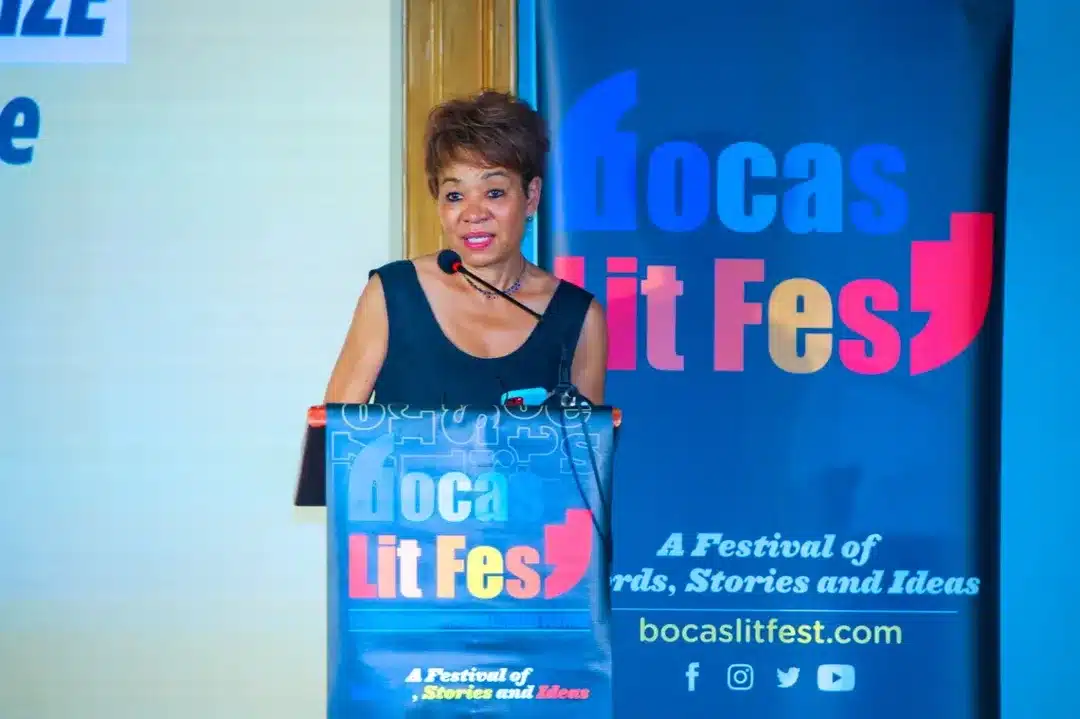
At the 2026 edition of the Bocas Lit Fest, in the Old Fire Station in Port of Spain, Trinidad and Tobago, Margaret Busby, president of the jury, calls out the name of Tessa McWatt. The audience applauds. It was an historic moment: for the first time in the 16-year history of the OCM Bocas Prize for Caribbean Literature, a Guyana-born author won the grand prize.
An award-winning book beyond the award
The award-winning book is: “The Snag: A Mother, a Forest, and Wild Grief”. A memory. Random House Canada and Scribe, UK, publish it. The judges described it as “a work of rare brilliance”. The prize comes with an endowment of US$10,000, funded by One Caribbean Media Limited. But money isn’t everything. What matters is what this recognition means for Guyana, a mainland Caribbean country whose literature remains too little read outside its borders.
Tessa McWatt was born in Georgetown, Guyana. Tessa McWatt left the country at a young age for Canada, then settled in the UK, where she teaches creative writing at the University of East Anglia. Tessa McWatt has published eleven books: novels, children’s texts, essays and non-fiction. Tessa McWatt is also a librettist, opera librettist and Fellow of the Royal Society of Literature.
The Snag, a memoir of grief and the living
The OCM Bocas Prize-winning memoir is not an easy book to summarize. The Snag which could be translated as “the snag” or “the obstacle” interweaves three threads. The story of the illness and death of the author’s mother. A meditation on the forest and what natural ecosystems can teach us about grief. And a reflection on the great contemporary destabilization: climate, loss of biodiversity, loneliness, aging, human lives sometimes reduced to statistics.
A Caribbean prize in three categories
The OCM Bocas Prize has existed since 2011. It is awarded each year to a book published in the previous year by a Caribbean author who is a citizen or was born in the Caribbean. The prize is divided into three categories: poetry, fiction and literary non-fiction. Each category has its own winner, who receives 3,000 US dollars. Then a grand prize winner is chosen from among the three, with an endowment of 10,000 US dollars.
For the 2026 edition, the other two category winners were Justin Haynes, for the novel Ibis, and Canisia Lubrin, for The World After Rain: Anne’s Poem. Tessa McWatt first won the non-fiction category before being named overall winner. This achievement reinforces the importance of The Snag in a selection where poetry, fiction and non-fiction each carried a strong voice from the contemporary Caribbean.
Guyana, continental territory of the literary Caribbean
One singularity of the 2026 selection is worth mentioning. All three category winners write from the diaspora: McWatt from the UK, Haynes from the USA, Lubrin from Canada. The OCM Bocas Prize is a reminder that Caribbean literature does not stop at the physical borders of territories. It circulates with families, languages, wounds, memories and books.
For Guyana, the moment is doubly historic. The same ceremony also honored another Guyanese-Canadian: Frank Birbalsingh, scholar and literary critic, winner of the Prix Henry Swanzy 2026 for his distinguished service to Caribbean letters. For a country with a population of less than one million, it’s a powerful public statement.
Guyana’s uniqueness is worth clarifying. English-speaking Guyana, located on the South American continent and bordering Venezuela, Brazil and Suriname, belongs geographically to South America but culturally to the English-speaking Caribbean. This dual belonging produces a literature that constantly questions categories. Wilson Harris, David Dabydeen, Pauline Melville, Fred D’Aguiar, Oonya Kempadoo: the list of great Guyanese voices of the diaspora is dense, and the consecration of Tessa McWatt is part of this lineage.
A consecration that opens the story
The 2026 Bocas Lit Fest theme was “All Together Now”. In this context, Tessa McWatt’s victory takes on a special resonance. It is a reminder that the literary Caribbean is also shaped by its dispersed voices, migrant trajectories and family memories. Above all, it is a reminder that Guyana, often placed on the margins of island narratives, has long been an essential part of Caribbean history.
Reading “The Snag”, one encounters a major tension in Caribbean literature: bringing the world into the intimate narrative, and making the Caribbean narrative heard in the world. Tessa McWatt achieves this without turning pain into a slogan. Her victory in the OCM Bocas Prize does not close a story. It opens up a question: how many other Guyanese voices are still waiting to be read at the height of their power?
📸@Tessa McWatt
Tessa McWatt is an author born in Georgetown, Guyana, whose career spans the Caribbean, Canada and the UK. She is known for a body of work that blends family memory, identity, migration and her relationship with the living world. Her victory in the OCM Bocas 2026 Prize reinforces Guyana’s place in English-speaking Caribbean literature, and highlights an important voice from the Guyanese diaspora.
Tessa McWatt’s victory is historic, as it makes her the first author born in Guyana to win the grand prize of the OCM Bocas Prize for Caribbean Literature. This recognition goes beyond mere literary achievement: it is a reminder that Guyana, although located on the South American continent, occupies a major place in the English-speaking Caribbean cultural space.
The Snag: A Mother, a Forest, and Wild Grief is a memoir that links intimate grief with a broader reflection on nature, the forest and contemporary fragilities. In it, Tessa McWatt evokes the illness and death of her mother, while questioning how ecosystems, family loss and the crises of today’s world can all come together in the same human experience.