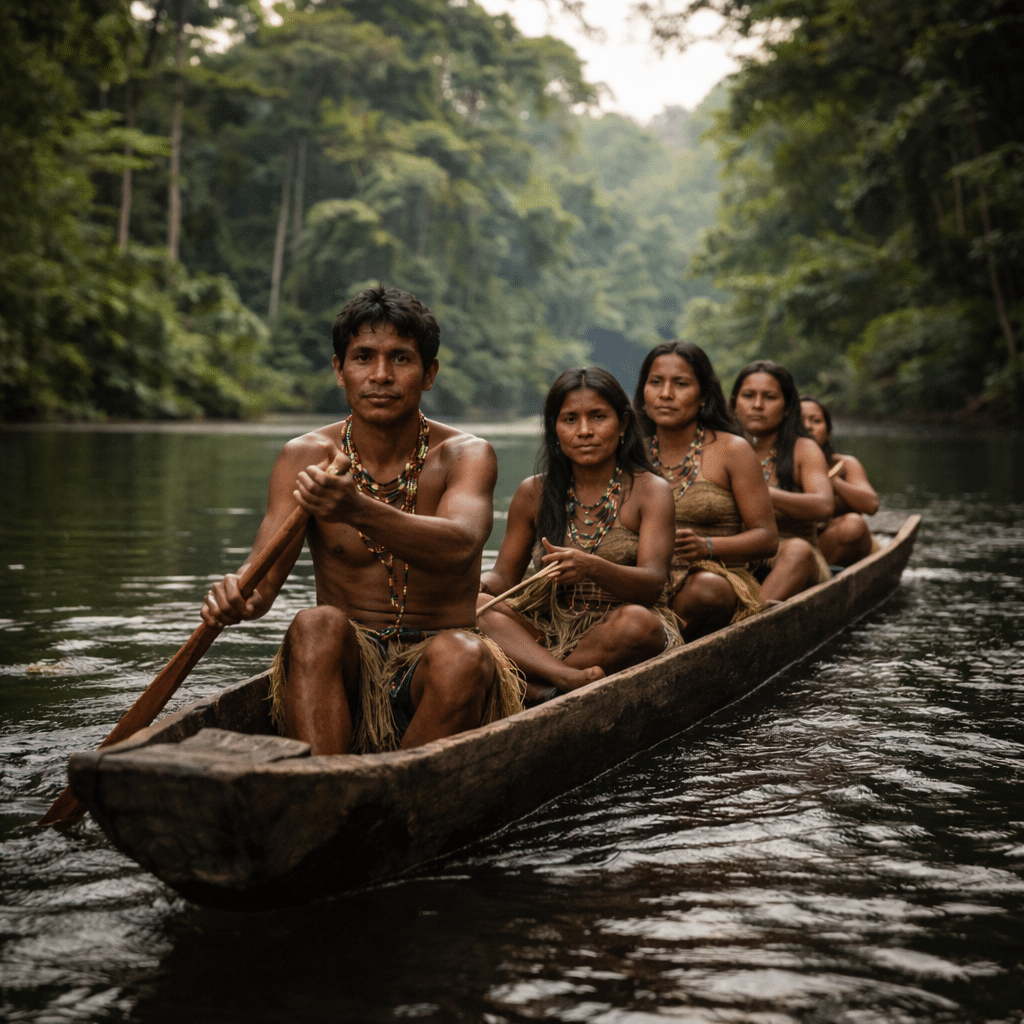
In the history of the Caribbean and the Guyana Plateau, indigenous peoples play a founding role that is often under-documented. Among them, the Teko of French Guiana embody one of the oldest cultural continuities still visible today. Their presence in eastern French Guiana, close to the Oyapock River and the Brazilian border, is a reminder that the region’s history did not begin with European colonization or plantation societies. It is part of a long history, predating modern states, in which Amerindian peoples have shaped territorial, linguistic and cultural balances.
Approaching the Teko is not about evoking a fixed heritage, but about understanding how a people of Amazonian tradition continues its trajectory into the XXIᵉ century, between cultural continuity and adaptation to contemporary realities.

Origins and ancient trajectories
The Teko belong to the large Tupi-Guarani family, one of the most extensive linguistic and cultural groups in South America. For centuries, the Tupi-Guarani peoples have occupied a vast territory stretching from the southern Amazon to the coastal and river areas in the north of the continent. Their history is marked by constant displacement, exchange and recomposition, long before the arrival of the European colonial powers.
The Teko presence in present-day French Guiana is part of this ancient dynamic of mobility and adaptation. The first written descriptions date back to the accounts of European travelers and missionaries in the XVIIᵉ and XVIIIᵉ centuries. These sources, often fragmentary and biased by the colonial gaze, evoke Amerindian groups settled along rivers and practicing a structured forest economy.
Long referred to as “Émerillons” (emeralds), a term now rejected by the community because it derives from colonial nomenclature, the Teko are reclaiming their self-name. This change of name reflects a desire to reclaim their identity and language. It is part of a broader movement to recognize indigenous peoples in French Guiana.


Territorial layout and organization of space
Teko villages are concentrated mainly in the south and east of French Guiana, notably in the commune of Camopi and along the Oyapock River. These areas, accessible mainly by river or air, have helped to preserve a certain cultural and linguistic balance.
The spatial organization of the villages is based on a community logic. The dwellings, often built around family carbets, are set in a dense forest environment. This layout ensures direct proximity to natural resources: rivers, hunting grounds, agricultural areas and gathering sites.
The territory is not limited to a productive function. It is a space of memory, where stories, itineraries and knowledge linked to the history of the group are transmitted. Places bear names, associated with events, ancestors or mythological episodes. This oral cartography reinforces the link between collective identity and lived space.
Cassava, forest and ecological knowledge
The Teko economy is based on subsistence farming adapted to Amazonian conditions. Cassava plays a central role. Cultivated on open plots using the slash-and-burn technique, it is transformed into couac, patties or fermented beverages. Cassava cultivation follows a precise schedule, combining periods of clearing, planting, harvesting and processing.
Fishing, hunting and gathering are organized around this agricultural base. The rivers provide fish and shellfish, while the forest offers game, fruit and medicinal plants. The Teko have a detailed knowledge of ecological cycles, seasons and animal behavior. This environmental knowledge, passed on orally, enables them to manage their resources wisely.
In a global context marked by the degradation of ecosystems, these practices are attracting growing interest. They bear witness to a relationship with nature based on balance and continuity rather than intensive exploitation. For the Teko, the forest is more than just a backdrop: it structures social life, dietary practices and symbolic representations.


Language and transmission: a central issue
The Teko language, belonging to the Tupi-Guarani group, remains a pillar of collective identity. It is used in daily life, family exchanges and traditional stories. However, the spread of French-language schools and increasing exposure to French-language media are changing linguistic practices.
Transmission of the language relies mainly on the family and community. Local initiatives, sometimes supported by educational institutions, aim to strengthen bilingual teaching and document Teko lexicon and grammar. The aim is not just to preserve a language, but to maintain a system of knowledge and representations.
Each native language carries a specific vision of the world: classification of plants, animals and natural phenomena, organization of social relations. The disappearance of a language means the loss of this knowledge. The linguistic vitality of the Teko people is therefore a major heritage issue for French Guiana and the Amazonian Caribbean as a whole.

Contemporary transformations
Today, the Teko live at the crossroads of several dynamics. Access to education, healthcare and administrative services is still conditioned by the geographical isolation of certain villages. Travel to urban centers, such as Saint-Georges-de-l’Oyapock or Cayenne, is limited by distance and means of transport.
The younger generations navigate between different cultural universes. They attend republican schools, use digital technologies and participate in social networks, while remaining rooted in community life. This plurality of experience does not necessarily mean a cultural rupture. It can also foster forms of adaptation and identity recomposition.
The territorial issue remains central. Illegal gold panning, present in certain areas of French Guiana, poses a threat to natural resources and water quality. Teko communities, like other indigenous peoples, are committed to environmental protection and the recognition of their territorial rights. These issues go beyond the local dimension: they concern the preservation of Amazon biodiversity and the recognition of indigenous knowledge.


The Teko in wider Caribbean history
Integrating the Teko into a reflection on the Caribbean implies broadening the definition of this space. Although French Guiana is on the mainland, it shares with the Caribbean archipelago historical trajectories linked to colonization, human circulation and cultural exchange. The Amerindian peoples constitute the oldest layer of this history.
Before the arrival of Europeans, exchange networks between indigenous populations were already linking Amazonia, the Guianas and certain island areas. Circulation of goods, techniques and stories structured this space. The Teko are part of this ancient geography, where today’s borders did not exist.
Acknowledging their place in regional history enables us to move beyond a strictly colonial vision of the Caribbean. It invites us to consider indigenous societies as actors in their own right, bearers of knowledge and practices that have contributed to the formation of today’s cultural landscapes.

A living memory to recognize
The Teko are not a relic of the past, but an active component of Guyanese and Caribbean cultural diversity. Their presence is a reminder of the long history of human occupation in the region and the wealth of knowledge developed in interaction with the Amazonian environment.
At a time when Caribbean societies are seeking to better understand their roots and heritage, knowledge of indigenous peoples is essential. It enables us to situate contemporary trajectories within a long history, marked by encounters, resistance and adaptation.
Writing about the Teko means recognizing this historical and cultural depth. It is also a reminder that the Caribbean is more than just an island archipelago: it includes continental territories where ancient traditions are still alive and evolving. In the heart of French Guiana, the Teko continue their history with discretion, but their contribution to regional memory remains fundamental.
They are an Amerindian people from French Guiana, belonging to the Tupi-Guarani cultural and linguistic family. Mainly settled along the Oyapock River, they perpetuate a culture based on oral transmission, the Teko language and a close relationship with the Amazon rainforest.
They live mainly in the east and south of French Guiana, notably in the commune of Camopi and in several villages along the Oyapock River. Some groups are also present on the other side of the border, in Brazil.
They represent one of the oldest human presences in the region. Their history reminds us that the Caribbean and the Guyana Plateau were already inhabited long before European colonization. Their language, knowledge and relationship with the land help us to understand the Amerindian roots of Caribbean identity.