
BlueSeas Festival: in CuraƧao, Pietermaai becomes the epicenter of Caribbean blues in 2026

BlueSeas Festival

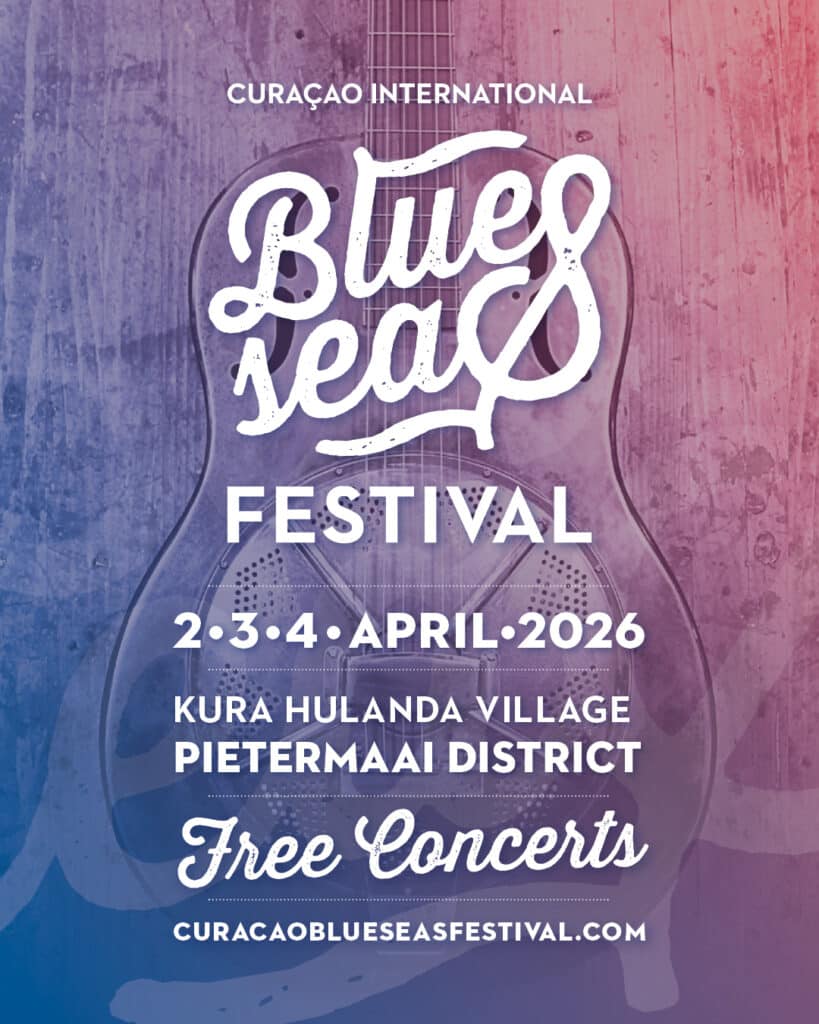
From April 2 to 4, 2026, CuraƧao hosts another edition of the BlueSeas Festival a musical event that is gradually establishing itself as one of the most unique cultural events in the Caribbean. Free, open and rooted in the urban space, the festival goes far beyond simple musical programming to become a genuine territorial experience.

Right from the opening night, Thursday April 2 at Kura Hulanda Village, the mood is set: the blues settle into a heritage setting, before taking full possession of the Pietermaai district on April 3 and 4. This two-stage format structures an immersive experience in which music, architecture and local life are seamlessly interwoven.

A free festival that transforms the city into an open-air stage

The BlueSeas Festival is based on the principle of offering free concerts in public spaces. This choice is not insignificant. It widens access to live music, while creating direct interaction between international artists, local residents and visitors. At Pietermaai, the stages are not isolated. They are integrated into the streets and squares, and supported by a network of bars and restaurants that play an active part in the event. This configuration gives the BlueSeas Festival an organic, almost living dimension, where each performance fits into the rhythm of the neighborhood.

The result is clear: the festival isn’t something to be consumed, it’s something to be experienced. You circulate, you discover, you stop, you come back. The experience becomes as important as the program itself.

BlueSeas Festival

Pietermaai, symbol of a successful transformation

The choice of Pietermaai is no accident. This historic district of Willemstad has undergone a profound transformation since the 2000s, from a neglected area to a dynamic space combining restored heritage and intense cultural life. Today, Pietermaai is often compared to a creative district, with charming hotels, cafƩs, galleries and restaurants within walking distance. By locating the BlueSeas Festival in this setting, the organizers are promoting a vision of cultural tourism based on the urban experience.

In this way, the festival acts as an eye-opener. It puts the spotlight on a neighborhood, while enhancing its attractiveness. This synergy between cultural event and urban revitalization is one of the most interesting points to analyze.

BlueSeas Festival
©corendon
BlueSeas Festival
©mycuracaoguide
©mycuracaoguide
©Pietermaai-District-Curacao

International programming between heritage and renewal

The 2026 edition of the BlueSeas Festival confirms its international positioning with a selection of artists spanning several generations of the blues. Among them, Cedric Burnside embodies a direct link with the history of the genre. Grandson of the legendary R. L. Burnside, he is part of a deep-rooted musical tradition, while offering a contemporary approach to the blues. Alongside him, Samantha Fish brings a different kind of energy, marked by rock influences and a proven stage presence. Her career, punctuated by collaborations with major figures in international music, bears witness to the festival’s ability to attract high-profile artists.

The BlueSeas Festival also showcases a new generation with artists such as Toby Lee, a young British guitarist whose rapid rise on the blues scene illustrates the renewal of the genre. Other names in the line-up include Jackie Venson, Quinn Sullivan Band, Kirk Fletcher and J and the Causeways, confirming the diversity and artistic richness of this year’s event.

BlueSeas Festival
BlueSeas Festival
BlueSeas Festival
BlueSeas Festival
BlueSeas Festival
BlueSeas Festival
BlueSeas Festival
BlueSeas Festival

A cultural project driven by a strategic vision

Behind the BlueSeas Festival is the Fundashon Bon Intenshon Foundation, which plays a central role in CuraƧao’s cultural development. Far from limiting itself to the organization of events, this structure makes the festival part of a global strategy of international outreach. The aim is twofold: to attract visitors while promoting local talent and spaces. The festival thus becomes a tool at the service of the region, contributing to its image and economic dynamism.

This approach is reinforced by our collaboration with Mojo Concerts, a recognized player in the organization of musical events, guaranteeing a high level of production.

An experience that goes beyond the simple musical event

What really sets the BlueSeas Festival apart is its ability to create a complete experience. Music is only one point of entry. Around it, multiple dimensions unfold: discovery of heritage, immersion in a lively neighborhood, interaction with the local scene. The free format reinforces this accessibility, while encouraging a diversity of audiences. Residents and visitors share the same spaces, the same concerts, the same moments. This mix contributes to the festival’s identity.

In 2026, the BlueSeas Festival confirms its role in the Caribbean cultural landscape. It’s not just an event for the diary, but a model urban festival that questions how culture can transform a territory.

The BlueSeas Festival 2026 takes place from April 2 to 4, with an opening in Kura Hulanda on April 2 and the main concerts in Pietermaai on April 3 and 4.

Yes, the BlueSeas Festival is a free street festival open to all in Pietermaai’s public spaces.

The festival takes place in CuraƧao, mainly in the historic Pietermaai district, with an opening night at Kura Hulanda Village.

Leave a Reply

Your email address will not be published. Required fields are marked *

More articles from RK

Doh study it
HISTORY & HERITAGE
Tolotra

“Doh study it”: When Trinidad Learns to Let Go

A comment keeps running through your mind. A coworker spoke too hastily, a loved one criticized your decision, or a minor annoyance suddenly feels like a big deal. In Trinidad, the response might be as simple as: “Doh, study it”. Depending on the situation, it means ā€œdon’t worry,ā€ ā€œdon’t pay any attention to it,ā€ or ā€œdon’t let it get to you.ā€ “Doh study it” is part of Trinidad English Creole, an English-based creole language used in informal communication in Trinidad. The Atlas of Pidgin and Creole Language Structures notes that it plays an important role in everyday communication and national identity, while coexisting with official English. Trinidadian Creole also differs from the Creole spoken in Tobago, even though the two islands form a single country. What does ā€œDoh study itā€ really mean? In standard English, the verb to study First and foremost, it refers to the act of studying, examining,

Read More Ā»
Bonaire
TOURISM
Tolotra

Bonaire: Three markets account for 85.5% of visitors

Bonaire welcomed 13,387 overnight visitors in June 2026, according to preliminary data from the Tourism Corporation Bonaire. Visitor numbers declined slightly by 1.6% year-over-year. The most revealing information, however, lies in the travelers’ countries of origin: the Netherlands, the United States, and CuraƧao together accounted for 85.5% of arrivals. Bonaire’s visitor numbers remain close to 2025 levels In June 2026, the island welcomed 13,387 visitors, compared with 13,606 a year earlier. The difference amounts to 219 fewer arrivals. This variation remains limited, especially when viewed over a longer period: by June 2025, attendance had increased by 12,2 % compared to June 2024. The 2026 figure therefore reflects more of a stabilization following the sharp increase recorded the previous year. The 1.6% decline provides a useful point of comparison, while trends in the major markets offer a more accurate picture of visitor numbers. Three markets bring 11,445 visitors to Bonaire The

Read More Ā»
Brimstone Hill Fortress
TOURISM
Tolotra

Brimstone Hill Fortress: Two Centuries of History at the Summit of Saint Kitts

To the northwest of Saint Kitts, the walls of Brimstone Hill Fortress overlook the coast from a volcanic hill nearly 240 meters high. Behind the panoramic view lies a more complex history: that of a fortress designed by the British, built and maintained by enslaved Africans, and designated aUNESCO World Heritage Site in 1999. Brimstone Hill Fortress, a citadel perched atop a volcano As you climb Brimstone Hill, the sea comes into view between the steep slopes and the dark stone ramparts. From this natural vantage point, soldiers could observe the western coast of Saint Kitts and keep watch for the possible arrival of enemy ships. The location was far from insignificant. This volcanic hill, nearly 800 feet high, had steep, hard-to-access slopes. It thus offered a prime vantage point and a defensive refuge in the event of a naval attack. Nevertheless, the builders had to adapt their techniques to

Read More Ā»

conTACT RK

we'd love to have your feedback on your experience so far

Join The List

Join our RichĆØs Karayib community! Ā Sign up for our newsletter.

Want To Maximize Your Business Presence On Riches Karayib?

Complete the form to start the application