
Voltaire Falls: 70 km of trail to reach the waterfalls.

Chutes Voltaire

In Saint-Laurent-du-Maroni, the journey to the Voltaire Falls begins well before the first waterfall. From the town, the Paul Isnard Trail leads into the forest for about 70 kilometers. After being closed to the public for several years, the site has just reopened following a restoration program led by the Territorial Collectivity of French Guiana. The goal is threefold: to make the trail safer, to better accommodate visitors, and to showcase this natural site all without losing what gives this place its unique character.

70 kilometers before the trailhead

The figure illustrates the scale. The “Cascades et crique Voltaire” ZNIEFF, listed in the National Natural Heritage Inventory, begins at the end of the Paul Isnard trail, 70 kilometers south of Saint-Laurent-du-Maroni. The French Guiana Regional Nature Park also notes that you must take this road from the town before it turns into a dirt track.

Once you arrive, the journey continues on foot. The Chutes Voltaire trail is listed as 5.3 kilometers long and takes about three hours to walk. While this distance doesn’t make the place inaccessible, it does remind us of something obvious: here, the journey begins long before you reach the water. The trail, the forest, and the path are all part of the experience.

A Reopening Focused on Safety

The closure had brought the issue of access to the forefront. The renovation therefore had to address several areas. A comprehensive signage system has been installed starting from the town of Saint-Laurent-du-Maroni, particularly along the Paul Isnard Trail. A new visitor area now includes a parking lot, a parking space for people with disabilities, an access gate, and an information sign.

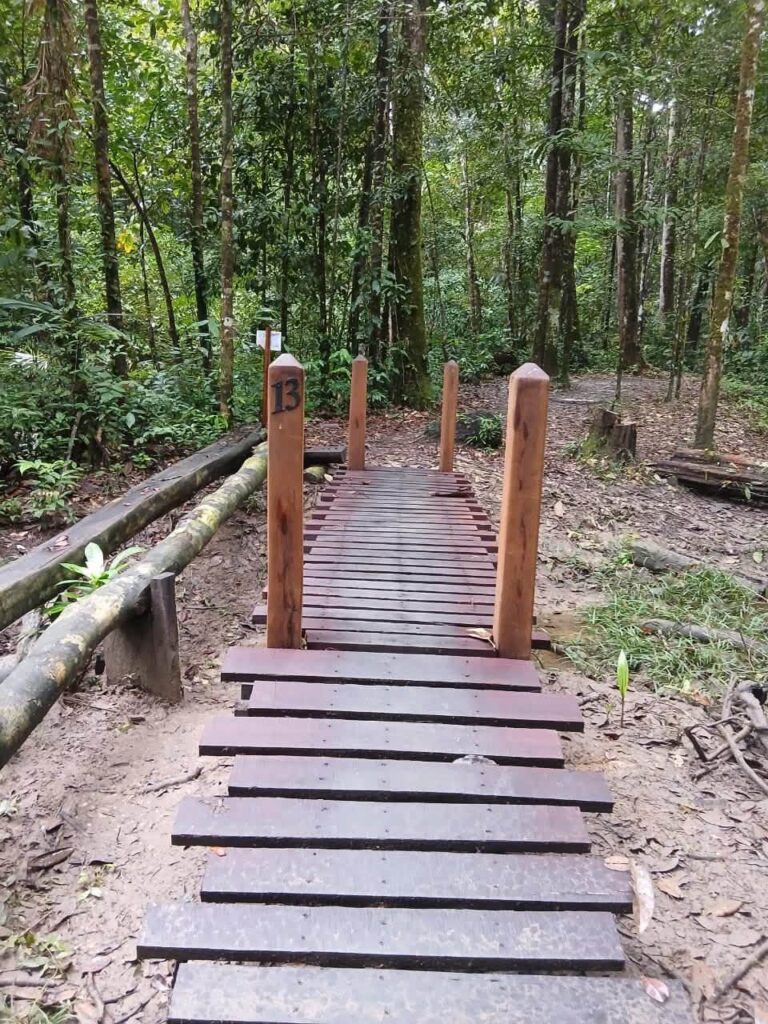
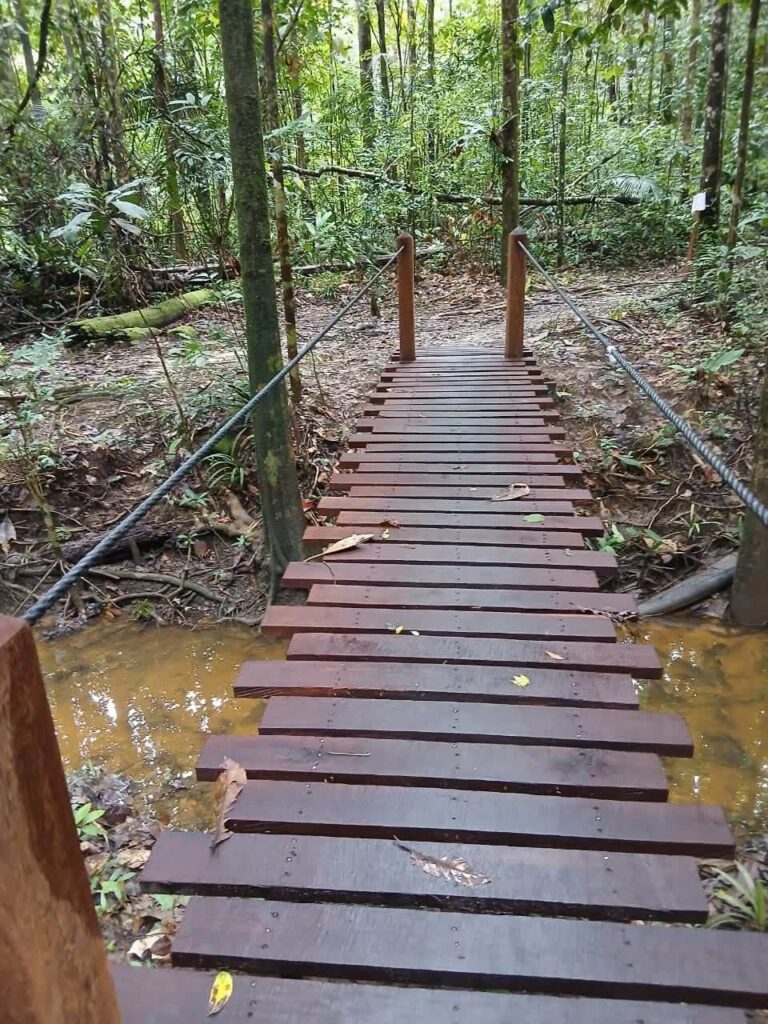
The most noticeable change is the reconstruction of the main footbridge. Approximately 21 meters long, it spans the Voltaire Creek. It was designed to better withstand flooding. The trail has also been restored, with several structures built to allow hikers to cross wetlands. According to information provided at the reopening, all of these improvements have received the necessary regulatory and technical approvals.

Voltaire Falls
Voltaire Falls
Voltaire Falls
Voltaire Falls

Voltaire Falls: A Landscape Unlike Any Other in French Guiana

The Voltaire Falls are not only notable for their remote location. It is a particularly rugged area, where the creek cuts through hard rock before reaching the waterfall zone. Over a distance of approximately 200 meters, the Voltaire Falls have a vertical drop of 35 meters, described in this official documentation as unparalleled in French Guiana. The site combines waterfalls, cascades, rocky thresholds, rapids, and forested areas. The area is recognized for its scenic, geomorphological, ecological, floristic, and faunistic features.

A multidisciplinary survey conducted in 2011 examined, among other things, the flora, fish, reptiles, amphibians, and non-flying mammals. This rich biodiversity serves as a reminder that opening the area to the public must also take into account a sensitive natural environment. The Voltaire Creek is part of the Maroni watershed and originates in a small mountain range east of the Sparouine Mountains. It flows for approximately 30 kilometers. In its upper reaches, the valley narrows and becomes winding: this is where the waterfalls are located. The terrain thus explains the spectacular appearance of the Voltaire Falls today.

Voltaire Falls
Voltaire Falls
Voltaire Falls
Voltaire Falls

At the foot of the waterfalls, a new kind of hospitality

The restoration doesn’t stop at the trail. At the base of the Voltaire Falls, visitors now have access to a large shelter, a fire pit, hammock shelters, and picnic tables with benches. These facilities are designed to provide a more comfortable rest stop after the hike. The reopening may also boost the appeal of western French Guiana as a tourist destination. The inn located at the site’s entrance is one of the local businesses likely to benefit from the return of visitors. This connection between natural heritage and the local economy adds another dimension to the work that has been done.

But the challenge won’t just be attracting more visitors. It will also be necessary to maintain a balance between visitor numbers, safety, and respect for the environment. At the Voltaire Falls, distance remains a key factor: 70 kilometers of road before the trail begins, followed by the forest and the creek leading to the waterfalls. The renovation makes the route safer and more comfortable. It doesn’t change the fact that it’s remote. And that may be precisely what makes the Voltaire Falls a unique destination in western French Guiana.

The Voltaire Falls are located in western French Guiana, south of Saint-Laurent-du-Maroni. They can be reached via the Paul Isnard trail, traveling about 70 kilometers before reaching the trailhead.

From Saint-Laurent-du-Maroni, take the road and then the Paul Isnard trail for about 70 kilometers. Once there, the journey continues on foot along a trail that is expected to take about three hours to complete.

The renovation of the Voltaire Falls is primarily aimed at making the trail safer and improving the visitor experience. The work includes new signage, visitor facilities, trail restoration, and a main footbridge approximately 21 meters long that spans the Voltaire Creek.

Leave a Reply

Your email address will not be published. Required fields are marked *

More articles from RK

Bonaire salt marshes: pink ponds and white salt mountains in the south of the island
HISTORY & HERITAGE
Tolotra

Bonaire: 3,700 hectares of salt marshes conceal a history of slavery

At the southern tip of Bonaire, a Dutch-speaking island in the Caribbean, the salt marshes stretch out in pink and white basins across nearly 3,700 hectares—thirteen percent of the island’s total area. This postcard view, photographed every year by thousands of visitors from the coastal road, hides a history dating back more than five centuries, the story of salt that shaped Bonaire’s economy and, for two hundred years, the lives of hundreds of enslaved people. Along EEG Boulevard, which runs along the southern coast of Bonaire, mountains of white salt come into view kilometers before you reach them. Each contains about 10,000 metric tons of salt that is 99.6% pure, piled nearly 15 meters high, with up to 200,000 metric tons stored at any given time. Their whiteness, so intense that you need to keep sunglasses handy, stands in stark contrast to the pink of the neighboring pools. The salt

Read More »
Journées européennes du patrimoine 2026
EVENT MANAGEMENT
Tolotra

European Heritage Days 2026: Martinique Opens Its Archives.

On September 15, at 5 p.m., the conference room of Martinique’s Cultural Affairs Department is already packed. Journalists, cultural leaders, organizations, artists, and heritage professionals have gathered to find out what the 43rd edition has in store. With just four days to go before the 2026 European Heritage Days , scheduled for September 19 and 20, this press conference already feels like a journey across Martinique—from its Creole huts to its lighthouses, from Saint-Pierre to the monuments we sometimes pass by without really noticing them. European Heritage Days 2026: A Lively Conference Johan-Hilel Hamel, Martinique’s director of cultural affairs, opened the meeting without putting on airs. He even warned that the evening would not be a long monologue. The conversation quickly began to flow. A representative from Les Trois-Îlets speaks, followed by Xavier Nicolas from the Directorate of the Sea, Philippe Villard from the Heritage Foundation, Florence Le Gal from

Read More »
caribbean cinema
FILM & VIDEO
Tolotra

S3/10 – Stories of Caribbean Cinema: Two Perspectives on the Year 1980. Texts by Guillaume Robillard. Ciclic, 2026.

With this third episode, *Stories of Caribbean Cinema* moves into the 1980s. The first two installments covered Cuba, Jamaica, Trinidad and Tobago, and Guadeloupe, from the 1960s through the emergence of Caribbean cinema. This time, two films made in the same year take radically different directions. In Jamaica, *Children of Babylon* explores romantic, sexual, and racial relationships with unusual freedom. In Guadeloupe, *Live Free or Die* draws on several centuries of history centered on the legacy of Commander Ignace. This article is the third installment in a series of ten. Two installments have already been published, and seven more will follow in this chronology of Caribbean cinema. 1980: JAMAICA – “CHILDREN OF BABYLON”, BY LENNIE LITTLE-WHITE This film is unique in Jamaican cinema and, more broadly, in Caribbean cinema as a whole. Far from the social deprivation of Kingston’s ghettos, in a villa in the countryside (complete with a swimming

Read More »

conTACT RK

we'd love to have your feedback on your experience so far

Join The List

Join our Richès Karayib community!  Sign up for our newsletter.

Want To Maximize Your Business Presence On Riches Karayib?

Complete the form to start the application