The MAGHIC 2 project, launched in March in Pointe-à-Pitre with the support of the INTERREG Caribbean program, marks a decisive step in the development of a low-carbon maritime sector adapted to the realities of the Caribbean.
At a time when climate issues are calling for far-reaching changes, the Caribbean is asserting its determination to become a pilot region for sustainable maritime transport. It is against this backdrop that FARWIND Energy, a start-up committed to decarbonizing maritime transport, is coordinating the MAGHIC 2 project, with the aim of structuring a genuine industrial and scientific sector around vele propulsion and hydrogen in the region.
Financed with €2.2 million in ERDF funds via INTERREG Caribbean, MAGHIC 2 embodies an alliance between technological innovation, academic research and regional ambition.
Innovative marine propulsion tested under real-life conditions
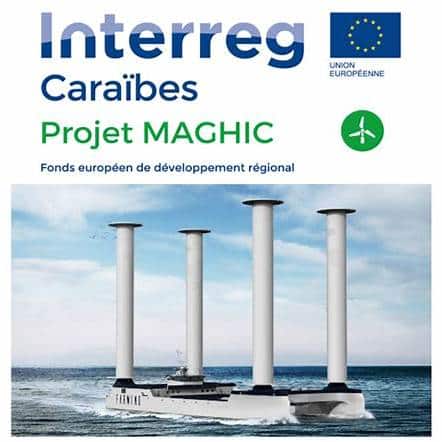
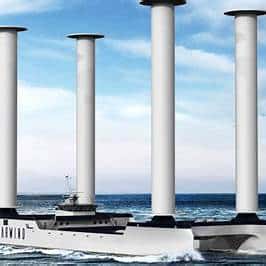
At the heart of the MAGHIC 2 project, the rotor sail developed by FARWIND Energy promises a significant reduction in CO₂ emissions, up to 40% less fuel for ships. This technology, proven in severe maritime environments, opens up concrete prospects for more responsible shipping, in line with European climate objectives and those of the IMO.
But MAGHIC 2 goes further: the project also explores innovative hydrogen storage solutions, both on land and at sea, capable of holding between 10 and 100 tonnes, with reduced land impact. A response to the logistical and energy challenges specific to island geography.
A Caribbean research and industry network to support the transition
One of the project’s strengths lies in its ability to create a regional dynamic around skills and knowledge. FARWIND Energy brings together a network of leading academic institutions:
Caribbean Maritime University (Jamaica)
University of Trinidad and Tobago
Centro Nacional de Investigaciones Cientificas (Cuba)
Universidad Autonoma de Campeche (Mexico)
These establishments will focus their work on the service life of materials and the adaptation of solutions to the specific climatic and maritime conditions of the Caribbean.
On the industrial side, SARA (Société Anonyme de la Raffinerie des Antilles) is joining the project to promote technology transfer and strengthen local skills. The ambition is clear: to structure a sustainable regional ecosystem around low-carbon marine propulsion and the hydrogen industry.
A strategic vision for Caribbean energy sovereignty
By consolidating a base of regional skills and leveraging appropriate technologies, MAGHIC 2 sets the Caribbean on the path to an ambitious and coherent maritime energy transition. The project is helping to build energy sovereignty to enhance the competitiveness and resilience of Caribbean territories.
“This project illustrates an integrated approach combining innovation, industrialization and scientific cooperation, and represents a major step forward for more sustainable shipping,” says Arnaud Poitou, President of FARWIND Energy.
Launched in Guadeloupe, MAGHIC 2 is helping a smarter, bolder Caribbean emerge, capable of inventing its own answers to global energy challenges while making the most of its natural resources, know-how and strategic position.