Martinique – Alain Joséphine: revealing depth through color

Alain Joséphine

Alain Joséphine, an artist from Martinique now based in Guadeloupe, is one of those painters who show us much more than a landscape: a sensation, a memory, an inner vibration. Through his powerful works, he summons childhood, tropical nature, the fertile void and the music of gesture – building a body of work that is both profoundly Caribbean and universal.

A childhood marked by a place: Régale

It all began in Rivière-Pilote, in the Régale district, an area of the Martinique countryside that shaped the artist’s imagination. “I lived this place. It had a huge impact on me,” he confides. It’s the traces of this intimate place that we find in his paintings, where nature explodes in fragments of color, between sky and earth, between memories and matter.

Alain Joséphine, artiste martiniquais aujourd’hui installé en Guadeloupe, est de ces peintres qui donnent à voir bien plus qu’un paysage : une ...
Alain Joséphine

Color as space

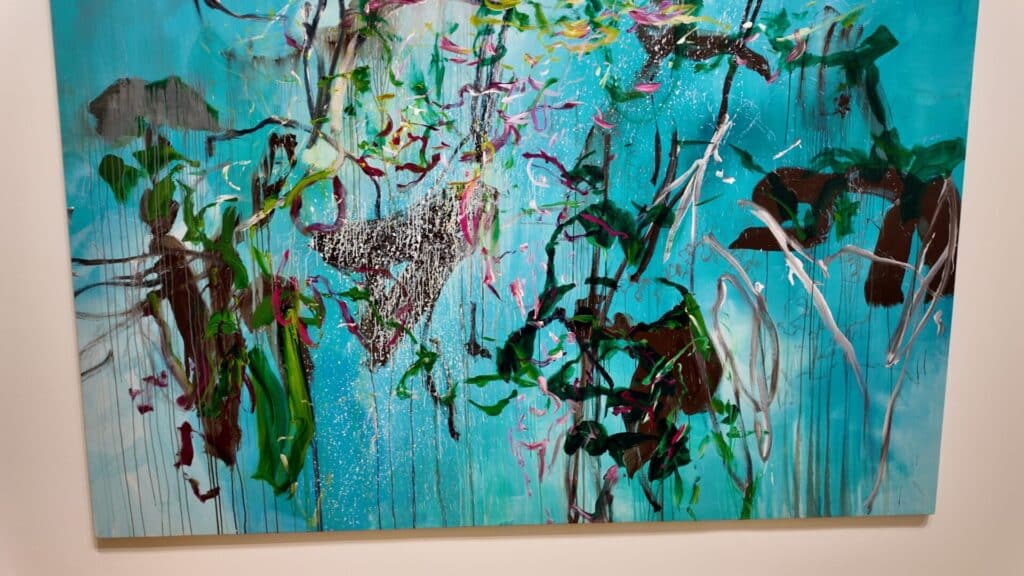
Thanks to the teaching of Zao Wou-Ki, a major Franco-Chinese painter of the 20th century and his first master, he understood that it was possible to create space without drawing, using color alone.

From this apprenticeship, he retained a revelation: “You could create space just with the power of color, without necessarily drawing anything.” From then on, color became for him a territory in its own right, a tool for working with depth, without contours, without limits.

Alain Joséphine
Alain Joséphine

The moving gaze, between emptiness and light

In Alain Joséphine’s work, the eye moves across the canvas: “There’s this oscillation between low angle and high angle,” he says. At times, the viewer is invited to look up at a sky saturated with vegetation; at other times, he or she is drawn into a darker, more introspective world.

This play of perspectives is often structured by an omnipresent blue background, which becomes the setting for an eulogy of lightness and silence. “Emptiness allows us to project ourselves,” he asserts. For him, emptiness is never absence: it’s breath, breathing, space for the imaginary.

Alain Joséphine

In the same spirit of openness, Alain Joséphine doesn’t give his works titles.
” Everyone sees something, everyone feels something different. It’s better that way.”
This refusal to name contributes to the freedom of the gaze, to the sensitive experience of the observer – without any imposed orientation.

Art inhabited by rhythm and poetry

As a painter, musician and poet, Alain Joséphine’s work is deeply sensory. Music, rhythm and poetry are not secondary arts: they form the sensitive pillars of his creation. “It’s these three elements that define what I do.

Each canvas becomes a score, a beat, a silence, an inner song. Her approach is lively, organic, and rooted in one demand:
” Art is something that eludes us all the time. It takes a lot of work to maintain this stability in production, in the liveliness of gesture and gaze.”

Alain Joséphine
Alain Joséphine

You have to build human beings in order to build art

This simple yet powerful phrase sums up Alain Joséphine’s philosophy. For him,art is not an end in itself, but a quest, a mirror of being. It’s not just about producing, but about building a presence in the world, a sensitivity, a humanity. For it is by touching the essence of the human being that a true, profound, inhabited work of art can emerge.

Alain Joséphine
Alain Joséphine

An exhibition to discover at the Fondation Clément

Discover the world of Alain Joséphine, between lyrical abstraction, Caribbean memory and chromatic spirituality.

An inspiration for all those who seek, in art, a space for reconnection with oneself, with others, and with nature.

📍 Exhibition : Régale
📅 24.04.2025 to 15.06.2025
📌 Fondation Clément, Le François – Martinique

Leave a Reply

Your email address will not be published. Required fields are marked *

More articles from RK

Ser’i Neger
HISTORY & HERITAGE
Tolotra

Ser’i Neger, 231 years after the Battle of Tula.

In Curaçao, Ser’i Neger today bears witness to the history of the former Fontein plantation. On August 25, 1795, this landscape became one of the main theaters of the revolt led by Tula against slavery. Two hundred thirty-one years later, the story of this battle has returned to the forefront, along with an urgent heritage issue. How can we preserve a site where a crucial chapter in Curaçao’s struggle for freedom was written? On August 17, 1795, it all began in Kenepa Eight days before the Battle of Ser’i Neger, the revolt began at the Kenepa plantation, now also known as Knip. On August 17, enslaved people, led by Tula, refused to return to work and demanded their freedom. The official website of Curaçao describes this event as the beginning of the most significant resistance to slavery in the island’s history. The movement was not limited to Kenepa. The insurgents

Read More »
¿Qué lo que?
HISTORY & HERITAGE
Tolotra

“¿Qué lo que?” Three words, three letters, one identity

In the Dominican Republic, an encounter can begin with three words that might baffle anyone who translates Spanish literally. A friend arrives, a message pops up, a conversation begins, and out comes this familiar phrase: “¿Qué lo que?” It doesn’t require a complicated explanation. Above all, it establishes a connection. Behind this phrase lies a social convention, a way of speaking, and, now, three very recognizable letters: KLK. What does “¿Qué lo que?” really mean? The closest equivalent would be “what’s new?”, “what’s going on?”, or, in English, “what’s up?”. SpanishDictionary classifies the expression as a regionalism used in Dominican Republic and as a greeting. In other words, a literal translation isn’t very helpful. In conversation, “¿Qué lo que?” primarily serves as a casual opening. The response, therefore, doesn’t need to be a detailed account of one’s day. Like many greetings, the expression can simply establish a sense of closeness

Read More »
37th CBU Media Awards
NEWS
Tolotra

37th CBU Media Awards: 4 awards for Richès Karayib.

In its first appearance at the 37th CBU Media Awards, Richès Karayib walked away with four honors: two Awards and two Special Mentions. The results were announced on August 19 in Georgetown, Guyana, during a ceremony that was broadcast and streamed throughout the region. This debut immediately established the media outlet as one of the standout newcomers at this 37th edition. Four awards on his first try The Caribbean Broadcasting Union has named Richès Karayib among the “first-time entrants” that made a strong impression this year. In total, the media outlet received two awards and two special mentions in the Print and Digital categories. This recognition comes during a particularly packed edition. The 37th CBU Media Awards honored 92 winners of Awards and Special Mentions across 56 categories. Professionals and media outlets from thirteen countries and territories across the English-, French-, and Spanish-speaking Caribbean had their productions honored. According to

Read More »

conTACT RK

we'd love to have your feedback on your experience so far

Join The List

Join our Richès Karayib community!  Sign up for our newsletter.

Want To Maximize Your Business Presence On Riches Karayib?

Complete the form to start the application