Martinique – Alain Joséphine: revealing depth through color

Alain Joséphine

Alain Joséphine, an artist from Martinique now based in Guadeloupe, is one of those painters who show us much more than a landscape: a sensation, a memory, an inner vibration. Through his powerful works, he summons childhood, tropical nature, the fertile void and the music of gesture – building a body of work that is both profoundly Caribbean and universal.

A childhood marked by a place: Régale

It all began in Rivière-Pilote, in the Régale district, an area of the Martinique countryside that shaped the artist’s imagination. “I lived this place. It had a huge impact on me,” he confides. It’s the traces of this intimate place that we find in his paintings, where nature explodes in fragments of color, between sky and earth, between memories and matter.

Alain Joséphine, artiste martiniquais aujourd’hui installé en Guadeloupe, est de ces peintres qui donnent à voir bien plus qu’un paysage : une ...
Alain Joséphine

Color as space

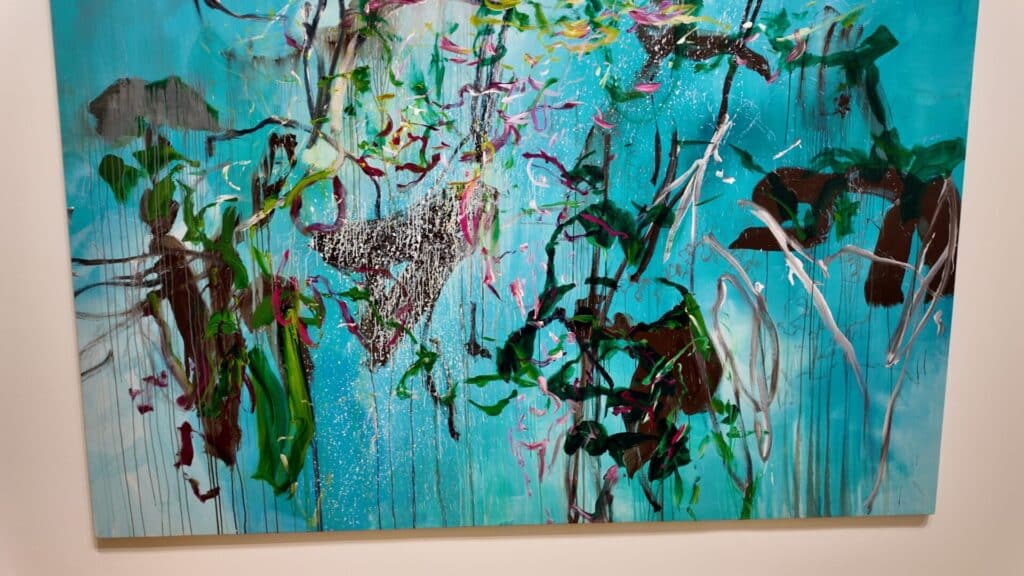
Thanks to the teaching of Zao Wou-Ki, a major Franco-Chinese painter of the 20th century and his first master, he understood that it was possible to create space without drawing, using color alone.

From this apprenticeship, he retained a revelation: “You could create space just with the power of color, without necessarily drawing anything.” From then on, color became for him a territory in its own right, a tool for working with depth, without contours, without limits.

Alain Joséphine
Alain Joséphine

The moving gaze, between emptiness and light

In Alain Joséphine’s work, the eye moves across the canvas: “There’s this oscillation between low angle and high angle,” he says. At times, the viewer is invited to look up at a sky saturated with vegetation; at other times, he or she is drawn into a darker, more introspective world.

This play of perspectives is often structured by an omnipresent blue background, which becomes the setting for an eulogy of lightness and silence. “Emptiness allows us to project ourselves,” he asserts. For him, emptiness is never absence: it’s breath, breathing, space for the imaginary.

Alain Joséphine

In the same spirit of openness, Alain Joséphine doesn’t give his works titles.
” Everyone sees something, everyone feels something different. It’s better that way.”
This refusal to name contributes to the freedom of the gaze, to the sensitive experience of the observer – without any imposed orientation.

Art inhabited by rhythm and poetry

As a painter, musician and poet, Alain Joséphine’s work is deeply sensory. Music, rhythm and poetry are not secondary arts: they form the sensitive pillars of his creation. “It’s these three elements that define what I do.

Each canvas becomes a score, a beat, a silence, an inner song. Her approach is lively, organic, and rooted in one demand:
” Art is something that eludes us all the time. It takes a lot of work to maintain this stability in production, in the liveliness of gesture and gaze.”

Alain Joséphine
Alain Joséphine

You have to build human beings in order to build art

This simple yet powerful phrase sums up Alain Joséphine’s philosophy. For him,art is not an end in itself, but a quest, a mirror of being. It’s not just about producing, but about building a presence in the world, a sensitivity, a humanity. For it is by touching the essence of the human being that a true, profound, inhabited work of art can emerge.

Alain Joséphine
Alain Joséphine

An exhibition to discover at the Fondation Clément

Discover the world of Alain Joséphine, between lyrical abstraction, Caribbean memory and chromatic spirituality.

An inspiration for all those who seek, in art, a space for reconnection with oneself, with others, and with nature.

📍 Exhibition : Régale
📅 24.04.2025 to 15.06.2025
📌 Fondation Clément, Le François – Martinique

Leave a Reply

Your email address will not be published. Required fields are marked *

More articles from RK

Doh study it
HISTORY & HERITAGE
Tolotra

“Doh study it”: When Trinidad Learns to Let Go

A comment keeps running through your mind. A coworker spoke too hastily, a loved one criticized your decision, or a minor annoyance suddenly feels like a big deal. In Trinidad, the response might be as simple as: “Doh, study it”. Depending on the situation, it means “don’t worry,” “don’t pay any attention to it,” or “don’t let it get to you.” “Doh study it” is part of Trinidad English Creole, an English-based creole language used in informal communication in Trinidad. The Atlas of Pidgin and Creole Language Structures notes that it plays an important role in everyday communication and national identity, while coexisting with official English. Trinidadian Creole also differs from the Creole spoken in Tobago, even though the two islands form a single country. What does “Doh study it” really mean? In standard English, the verb to study First and foremost, it refers to the act of studying, examining,

Read More »
Bonaire
TOURISM
Tolotra

Bonaire: Three markets account for 85.5% of visitors

Bonaire welcomed 13,387 overnight visitors in June 2026, according to preliminary data from the Tourism Corporation Bonaire. Visitor numbers declined slightly by 1.6% year-over-year. The most revealing information, however, lies in the travelers’ countries of origin: the Netherlands, the United States, and Curaçao together accounted for 85.5% of arrivals. Bonaire’s visitor numbers remain close to 2025 levels In June 2026, the island welcomed 13,387 visitors, compared with 13,606 a year earlier. The difference amounts to 219 fewer arrivals. This variation remains limited, especially when viewed over a longer period: by June 2025, attendance had increased by 12,2 % compared to June 2024. The 2026 figure therefore reflects more of a stabilization following the sharp increase recorded the previous year. The 1.6% decline provides a useful point of comparison, while trends in the major markets offer a more accurate picture of visitor numbers. Three markets bring 11,445 visitors to Bonaire The

Read More »
Brimstone Hill Fortress
TOURISM
Tolotra

Brimstone Hill Fortress: Two Centuries of History at the Summit of Saint Kitts

To the northwest of Saint Kitts, the walls of Brimstone Hill Fortress overlook the coast from a volcanic hill nearly 240 meters high. Behind the panoramic view lies a more complex history: that of a fortress designed by the British, built and maintained by enslaved Africans, and designated aUNESCO World Heritage Site in 1999. Brimstone Hill Fortress, a citadel perched atop a volcano As you climb Brimstone Hill, the sea comes into view between the steep slopes and the dark stone ramparts. From this natural vantage point, soldiers could observe the western coast of Saint Kitts and keep watch for the possible arrival of enemy ships. The location was far from insignificant. This volcanic hill, nearly 800 feet high, had steep, hard-to-access slopes. It thus offered a prime vantage point and a defensive refuge in the event of a naval attack. Nevertheless, the builders had to adapt their techniques to

Read More »

conTACT RK

we'd love to have your feedback on your experience so far

Join The List

Join our Richès Karayib community!  Sign up for our newsletter.

Want To Maximize Your Business Presence On Riches Karayib?

Complete the form to start the application