

Auxence Contout would have been 100 years old this year. In Cayenne, an exhibition entitled “Le Doko des traditions guyanaises” pays tribute to him, tracing the singular itinerary of this man whose name alone embodies the love of Guyana, its languages, its stories and its youth. Organized by CESECE Guyane, this cultural event invites us to rediscover a tireless thinker, educator and collector, whose work has had a lasting impact on the intellectual and popular life of the territory.
A journey in the service of education and transmission
Born in Cayenne, Auxence Contout distinguished himself from an early age by his insatiable curiosity and deep passion for Guyanese culture. After brilliant studies, he flew to Paris in 1947, then became a mathematics teacher in Douala, Cameroon. This African interlude had a strong influence on his vision of oral cultures and their similarities.
Returning to French Guiana in 1958, he became a major player in secondary education: teacher, principal, then principal of the Collège République – which later bore his name. Auxence Contout didn’t limit himself to imparting academic knowledge; he introduced his pupils to local history, linguistic richness and the importance of collective memory.


A tireless defender of Creole and oral heritage
Auxence Contout ‘s work cannot be understood without mentioning his attachment to the Creole language. He analyzed its particularities with rigor and passion, contributing to its recognition as a central element of Guyanese identity. He has also criss-crossed the territory collecting tales, proverbs and legends, considering these stories to be the foundations of popular culture and essential vectors of transmission.
Every week, he publishes columns in the local press, in which he shares these treasures collected from the elders. Today, these writings have an undeniable heritage value, used by anthropological researchers, teachers and contemporary storytellers alike.
Carnival and folklore: pillars of living culture
Auxence Contout has studied Guyanese carnival in depth, its origins, symbols and evolution. He saw in this popular festival a faithful mirror of society: its tensions, its joys, its mutations. Through his publications, essays and lectures, he has made a major contribution to the understanding of this tradition and its enhancement within the collective memory.
More broadly, his interest in dances, songs and rituals bears witness to a constant concern: to preserve without freezing, to pass on without folklorizing, to keep alive a culture in perpetual evolution.
A prolific writer at the service of Guyanese culture
With some fifteen books to his credit, Auxence Contout has left a lasting imprint on Guyana’s literary and intellectual landscape. His flagship publications include Lambeaux de camougué, Le parler guyanais, La Guyane des proverbes and Contes et légendes de Guyane. These works all have the same objective: to bring a love of local culture to new generations, giving them the tools to better understand their history, their language and their roots.
His teaching approach remains modern: accessible, rigorous, and always rooted in the experience of the Guyanese people.

Le Doko des traditions guyanaises" exhibition: a lively tribute
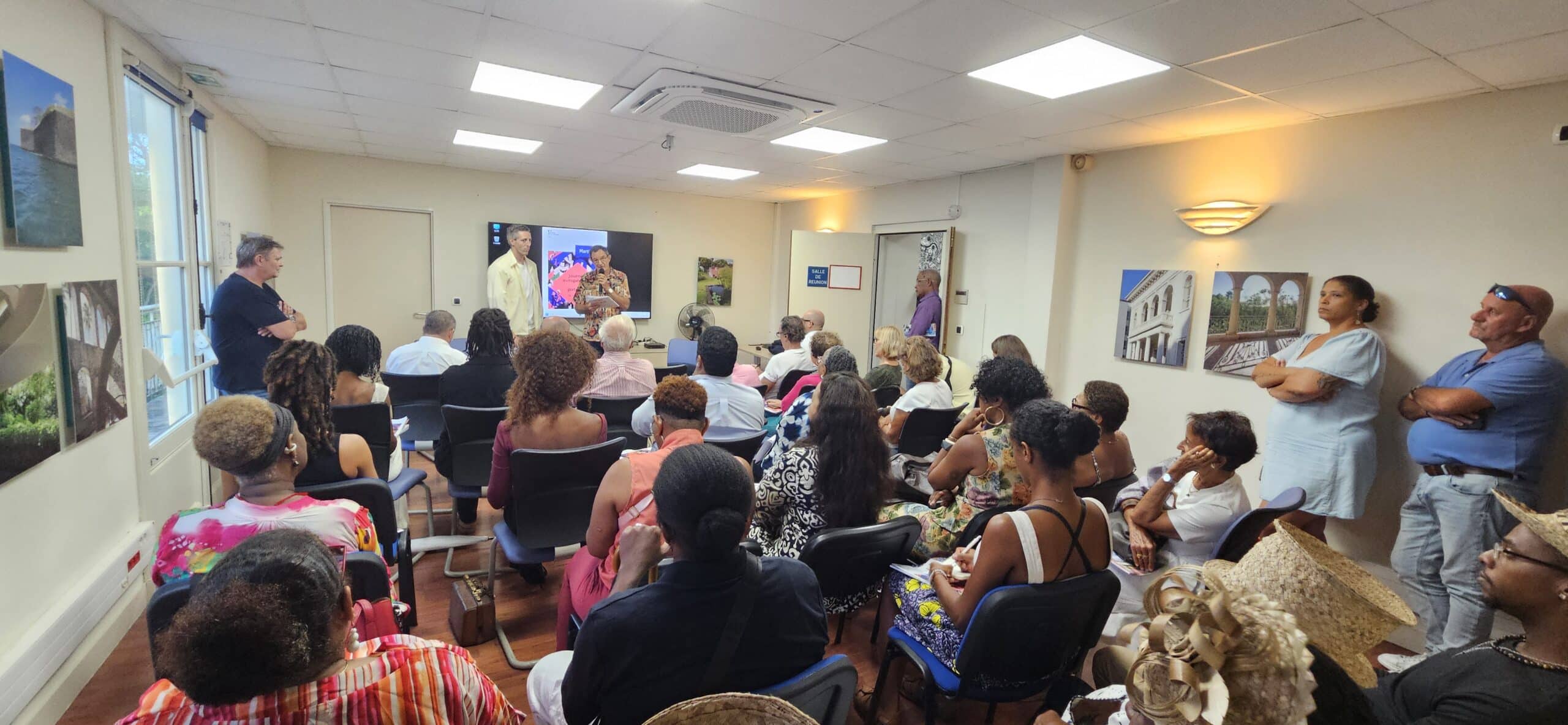
To celebrate the centenary of Auxence Contout, CESECE Guyane has designed an immersive exhibition, on view until May 30 in Cayenne. Manuscripts, excerpts from books, folklore objects, photographs and testimonials make up a journey that reflects the breadth of her cultural commitment. Workshops, public readings and encounters are also on offer, bringing together past and present, erudition and orality, tradition and modernity.
Following its presentation in Cayenne, the exhibition will travel around Guyana, notably to the college that bears his name, before joining the collections of the Collectivité territoriale. A way of extending the message of a man who never ceased to believe in the power of transmission.

A reference figure for young people
Auxence Contout saw youth as a lever for transformation and hope. He encouraged young artists, writers, teachers and organizers of cultural events to reclaim their heritage. He often repeated: “Fo nou pran divan, anvan divan pran nou”, a Creole maxim calling for initiative and action. He embodied this philosophy to the very end, through his civic, associative and educational commitments.
Alongside his literary and educational activities, he was also active in sport, notably founding the Guiana Handball League. President of the Council for Culture, Education and the Environment, Auxence Contout has combined passion and responsibility in the service of his native land.

Today, rediscovering Auxence Contout means reconnecting with a living memory of French Guyana. It’s also a reminder that a culture can only survive if it is passed on, questioned and shared. Through his books, his public activities and the exhibition dedicated to him, he continues to illuminate the paths of Guyanese identity.



2 Responses