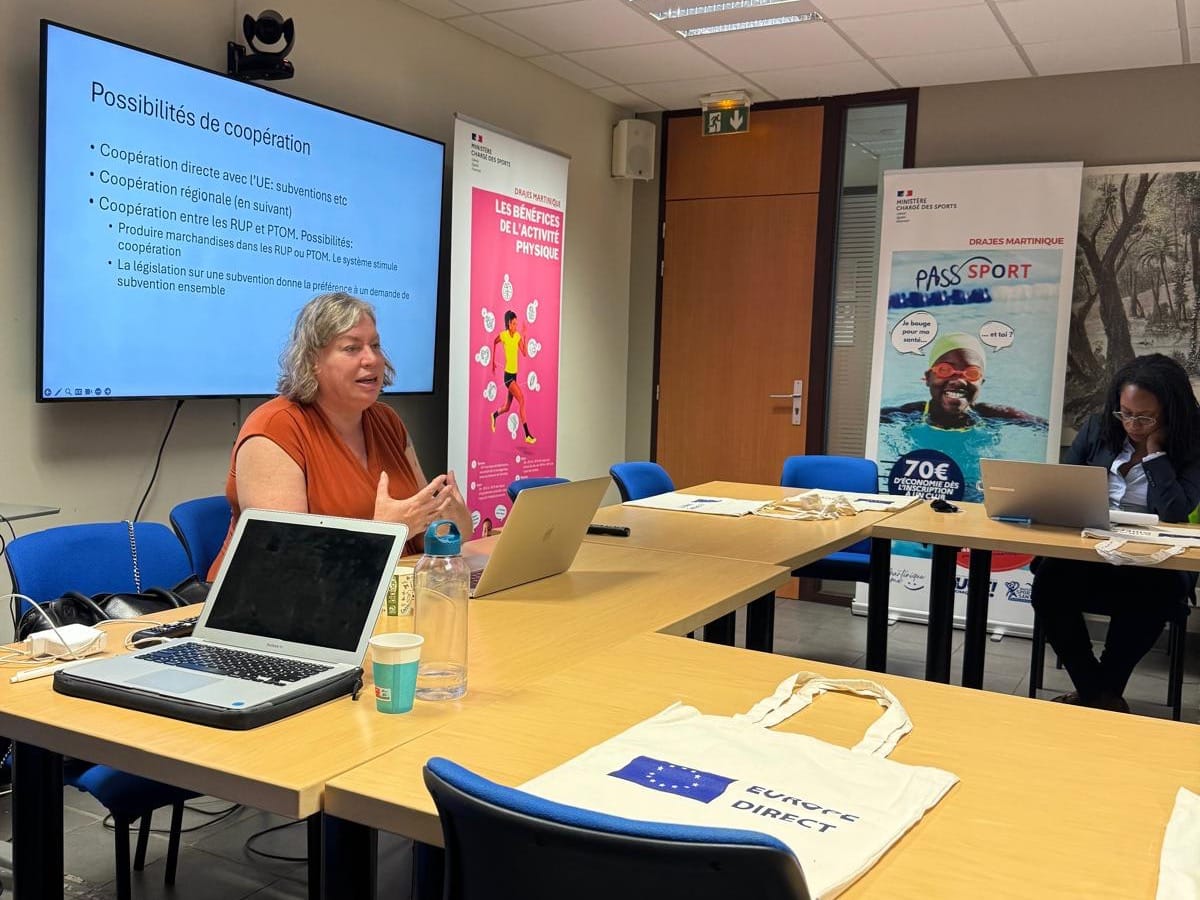
On November 19, during a key moment for understanding the dynamics of RUP and PTOM, the Centre Europe Direct Antilles-Guyane (CEDAG), in partnership with the COMOB of Martinique and the DRAJES Martinique, organized two discussion sessions on the occasion of the visit of Flora Goudappel, specialist in European constitutional law and Europe Direct Curaçao representative. The aim of the meeting was to gain a better understanding of the links between the European Union and the Outermost Regions (RUP) and Overseas Countries and Territories (PTOM). It was part of a shared desire to explore what RUP and PTOM dynamics mean in concrete terms for Caribbean territories.
Une carrière mondiale et un retour triomphal
The visit was part of a dynamic initiated a year ago: Curaçao wanted to gain a better understanding of Martinique, its European status and the scope for cooperation in the Caribbean. A territory of 160,000 inhabitants, which has just proudly celebrated its historic first qualification for the World Cup, was demonstrating its desire to forge concrete relations with another neighboring island territory… and a European one at that. A way of demonstrating that, beyond institutional arrangements, cooperation is first and foremost rooted in human initiatives.
European statutes structure Caribbean relations
In the course of the discussion, Flora Goudappel highlighted the nuances between RUP and PTOM status.
The RUP – such as Martinique, French Guiana and the Canaries – belong fully to the European Union, and benefit from derogations adapted to their insular and economic realities.
The PTOM, including Curaçao, are not part of the European Union, but enjoy a preferential position that gives them access to the European market and enables them to develop partnerships. These differences profoundly structure relations in the region.
To illustrate these distinctions, Flora Goudappel drew on real-life situations: migratory pressures in the Canaries, national choices concerning the Schengen visa, and debates in the Netherlands surrounding the planned changes to the status of Bonaire and Sint Eustatius. These realities show how in the RUP and PTOM frameworks shape the trajectories of each territory.

Building European cooperation: a mechanism for working together
One strong idea came up again and again: to use European funds, you need to master the necessary skills.
Work carried out with the Organisation for Economic Co-operation and Development (OCDE) over a period of eighteen months has highlighted a real challenge: coordination between the European Union, the State, the Region and operational players needs to be strengthened to enable smoother access to funds. When one of these links is weakened, the whole process becomes more complicated, particularly for the RUP and PTOM.
The OCDE toolbox – now accessible via the Centre Europe Direct Antilles-Guyane (CEDAG) – has been designed to support local teams, facilitate their work and make European schemes more accessible.
The Bwa Lansan association also shared its experience, illustrating how the gradual mastery of programs can transform the scope of a project and improve cooperation between RUP and PTOM.
Caribbean dynamics: where Martinique and Curaçao meet
Discussions then turned to the place of Martinique and Curaçao in regional forums such as the Caribbean Forum of the African, Caribbean and Pacific Group of States (CARIFORUM) and the Caribbean Community (CARICOM).
The Economic Partnership Agreement between the European Union and CARIFORUM opens up a wide range of prospects: youth mobility, educational programs, economic or environmental projects – these are just some of the areas in which the OR and OCT territories can find common ground.
Martinique and Curaçao are observers to CARICOM. They can attend meetings and take part in discussions, but do not enjoy full prerogatives. In the case of Martinique, this position has yet to be ratified by France, a prerequisite for full operational status. The discussions highlighted the importance of better understanding these mechanisms, so that Martinique’s local authorities can assess what these regional spaces can really do for them.

A day of sincere exchanges and shared questions
When the participants took the floor, their presentations revealed a mosaic of backgrounds: local authority officials, tourism players, association leaders, international mobility professionals. All shared the same desire: to forge stronger links between Caribbean territories, despite administrative borders, different languages and divergent statuses.
Several participants raised specific questions, while others shared their own experiences. The exchanges were characterized by frankness, lucidity and a shared desire to understand how to move forward together in concrete ways.
This collective dynamic has given substance to the idea that regional cooperation is not just an institutional principle: it is built on the voices, expectations, needs and ambitions of each individual, and on the subtle articulation of the realities of the RUP and PTOM.

A common trajectory to be written between Europe and the Caribbean
As the meeting drew to a close, a clear feeling emerged: Martinique and Curaçao possess fertile ground for developing joint projects. Mobility, education, ecology, local economy, innovation, culture… the possibilities are numerous, provided that the territories can mobilize European and regional tools in a coherent way, as encouraged by the RUP and PTOM.
The discussions on November 19 have opened up a path. A path where collaborations become possible, where European frameworks are read more clearly, and where Caribbean territories find spaces to meet differently.
That day, cooperation took shape in the voices present, but also in the desire to extend these exchanges beyond this meeting, to build a lasting relationship, adapted to the realities of the Caribbean and the ambitions of each territory – a valuable dynamic in all RUP and PTOM relations.


FAQ - RUP and PTOM in the Caribbean region
The outermost regions (RUP) are fully integrated into the European Union, and apply European law, with some adaptations to reflect their insularity. The Overseas Countries and Territories (PTOM), on the other hand, are not integrated into the European territory, but benefit from a preferential status enabling enhanced cooperation, particularly in the economic and educational fields.
Martinique, as an RUP, and Curaçao, as an PTOM, share common challenges: youth mobility, ecological transition, local economy, education and innovation. Their cooperation makes it possible to use European and Caribbean tools in a complementary way, opening up hitherto little-exploited regional perspectives.
European schemes – mobility, training, partnerships, regional programs – offer RUP and PTOM concrete opportunities for collaboration. The toolbox developed with the Organisation for Economic Co-operation and Development (OCDE) helps territorial players to make better use of these programs.