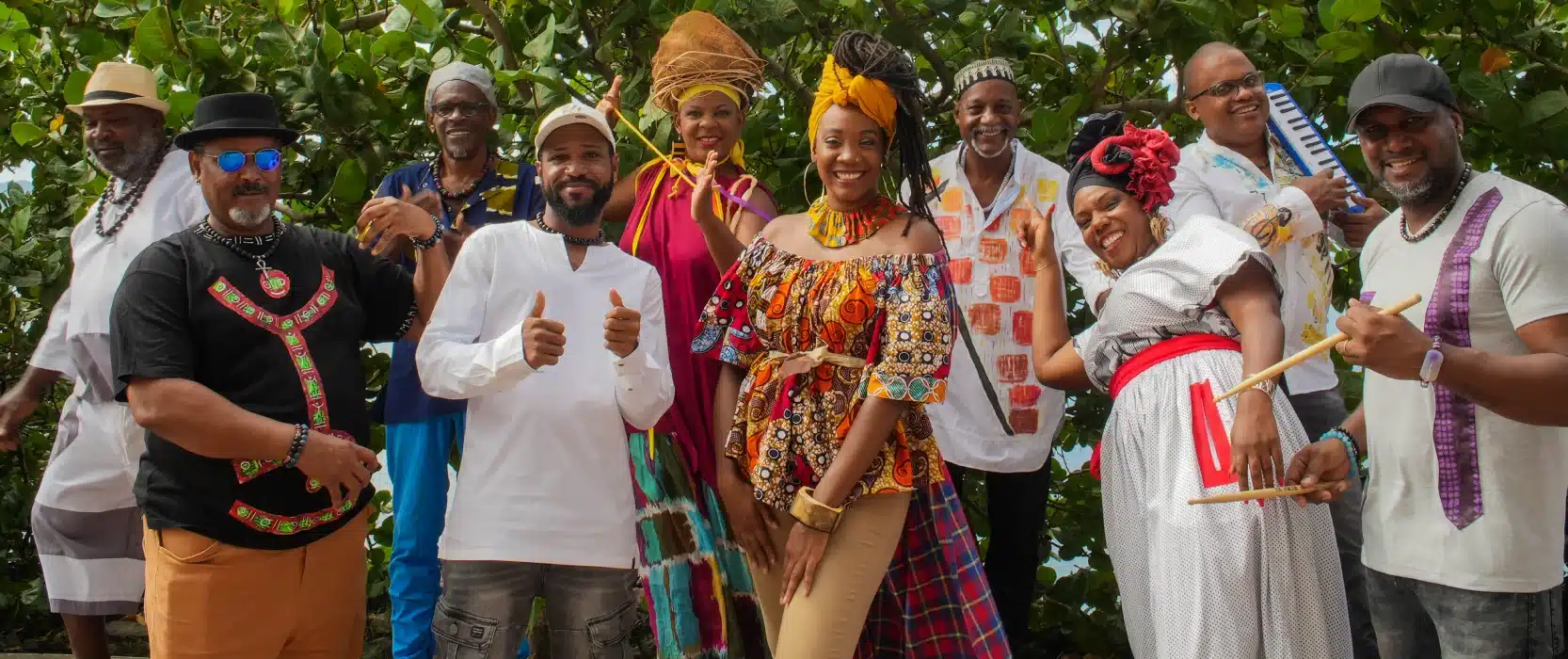
On August 9, 2026, Bélya will officially release “Adoumanman”, a ten-track album conceived as a balance between the bèlè heritage and contemporary creativity. In this album, the Martinican band sets to music themes of migration, memory, transmission, violence, resistance, and hope, without turning a blind eye to the present.
Bélya: Heritage as a Starting Point
With Adoumanman, Bélya pursues an idea that runs through his artistic approach: remaining deeply rooted in bèlè while allowing this art form to evolve with the times. The group refers to its style as “Bèlè Fusion” and performs k’bel, or kadans bèlè, drawing notably on the rhythms of Samaritan and Arlesian bèlè, as well as the musicians’ experiences with carnival, gospel, zouk, and jazz.
The vision behind this new album can be summed up in a few words: “Roots, and openness to the winds of the world”. Adoumanman also uses the phrase “Mi Plézi dann.” The goal, therefore, is not to put tradition on display, but to draw on the rich rhythmic and musical heritage passed down by our ancestors and integrate it into a contemporary context.

Ten titles, ten ways of looking at the present
The ten tracks bring this ambition to life.
– Migran follows a mother and her son, Ibrahim, as they flee their country for Europe, crossing the desert, the sea, and facing the dangers of the journey.
– Chape explores a relationship where physical abuse has replaced moments of “kolé lapo” and where loved ones are urging the couple to break the cycle.
– Zayann leads to “Zayonn,” the “great woods,” a source of inspiration and creative energy for Bélya. Kokoye links the drum once played during the danmié—the dance of the same name—to a story of friendship fractured by resentment and revenge, in which drums, songs, and music restore peace.
– Avriyet reimagines a classic from the bèlè tradition with a new orchestration.
– Dekolonial explores cultural clashes, domination, confrontations, and destruction, but also resistance, resilience, and utopian visions to be rebuilt.
– Lyannaj Bele takes the form of a medley of bèlè songs driven by the rhythm section of Bélya.
– Depi Ventan pays tribute to parents and the upbringing they provide for their children, while Limina honors Lumina Sophie, heroine of the 1870 Southern Uprising, and “all the Luminas of the World.”
Finally, Ich Madinina affirms his attachment to the island of Martinique in a hymn to hope, tolerance, and respect.

When bèlè Becomes a Living Material
This storytelling style relies as much on lyrics as on sound. “Traditional” instruments take center stage: the tanboubèlè, tanboupak, doumpak, and bwapitak interact with drums, piano, bass, and guitar. The vocals of Ivy Jalta and Stella Gonis feature on several tracks, while Bèbène and Metjo take the lead on “Kokoye.”
The band features Jimmy Thomasi on drums, Elizé Domergue on piano, and Hervé Martini on bass, with Krys Dachir and Harry Brédas on guitars. Justin Lesalles, Jocelyn Bernadine, Henri Altorn, and Eric Bertrand round out the percussion section.
This fusion does not erase the bèlè. Rather, it makes it the cornerstone. Even the staging of Bélya This says something: the musicians form a semicircle open to the audience, which completes the Wondi. The music is then no longer limited to what is being played; it becomes connection, flow, and transmission.

Adoumanman: A New Chapter for Bélya
Adoumanman continues a career already marked by *Fondok* and *Djenm* in 2010 and the single *Konngo* in 2023. Bélya has also taken his music beyond Martinique, notably to Guadeloupe, Trinidad, France, Japan, and Senegal. This exchange truly brings to life the idea of openness championed by the group. The “breaths of the world” do not distance us Bélya from its base: they become another way to make it resonate.
With Adoumanman, the issue isn’t really about choosing between tradition and contemporary creation. Rather, the ten tracks show how one can enrich the other. With just two days to go before its official release, the album thus raises a question : How will future generations keep the bèlè alive in their own way?
The album *Adoumanman* by Bélya will be officially released on August 9, 2026. It features ten tracks built around the bèlè tradition and contemporary themes.
Adoumanman includes 10 tracks : Migran, Chape, Zayann, Kokoye, Avriyet, Dekolonial, Lyannaj Bele, Depi Ventan, Limina, and Ich Madinina.
The bèlè forms the musical foundation of Bélya. The group has developed a contemporary style, known in particular as “Bèlè Fusion” and “k’bel” or “kadans bèlè,” in which bèlè rhythms and instruments blend with other musical influences.