Bequia, the maritime soul of the Grenadines

Bequia

An island apart in the Caribbean

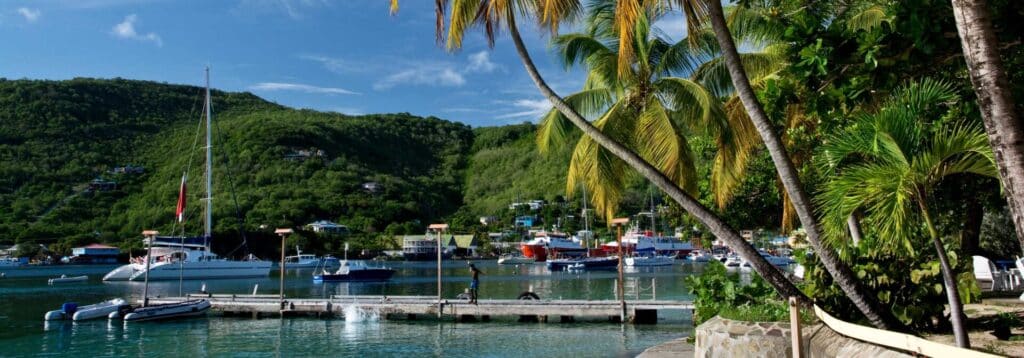
Bequia, the second largest island of Saint Vincent and the Grenadines, covers an area of around 18 km². It may seem modest in size, but its history and identity make it a singular territory. As soon as you approach its shores, a direct link with the sea is revealed: fishing boats lined up on the sand, sailboats at anchor in Admiralty Bay, shipyards where wood crafts are perpetuated. Bequia is a land shaped by the sea, its riches and its trials.

The breath of maritime history

© Photos Wilfred Dederer © BTA 2025

Bequia’s memory is deeply linked to whaling. As early as the end of the XIXᵉ century, locals learned from American whalers how to hunt humpback whales. This practice, now classified by the International Whaling Commission as “aboriginal subsistence hunting”, remains limited to a quota of four catches per year, rarely reached. More than a resource, it is now a heritage that illustrates how an island community has built its survival on the sea.
At the same time, Bequia retains a tradition of wooden boat building. In the villages, carpenters still fashion boats by hand. Each boat is a collective work of art, reflecting skills handed down from generation to generation.

Bequia
© Photos Wilfred Dederer © BTA 2025
Bequia
© Photos Wilfred Dederer © BTA 2025

The power of nature and everyday life

The island’s landscapes are a mix of beaches, hills and viewpoints. Princess Margaret Beach, just a stone’s throw from Port Elizabeth, stretches out its blond sand bordered by almond trees. Further south, Friendship Bay opens its waters to the Atlantic, offering a livelier sea. Trails lead up to Peggy’s Rock, a peak that reveals the beauty of the surrounding Grenadines.
These landscapes are also the rhythms of daily life. Fishermen leave the bay at dawn and return laden with tuna, sea bream and lobster. The market comes to life afterwards, reflecting a way of life still centered on the sea and its resources.

Bequia
© Photos Wilfred Dederer © BTA 2025
Bequia
© Photos Wilfred Dederer © BTA 2025

A preserved island culture

Bequia
© Photos Wilfred Dederer © BTA 2025
Bequia
© Photos Wilfred Dederer © BTA 2025

With around 5,000 inhabitants, Bequia remains a community on a human scale. Musical traditions – steelband, reggae, calypso – accompany gatherings, while crafts express the local identity. Meticulously carved models of wooden boats tell of the island’s maritime past, and are on display even in the small stores of Port Elizabeth.
This attachment to the island’s heritage is also expressed in its gastronomy, which focuses on seafood. Each dish is a reminder of the balance between tradition and adaptation.

Bequia
© Photos Wilfred Dederer © BTA 2025
Bequia
© Photos Wilfred Dederer © BTA 2025

Port Elizabeth, an island crossroads

Port Elizabeth, Bequia’s modest capital, nestles at the head of Admiralty Bay. This natural harbor attracts fishermen, sailors and visiting yachts. For decades, it has been a renowned stopover for Caribbean sailing. Here, the liveliness of the anchorage contrasts with the tranquility of the lanes lined with colorful houses and small cafés. The island has not sought to become a mass destination: it favors a measured approach to tourism, based on close contact with the locals.

Bequia
Port Elizabeth. © Photos Wilfred Dederer © BTA 2025

Legacy and future

Bequia illustrates the dilemmas faced by many small Caribbean islands: preserving authenticity while securing an economic base. Controversial whaling is often the focus of debate, but it does not sum up the island. The future also relies on fishing, local agriculture, boating and handicrafts, all sectors that maintain a resilient economy.
This direction reflects a clear choice: to maintain a balance between openness to the world and respect for an identity forged by the sea.

A sensitive and human Caribbean

Bequia is not an island defined by its size or infrastructure, but by its maritime soul. Its landscapes, traditions and people make up a mosaic where every detail carries the weight of history and the hope of the future. On this island of the Grenadines, the sea is more than just a horizon: it is a memory, a resource and a promise.

Bequia
© Photos Wilfred Dederer © BTA 2025
Bequia
Bequia
© Photos Wilfred Dederer © BTA 2025
Bequia
© Photos Wilfred Dederer © BTA 2025
Bequia
© Photos Wilfred Dederer © BTA 2025
Bequia
© Photos Wilfred Dederer © BTA 2025

Leave a Reply

Your email address will not be published. Required fields are marked *

More articles from RK

Errol Barrow
HISTORY & HERITAGE
Tolotra

Barbados – January 21: why does Barbados honor Errol Barrow, Father of Independence, on this date?

Every January 21stBarbados is taking a break. This national holiday is in no way anecdotal. It is a reminder of the central role played by one man in the political construction of the country, and in the affirmation of a sovereignty conceived over the long term. That man is Errol Barrowrecognized as the Father of Independence. A date that structures national memory January 21 is the birth date of Errol Barrow, born in 1920. Making this day a public holiday is not a purely symbolic gesture. It’s a reminder that Barbados’ independence was not just a formal act in 1966, but a political path built with method, constancy and clarity. Through this commemoration, the Barbadian state is underlining a simple idea: independence is a collective project that takes place over time and is based on precise political choices. Errol Barrow, a structured political trajectory He belongs to a generation of

Read More »
Citadelle Henri
HISTORY & HERITAGE
Tolotra

Haiti – Citadelle Henri: a Haitian bastion at the heart of Caribbean history

Citadelle Henri. The name sounds like an affirmation. That of a territory, a people and a region that, at the beginning of the XIXᵉ century, chose to stand up to empires. Dominating northern Haiti at an altitude of over 900 metres, the Citadelle Laferrièrebetter known as the citadel Henriremains one of the most powerful monuments in the Caribbean. Beyond its monumentality, it embodies strategic thinking, conquered sovereignty and a message addressed to the Atlantic world. A founding historical context for Haiti and the Caribbean It was born in the immediate post-war period of Haitian independence (1804). At the head of the Kingdom of the North, Henri Christophe between 1805 and 1820, erected a defensive system unrivalled in the region. The aim was clear: to prevent any return of the colonial powers, particularly France, and to secure a sovereign black state in the heart of the Caribbean. In a Caribbean region

Read More »
Stephen Cat Coore
MUSIC
Tolotra

Jamaica – Reggae legend Stephen Cat Coore dies aged 69

Stephen Cat Coore died at the age of 69, leaving the Caribbean bereft of one of its most consistent and demanding artisans. Guitarist, singer, composer and co-founder of the group Third World, he embodies a singular trajectory in the history of Jamaican music: that of a creator who chose continuity, rigor and thoughtful openness rather than rupture or effect. His death is not just that of a renowned musician. It marks the loss of a cultural landmark, of a man who knew how to think of reggae as a space for dialogue between Caribbean heritage and the global circulation of sounds. A musical heritage steeped in Jamaican history Stephen Cat Coore was born in a Jamaica where music was already structuring the collective narrative. Son of Bunny Ruggs, a member of the Maytals, he grew up in the shadow of a heritage shaped by ska, rocksteady and the first expressions

Read More »

conTACT RK

we'd love to have your feedback on your experience so far

Join The List

Join our Richès Karayib community!  Sign up for our newsletter.

Want To Maximize Your Business Presence On Riches Karayib?

Complete the form to start the application