The Bushinengués carry a history born of flight, forest and reconstruction. In Papaïchton, on the Maroni River, Carlos Adaoudé, known as Kalyman, sculpts and paints forms inspired by the decorations that adorned traditional Bushinengue homes. Adaoudé is a sculptor. But he is also a transmitter of memory: each piece he creates is an extension of the know-how that has enabled an entire culture to survive slavery and contemporary upheavals.
In this art, nothing is merely decorative. Lines, colors and geometric shapes tell of a way of inhabiting the world. They carry signs, messages and memories. Tembé reads like a memory transmitted by wood, color and gesture.
Free societies born of marronnage
The Bushinengués, or Bushinenge as they are spelled, are the descendants of enslaved Africans who escaped from the plantations of Suriname, then a Dutch colony, in the 17th and 18th centuries. In the forest interior, they built autonomous societies based on African heritages, local adaptations and knowledge forged through resistance.
This story is not just about escape. It’s also about political organization, military strategies, alliances and negotiations. The resistance of the maroon groups led the Dutch colonial authorities to sign several peace treaties: with the Ndyuka, also known as Okanisi, in 1760, with the Saamaka in 1762, then with the Matawai in 1767.
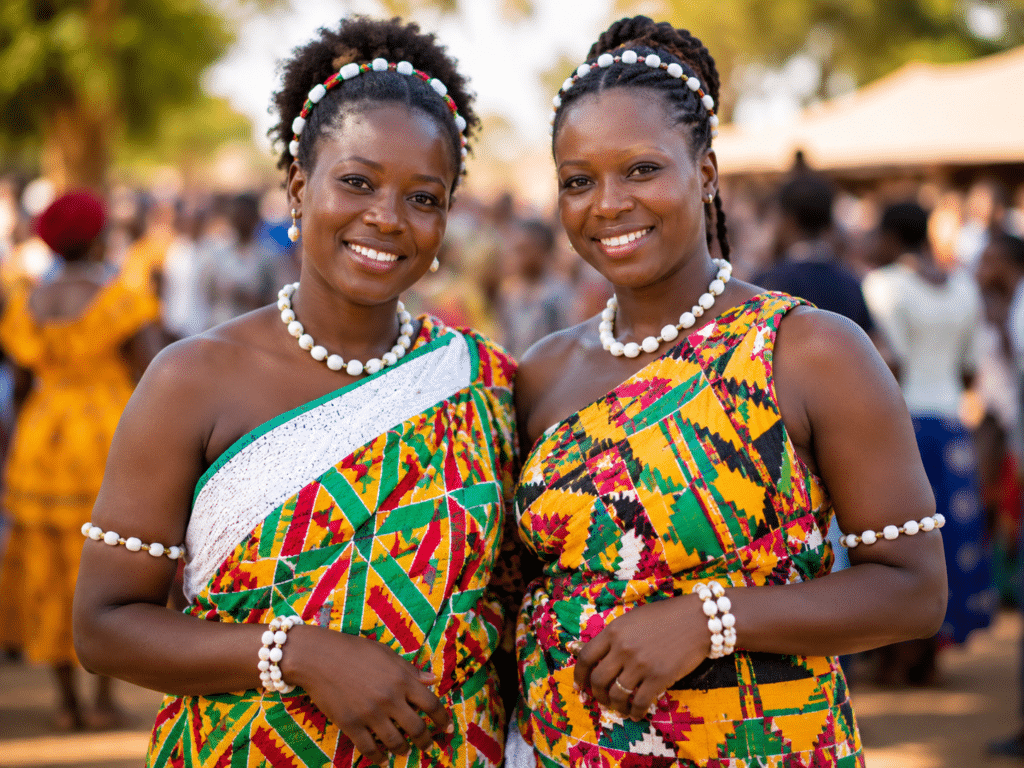
Today, there are generally six major Bushinengue groups: the Saamaka, the Ndyuka or Okanisi, the Aluku or Boni, the Paamaka, the Matawai and the Kwinti. Their history lies mainly between Suriname and French Guiana. The Maroni, called Marowijne on the Surinamese side, remains one of the central axes of this history.
The Maroni, a land of life and transmission
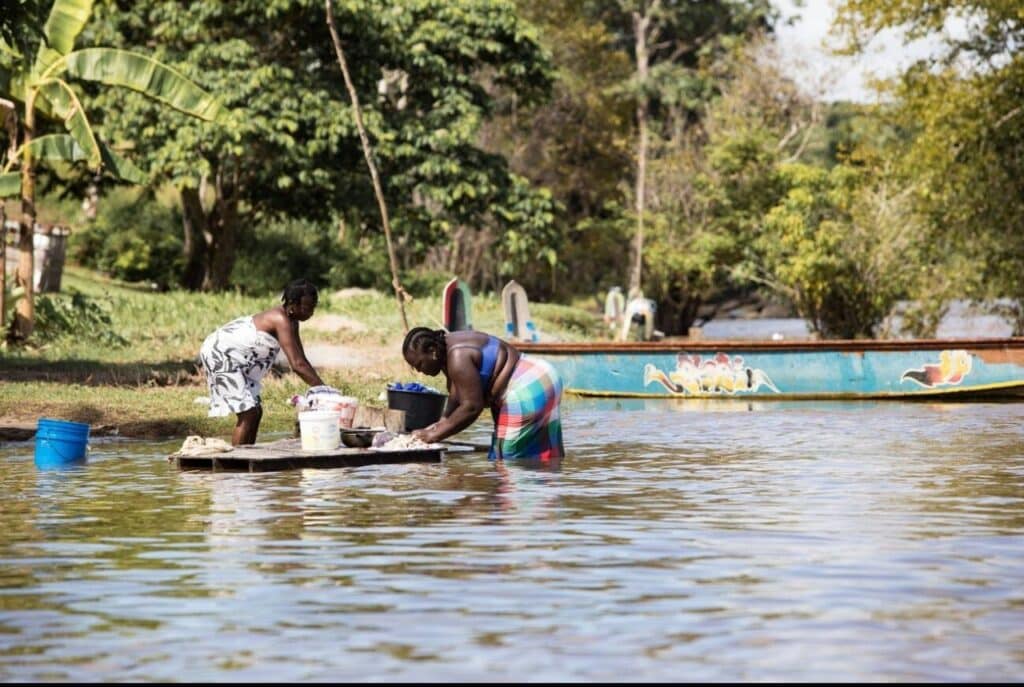
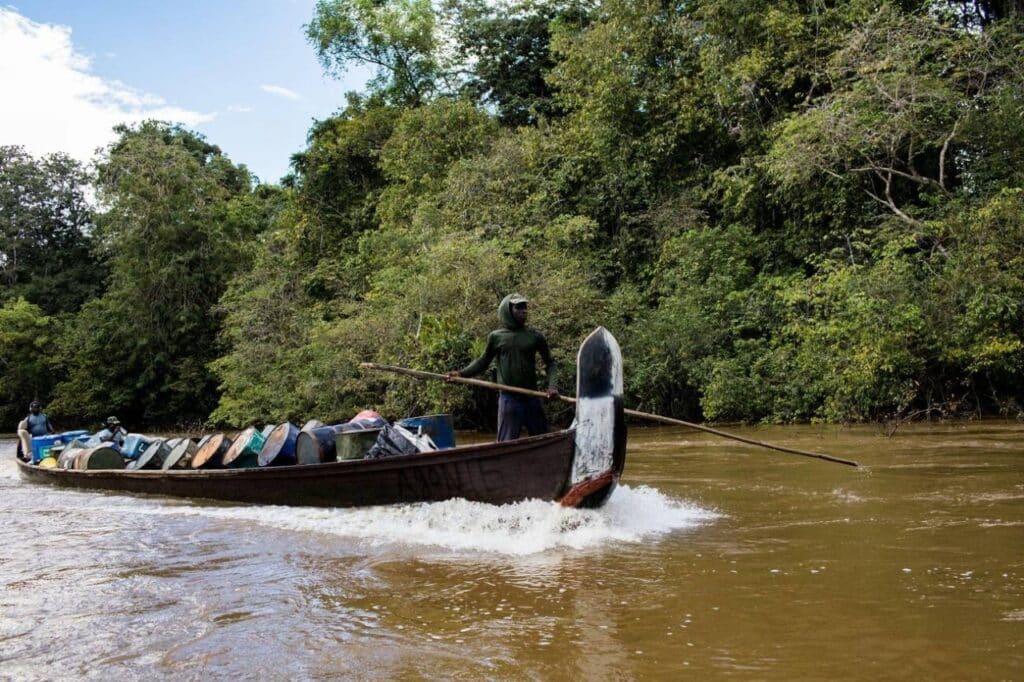
In French Guiana, the Bushinengue communities have a strong presence in western Guyana, particularly along the Maroni River. Saint-Laurent-du-Maroni, Apatou, Grand-Santi, Papaïchton and Maripasoula are just some of the places where this presence can be seen in languages, families, canoes, houses and links with neighboring Suriname.
The river is more than just an administrative boundary. For the people who live along its banks, it is a route, a memory and a living space. Exchanges, markets, kinships and cultural practices are a reminder that the history of the Bushinengués is first and foremost understood from the river.


Tembé, an everyday art turned heritage
One of the most visible expressions of Bushinengue material culture is the tembé. This graphic art, sculpted or painted, is linked to the Maroon peoples of Guyana and Suriname. It is expressed on wood, canvas, gourds, fabrics, everyday objects and elements of the traditional habitat.
Traditionally, Tembé motifs adorned pirogues, paddles, benches, combs, doors, house facades and pediments. In some communes of the Maroni, notably Apatou, Maripasoula and especially Papaïchton, traditional houses called ossu had a decorated pediment, the kopo.
In 2020, tembé was included in France’s National Inventory of Intangible Cultural Heritage. This recognition gives institutional visibility to a practice long passed down through families, villages and everyday objects. It also serves as a reminder that this heritage is not static. It continues to evolve and inspire new generations.

Languages that carry history
Another Bushinengue singularity has to do with languages. In French Guiana, institutional references recognize Neng(e), with its Aluku, Ndyuka and Pamaka components, as well as Saamaka among the languages of France. Sranan tongo, a Surinamese Creole, is also spoken in western Guyana.
These languages are more than just means of communication. They carry a memory of marooning, migrations and relations between the shores. They speak of the world from a specific historical experience: that of peoples who have rebuilt a free society far from the plantations.
Institutional recognition still fragile
The place of Bushinengués in Guiana’s institutional life has gradually been affirmed. The Conseil consultatif des populations amérindiennes et bushinenge was created in 2008. The Grand Conseil coutumier des populations amérindiennes et bushinenges de Guyane then reinforced this recognition.
The land issue remains central. In French Guiana, Zones de Droits d’Usage Collectifs, collective concessions and collective cessions are tools of French law. They recognize certain collective uses linked to forestry, hunting, fishing, gathering and abattis. However, they are still subject to administrative arbitration and local tensions.


A culture facing the challenges of the present
The future of Bushinengue communities also depends on the environment. The pressure of illegal gold mining, mercury pollution, river damage and tensions surrounding the forest are weighing heavily on the inland territories of Guyana.
But the history of the Bushinengués is not just a history of threats. It’s also a story of creation. Tembé continues to invent itself. Languages continue to circulate. Families, associations, customary authorities and inhabitants of the Maroni continue to pass on knowledge that goes beyond heritage.
The Bushinengués carry an essential Caribbean memory. Their story is a reminder that freedom was not achieved by decree alone. It was also built in the forest, on the rivers, in the languages, in the homes, in the objects and in the gestures handed down.
The Bushinengués are the descendants of Maroon communities formed by enslaved Africans who escaped from the plantations of Suriname in the 17th and 18th centuries. They built autonomous societies in the forest interior, mainly between Suriname and Guyana. Their history is linked to marronage, the Maroni River, Bushinengue Creole languages and a strong material culture, of which tembé is one of the most visible expressions.
Tembé is much more than a decorative art form. Among the Bushinengués, it appears on canoes, paddles, benches, combs, doors and house pediments. Its geometric motifs convey a memory, an identity and a way of linking generations. Listed in France’s Inventaire national du patrimoine culturel immatériel in 2020, tembé is testimony to a living heritage that is still practiced, reinterpreted and transmitted in French Guiana.
The Bushinengue people live mainly in Suriname and French Guiana, with a particularly strong presence in western Guyana, along the Maroni River. Communes such as Saint-Laurent-du-Maroni, Apatou, Grand-Santi, Papaïchton and Maripasoula are linked to this history. The Maroni River plays a central role, linking families, languages, cultural practices and traffic between the two banks.