
From December 11, 2026, to March 5, 2027, the route Martinique – Panama City, Air France will offer this route twice a week, with a stopover in Pointe-à-Pitre. More than just a new destination, this route could transform the way people from Martinique travel to Central America, South America, and several Caribbean territories.
Martinique – Panama City : Redrawing the Map of Travel
From Martinique, certain cities on the American continent appear close on a map, yet are difficult to reach. To get to Quito, Lima, San José, or Tegucigalpa, travelers often have to deal with long routes and inconvenient connections. The new route is expected to reduce this sense of isolation. Passengers will depart from Fort-de-France, make a stop in Pointe-à-Pitre, and then continue on to Panama City. This is therefore not a direct flight, but a new regional route connecting the French West Indies to one of the main hubs on the American continent.
This trend goes beyond the issue of tourism alone. It also affects families, students, professionals, artists, and entrepreneurs who have ties to Spanish- and English-speaking regions in the Americas.



Two flights a week to launch new routes
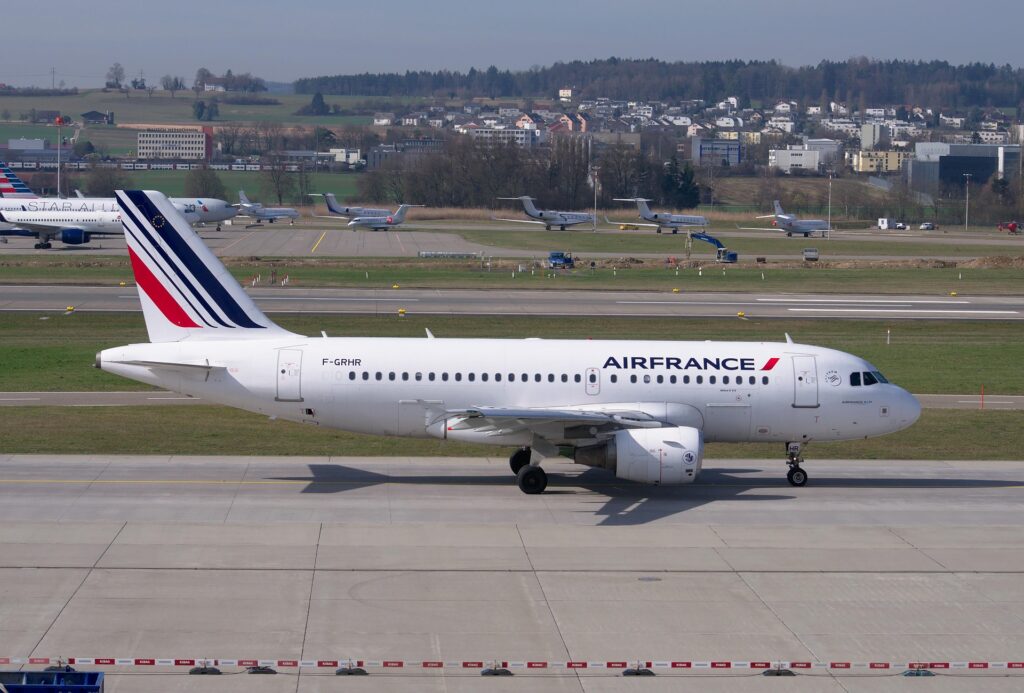
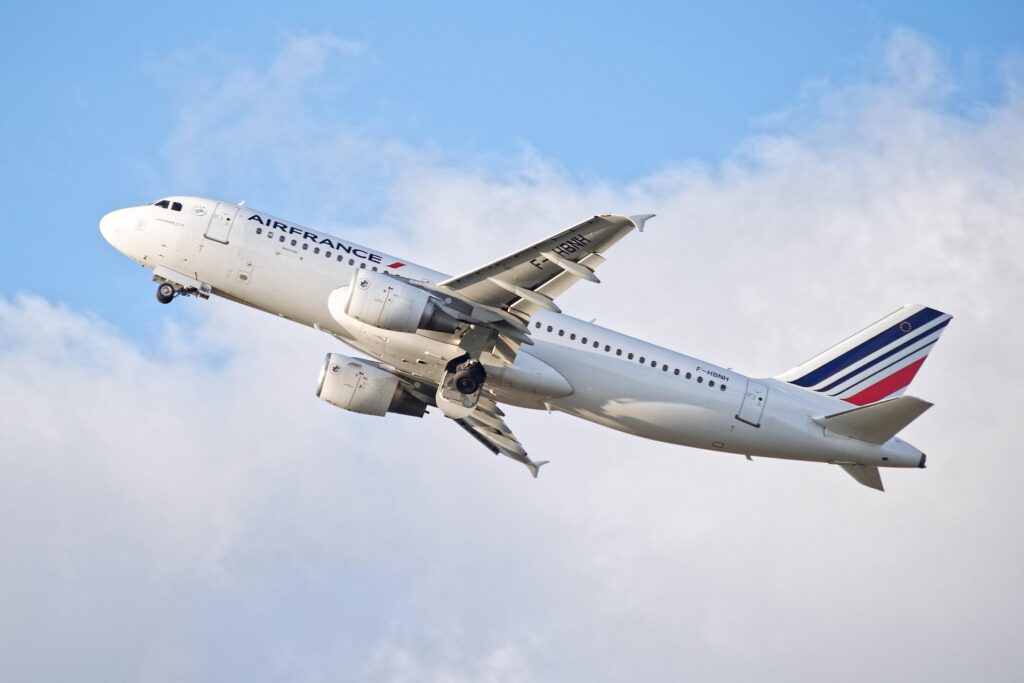
The route will be operated by an Airbus A320, with 170 seats divided between Business and Economy class. High-speed Wi-Fi is also available on board. Bookings are now open, with a promotional round-trip fare starting at 499 euros (including tax), excluding service fees. This is an introductory price and may vary depending on dates, availability, and booking conditions. The program remains subject to obtaining the necessary government approvals. This first season of Martinique – Panama City should therefore be considered a launch phase.
Panama City: A Destination and a Stopover
The appeal of this flight lies in Panama City’s dual role. The capital is worth visiting in its own right, with its canal, historic district, and Panamá Viejo, an archaeological site that highlights the isthmus’s historic role in interoceanic trade. The complex comprising Panamá Viejo and the historic district is listed on the UNESCO World Heritage List. Panama City also serves as a gateway to continue your journey to other destinations. The announced destinations include Asunción, Guatemala City, Guayaquil, Quito, Lima, Managua, Montevideo, San José, and Tegucigalpa. Havana, Georgetown, Port of Spain, Punta Cana, and Santo Domingo are also among the destinations accessible via connecting flights.
This new geographical landscape could bring Martinique closer to countries with which it already has trade ties, but where such ties are sometimes hindered by a lack of convenient connections. Martinique – Panama City thus becomes a gateway to the Americas and offers a new alternative for organizing certain regional trips.

Martinique – Panama City Revives Caribbean Memories
The connection between the French West Indies and Panama did not begin with aviation. It spans the history of the canal and the large-scale Caribbean labor migrations of the early 20th century. The Panama Canal Authority reports that approximately 7,500 men were recruited in 1907 from the French islands of Martinique and Guadeloupe. They traveled to the isthmus to work on the construction project led by the United States. Behind this figure lie individual life stories, separated families, departures that were sometimes permanent, and a Caribbean presence that has contributed to Panama’s modern history.
This thesis lends a special depth to this new connection. More than a century after those crossings, modes of transportation have changed, but the movement of people continues to link the Caribbean territories to the mainland. Air travel is thus part of a history that predates flight schedules and connecting flights. It serves as a reminder that Caribbean societies have long been shaped by departures, returns, work, and encounters between the islands and the mainland.

A Trial Season for Martinique
For Nathalie Sébastien, Chair of SAMAC’s Executive Board, this service is intended to strengthen tourism, economic, and cultural ties with the Americas. The success of the initiative will be measured by its practical implementation: affordable prices, convenient schedules, seamless connections, and the ability to meet the needs of travelers from Martinique. The first season of Martinique – Panama City will show whether this expansion will be limited to the winter or whether it can become a long-term development. Behind these two weekly flights lies a broader question: Can Martinique regain a more central role in Caribbean and U.S. air travel?
The Route Martinique – Panama City will be offered from December 11, 2026, to March 5, 2027. Air France plans to operate two flights per week departing from Fort-de-France, with a stop in Pointe-à-Pitre. The schedule is subject to the necessary government approvals.
No. Passengers will depart from Martinique Aimé Césaire Airport and make a stop in Pointe-à-Pitre before continuing on to Panama City. It is therefore more accurate to refer to this as a new air route rather than a direct flight.
The announced connecting flights will allow passengers to continue on to Lima, Quito, San José, Guatemala City, Port of Spain, Havana, Santo Domingo, and several other cities in Central America, South America, and the Caribbean.
Between people leaving for vacation, families returning home, and visitors arriving, the Martinique Aimé Césaire Airport is going through one of the busiest periods of the year. Through September 6, 2026, enhanced measures are in place to handle the increase in traffic without compromising the quality of service. Behind the lines, security checks, and luggage, another challenge is emerging: preserving the Martinique hospitality that is evident from the very first moments.
Martinique Aimé Césaire Airport: Maintaining a High Standard of Service During the High Season
The peak season began on June 26. According to SAMAC, several hundred thousand passengers are expected to pass through the airport this summer, with traffic projected to exceed last year’s levels. As a result, airlines, ground handling staff, border police, customs officials, and airport crews have stepped up their coordination.
This initiative addresses a clear operational need. It also impacts the region’s image. For some travelers, the airport terminal is their first tangible encounter with Martinique. For others, it marks a return home, a family reunion, or a departure after several weeks on the island. In these emotionally charged moments, providing a warm welcome goes beyond simply moving a line along.

Martinique’s hospitality is also reflected in its educational focus
Since July 9, about ten seasonal workers—easily recognizable by their orange polo shirts—have been assisting passengers upon departure and arrival. Their job seems simple: point out a counter, explain a route, or direct passengers to the right service. Yet, in a busy terminal, this human presence can prevent a great deal of confusion.
At the Martinique Aimé Césaire Airport, so maintaining a welcoming atmosphere means not leaving travelers to navigate procedures on their own. A family with young children, an elderly person, or a passenger in need of assistance does not experience the hustle and bustle in the same way as a frequent flyer. The quality of the welcome is therefore measured by the clarity of the information provided and the ability to reassure passengers.
Arrive four hours early for a more stress-free trip
For international flights, passengers are asked to arrive at least four hours before departure. This time frame is intended to allow passengers to complete check-in, security screening, and border control procedures without undue haste.
Before arriving at the Martinique Aimé Césaire Airport, each passenger should also verify that their documents are valid and review their airline’s baggage policies. Liquids, electronic devices, and prohibited items must be packed in accordance with the guidelines. Travelers who require special assistance are encouraged to contact their airline before departure.
These precautions help ensure that everything runs smoothly for everyone. A missing document, non-compliant luggage, or a late arrival can slow down several steps in the process and add stress to an already hectic time.
The welcome begins before you enter the terminal
SAMAC also urges visitors to respect the designated parking areas. Waiting on access roads or near parking lot entrances and exits can cause significant traffic delays, even extending onto the RN5.
Around the Aimé Césaire Airport in Martinique, so the experience depends on everyone’s behavior. Using the designated parking areas, packing your luggage in advance, and arriving early helps the staff better assist travelers. Hospitality becomes a shared responsibility among the institution, the staff, and the public.

Modernize Without Dehumanizing
SAMAC highlights the investments made in recent years to improve the passenger experience. However, facilities alone are not enough to create a positive experience. Clear signage, well-managed procedures, and appropriate infrastructure are most effective when complemented by attentive staff.
The summer travel rush is thus a real-world test for the Martinique Aimé Césaire Airport. It demonstrates its ability to handle heavy traffic while maintaining the Martinican way of welcoming guests: explaining, guiding, and assisting. In a place where everyone seems to be in a hurry, hospitality is sometimes evident in a simple gesture: not letting anyone figure out their way on their own.
For international flights, SAMAC recommends arriving at the Martinique Aimé Césaire Airport at least four hours before departure. This allows enough time to complete check-in, security screening, and border control procedures.
Enhanced security measures are in place through September 6, 2026. Staff from the airport, airlines, border police, and customs are on duty. About ten seasonal workers wearing orange polo shirts are also helping guide travelers through the terminal.
Travelers should check their documents, pack their luggage according to their airline’s guidelines, and notify the airline in advance if they need assistance. People accompanying travelers should use the designated parking areas to avoid blocking access roads and traffic heading toward the RN5.
Direct flight between Saint Kitts and Nigeria is part of a more profound evolution in relations between the Caribbean and the African continent. On March 21, 2026, a charter flight left Robert L. Bradshaw International Airport with over 100 passengers from eight Caribbean territories. The aircraft landed the next day in Abuja, Nigeria, marking a concrete break with traditional travel routes. This journey is more than just a logistical feat. It embodies a political will: to reduce dependence on European and North American hubs, and to structure direct connections between two regions that have historically been linked, but are still poorly connected in practice.
A break with imposed routes
Until now, travelling to Africa from the Caribbean involved long and costly detours. Multiple stopovers, long journey times, administrative complexity: these constraints limited exchanges, particularly economic ones. This direct flight between St. Kitts and Nigeria changes all that. It doesn’t just reduce travel time. It redefines the conditions of access. By eliminating geographical intermediaries, it opens up the possibility of a more direct, fluid and potentially more frequent relationship.
This is a strategic development. In a region where connectivity determines opportunities, each new air route can change the dynamics of trade, tourism and institutions.

An assertive lever for economic diplomacy
The composition of the delegation spoke volumes about their intentions. Alongside political representatives were entrepreneurs, investors and cultural players. This choice confirms that the objective goes beyond the institutional framework. The trip took place against the backdrop of the Afri-Caribbean Investment Summit (AACIS) in Abuja. Discussions focused on sectors identified as priorities: agriculture, blue economy, cross-investment and cultural industries.
The direct flight between St. Kitts and Nigeria thus becomes a tool. It facilitates meetings, speeds up negotiations and lends operational credibility to projects that are often mentioned but rarely put into practice. The ambition is clear: to create a trade corridor between the Caribbean and West Africa. This notion, still theoretical, takes tangible form here.
A political reading of the Africa-Caribbean rapprochement
Beyond the economic stakes, the initiative is part of a broader reading of international relations. It reflects a desire to strengthen ties between theOrganization of Eastern Caribbean States (OECS) and the Economic Community of West African States (ECOWAS). This positioning marks an evolution. The Caribbean no longer seeks solely to consolidate relations with its traditional partners. It is exploring alternative avenues, in line with a logic of South-South cooperation. In this context, the direct flight between Saint Kitts and Nigeria sends out a signal. It shows that links between regional blocs are possible, provided they are supported by concrete infrastructures.
"Reverse Middle Passage": a reinvested symbol
The initiative is accompanied by a strong symbolic dimension, through the expression “Reverse Middle Passage”. It refers back to transatlantic history, but reverses its meaning. It is no longer an imposed crossing, but a chosen journey, organized around economic and strategic interests. This change of perspective is not insignificant. It is part of a re-reading of relations between Africa and the Caribbean, based on cooperation rather than memory alone. In this context, the direct flight between Saint Kitts and Nigeria goes beyond air transport. It is part of an attempt at political and economic repositioning.
Real but conditional opportunities
The prospects opened up by this link are numerous. They include
- – bilateral investments,
- – Caribbean exports,
- – collaborations in the blue economy,
- – the circulation of cultural and creative players.
But these opportunities remain conditional. A one-off flight is not enough to structure a lasting relationship. Continuity will be decisive: economic agreements, financing mechanisms, regularity of connections, diplomatic follow-up. The direct flight between Saint Kitts and Nigeria is a starting point, not an end point.

A new geography of trade under construction
This move raises a fundamental question: is the Caribbean in the process of redesigning its connecting axes? By bypassing the routes dominated by the North, this initiative proposes a different reading of the Atlantic. It brings together two areas which, despite their shared history, are still far apart in contemporary exchanges. The direct flight between St. Kitts and Nigeria will not immediately transform regional balances. But it does introduce a concrete possibility: that of a direct, structured and assumed relationship between the Caribbean and Africa. In a context where mobility directly influences economic opportunities, this development deserves particular attention.
The direct flight between St. Kitts and Nigeria is profoundly changing mobility conditions between the Caribbean and Africa. Until now, travel between the two regions required stopovers in Europe or North America, which added considerably to journey times and costs. This new link reduces these constraints and facilitates travel for decision-makers, entrepreneurs and investors. In the medium term, this can accelerate trade, encourage economic partnerships and strengthen the Caribbean’s presence in African markets.
This flight is strategic, because it’s not just about air travel, but a tool for regional cooperation. It is part of a process of rapprochement between the Organization of Eastern Caribbean States (OECS) and ECOWAS. The direct flight between Saint Kitts and Nigeria creates an operational link between two regional blocs, facilitating economic meetings, negotiations and joint projects. It also helps to reposition the Caribbean as an active player in South-South dynamics.
At this stage, it’s a charter flight organized as part of a major economic event. For a scheduled service to become a reality, a number of conditions will have to be met: sufficient demand, solid bilateral agreements, a viable business model for the airlines and a lasting political commitment. The direct flight between St. Kitts and Nigeria is therefore a first step, but its transformation into a scheduled service will depend on the concrete benefits of this initiative.
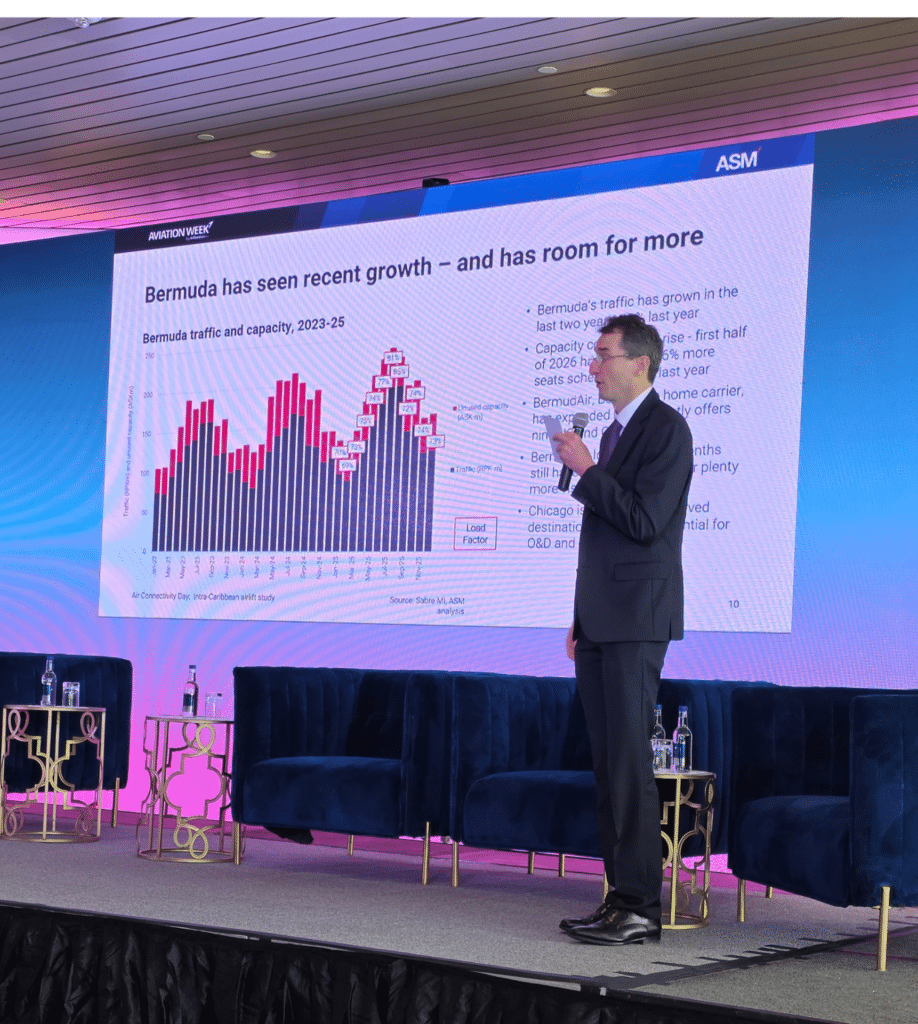
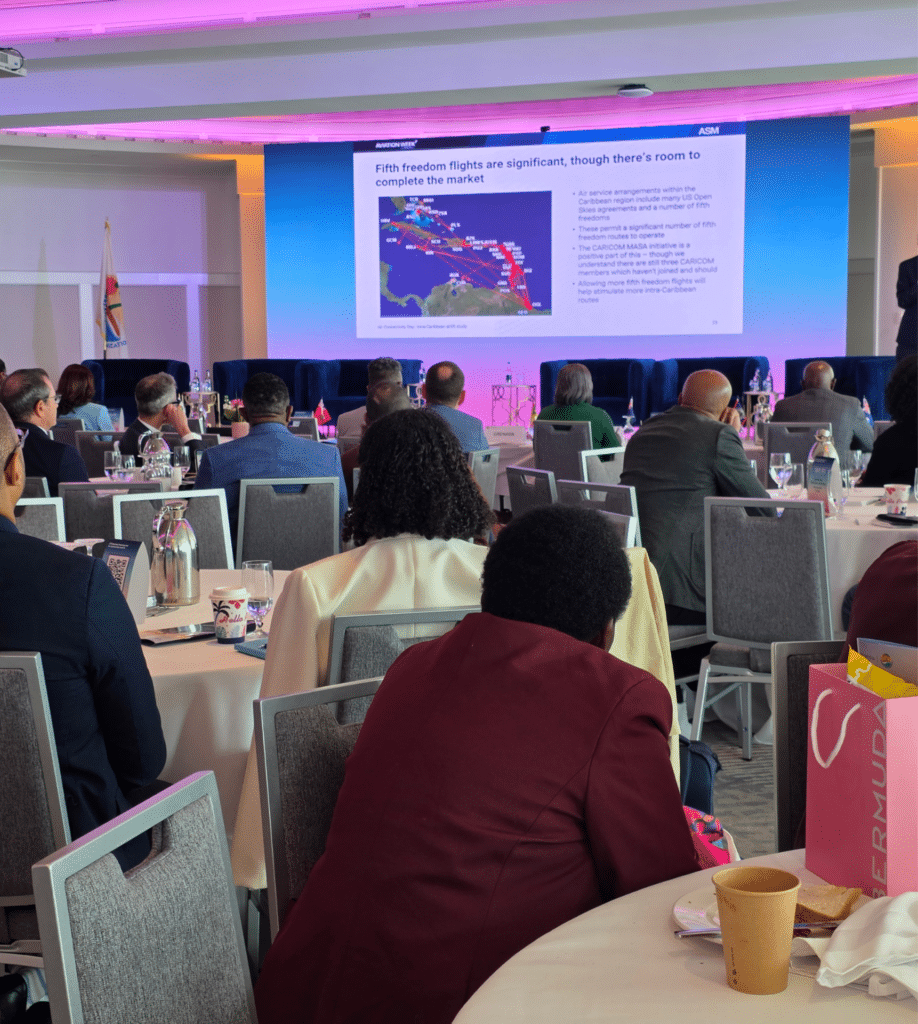
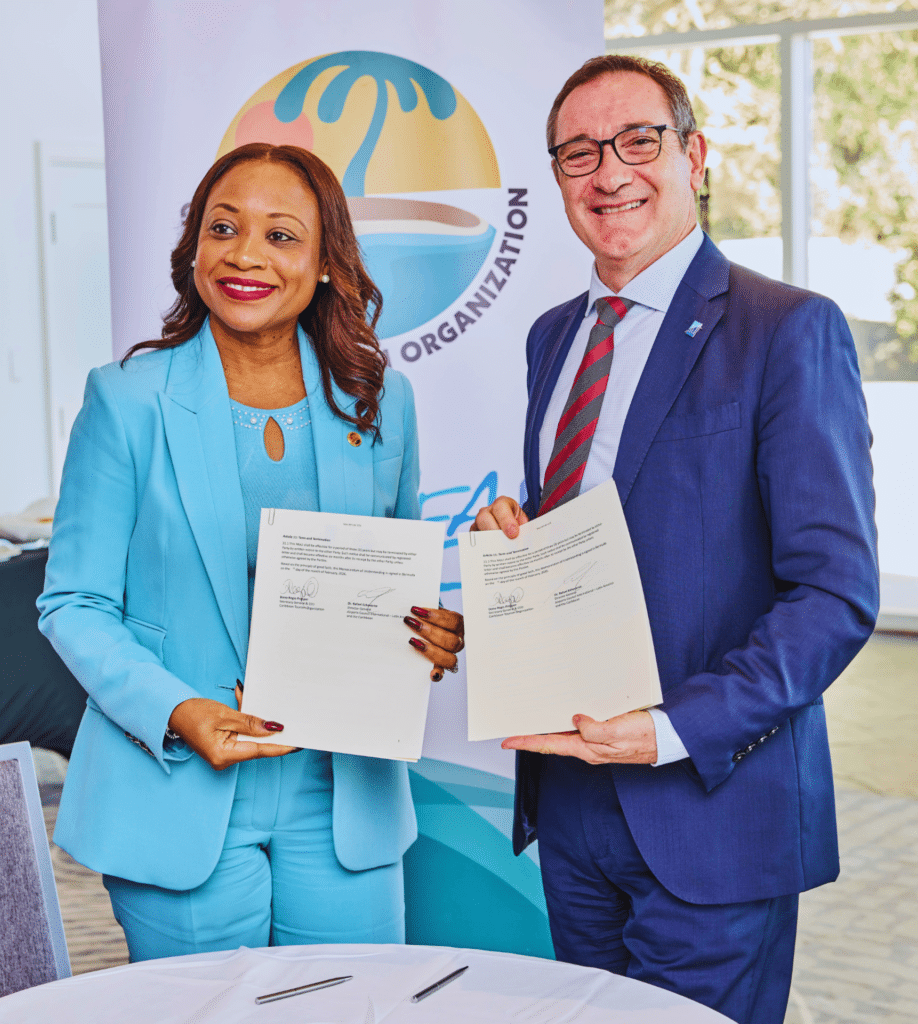
At first glance, a summit on air connectivity seems to be a strictly technical affair: routes, capacity, infrastructure, growth strategies. However, in Bermuda, the CTO Air Connectivity Summit demonstrated that an event dedicated to aviation can also become a genuine cultural and tourist showcase. In the island territories of the wider region, mobility is never just economic. It is profoundly human, based on identity and culture.
Connecting territories, bringing cultures closer together
Discussions at the CTO Air Connectivity Summit focused on the challenges of intra-regional connectivity and the need to strengthen links within the region. But behind these technical issues lies a broader reality: better connecting the region also means facilitating the flow of ideas, artists, entrepreneurs, talent and visitors.
Air connectivity thus becomes an indirect lever for boosting culture and tourism. It is a prerequisite for :
- – the development of multi-destination tourism
- – organizing regional events
- – mobility for young people and creators
- – international visibility of island heritages
In a region rich in tradition and creativity, each new air route is also a bridge between identities.
An opening rooted in Bermudian identity
The CTO Air Connectivity Summit opened with the playing of the national anthem, a solemn moment affirming the institutional anchorage of the host territory.
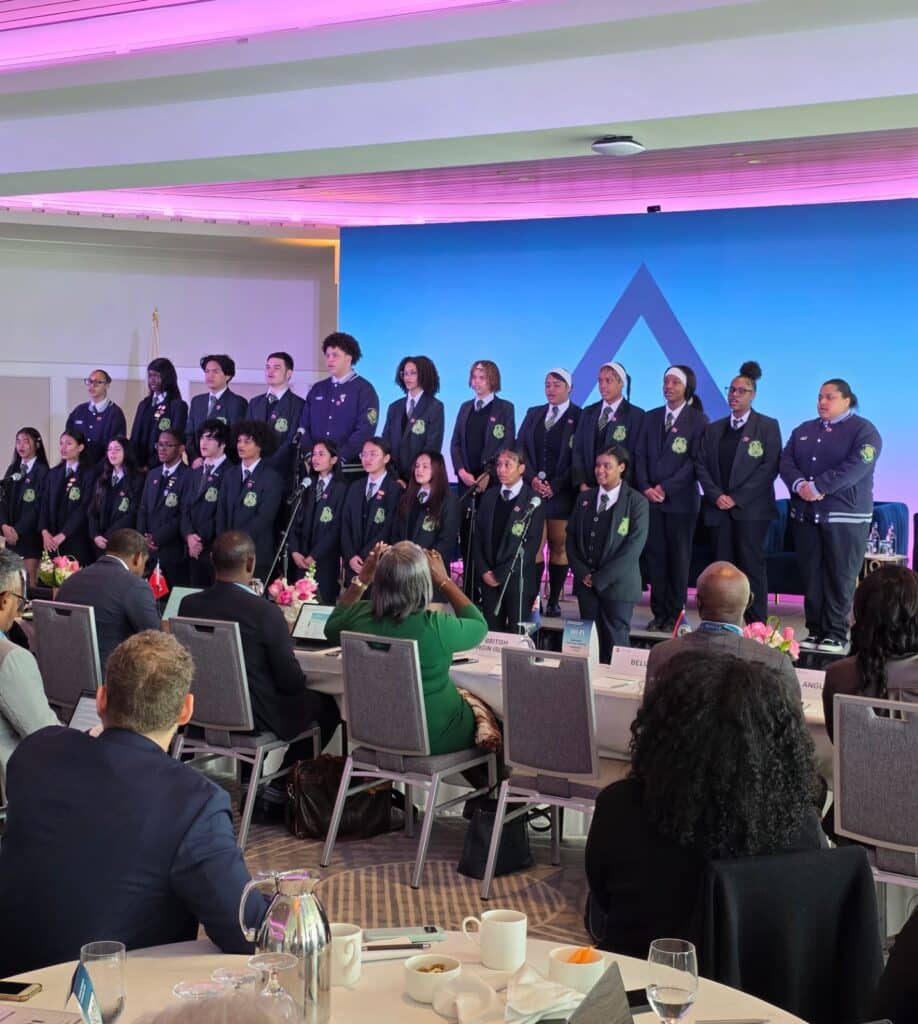
Between several panels, a youth choir took part, offering an interlude marked by commitment and transmission. In a summit devoted to the future of regional connectivity, the presence of young people was not insignificant: it was a reminder that economic development is part of the continuity of generations.

The closing ceremony of the CTO Air Connectivity Summit featured a traditional performance by the Gombeys. This is an emblematic expression of Bermudian heritage. This tradition combines percussive music, rhythmic dance and distinctive costumes adorned with bangs, feathers and colorful masks. Inherited from African and British influences, it embodies a strong cultural identity.
These moments transformed a strategic summit into a territorial experience.


Culture and attractiveness: a natural alliance
In a context of increasing global tourism competition, destinations can no longer limit themselves to promoting their landscapes. They must assert their uniqueness.
In Bermuda, culture is an active part of the experience. It’s expressed in music, traditions, youthfulness – and even dress codes.
The famous Bermuda shorts are a recognized form of professional attire in the archipelago. Worn with jacket and tie in institutional and business environments, they illustrate an elegant adaptation to the island’s climate while asserting a distinctive identity. Tradition and modernity coexist naturally, including in diplomatic and business environments.
This coherence between culture, protocol and the economic environment plays a key role in the region’s positioning as a tourist destination.

A growing regional dynamic
Beyond the technical discussions, the CTO Air Connectivity Summit highlighted an essential reality: connectivity is a strategic tool, but it is also a vector of cultural influence. In the Caribbean region, air development cannot be dissociated from the identity of the territories it serves.
Linking destinations also means :
- – strengthening cultural exchanges
- – enhancing local heritage
- – boosting tourist appeal
- – building a more integrated regional vision
In Bermuda, the balance between economic strategy and cultural affirmation offered an inspiring example.
The CTO Air Connectivity Summit didn’t just talk about air routes and infrastructure. It showed that an economic event can become a space for cultural representation, where a territory welcomes visitors, asserts its identity and projects its image. In a region where tourism and culture are intimately linked, connectivity is more than just passenger flows. It becomes a bridge between territories, generations and imaginations, and this is perhaps where its true richness lies.


The CTO Air Connectivity Summit is a regional summit organized by the Caribbean Tourism Organization (CTO), dedicated to air connectivity issues, route development strategies and cooperation between island territories.
The CTO Air Connectivity Summit aims to strengthen intra-regional connectivity, support multi-destination tourism and facilitate economic, cultural and institutional exchanges between island territories.
In Bermuda, the CTO Air Connectivity Summit incorporated strong cultural elements, including a performance by the Gombeys and the participation of a youth choir, illustrating the link between connectivity, territorial identity and tourist appeal.
The successful launch of Ariane 64 from the French Guiana Space Center in Kourou is not just a European technical achievement. Ariane 64 marks a strategic milestone for the entire Caribbean. By placing 32 satellites of the Amazon Leo project into orbit, the European launcher confirms that the Caribbean region – via French Guiana – is at the heart of a global transformation linked to Internet access, connectivity and digital infrastructures.
Behind the precision of the figures and the technological success, a new reality is taking shape: that of a Caribbean directly connected to the major spatial and digital dynamics of the XXIᵉ century.
A successful launch from the heart of the Caribbean
At 1:45 pm, Ariane 64 blasted off from its launch pad in Kourou, French Guiana, carrying 32 satellites destined to join the Amazon Leo constellation. The mission, carried out without incident, lasted 1 hour 54 minutes, with a crucial phase of gradual satellite separation at an altitude of around 465 kilometers. This launch marks a major technical achievement for Europe’s new generation of launchers. For the first time, the Ariane 6 rocket was used in its A64 configuration, equipped with four lateral boosters, compared with two for the A62 version used on the first flights. This evolution doubles the payload capacity to 21.6 tonnes, compared with 10 to 11 tonnes previously.
Jean-Frédéric Alasa from French Guiana was in charge of operational management of the launch from the Jupiter room, reminding us that French Guiana is not just a European launch base: it is also a Caribbean territory fully involved in global space engineering.

Amazon Leo: a constellation to connect the planet
Ariane 64’s mission was to deploy the first elements of the Amazon Leo project, a constellation of low-earth orbit satellites designed to provide fast, stable Internet access to areas poorly served by terrestrial networks. Eventually, more than 3,200 satellites will make up this global network. Their deployment is part of a program of launches spread over several years, including a series of 18 missions entrusted to Ariane 6. Over a period of five years, thousands of satellites will be linked to a vast system of antennas, optical fibers and ground stations to form a global connectivity infrastructure.
The aim of the Ariane 64 launch is clear: to offer high-performance Internet access in rural, island or isolated areas, where traditional terrestrial networks are insufficient or costly to deploy.


A global battle for the space Internet
The Amazon Leo project is part of a major international competition for satellite Internet access. Several technology giants are investing heavily in these low-orbit constellations, considered to be the next global digital revolution. In this race, Europe intends to maintain its position thanks to Ariane 64, while the United States is stepping up private and public initiatives. With the Kourou Space Center, French Guiana is becoming a strategic point in the global technological balance. Each launch reinforces the position of this Caribbean territory as an essential space platform.
Beyond the industrial stakes, this competition is shaping future access to the Internet, data and digital services for millions of users worldwide.
What this means for the Caribbean
For Caribbean territories, the expansion of satellite Internet could represent a major transformation. Many islands and rural areas still face connectivity challenges: costly infrastructure, dependence on undersea cables, uneven coverage between urban and remote areas.
The gradual arrival of constellations like Amazon Leo opens up the possibility of faster, more stable Internet access in previously underserved regions. For local populations, this could mean :
- – better access to online education and distance learning;
- – development of teleworking and digital activities;
- – advances in telemedicine for isolated areas ;
- – modernization of public services and local businesses.
In an island region where connectivity is an essential lever for economic and social development, these developments could reduce the digital divide and strengthen regional integration.

French Guiana, the Caribbean's space gateway
Each launch from Kourou is a reminder that the Caribbean is not just about its cultural and tourist heritage. It is also involved in the world’s major scientific and technological innovations. The Guiana Space Center, Europe’s only spaceport, gives the region a strategic position in the international space economy. For French Guiana, these missions also represent economic spin-offs, skilled jobs and scientific influence that extend far beyond its borders. For the Caribbean as a whole, they reinforce the idea that the region can play an active role in the industries of the future.
In 2026, seven to eight Ariane 6 launches are already scheduled, confirming the gradual ramp-up of the European program. Each of these launches will help consolidate the position of French Guiana and, by extension, the Caribbean in the global space ecosystem.
A Caribbean connected to the future
The success of the Ariane 64 launch is more than just a technical achievement. It symbolizes the Caribbean’s entry into a new phase of global connectivity, where space becomes a lever of development for island and coastal territories. Through Guiana and Ariane 64, the region is directly involved in building the digital infrastructures of tomorrow. The expansion of satellite Internet, the evolution of space technologies and international investment could profoundly reshape the economic and social balance in the Caribbean.
In the years to come, access to a faster, more stable Internet could transform education, work, entrepreneurship and exchanges between the islands. The launch of Ariane 64 marks a decisive step towards a Caribbean fully connected to the major technological dynamics of today’s world.
The Guiana Space Center is Europe’s leading spaceport. Each launch reinforces Guiana’s strategic role and places the Caribbean at the heart of the world’s major technological innovations, particularly in terms of Internet connectivity.
Amazon Leo is a constellation of over 3,200 satellites designed to provide fast, stable Internet access in underserved areas. These low-orbit satellites are designed to improve global connectivity, including in island territories.
Satellite Internet could improve digital access in islands and isolated areas, promote teleworking, online education and telemedicine, and support the economic development of Caribbean territories.
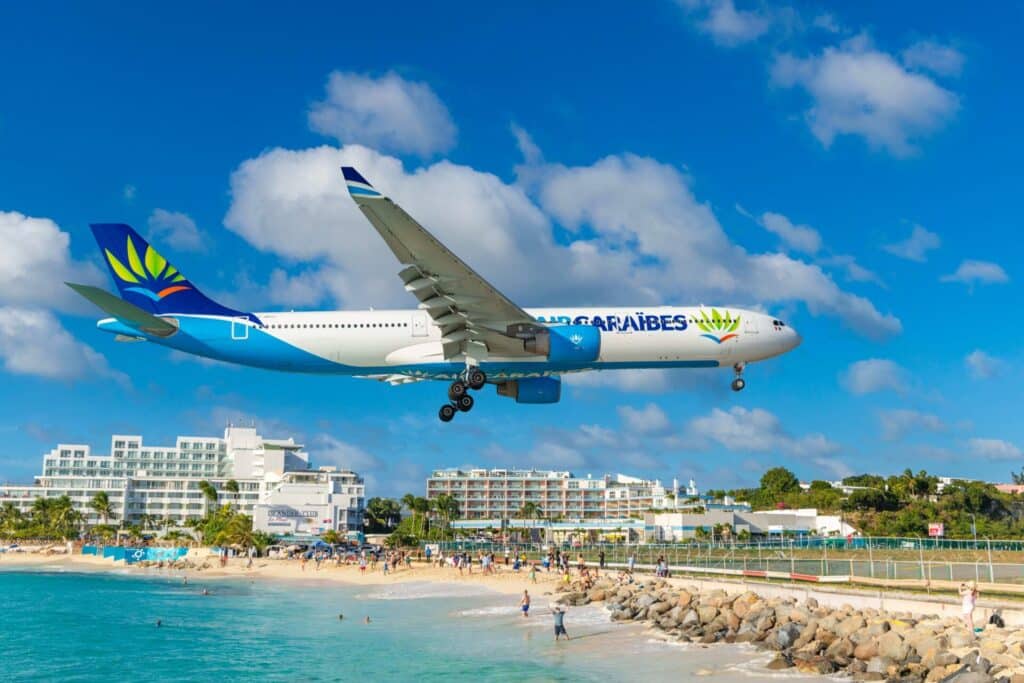
Appointed Deputy CEO in January 2026, Karen Virapin becomes the first woman from the French overseas territories to reach this level of governance within Air Caraïbes. A major development for the airline, but also a strong signal for the Caribbean air transport sector. Beyond the symbolism, this appointment raises a central question: what concrete impact could it have on governance, social dialogue, the regional network and service quality?
An appointment that reflects continuity, but not stasis
Having been with the company for fourteen years, Karen Virapin is no parachute. A former Director of Human Resources, Karen Virapin has been involved in all the company’s structural transformations: organizational changes, workforce growth, adaptation to the economic and social constraints of the airline industry. Her appointment to the position of Managing Director is therefore a logical step in the company’s continuity.
But continuity does not mean standstill. In a sector as exposed as air travel, marked by a fragile balance between costs, social demands, quality of service and local expectations, governance plays a decisive role. And it is precisely at this level that this appointment takes on its full meaning.

First woman from the French overseas territories to reach this level: a signal for Caribbean aviation
Air transport has historically been a very male-dominated sector, particularly in the executive ranks. The arrival of Karen Virapin as Managing Director is therefore a strong marker, both for the representation of women and for that of talent from the French overseas territories.
This signal goes beyond the company’s internal framework. It refers to a broader reality: the ability of companies operating in the Caribbean to recognize locally-built career paths, rooted in a detailed knowledge of the region, and not solely the result of external trajectories. This recognition is not just symbolic; it can influence the way strategic decisions are made, prioritized and implemented.
Social dialogue: a strategic lever, not a slogan
In the airline industry, social dialogue is never a secondary issue. Working conditions, organization of schedules, changes in professions, operational pressures: every decision has a direct impact on the stability of the company and the customer experience.
The fact that the new Managing Director comes from a human resources background is not insignificant. This does not guarantee the absence of tensions or consensual decisions, but it does imply a method. A method based on an understanding of internal balances, the expectations of both flight and ground crews, and the constraints specific to Caribbean services.
In the medium term, the impact will be measured less by rhetoric than by concrete indicators: social climate, ability to anticipate conflicts, continuity of service in sensitive periods.
Caribbean-Guyana regional network: local governance put to the test
Based in Pointe-à-Pitre, Karen Virapin embodies a form of governance rooted in the territories served. This geographic positioning is not neutral. It puts management as close as possible to the realities of the Antilles-Guyane regional network, which is often faced with specific challenges: flight regularity, connections, territorial continuity, and the expectations of residents and tourism professionals alike.
It’s not just a question of maintaining individual lines, but of ensuring their overall coherence. How can we link regional and transatlantic networks? How can we guarantee a clear and reliable offer in a context of increased competition and pressure on costs? Here again, future decisions will enable us to assess the real scope of this so-called “local” governance.

Service quality: maintaining high standards in a context of transformation
One of the major challenges for any airline lies in its ability to transform itself without degrading the quality perceived by passengers. Fleet modernization, internal reorganization, operational adjustments: each change entails a risk for the customer experience.
Against this backdrop, the new Executive Vice President’s career path will be closely scrutinized for consistency between internal transformation and the service promise. Punctuality, regularity, quality of welcome and management of disruptions are all concrete markers for passengers and for the regions that depend on air connectivity.
What territories can expect to see in the coming months
For the French West Indies and Guyana, the stakes go far beyond internal governance. It affects mobility, tourism, economic attractiveness and daily life. The concrete impact of this appointment can be assessed through a number of weak but revealing signals: social stability, legibility of the regional offer, continuity of services, capacity to adapt to unforeseen events. It’s not a question of waiting for spectacular ruptures, but of observing whether the promise of an anchored leadership, attentive to Caribbean realities, is translated into reality.
An appointment observed far beyond the company
Karen Virapin’s appointment to the position of Chief Operating Officer is more than just a new face inAir Caraïbes governance. She also embodies a broader evolution in the relationship between companies, territories and leadership in the French Caribbean. It’s an evolution that’s still fragile, but one that’s full of structural challenges. The next few months will tell whether Karen Virapin’s appointment marks a mere symbolic milestone, or a lasting step forward in the way we think about the governance of Caribbean air transport.
Karen Virapin is a French executive originally from Guadeloupe, appointed Chief Operating Officer of Air Caraïbes in January 2026. She has been with the company for fourteen years, and for over a decade held the position of Director of Human Resources.
Her career has been built up both in France and in the West Indies, with solid experience of organizational management and social dialogue in a demanding air transport sector. Her appointment makes her first woman from the French overseas territories to reach this level of governance within the company.
The Managing Director holds a executive position governance. She works in close coordination with General Management and is directly involved in the company’s strategic, operational and organizational decisions.
- – supervision of internal organization,
- – managing structural transformations,
- – social dialogue with teams,
- – consistency between business strategy, operational constraints and service quality.
Air Caraïbes plays a central role in air connectivity in the French West Indies and French Guiana. The company provides both:
- – essential transatlantic links with France,
- – a structuring regional network for intra-Caribbean mobility.
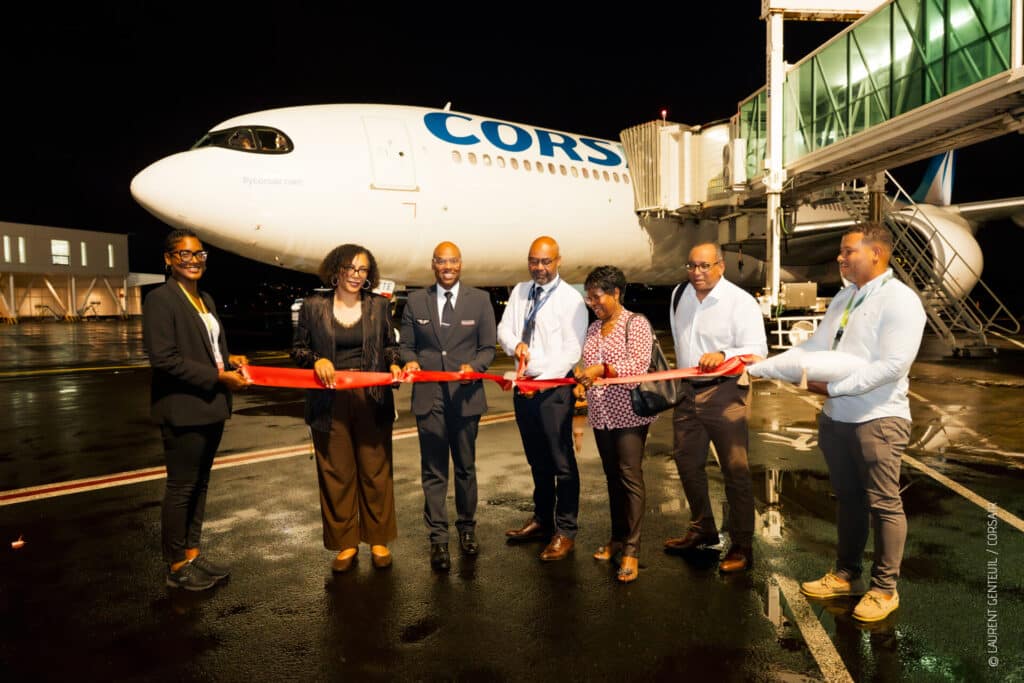
On December 15, 2025, Aimé-Césaire airport welcomed the first direct flight from Bordeaux to Fort-de-France, operated by CORSAIR. This new route marks a strategic turning point for Martinique’s connectivity and accessibility to the Caribbean from south-western France.
A three-way partnership to enhance regional appeal
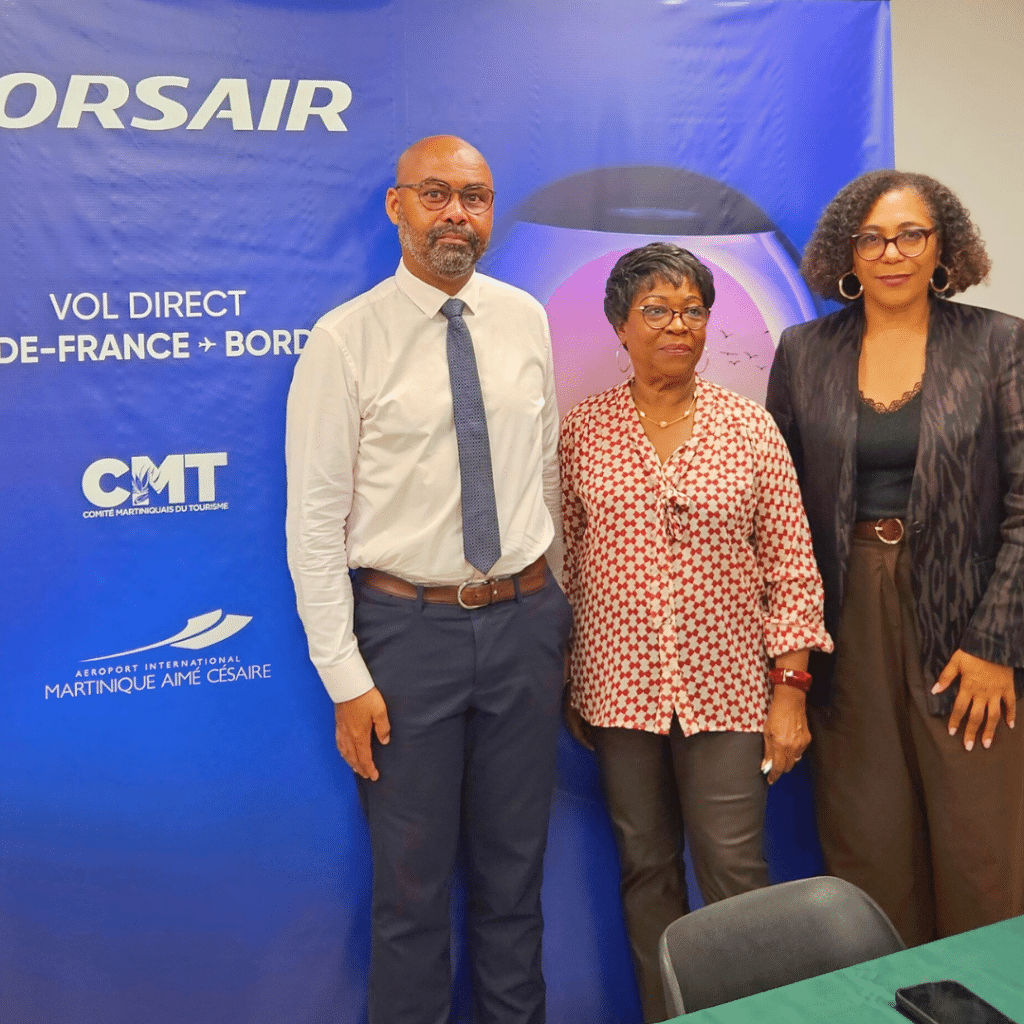
The arrival of this inaugural flight at 5:47pm is no coincidence. It is the result of several months of collaborative work between three key players: Société Aéroport Martinique Aimé Césaire (SAMAC), the airline CORSAIR and the Comité Martiniquais du Tourisme (CMT).
Nathalie Sébastien, Chairman of SAMAC’s Management Board, hails this collective dynamic: “It’s all about selling a territory, selling a destination. And that’s only possible with the partnership of an airline and the Comité du Tourisme.” For her, this route embodies a clear vision: to open Martinique’s skies to the French provinces, beyond the traditional Parisian gateways of Orly and Charles de Gaulle.

The President underlines the historical, economic and academic links between Bordeaux and Martinique. “It’s a chance for the Martinican community living in Bordeaux to return more often and more easily to Martinique, and vice versa”, she explains. But beyond the diaspora, the entire South-West region now has seamless access to Martinique, without having to transit via Paris.
Marie-Ange Ravin, CMT Board member and representative of President Bénédicte Di Geronimo, emphasizes the strategic dimension of this opening: “The development of flows from the provinces is a major strategic focus for the Comité Martiniquais du Tourisme. For a long time focused on Paris, Martinique’s accessibility is now expanding towards high-potential outbound regions.”

A line designed for mobility and accessibility
Every Monday from December 15, 2025 to April 20, 2026, CORSAIR will operate this seasonal route during the high season. The choice of day and time slots is not an insignificant one. As Nathalie Sébastien explains, “agreeing on the choice of day and time slots is important, as it will have an impact on the passenger experience.” The aim is to facilitate travel for a full week, during a period when Martinique’s airport is very busy.
Eddy Luce, CORSAIR’s Regional Director for the Antilles, confirms this strategic approach: “For us, this is a strong signal to the people of Martinique. CORSAIR continues to invest in the overseas territories to strengthen the island’s accessibility and connect it sustainably to the major French regions.” The company is currently the only one to offer direct flights from the provinces to Martinique, with Bordeaux and Nantes departing from Pointe-à-Pitre.
This route meets strong demand. Load factors have been excellent since sales opened in March 2025. “If you’d like to fly to Bordeaux, I urge you to get your ticket right away, as seats are going to be a bit tight,” warns Eddy Luce with a smile.

A modern fleet for sustainable tourism
CORSAIR has chosen to operate this route with its most modern fleet: the Airbus A330 Neo, which now accounts for 100% of its long-haul operations. These latest-generation aircraft offer a dual advantage: enhanced passenger comfort and a reduced environmental footprint.
“Their technology reduces CO₂ emissions per seat by 25% and the noise footprint by 60%,” Eddy Luce details. For the company, it’s a concrete way of contributing to more sustainable air transport while maintaining essential routes. With an average fleet age of just two years, CORSAIR has the youngest fleet in its category on the market.
This move upmarket also translates into a premium passenger experience. The company has been rewarded two years running by Skytrax as Best Leisure Airline, in 2024 and 2025. “Our ambition is clear: to offer all our customers, whatever their class of travel, a modern, high-quality flying experience,” asserts the Regional Director.

Financial and marketing support to perpetuate the line
Aware that launching a line is not enough, SAMAC has set up a tailor-made support system. “Our aim is also to enable Martiniquais to discover Bordeaux,” explains Nathalie Sébastien. The airport has committed support both in terms of airport charges and marketing, via social networks and targeted promotional actions.
On the CMT side, work on outbound markets began in September 2025 with a major operation in Bordeaux. “We organized a meeting with nearly a hundred travel agents from the Bordeaux and Nouvelle-Aquitaine regions, in partnership with CORSAIR and Bordeaux airport, so that agencies could program and give greater visibility to packages between Bordeaux and Fort-de-France”, explains Gaëtan Paderna.
The program continues with digital campaigns, promotional caravans and easy-to-use packages to encourage bookings. The message is clear: this line must be a long-term one.


More than an air link, a human bridge
Beyond the tourism and economic stakes, this new link has a profoundly human dimension. In particular, it meets the mobility needs of young Martiniquans studying in Bordeaux, one of France’s major university cities. “This direct service will make it easier for them to maintain links with their home territory, their families and Martinique”, emphasizes Marie-Ange Ravin.
For families in the diaspora, it’s also a new-found convenience. Travel between the two territories becomes smoother and more accessible, with a reduced carbon footprint thanks to the absence of a Paris stopover.
Nathalie Sébastien concludes with a warm invitation: “Truly, don’t be afraid to set off and discover what these two territories have to offer. A direct link means more opportunities to travel, more opportunities to discover others, even if it’s someone else you think you know. Dare to travel, dare to discover.”
This inaugural Bordeaux – Fort-de-France flight is much more than just a new air route. It’s a bridge between two territories, an opportunity for tourism, the economy, young people and the future of Martinique.
About CORSAIR CORSAIR is a French airline specializing in long-haul services to French overseas territories and leisure destinations. It operates a 100% Airbus A330 Neo fleet and was voted best leisure airline by Skytrax in 2024 and 2025.
About SAMAC SAMAC: Société Aéroport Martinique Aimé Césaire manages Martinique’s international airport, which has benefited from over 120 million euros of modernization work and can handle over 3 million passengers a year.
About CMT The Comité Martiniquais du Tourisme is responsible for promoting Martinique as a destination to national and international outbound markets.
FAQ
The direct Bordeaux – Fort-de-France flight operated by CORSAIR began on December 15, 2025, with the first inaugural flight welcomed at Aimé-Césaire airport in Martinique.
The service runs once a week, every Monday, from December 15, 2025 to April 20, 2026, during the peak tourist season.
CORSAIR operates this route with Airbus A330 Neo, latest-generation aircraft that reduce CO₂ emissions per seat and enhance passenger comfort.
On November 4, 2025, the Ariane 6 rocket successfully completed its mission, placing the Sentinel-1D satellite into orbit. Lift-off from the Guiana Space Center in Kourou took place at 6:03 pm under perfectly clear skies. Thirty-four minutes later, the satellite reached orbit, confirming the reliability of the European launcher and the skill of the teams mobilized on site. This success reinforces French Guiana’s place in European space history, and illustrates the decisive role played by this Caribbean territory in global scientific innovation.
A perfectly executed mission
Designed in its twin-engine version, Ariane 6 ensured a flight without the slightest incident. All systems operated stably, from ignition to satellite release. The European Space Agency (ESA) confirmed receipt of the first signal from Sentinel-1D thirty-nine minutes after liftoff, validating the launch as a complete success. This flight marks a new stage in the ramp-up of the Ariane program.
Objective: to guarantee Europe total autonomy of access to space. For French Guiana, this launch consolidates its role as a strategic space base, a symbol of technical and human know-how recognized the world over.


The Guiana Space Centre, a driving force for success
For over half a century, Kourou has been home to the French Guiana Space Center, Europe’s spaceport. Its geographical position, close to the equator, allows it to benefit from the Earth’s rotation, saving fuel while increasing payload capacity.
EachAriane 6 launch mobilizes hundreds of specialists: engineers, technicians, operators and safety experts. This activity sustains thousands of direct and indirect jobs in French Guiana, and reinforces the region’s image as a major scientific player. Beyond the local economy, the entire Caribbean region is involved in a project of global scope, uniting innovation, technology and international cooperation.

Sentinel-1D: a satellite at the service of the Earth
The Sentinel-1D satellite, launched by Ariane 6 is part of the European Copernicus program, designed to observe the planet with unrivalled precision. This satellite replaces Sentinel-1A, launched eleven years ago, and will operate alongside Sentinel-1C. It carries a synthetic aperture radar capable of capturing images of the Earth’s surface, day and night, even under cloud cover.
The data it gathers is essential for maritime surveillance, natural disaster prevention, soil studies and mapping vulnerable areas. Thanks to this information, scientists can monitor land movements, floods and the effects of climate change on coastlines.

The Caribbean and environmental challenges
From Kourou, satellites powered by Ariane 6 contribute to understanding the climatic phenomena affecting the Caribbean. The region’s islands are among the most exposed to sea-level rise, deforestation and cyclones. Copernicus data enable us to observe these trends and adapt risk management policies.
These radar images are used to map mangroves, monitor coral reef degradation and assess coastal erosion. Through these missions, French Guiana and the Caribbean are actively participating in the global scientific effort to better protect tropical territories. Each launch of This makes Ariane 6 a concrete step towards sustainability and environmental awareness.
Exemplary scientific cooperation
The Sentinel-1D mission is the result of a close partnership between ESA, the European Commission, Thales Alenia Space and Airbus Defence and Space. This cooperation demonstrates the excellence of the European industrial model.
Simonetta Cheli, ESA’s Director of Earth Observation Programs, commented: “This launch aboardAriane 6 completes the Sentinel-1 mission. It ensures the continuity of service that is essential for understanding our environment and for climate research.”
Ramon Torres, Sentinel-1 project manager, praised the collective work of the European and Guyanese teams, underlining the importance of this achievement for the global scientific community. Thanks to these joint efforts, Europe is consolidating its leadership in Earth observation.

Modern, responsible technology
Measuring 60 meters long and weighing nearly 900 tons, Ariane 6 has been designed for flexibility and performance. Its Vulcain 2.1 main engine and reignitable Vinci upper stage enable multiple satellites to be launched on a single mission, while reducing costs and emissions.
The launcher complies with the strictest environmental standards. European engineers have integrated technologies that limit the production of space debris and optimize energy consumption. This concern for efficiency illustrates the desire to reconcile scientific progress with ecological responsibility. By placing Sentinel-1D in orbit, Ariane 6 demonstrates that innovation and sustainability can go hand in hand.


French Guiana, between Europe and the Caribbean
The Guiana Space Center embodies the link between Europe and the Caribbean. This tropical territory, both Amazonian and maritime, symbolizes cooperation between continents. In an environment dominated by nature, the presence of the spaceport bears witness to a rare alliance between high technology and preservation of the natural environment.
Each mission is a reminder that French Guiana is not on the bangs of Europe, but at the heart of a global project focused on science and the future. The rockets Ariane 6 rises from this Caribbean territory to serve global research, unite peoples and inspire a new generation of engineers and researchers.
Ariane 6: a shared vision
The successful launch on November 4, 2025 confirms the strength of the European space program. With Ariane 6, Europe has a competitive, safe and sustainable launcher. This success illustrates the ability of European teams to innovate from a Caribbean base.
French Guiana continues to be the pillar of this adventure, linking Earth to space, science to society. Each mission bears witness to the cooperation between nations, and to our confidence in the future. Under the skies of Kourou, the Caribbean proves that it is not only a place of nature, but also a place of progress and excellence.
A strategic conference in Trinidad and Tobago
The press conference held in Trinidad and Tobago on October 6, 2025, as part of the ACI-LAC 2025 ANNUAL ASSEMBLY – CONFERENCE AND EXHIBITION, brought together the region’s leading airport industry executives. Around Mónica Infante (President of ACI-LAC and CEO of Aerodom), from the Dr. Rafael Echevarne (Managing Director, ACI-LAC) and Hayden Newton (Managing Director, Airports Authority of Trinidad and Tobago), discussions focused on traffic growth, sustainability and the investments needed to support the growth of air transport in the Caribbean and Latin America.
ACI-LAC which stands for Airports Council International – Latin America & Caribbean, is the regional branch of the worldwide airport organization. It represents the interests of 91 members operating over 360 airports in 42 countries and territories in the region.

ACI World confirms record figures
Data released during the ACI-LAC 2025 Annual Meeting show that passenger traffic in Latin America and the Caribbean will reach 789 million passengers by the end of 2025.
The best-performing countries will be :
- – Colombia 105 million (+5.6%)
- – Mexico 191 million (+4.5%)
- – Brazil: 221 million (+2.1%)
The region (Latin America and the Caribbean) is expected to handle nearly 821 million passengers in 2026 according to official ACI World projections. These figures reflect the strength of the post-pandemic recovery and the Caribbean’s growing place in international connectivity.

Long-term forecasts and a global pace
Regional air traffic is expected to reach 1.725 billion passengers by 2053, with an average annual growth rate (CAGR – Compound Annual Growth Rate) of 2.9% over the next thirty years, a rate similar to the global average.
The ACI World report also states that traffic will double between 2024 and 2047, from 758 million to 1.482 billion passengers.
Annual growth projections by sub-region confirm :
- – Mexico: +3.4%, driven by the expansion of its international hubs ;
- – Brazil: +2.4%, sustained by growth in domestic traffic ;
- – Caribbean: +2%, more moderate growth, due to the small size of island markets, their dependence on tourism and the current limitations of inter-island connectivity;
- – Other Latin American countries (excluding Mexico and Brazil) : +3%, thanks to economic diversification and new regional air corridors.

Colossal investments for sustainable growth
Capital expenditure requirements (CAPEX) for the period 2026-2040 amount to US$82.6 billion, of which over US$30 billion will be devoted to the construction of new greenfield airports.
According to data from the ACI-LAC 2025 Annual Meeting, every million additional passengers generates 9,500 jobs and $25 million in GDP, demonstrating the direct economic impact of air transport on the region.

Carbon neutrality and accessibility: regional leadership
On the environmental front, speakers highlighted the results of the Airport Carbon Accreditation (ACA) program at the ACI-LAC 2025 ANNUAL ASSEMBLY.
By September 2025, 621 airports worldwide were certified, including 104 in Latin America and the Caribbean. The region thus ranks second in the world for the number of airports committed to this approach.
This internationally recognized program assesses and rewards airports’ efforts to reduce their carbon emissions, in line with ACI World’s Net Zero 2050 objective.
The other indicator of progress concerns Accessibility Enhancement Accreditation (AEA): of the 47 airports certified worldwide, 17 are in the LAC region. This distinction confirms the role of the Caribbean and Latin America as world leaders in air accessibility for passengers with disabilities.

Connectivity and liberalization: the pillars of the future
Looking beyond the figures, Mónica Infante and Rafael Echevarne stressed the urgent need to strengthen intra-Caribbean connectivity.
For Mónica Infante, the priority is to break down regulatory barriers and create a framework enabling new regional airlines to operate freely.
For his part, Rafael Echevarne reiterated that air transport liberalization is essential to boost competition and reduce costs for passengers.
“Aviation is not just an economic sector, it’s a vital infrastructure for the integration and sustainable development of our territories,” he declared.
Finally, Hayden Newton underlined the Airports Authority of Trinidad and Tobago’s commitment to modernizing infrastructure through biometrics, automated systems and digital innovations.
The ACI-LAC 2025 ANNUAL ASSEMBLY confirmed the dynamic growth, innovation and sustainability of the airport sector in Latin America and the Caribbean.
With solid forecasts, massive investment and a vision focused on carbon neutrality, the region is establishing itself as a model of resilience and transformation in global air transport.
The Airline Conference 2025 will take place in Cayenne, French Guiana, on October 23 and 24. This event confirms the commitment made during the first edition in 2024 in Martinique: to give French Guiana the responsibility of hosting the sequel.
This second edition takes place against a backdrop marked by the need to strengthen regional connectivity, accelerate the ecological transition and prepare for the future of space. The Airline Conference 2025 promises to be a strategic event for the entire Antilles-Guyane region.
Six preparatory workshops to lay the foundations for the conference
In September, six preparatory workshops brought together airports, airlines, aviation authorities, local authorities, space experts and economic players. These working sessions enabled us to draw up a diagnosis and outline the main lines that will structure the Airline Conference 2025.
1. Multiscale connectivity and emerging companies
The arrival of new operators such as Caribbean Airlines, the growth of St-Barth Executive and the opening of specific routes (to Cap-Haïtien, by Sunrise) were among the highlights of the discussions. However, participants emphasized the weight of the European regulatory framework, which is stricter than that of other Caribbean countries, and recalled that airlines are now demanding risk-sharing with the territories.
2. Airport governance and performance
A comparative overview highlighted the diversity of management models: concessions in Martinique, Guadeloupe and French Guiana, local authority management in Saint-Barthélemy and Saint-Martin, and a state-owned company model in Barbados with a PPP project. Discussions converged on the need to create a regional body that would be more technical than political, in order to strengthen cooperation between platforms.
3. Aerospace skills and synergies
Preparations for the Antilles-Guyane Air Transport Conference also highlighted the urgent need to structure a common frame of reference for aerospace professions. Maintenance, remote piloting of drones, space engineering: the needs are numerous and strategic. The creation of a Caribbean aerospace cluster was chosen as a priority tool for federating rectorats, universities, CNES and ENAC.
4. Ecological transition and sustainable air travel
The prospect of COP30 in Brazil set the tone for the discussions, with the reduction of carbon footprints taking center stage. Air France-KLM detailed its strategy (fleet modernization, 10% sustainable fuels by 2030), while SARA presented its plans for local biofuel production. The region’s airports emphasized their climate resilience and renewable energy initiatives.
The creation of an SAF group purchasing platform and joint lobbying of the European Union to adapt the ETS system have been identified as priorities.
5. Freight, logistics and regional integration
The findings are clear: freight is structurally lagging behind, particularly in Cayenne. The EFTI4All project was highlighted as a lever for digitizing and simplifying customs procedures. Participants stressed the importance of supporting SMEs to avoid a digital divide, and of exploiting the potential of free trade zones to boost exports.
6. Financing and innovation
The workshop highlighted the difficulties of financing strategic projects such as Flying Whales in French Guiana, and proposed the creation of a regional investment fund. Financial institutions (AFD, BPI, SEM patrimoniale, Caribbean banks) were identified as essential partners. All players agreed on the priority of formalizing the air and space cluster at the Airline Conference 2025.

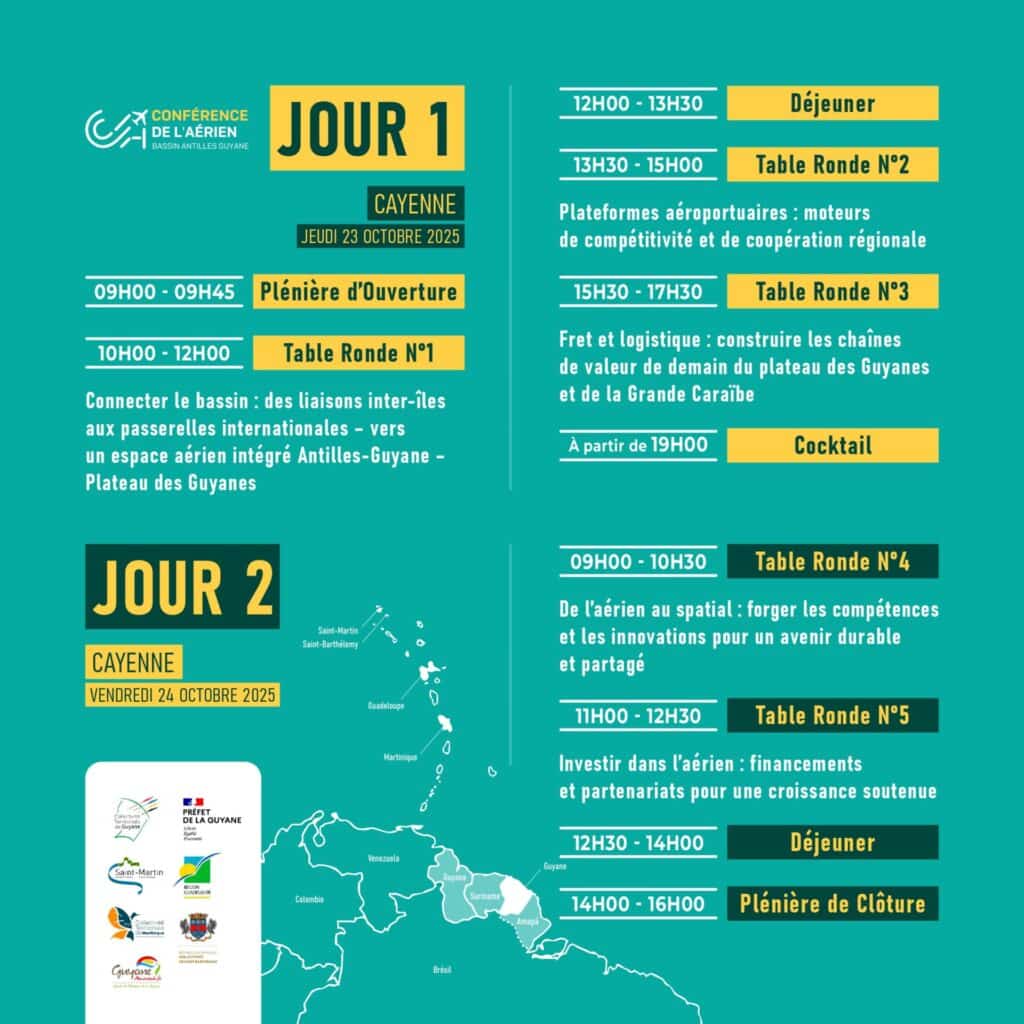
The official program for October 23 and 24, 2025
The round tables and plenary sessions announced will provide a concrete framework for the priorities emerging from the preparatory workshops. The two-day format will enable the Airline 2025 Conference to move from strategic reflection to operational commitments.
Day 1 – Thursday, October 23, 2025, Cayenne
- 🕐 12:30 pm – 2:00 pm : Inaugural lunch.
- 🕐 2:00 pm – 4:00 pm : Opening plenary – Connecting the basin: from inter-island links to international gateways – towards an integrated Antilles-Guyane airspace – Plateau des Guyanes.
- 🕐 16h00 – 18h00 : Round Table 1 – From air to space: forging skills and innovations for a sustainable, shared future.
- 🕐 7:00 pm: Welcome cocktail.
Day 2 – Friday, October 24, 2025
- 🕐 09h00 – 09h45 : Opening plenary.
- 🕐 10h00 – 12h00 : Round Table 2 – Airport hubs: drivers of competitiveness and regional cooperation..
- 🕐 12h00 – 13h30 : Lunch.
- 🕐 1:30 pm – 3:00 pm : Round Table 3 – Freight and logistics: building tomorrow’s value chains in the Guiana Shield and Greater Caribbean..
- 🕐 3:30 pm – 5:30 pm : Round Table 4 – Investing in air travel: financing and partnerships for sustained growth.
- 🕐 17:30 – 18:00: Closing plenary.

Strategic challenges for the region
The Airline Conference 2025 aims to provide clear answers to several major challenges. The Airline Conference 2025 aims to ensure the continuity of inter-island links, strengthen training, accelerate the ecological transition and modernize freight. It will also lay the foundations for a regional fund, by formalizing public-private partnerships.

An assertive political dimension
The Airline Conference 2025 goes beyond the technical framework: it symbolizes a strong political will. After Martinique in 2024, French Guiana is keeping its promise to organize this second edition, and asserting its strategic position in Caribbean cooperation.
On October 23 and 24, Cayenne will become the focal point for the region’s aviation and space ambitions. The Airline 2025 Conference will mark a new stage in regional cooperation.
