
French Guiana – Climate: Guyaclimat forecasts for French Guiana to 2100

Guyaclimat

A scientific program to anticipate the future climate

Guyaclimat is a benchmark study that analyzes the climatic transformations expected in French Guiana up to 2100. Carried out by Météo-France and the Bureau de recherches géologiques et minières (BRGM), this program is based on detailed regional projections to be released in 2022. The results provide a basis for action by local authorities, developers and economic players.

A response to targeted local demand

Specific needs in the face of the limitations of global models

For a number of years, Guyanese decision-makers have been calling for projections tailored to the realities of the territory. Although the IPCC’s global climate models are accurate on a planetary scale, they are not sufficient for effective planning on a local scale. Guyaclimat meets this need by providing analyses of five parameters: temperature, precipitation, wind, waves and sea level.

Multi-stakeholder financing

This project is supported by the Direction Générale des Territoires et de la Mer (DGTM), the Agence Française de Développement (AFD), the Agence de la Transition Ecologique (ADEME), the Office de l’Eau de Guyane, Météo-France and BRGM.

Guyaclimat
©Dans les forêts de Guyane

An adapted scientific methodology

Local data and advanced modeling

Guyaclimat teams combined field surveys, local observation data and global climate simulations from the sixth CMIP6 exercise. Downscaling of the global models was carried out with quantile-quantile bias correction, using the long series of observations from Guyana’s weather stations.

Climate scenarios

For atmospheric variables, two socio-economic scenarios were used: SSP2-4.5 (moderate emissions) and SSP5-8.5 (high emissions). For sea-level rise, the study uses the RCP2.6, RCP4.5 and RCP8.5 scenarios, as well as a scenario high-end for extreme cases.

Guyaclimat
©Météo-France Guyane

Temperatures: a sustained and marked rise

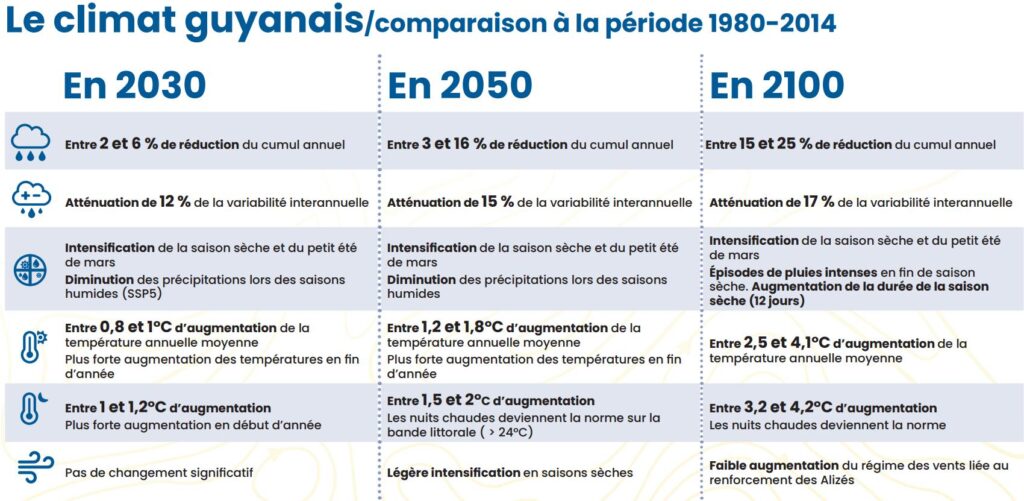
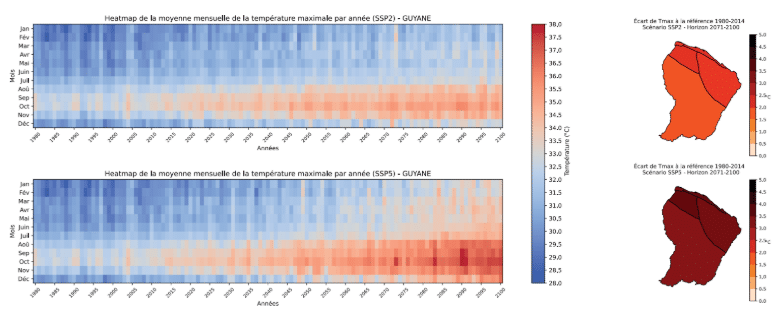
According to Guyaclimat, warming between now and 2100 will be between +1.5°C and +4°C, depending on emissions trajectories. Maximum temperatures could rise by +2.5 to +4.1°C, especially between August and November. In the Cayenne-Matoury area, afternoons would regularly exceed 34°C in the SSP5-8.5 scenario.

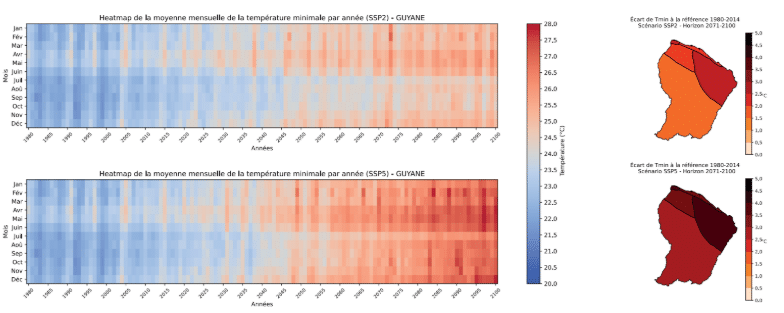
Minimums are expected to rise from +3.2 to +4.2°C, leading to more frequent hot nights throughout the year, with direct implications for public health and energy consumption.

Guyaclimat
Changes in maximum temperatures in French Guiana from 1980 to 2100 for both scenarios ©Météo-France Guyane
Guyaclimat
Changes in minimum temperatures in French Guiana ©Météo-France Guyane

Precipitation: more intense dry seasons

Guyaclimat simulations indicate an annual fall in precipitation of between -3% and -26%, depending on the scenario. This decrease would be particularly marked during the “little summer of March” and the long dry season. In September, the drop could reach -75% in some areas.

These trends would accentuate water stress and put pressure on forest ecosystems, whose equilibrium depends on regular water supplies.

Guyaclimat
Rainfall trends in French Guiana ©Météo-France Guyane

Sea level: the growing risk of chronic submersions

Guyaclimat forecasts a mean sea-level rise of +0.84 m by 2100 in the RCP8.5 scenario, with an uncertainty of between 0.59 and 1.17 m. This rise favors chronic submersions: temporary flooding occurring during high tides, even in calm weather.

The maps produced by the study identify vulnerable areas, in particular Cayenne, Kourou and Mana, and provide essential tools for guiding coastal development policies.

The Amazon rainforest, an ecological pillar under pressure

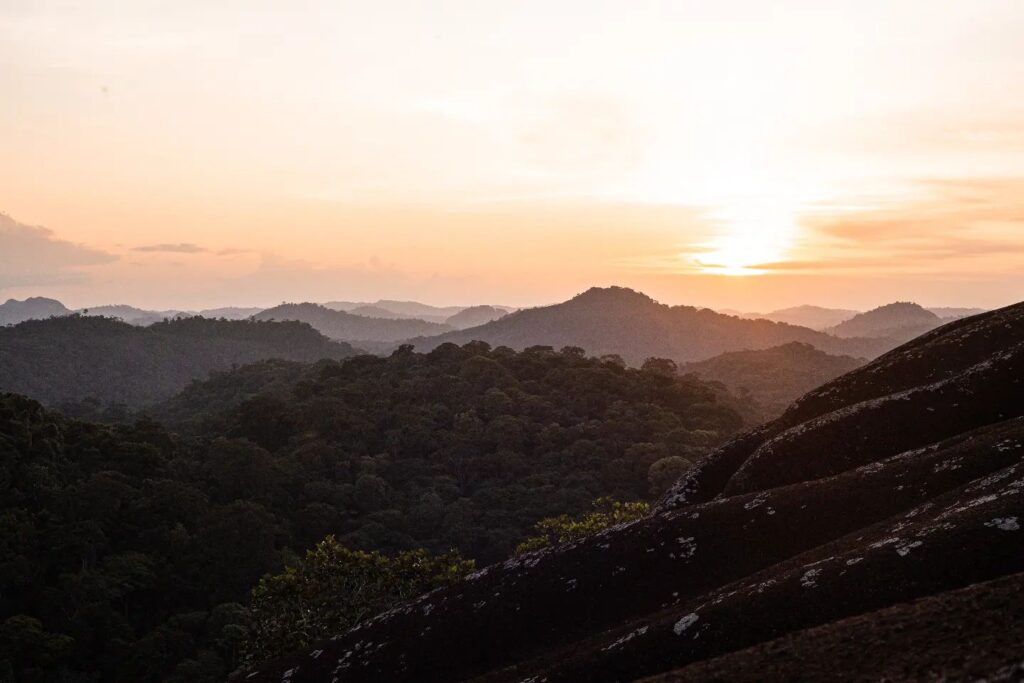
Covering around 97% of the country, Guiana’s forests are a major carbon sink. Guyaclimat points out that rising temperatures can reduce this capacity: in hot weather, trees close their stomata, slowing down photosynthesis and growth, thus limiting the absorption of carbon dioxide.

Guyaclimat
©Dans les forêts de Guyane
Guyaclimat
©Dans les forêts de Guyane
Guyaclimat
©Dans les forêts de Guyane
Guyaclimat
©Dans les forêts de Guyane
Guyaclimat
©Dans les forêts de Guyane
Guyaclimat
©Dans les forêts de Guyane

A strategic tool for adaptation

Guyaclimat is not limited to scientific analysis: it provides public and private players with a basis for decision-making. Projections can be integrated into development, resource management and risk prevention plans. The water, agriculture and energy sectors thus have reliable data with which to adapt their strategies.

Guyaclimat’s forecasts for 2100 highlight profound transformations: marked warming, reduced rainfall, rising sea levels and increased pressure on biodiversity. These findings call for swift, coordinated, science-based action to preserve the region and its inhabitants in the face of the century’s climatic challenges.

Leave a Reply

Your email address will not be published. Required fields are marked *

More articles from RK

Adhésion de la Martinique à la CARICOM
NEWS
Tolotra

Martinique’s accession to CARICOM: the National Assembly completes the French sequence

On January 28, 2026, the French Senate sent a strong political signal in favor of Martinique’s Caribbean roots. On April 16, the French National Assembly approved the agreement on accession to the Protocol on the Privileges and Immunities of the Caribbean Community. Clearly, Martinique’s membership of CARICOM has reached a decisive stage in the French procedure, following a process that began with the signing of the agreement in Bridgetown on February 20, 2025. From Senate vote to National Assembly agreement This sequence gives real continuity to the Senate vote in January. With the vote on April 16, France has now completed the parliamentary phase of this dossier. The French Ministry for Overseas Territories speaks of “definitive approval” of the agreement by the French Parliament, confirming that Martinique’s membership of CARICOM is now moving forward on a consolidated institutional basis, even if the legal wording still needs to be clarified. What

Read More »
Los Roques
TOURISM
Tolotra

Venezuela – Los Roques: another view of the Venezuelan coastline

In northern Venezuela, Los Roques is a unique territory. Far from the large mountainous islands of the region, this archipelago is made up of hundreds of islets, reefs and sandbanks. Here, the landscape is based on water, light and the horizon. The absence of marked relief, the clarity of the lagoons and the scattering of cayos give Los Roques an instantly recognizable identity. For travellers, Los Roques is not a classic island. It’s a fragmented space, where each move opens onto a new setting, often only a few minutes away by boat. An archipelago structured around Gran Roque At the heart of Los Roques, Gran Roque Island is the main entry point and inhabited center. This is where you’ll find the airstrip, accommodation and services. The village, made up of low, colorful houses, concentrates the archipelago’s human activity. This centralization makes the area even more legible. From Gran Roque, visitors

Read More »
Loto du Patrimoine 2026
HISTORY & HERITAGE
Tolotra

Loto du Patrimoine 2026: three sites that tell the living memory of Guadeloupe, French Guiana and Martinique

The Loto du Patrimoine 2026 is more than just a list of endangered monuments. For the Caribbean territories, this selection highlights three sites that each bear a sensitive part of local history: the Maison de l’historien Lacour in Basse-Terre, Guadeloupe, the former mill of the Loyola dwelling in Rémire-Montjoly, French Guiana, and the church of Notre-Dame-de-la-Visitation in Gros-Morne, Martinique. The French Ministry of Culture has selected them as one of the 18 emblematic regional sites for the 2026 edition. Why the Loto du Patrimoine 2026 is important for the Caribbean For a media attentive to the Caribbean, this selection has a particular significance. It shows that the Loto du Patrimoine 2026 doesn’t just fund technical worksites: it also supports places that structure collective memory, urban identity, historical narratives and cultural transmission. Since 2018, the Mission Patrimoine lottery has raised over 210 million euros and supported 1,080 sites; 70% of projects

Read More »

conTACT RK

we'd love to have your feedback on your experience so far

Join The List

Join our Richès Karayib community!  Sign up for our newsletter.

Want To Maximize Your Business Presence On Riches Karayib?

Complete the form to start the application