Cut Iron in Haiti: Art Born from Cemetery Crosses

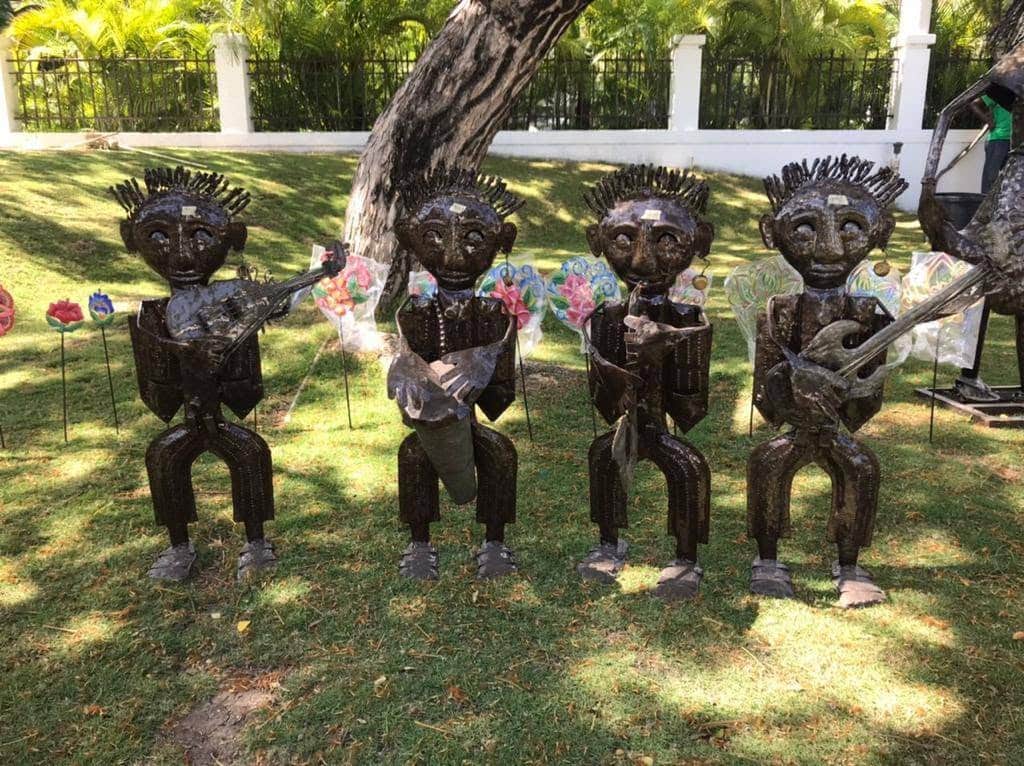
Four hammered metal musician sculptures lined up on the grass

In 1953, in a cemetery in Croix-des-Bouquets, two men stopped in front of some iron crosses. They were crafted by a blacksmith named Georges Liautaud. From this funerary gesture comes Haitian cut iron, an art form of hammered metal drums that artisans in Noailles have passed down ever since, in a village plagued by insecurity.

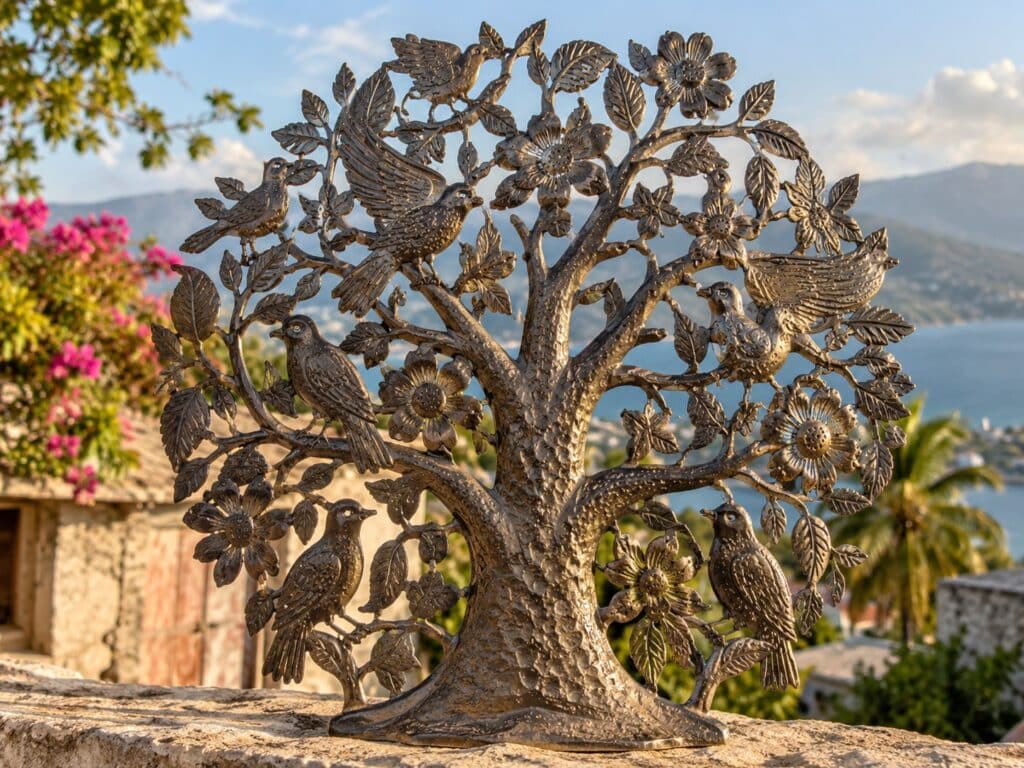
Cut-iron tree of life decorated with birds and flowers, set against a bay landscape

An Iron Cross at the Croix-des-Bouquets Cemetery

In 1953, some iron crosses caught the attention of two visitors at the Croix-des-Bouquets cemetery, about a dozen kilometers northeast of Port-au-Prince. DeWitt Peters, founder of the Centre d’Art in the capital, was accompanied by the painter Antonio Joseph. They tracked down the artist and encouraged him to become a sculptor. His name was Georges Liautaud. He was a blacksmith. He made these crosses for the Catholic graves in his town, just as he made farming tools.

Georges Liautaud: From Railroads to Sculpture

Georges Liautaud was born in Croix-des-Bouquets on January 26, 1899. He trained as a mechanic with a railroad company in the Cul-de-Sac Plain. Starting in 1926, he worked for five years for the Haitian American Sugar Company, where he repaired railroad tracks. In 1947, he returned home and opened his own blacksmith shop. There, he produced machine parts, livestock equipment, and tools, and crosses.

After meeting Peters, he changed direction. His sculpture draws on Vodou mythology, Christian history, and everyday Haitian life. The mermaid became his favorite subject.

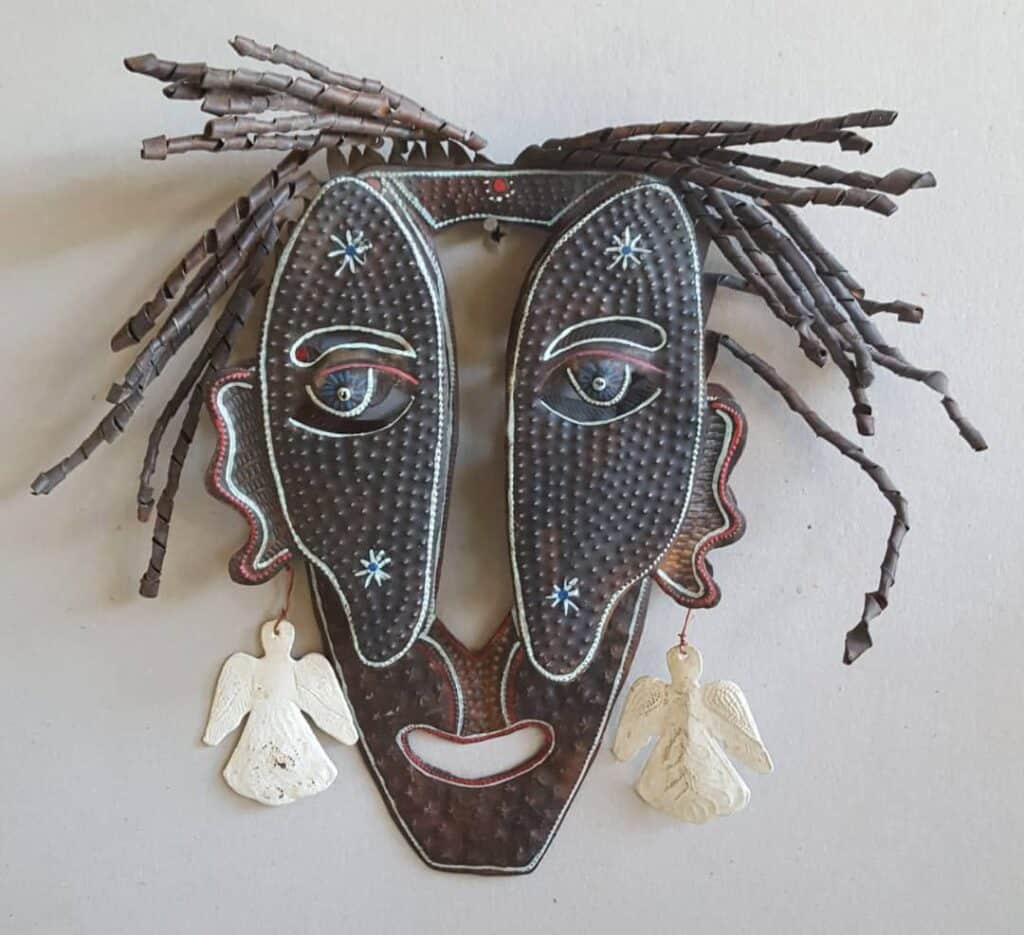
Hammered metal mask with spiral hair and two small white angels as pendants
Hammered metal mask with small angels © Village Artistique de Noailles – Facebook

How is cut iron made in Haiti?

It all starts with a used fuel drum. According to Haiti’s Inventory of Intangible Cultural Heritage, artisans remove the bottom and lid with a chisel and hammer, heat the drum to burn off the paint, and then flatten it between an anvil and a hammer. The resulting sheet measures approximately 186 centimeters by 86.

Hands of an artisan striking a chisel with a hammer on an engraved metal plate

The design is sketched in pencil or chalk. The cutting is done “strictly cold,” with a chisel and a hammer. The relief is created through chiseling and repoussé, using a punch or sometimes a nail. Next come the file, sandpaper, and then the varnish, which is dried in the sun. No mechanical or electric tools are used, the inventory notes.

In 1985, journalist Jontyle Theresa Robinson visited Serge Jolimeau’s studio for the Christian Science Monitor. She found a dirt floor, an artist sitting on the floor, a hammer, and nails of various sizes for piercing metal. The pieces resemble lace.

Noailles artisan sitting on the ground hammering a cut metal plate
An artisan works a cut-iron plate in Noailles © Village Artistique de Noailles – Facebook

A Line of Workshops in Noailles

Liautaud passed on his craft. He trained Murat Brierre and the Louis-Juste brothers, who in turn trained other artisans. According to the Centre d’Art’s online exhibition, Joseph Louis-Juste began sculpting in the 1960s under Liautaud, and the brothers joined the Centre d’Art in 1968. Gabriel Bien-Aimé, born in 1951, studied under Janvier Louis-Juste. Serge Jolimeau, born in 1952 in Noailles, studied under Seresier Louisjuste and joined the Centre d’Art in 1972.

Display table with angels, colorful trees of life and white candle holders in cut iron
Angels and trees of life in cut iron, Noailles © Village Artistique de Noailles – Facebook

Noailles, a neighborhood in Croix-des-Bouquets, thus became a village of studios. The Centre d’Art now lists more than 70 studios there. In 2011, Jolimeau told the Canadian press, “I was fortunate enough to know the great master, Georges Liautaud, and the Louis Juste brothers.” That statement sums up an entire legacy.

From the Village to Museums Around the World

The iron of Croix-des-Bouquets travels. Liautaud exhibited at the Centre d’Art in 1954, at the São Paulo Biennial in 1959, at the World Festival of Black Arts in Dakar in 1965, and at the Brooklyn Museum in 1978. In 1989, he was featured in the “Magiciens de la Terre” exhibition in Paris. His works are held in the collections of the MoMA in New York and the Musée national d’art moderne in Paris, among others. He died on August 8, 1992, at the age of 93.

Noailles workshop with trees of life, a fish and cut-iron figures hung on the wall and displayed on tables
Cut-iron workshop in Noailles © Village Artistique de Noailles – Facebook

Is Noailles cut iron recognized by UNESCO?

On January 25, 2009, the AfricAméricA Foundation and the Croix-des-Bouquets Artists and Artisans Association inaugurated the Georges Liautaud Community Museum. The UNESCO office in Haiti provided $10,000 in funding. Twenty artists paid tribute to him at the opening.

Four hammered metal musician sculptures lined up on the grass
Four hammered metal musicians © Village Artistique de Noailles – Facebook

In May 2019, the Ministry of Culture announced the inclusion of Noailles cut iron in the National Register of Haitian Cultural Heritage. This is a form of national recognition. It is not an inscription on UNESCO’s Representative List of the Intangible Cultural Heritage of Humanity. In 2023, however, the organization awarded $280,092 to a safeguarding project, scheduled to run from October 16, 2023, to October 13, 2026, to support the artists and artisans of Noailles amid the security crisis. We have not yet found a final report.

Noailles Faces the Crisis

The village paid the price for this crisis. In May 2022, artisan Jacques Jean-Robert stated that the gang war was severely affecting the artisans of Noailles and that the craft must not be abandoned. In October 2022, clashes between gangs rocked the village, according to the American media outlet Hyperallergic. Maksaens Denis, of the AfricAméricA Foundation, describes a village where the sound of hammers has given way to gunfire. The Ministry of Culture condemned the attacks and said it was working with Haiti’s delegation to UNESCO.

A Showcase Yet to Be Built

On October 8, 2026, in Pétion-Ville, UNESCO presented a report on a project to support artistic creation. Culture Minister Emmanuel Ménard announced the upcoming opening of the country’s first House of Culture in Port-au-Prince, which will serve as a venue for exhibiting and selling artwork. According to the Haitian press, cut-iron artisans from Croix-des-Bouquets will be able to showcase their creations there. No specific date was given.

Metal sculptures in a garden: fish, pink flamingo, cactus and figures
Metal sculptures displayed in a garden © Village Artistique de Noailles – Facebook

Like soup joumou, which Richès Karayib wrote about in September, this cultural heritage lives on as much in the actions as in the objects themselves. Seventy-three years after the 1953 cross, the Noailles cut iron is still looking for its showcase. Who will be the first to hang its pieces there?

Frequently Asked Questions About Cut Iron in Haiti

Cut iron is a Haitian art form of sculpting recycled drum metal, flattened and then cut cold, by hand, with a chisel and a hammer. It is associated with Croix-des-Bouquets, the village of Noailles, and the blacksmith Georges Liautaud.

Georges Liautaud was a Haitian blacksmith and sculptor, born in Croix-des-Bouquets on January 26, 1899, and died on August 8, 1992. In 1953, DeWitt Peters, founder of the Centre d’Art, noticed his cemetery crosses and encouraged him to take up sculpting.

No, not in the sense of being inscribed on the Representative List of the Intangible Cultural Heritage of Humanity. It is listed in the Haitian National Register of Cultural Heritage, as announced in May 2019. In 2023, UNESCO funded a safeguarding project worth $280,092.

Leave a Reply

Your email address will not be published. Required fields are marked *

More articles from RK

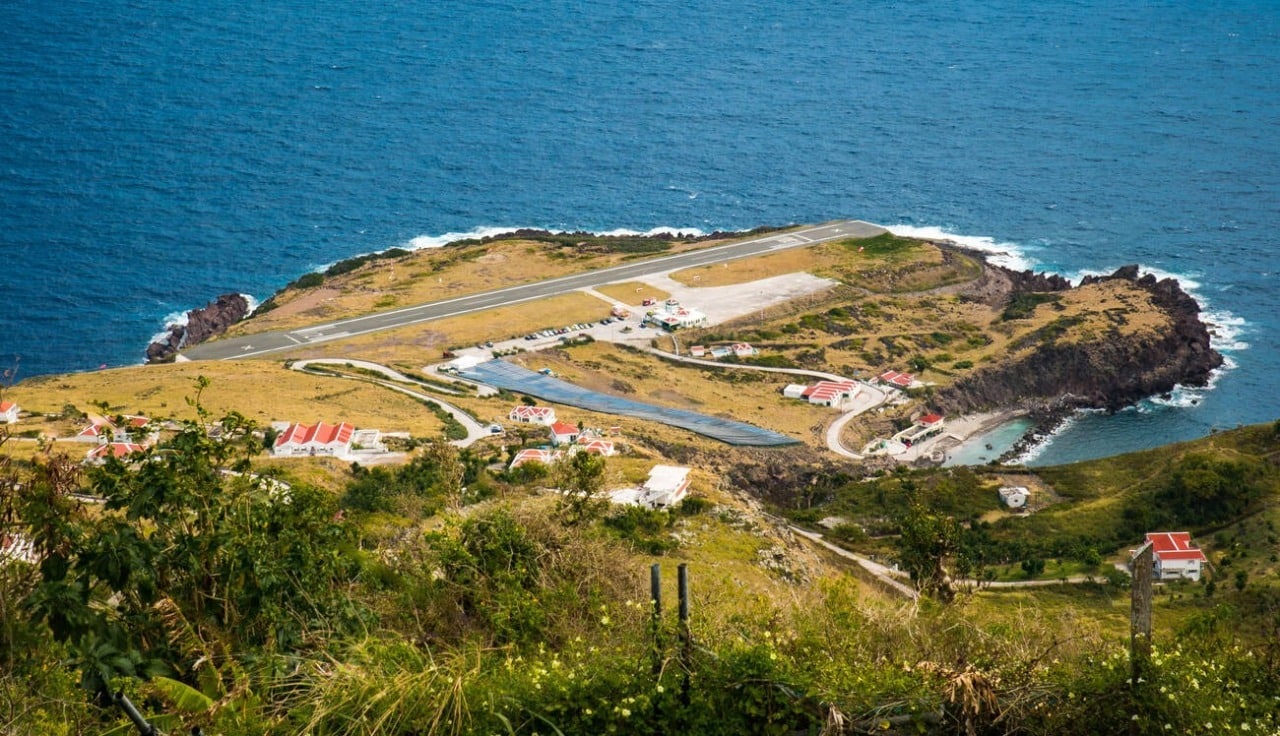
Aerial view of Juancho E. Irausquin Airport on Saba and its runway of about 400 meters between the hills and the sea
TOURISM
Tolotra

Juancho E. Irausquin Airport, a 400-meter runway to reach Saba

At Flat Point, on the island of Saba, the runway ends almost where the land meets the sea. About 400 meters long, it is part of Juancho E. Irausquin Airport, located in the Dutch Caribbean, southwest of Sint Maarten. Local authorities describe it as the airport with the world’s shortest commercial runway. But its story is not just about a record. It tells how a community established an air link where the terrain seemed to make it impossible. Why does Juancho E. Irausquin Airport have such a short runway? Saba is a small volcanic island covering about 13 square kilometers. Its steep slopes, cliffs, and scarce flat areas leave little room for infrastructure. It was at Flat Point, on the island’s coastline, that a runway was built. Official aeronautical data specify its exact length as 401 meters and its width as 18 meters. The figure commonly cited is therefore rounded.

Read More »
caribbean cinema
FILM & VIDEO
Tolotra

S10/10 – Stories of Caribbean Cinema, from Freda to Zion. Texts by Guillaume Robillard. Ciclic, 2026.

Ten episodes and more than sixty years of cinema. Since Cumbite in 1964, the series “Stories of Caribbean Cinema” has covered Cuba, Jamaica, Trinidad and Tobago, Guadeloupe, Martinique, Curaçao, Haiti, the Dominican Republic, and Antigua and Barbuda. For this final installment, Guillaume Robillard takes us to Haiti with Freda by Gessica Généus, and then to Guadeloupe with Zion by Nelson Foix. You are now watching the tenth and final episode of the series. The previous nine episodes are still available on Richès Karayib, so you can revisit the series from the beginning. 2021: HAITI – FREDA, BY GESSICA GÉNÉUS Female filmmakers are rare in Caribbean cinema. In addition to those already mentioned in this timeline, we can mention the Afro-Cuban Sara Gómez from Cuba, known for her docudrama In a way (In a certain way), released in 1977, was the very first film directed by a woman in this country,

Read More »

conTACT RK

we'd love to have your feedback on your experience so far

Join The List

Join our Richès Karayib community!  Sign up for our newsletter.

Want To Maximize Your Business Presence On Riches Karayib?

Complete the form to start the application