In Santo Domingo, on the banks of the Ozama River, the Fortaleza Ozama has weathered more than five centuries of Dominican history without ever falling into the hands of an attacker. It held the father of Dominican independence captive, served as a political prison under the Trujillo dictatorship, and withstood tank fire during the 1965 civil war.
Now a UNESCO World Heritage Site, the oldest European-built fortress still standing in the Americas continues to preserve, almost intact, the memory of a nation.
An arrival in chains, August 27, 1844
On August 22, 1844, Juan Pablo Duarte was arrested in Puerto Plata. Five days later, on August 27, he entered the Fortaleza Ozama in Santo Domingo. The government led by Pedro Santana had just declared him a traitor to the nation. Duarte, who had planned and led the young Dominican Republic to independence, was imprisoned in the dungeons of the Torre del Homenaje, the watchtower overlooking the Ozama River. He remained there for only a few days.
On September 10, 1844, he was deported to Hamburg, far from the country he had just helped bring into being. Two other figures of the independence movement, Francisco del Rosario Sánchez and Ramón Mella, also found themselves behind the walls of that same fortress amid the climate of political suspicion that prevailed during the first weeks of the young republic.
The oldest fort in Europe still standing in the Americas
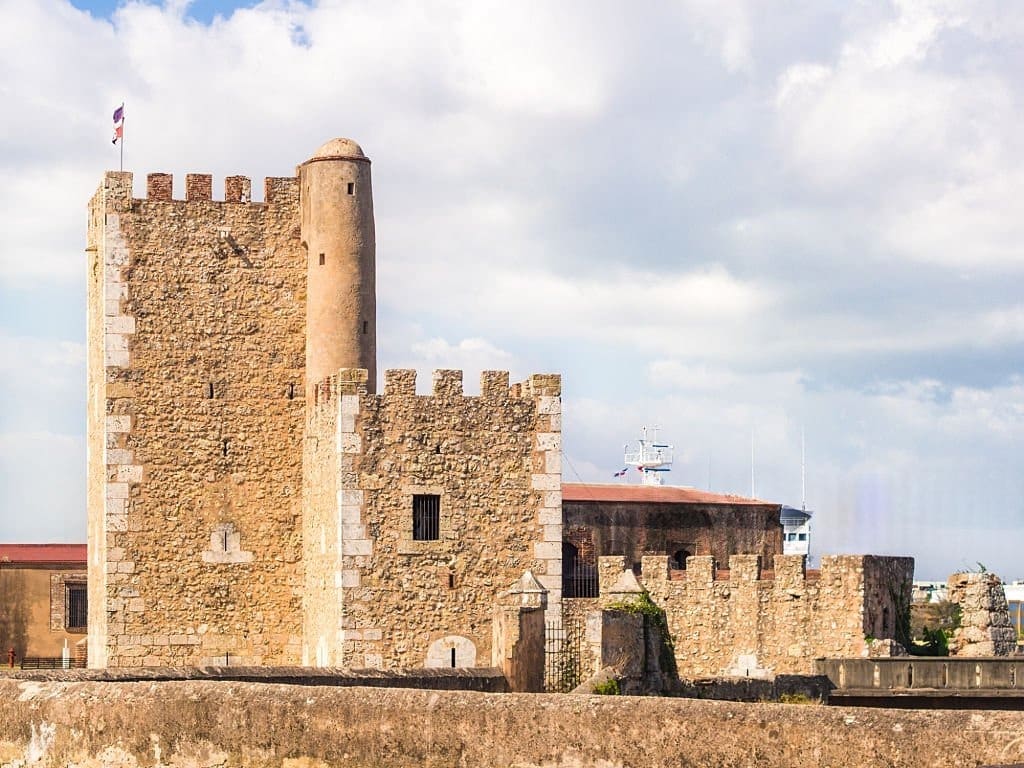
Fortaleza Ozama stands in the Colonial Zone of Santo Domingo, on the east bank of the river that gives the Dominican capital its name. Construction began in 1502 under the authority of Spanish Governor Nicolás de Ovando, who had just taken office on the island. Construction was completed a few years later, around 1507 or 1508, according to Dominican sources. The result is, to this day, the oldest military structure of European origin still standing in the Americas.
Its main tower, the Torre del Homenaje, stands about eighteen meters tall and served as a lookout post to monitor the Caribbean coast and spot enemy ships or pirate attacks. In the 18th century, in 1787, a gunpowder magazine with walls three meters thick, the Polvorín Santa Bárbara, was added to the defensive complex. Despite several attempts to attack it over the centuries, the fortress was never taken by force.

Such longevity is rare in a region where stone rarely withstands the test of time as well as memory does. Three centuries later, another Caribbean fortress listed as a UNESCO World Heritage Site, the Citadelle Henri in Haiti, would be built for the opposite reason: to protect a hard-won independence rather than to establish colonial rule. Two forts, two centuries, two histories of power that echo one another without being alike.
A Prison for Three Generations of Dominicans
The political history of the fortress does not end in 1844. Under Rafael Trujillo’s dictatorship, between 1930 and 1961, the cells in the Torre del Homenaje, nicknamed Las Solitarias, served as interrogation rooms for political opponents. The future Dominican president Juan Bosch was detained there in the early 1930s.
The writer Juan Isidro Jimenes Grullón, who would later recount those years in a book with the blunt title *Una Gestapo en América*, was also held in these dungeons, as was the poet Fabio Fiallo, who was imprisoned for his opposition to the U.S. military occupation. Three generations of Dominican dissidents, separated by nearly a century, thus found themselves behind the same stone walls.

The Breach of 1965
In April 1965, in the midst of the Dominican Civil War, the fortress once again became a military target. Constitutionalist fighters stormed the garrison, then held by police under the command of Colonel Germán Despradel, to seize its weapons.
A tank shell blew a hole in one of the walls, a mark of a clash that cost the life of one of the attackers, Illio Capocci. In the years that followed, the site’s use as a military and prison facility gradually faded, until it was completely transformed into a heritage site open to the public.

The Legend That Doesn't Stand the Test of Time
One name comes up often in accounts of the Fortaleza Ozama: that of Christopher Columbus, who is described as one of its famous prisoners. The story is appealing, but impossible. Columbus was arrested and sent back to Spain in chains in 1500, two years before construction of the fortress even began in 1502.
This confusion, though proven false by Dominican historians, continues to appear even in official tourist materials. It speaks volumes about how a place so steeped in real history sometimes ends up attracting, on top of that, made-up stories.
From a prison to an immersive museum
Today, Fortaleza Ozama houses a museum that uses 360-degree immersive projection to recount five centuries of Dominican history within the very walls where those events unfolded. Visitors who climb the steps of the Torre del Homenaje today pass by the same river that Spanish sentries once watched over, and the same courtyard where Duarte spent his final days on Dominican soil before going into exile.
One question remains, one that the fortress itself never quite answers: how many other places throughout the Caribbean still silently hold entire swaths of national memory that have yet to be told.

Fortaleza Ozama is a Spanish fortress whose construction began in 1502 in Santo Domingo. It is considered the oldest standing military structure of European origin in the Americas and has been part of the UNESCO World Heritage Site “Colonial City of Santo Domingo” since 1990.
No, this widely held belief is chronologically impossible. Christopher Columbus was arrested and sent back to Spain in 1500, whereas construction of the Fortaleza Ozama did not begin until 1502, two years later.
Yes, the fortress is open to the public in the Colonial Zone of Santo Domingo and now houses a museum that traces its history through an immersive experience. Please confirm visiting hours and guidelines directly with the Dominican heritage authorities before planning a visit.