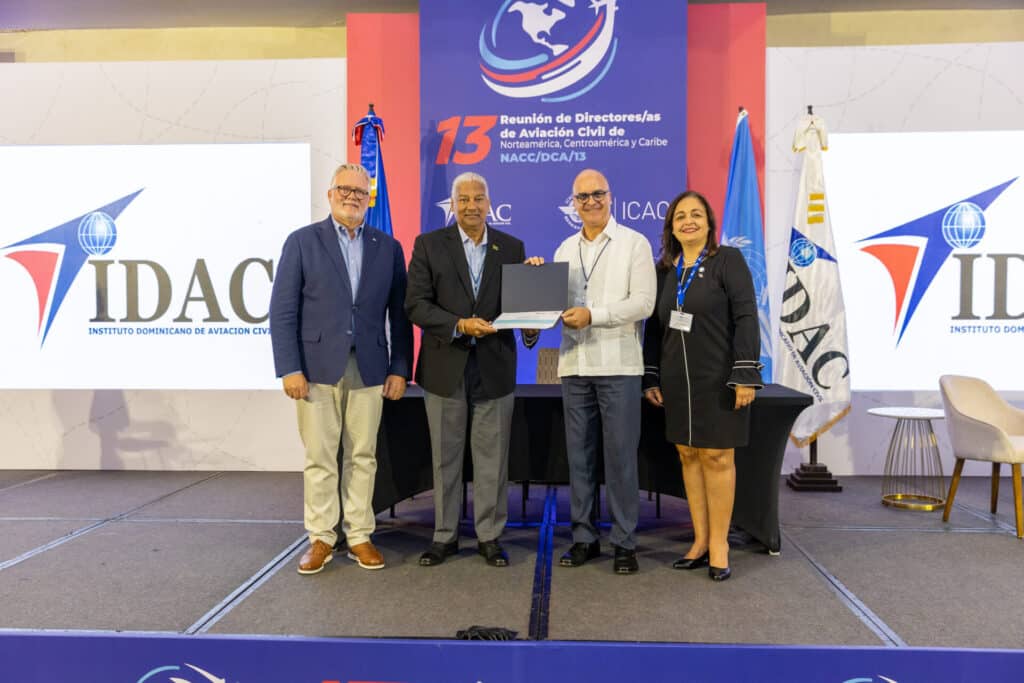
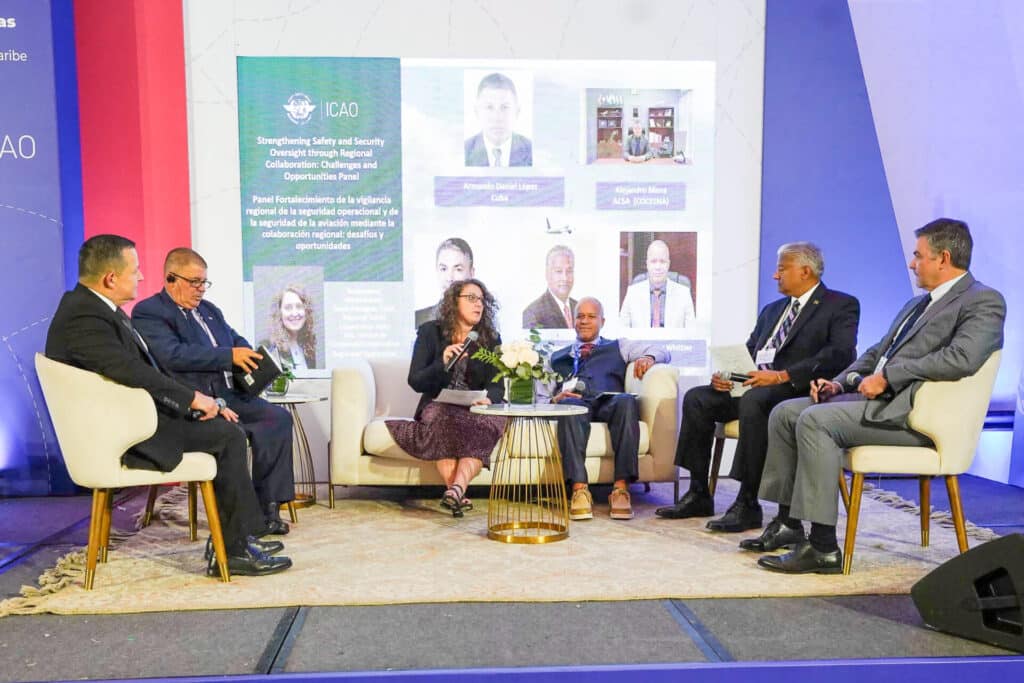
The 13ᵉ Meeting of Civil Aviation Directors of North America, Central America and the Caribbean (ICAO NACC/DCA/13) brought together public decision-makers, civil authority officials and technical partners to set regional priorities for safety, interoperability and connectivity. The meeting was held at the Santo Domingo Sheraton, under the aegis of the NACC regional office of the International Civil Aviation Organization and the Dominican Institute of Civil Aviation (IDAC).
At the heart of the discussions, the Collectivité Territoriale de Martinique (CTM), through the Direction de la Sécurité de l’Aviation Civile Antilles-Guyane (DSAC-AG), presented two structuring projects: the First Air Conference in Martinique and the LAC eFTI4all pilot site. The stated aim is to strengthen long-haul and intra-regional links, optimize freight, accelerate the dematerialization of information flows and place the region on a path of innovation at the service of the Greater Caribbean, in line with ICAO NACC/DCA/13.
Assumed visibility in a strategic forum
The ICAO NACC/DCA/13 format is a major operational rendez-vous for civil authorities in the area, with agendas, technical sessions and planning workshops aimed at sharing feedback and common roadmaps. Held from August 4 to 7, 2025, it confirms the importance of this forum for member states and territories.
In this context, Martinique relies on the DSAC Antilles-Guyane – the competent authority for Martinique, Guadeloupe, French Guiana, Saint-Barthélemy and Saint-Martin – to carry out its priorities: safety, quality of service, fluidity of operations on the ground and in the air, coordination with port and logistics infrastructures, in line with the commitments reiterated at ICAO NACC/DCA/13.
Two key announcements
These two announcements are part of the roadmap discussed at ICAO NACC/DCA/13 and supported by the Territory’s Logistics Strategy Commission, chaired by Sandra Casanova at the instigation of Executive Council President Serge Letchimy.
1) First Airline Conference in Martinique
Conceived as a working meeting between companies, infrastructure managers, service operators and institutional players, the conference has three aims:
- ✅Strengthen connections (long-haul and intra-regional) to improve service, reduce dependence on a few hubs and secure territorial continuity;
- ✅Improving freight capacity, a decisive factor in the competitiveness of export industries and the supply of island markets;
- ✅Accelerate innovation (equipment and procedures), with a focus on energy efficiency and operational performance.
The conference is intended as a catalyst to position Martinique as a key player in the regional and transatlantic air network.
2) eFTI4all LAC pilot site
The second focus is digital: Martinique serves as a pilot site for eFTI4all, a European project implementing the eFTI regulation (EU 2020/1056) and aimed at dematerializing transport documents. In concrete terms, the aim is to make information exchanges (shipments, formalities, controls) between companies and authorities interoperable and legally reliable, from the first kilometer to the last. On the scale of the Europe-Caribbean corridors, the reduction in delays, errors and administrative costs represents a direct gain for both companies and control authorities.
Why is it so important for the Greater Caribbean?
The regional economy is based on a logistics chain in which air and sea complement each other. By standardizing data and making their circulation more reliable, the approach adopted by ICAO NACC/DCA/13 makes it possible to anticipate load disruptions, improve the predictability of operations and save days on certain sensitive flows (spare parts, high-value health products). For airlines and forwarders, the challenge is not just a technological one: it’s a question of competitiveness and resilience in the face of climatic hazards, peak demand and regulatory constraints.
On the passenger side, the conference announced in Martinique should help structure more regular and better-coordinated connections between the islands and the major continental airports. Service quality depends as much on runway and departure lounge capacity as it does on procedures and the quality of data transmitted upstream. All operators will be keeping a close eye on the link between strategic thinking and practical implementation (slots, maintenance, handling, security).


Governance and cooperation
Martinique’s approach is based on clear governance: the CTM sets the course, the Logistics Strategy Commission ensures coordination, and the DSAC-AG guarantees alignment with safety and compliance requirements. This political-operational-regulatory triptych, presented at ICAO NACC/DCA/13, is essential if we are to move from announcements to achievements.


Next steps
- 🔜 Operational timetable: publication of the detailed program for the First Air Conference in Martinique (format, speakers, expected deliverables) and articulation with the workstreams defined by ICAO NACC/DCA/13.
- 🔜 eFTI4all: consolidation of use cases in the LAC (Latin America & Caribbean) zone and provision of tools for companies (interfaces, exchange repositories, compliance guides).
- 🔜 Partnerships: mobilizing airlines, port operators, logisticians, research centers and administrations to test, evaluate and deploy joint solutions – with Martinique as a bridgehead.
Martinique’s active participation in ICAO NACC/DCA/13 is more than just an institutional presence: it formalizes a course where connectivity, freight and reliable data come together. The Première Conférence de l’aérien en Martinique aims to organize the ramp-up of regional links and capacity, while eFTI4all provides the digital infrastructure needed to make exchanges more fluid and secure. On a Caribbean scale, the challenge is clear: boost performance without compromising on safety or transparency of operations.