Quadrille: dance memory and living heritage of the West Indies

Quadrille

In the French West Indies, the Quadrille is more than just a traditional dance. It is a strong cultural marker, a space for transmission and a living testimony to the social history of the Caribbean territories. Practiced for over a century in Guadeloupe and Martinique, this choreographic art illustrates the capacity of Caribbean societies to transform forms inherited from Europe into deeply rooted expressions of identity.

From European salons to West Indies town squares

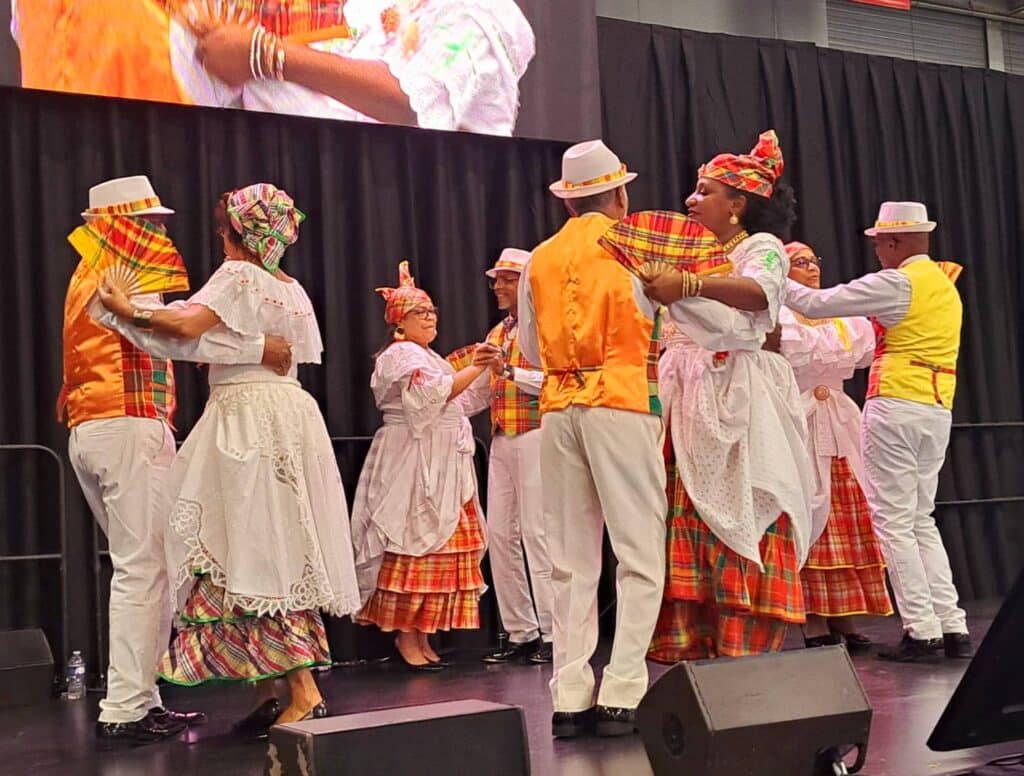
Originally, this dance appeared in European aristocratic salons in the XVIIIᵉ and XIXᵉ centuries. Imported into the French Caribbean colonies during the colonial period, it was initially reserved for the elites of large homes. The rules are strict: four couples arranged in a square perform a succession of codified figures, carried by regular music and a measured tempo.

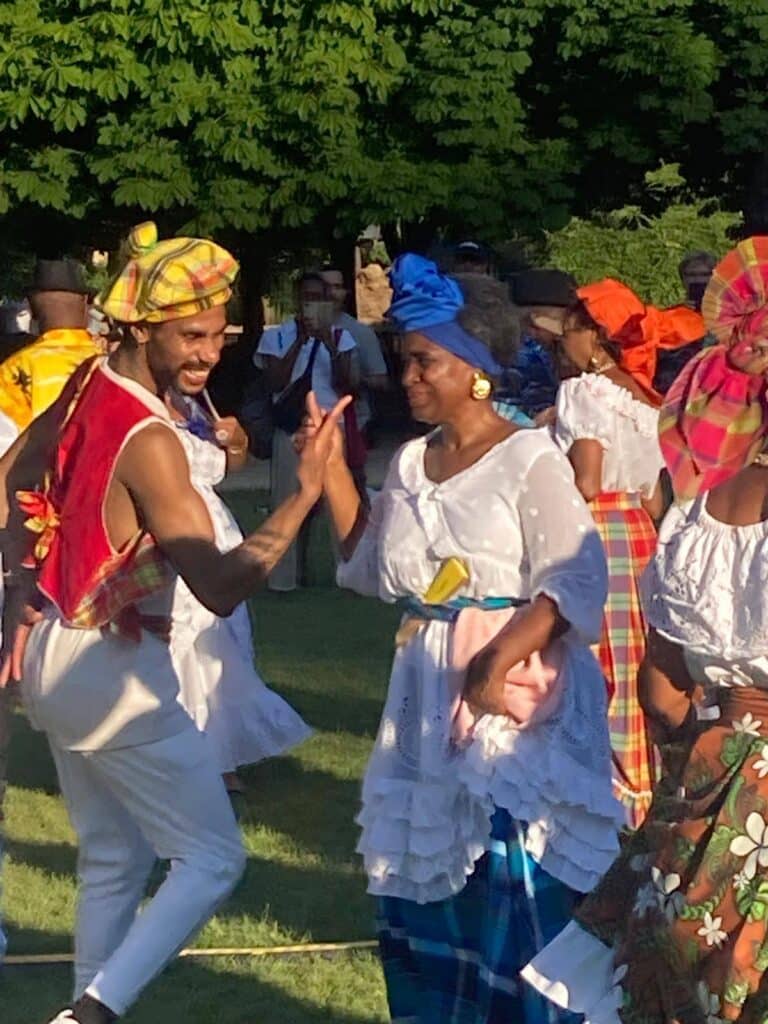
Over time, this practice moved out of closed circles and into popular spaces. It took root in villages, at community festivals and rural gatherings. This social shift marked a decisive turning point: dance changed function, audience and meaning. It ceased to be a simple form of social entertainment and became a collective moment, anchored in everyday life.

A profoundly Creole transformation

Le Quadrille has never remained static in the West Indies. It has been transformed by contact with local realities, in a gradual process of creolization. The music evolves, integrating violin, drum, chacha or accordion depending on the territory. Rhythms become more flexible, sometimes more intense, and melodies are imbued with Caribbean sensibilities.

Traditional figures – pants, summer, hen, shepherdess, final – keep their original French names, but their interpretation changes. Movements become more expressive, exchanges between dancers more intense, and the relationship with the audience stronger. The result is a lively form, both structured and free in its execution.

Quadrille
©Alfred Desirée (UCV) 2

Words at the heart of dance

One element in particular distinguishes the West Indian Quadrille: the importance of orality. The commander, or leader, announces the figures aloud, often in Creole. This rhythmic speech guides the dancers, structures the choreography and creates a constant link between music and movement.

In the Quadrille oral transmission plays a central role. It enables us to learn without the need for written support, and favors a collective appropriation of knowledge. Dance thus becomes a space of shared memory, where everyone learns by observing, listening and practicing.

Quadrille
©Alfred Desirée (UCV)
Quadrille
©Alfred Desirée (UCV)

A fundamentally collective practice

This dance is based on a simple but essential principle: the group. It doesn’t value individual performance, but coordination and listening to each other. Each dancer occupies a precise place, and the ensemble works only if everyone respects the common framework.

Historically, this collective dimension explains its importance at key moments in social life: weddings, patronal feasts, wakes and rural celebrations. It contributes to community cohesion and reinforces the sense of belonging.

Quadrille
©Alfred Desirée (UCV)

Costumes and heritage aesthetics

The costumes associated with this tradition play a major role. Women wear long dresses, often with checks or floral motifs, accompanied by elaborate headdresses. Men wear light shirts, dark pants, sometimes vests and hats.

These outfits are not mere ornaments. They contribute to the legibility of the figures, highlight the movements and recall the historical roots of dance in West Indian society.

Quadrille
©Alfred Desirée (UCV)
Quadrille
©Alfred Desirée (UCV)

A living tradition

Today, the Quadrille remains an active practice in Guadeloupe and Martinique. Cultural associations and folk groups ensure that it is passed on, particularly to younger generations. It is presented at heritage events, festivals and cultural events, contributing to the promotion of intangible heritage.

This continuity testifies to its ability to pass through time without losing its meaning. Dance remains a vector of memory, but also a space for dialogue between past and present.

FAQ

This is a traditional dance that originated in European salons, but has been transformed by West Indian societies into a collective practice rooted in Creole culture and community life.

The dance is performed in groups, generally by four couples, under the direction of a commander who announces the figures in a loud voice. Coordination, listening and memory play a central role.

Because it transmits a collective history, combining music, dance and orality, and because it continues to be practiced and taught as an essential element of West Indian cultural identity.

Leave a Reply

Your email address will not be published. Required fields are marked *

More articles from RK

French
NEWS
Tolotra

396 million people speak French: the 2026 report reveals

The Organisation internationale de la Francophonie has published a figure that reshuffles the deck in the global language debate: 396 million people now speak French. With this total, the French language in the world rises from 5th to 4th position behind English, Mandarin and Spanish, but ahead of standard Arabic. This is more than just an announcement. It marks a fundamental change in the place of French on the international stage, and confirms that the language continues to make headway in strategic areas such as education, economic exchanges, digital technology and cultural mobility. Global progress changes the narrative around French For years, French has often been portrayed as a language of great influence, but weakened in the face of global competition. The OIF’s 2026 report introduces an important corrective. The French language in the world is not only holding its own: it is gaining ground in terms of the number
Read More »
Bonaire
TOURISM
Tolotra

Bonaire, a Caribbean island built around the sea and conservation

In the southern Caribbean, off the coast of Venezuela, Bonaire is a territory in a class of its own. Less publicized than its neighbors Aruba and Curaçao, the island has built its identity around one central principle: the protection of its environment. Here, the sea structures the economy, landscapes and customs, while tourism development has been gradual and controlled. For travelers, Bonaire offers a clear picture: a compact island, visible natural areas, an accessible coastline and an organization geared towards sustainability. An island structured by its marine park Since 1979, Bonaire’s entire coastline has been protected by the Bonaire National Marine Park which completely surrounds the island. This marine area regulates nautical activities and aims to preserve the coral reefs, considered among the best preserved in the Caribbean. One of the island’s special features is the direct accessibility of its marine sites. Diving and underwater observation can be carried out
Read More »
Marcus Garvey
HISTORY & HERITAGE
Tolotra

Jamaica – Marcus Garvey, Jamaican hero of international renown

Marcus Garvey remains one of the most influential figures to emerge from the Caribbean. Born in Jamaica at the end of the 19th century, he transformed a local experience into a political and cultural project of international scope. At a time when black populations faced deeply rooted systems of exclusion, Marcus Garvey proposed a structured vision based on dignity, organization and autonomy. Recognized today as a national hero in Jamaica, he is much more than a historical symbol. His story helps us understand how the Caribbean helped shape major intellectual and political movements on a global scale. His name continues to circulate in contemporary debates on identity, memory and the development of societies born out of colonial history. From Jamaican origins to the formation of a committed conscience He was born on August 17, 1887 in St. Ann’s Bay, Jamaica, into a modest family. Very early on, he developed a

Read More »

conTACT RK

we'd love to have your feedback on your experience so far

Join The List

Join our Richès Karayib community!  Sign up for our newsletter.

Want To Maximize Your Business Presence On Riches Karayib?

Complete the form to start the application