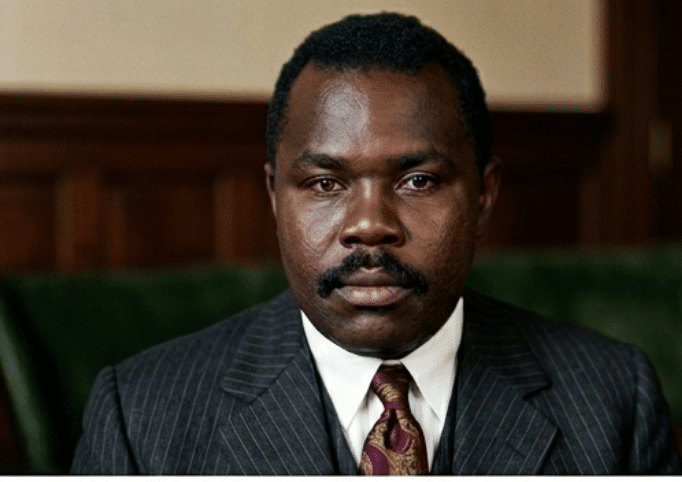
Every time you change channels on your TV, you’re using a technology invented by Raoul Georges Nicolo. This Guadeloupean engineer, born on June 21, 1923 in Gosier, was behind one of the most revolutionary devices in the history of television: the multichannel switching block. He was also the first Guadeloupean to earn a doctorate in science and join the French Atomic Energy Commission. His extraordinary career, from the son of a farmer to a pioneer in nuclear technology and telecommunications, is still too little known.
A difficult school career
Raoul Georges Nicolo was born into a modest family. His father, Sinclair Nicolo, a First World War veteran, believed in education as a lever for emancipation. Raoul, a brilliant student, entered the Lycée Carnot in Pointe-à-Pitre, but received no scholarship. He took on a series of odd jobs and bicycle races to finance his studies. In 1947, he left Guadeloupe for Paris with a dream: to become an engineer. He obtained his technical baccalaureate in France, then enrolled at the École Centrale d’Électronique. At the same time, he took evening classes at the Conservatoire National des Arts et Métiers, notably in physics and nuclear chemistry.
The inventor of the multi-channel TV set
In 1953, after graduating as a radio engineer, he joined the Thomson-Houston laboratories in Paris. There, in 1956, he invented the “multi-channel switching block”, enabling multiple channels to be received on a single TV set. Before this invention, a set could only receive a single frequency. This system marked a major turning point in the history of television. He then laid the foundations for what would become the remote control, filing several patents in Europe.
First Guadeloupean engineer at the CEA
That same year, he joined the French Atomic Energy Commission (CEA). There, he introduced electronics into nuclear control equipment, making decisive improvements to plant safety. His work focused on controlling the reactivity of atomic batteries in sub-critical regimes, contributing to the success of the French nuclear program.
Raoul Georges Nicolo was notably involved in improving the Ulysse reactor, developing prototypes such as ISIS and CABRI, and developing the PHENIX and SUPERPHENIX fast-breeder reactors. His expertise makes him a key player in the French energy transition.
A doctorate at the pinnacle of scientific recognition
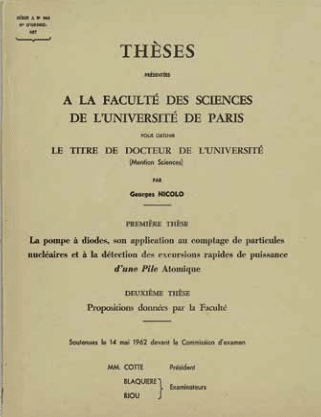
In 1958, Raoul Georges Nicolo began a thesis under the supervision of Duke Maurice de Broglie, winner of the Nobel Prize in Physics. He defended his thesis in 1962 on “the diode pump and its application to the detection of power excursions in atomic reactors”. He was awarded the “Très Honorable” distinction, the most prestigious university award. He thus became the first Guadeloupean to hold a doctorate in science, with a body of work that set a benchmark within the CEA.
Among his major contributions is a scientific work with a preface by Professor R. Guillien, entitled L’électronique dans les appareils de contrôle nucléaire. Guillien, entitled L’électronique dans les appareils de contrôle nucléaire. This book became a teaching aid abroad, confirming its author’s international stature.
Early political involvement
Right from the start of the Second World War, Raoul Georges Nicolo opposed the Vichy regime. Imprisoned aboard the school ship Jeanne d’Arc, he already showed a fierce determination to defend freedom.
In 1981, he made history as the first black candidate for the French presidential election. Claiming to be a “left-wing Gaullist”, he was unable to secure 500 sponsorships from elected representatives, but forced a debate on the visibility of overseas France and democratic transparency.
His commitment led to a major legal decision: the Nicolo ruling of October 20, 1989. This personal appeal against the European elections forced the Conseil d’Etat to recognize the superiority of international law over national law. This landmark decision, still taught in law schools, bears his name and transformed the French legal landscape.
A local player at the service of Guadeloupe
Returning to his native island, Raoul Georges Nicolo became a municipal councillor in Le Gosier from 1983 to 1989. He set up the ADIGA (Association de Défense des Intérêts Généraux des Antilles), a self-help group for young West Indians arriving in mainland France. His action, discreet but determined, touches hundreds of families.
His commitment to education and culture continued after his death, with several institutions bearing his name. In 2006, the Gosier multimedia library was renamed Médiathèque Raoul Georges Nicolo. Renovated in 2024, it now houses a medialab and RFID technologies, symbols of a forward-looking territory.
In 2011, the Lycée technique de Rivière des Pères became the Lycée polyvalent Raoul Georges Nicolo. Specializing in construction and applied arts, it offers courses ranging from BTS to DN MADE, preparing young Guadeloupeans for the professions of the future.
A living legacy
Raoul Georges Nicolo represents a model of endogenous success for overseas France. He demonstrates that scientific excellence can flourish far from the major metropolises. His message, still relevant today, encourages young people in the West Indies and Africa to turn to science:
“I would advise the black race, and in particular the French-speaking race, both African and West Indian […] to multiply its efforts in order to find the methods that allow for maximum science-oriented knowledge.”
Before his death in 1993, he received one of the highest distinctions from the International Biographical Center of Cambridge, which ranked him among the world’s great intellectual personalities.
A symbol of Caribbean intelligence
Raoul Georges Nicolo is the perfect example of a committed, rigorous and visionary intellectual. His inventions, used every day without anyone knowing their origin, are a reminder that science and creativity can be born in lands that are all too often invisible.
His name, now enshrined in law, in television history, in nuclear research and in the Guadeloupean public arena, remains a beacon for future generations. A Caribbean genius worth rediscovering.