The name SHAZ also known as Oulala Shaz, in recent years, his name has become synonymous with a modern sound architect, capable of putting his signature on projects of international stature. Born Mehdi Abbassi, this Franco-Tunisian producer and beatmaker from Essonne has made his mark in the highly competitive world of urban music. In August 2025, he is taking things a step further by coming to Martinique to share his know-how at a masterclass that promises to enrich the Caribbean music production landscape.
A career shaped by passion
Behind the SHAZ alias hides a precocious artist, trained from childhood on violin, piano, guitar and drums. This instrumental practice gave him a fine understanding of harmonies and rhythms. At just 17, he began his first digital compositions, fusing the organic and the digital. This dual skill has become his trademark: a music where electronic beats combine with multiple influences.
His rise was rapid. Published by Warner Chappell Music France , SHAZ is a prolific collaborator. In France, he has worked with SCH and Rilès, and contributed to Kalash’s album Tombolo, which includes a track with Ninho. The specialized press also cites his collaborations with Damso and Niska . Internationally, he is credited with contributing to projects alongside Migos, Young Thug and Key Glock.


From shadow to light
Long perceived as a discreet studio craftsman, SHAZ has chosen to step out of the shadows. Its objective is clear: to reach out to the public, assert its identity and pass on its experience. The creation of the channel 808CLUB alongside Alex Grox illustrates this desire to share. Conceived as a space dedicated to the culture of beatmaking, this initiative takes a behind-the-scenes look at music production and inspires a new generation of creators.
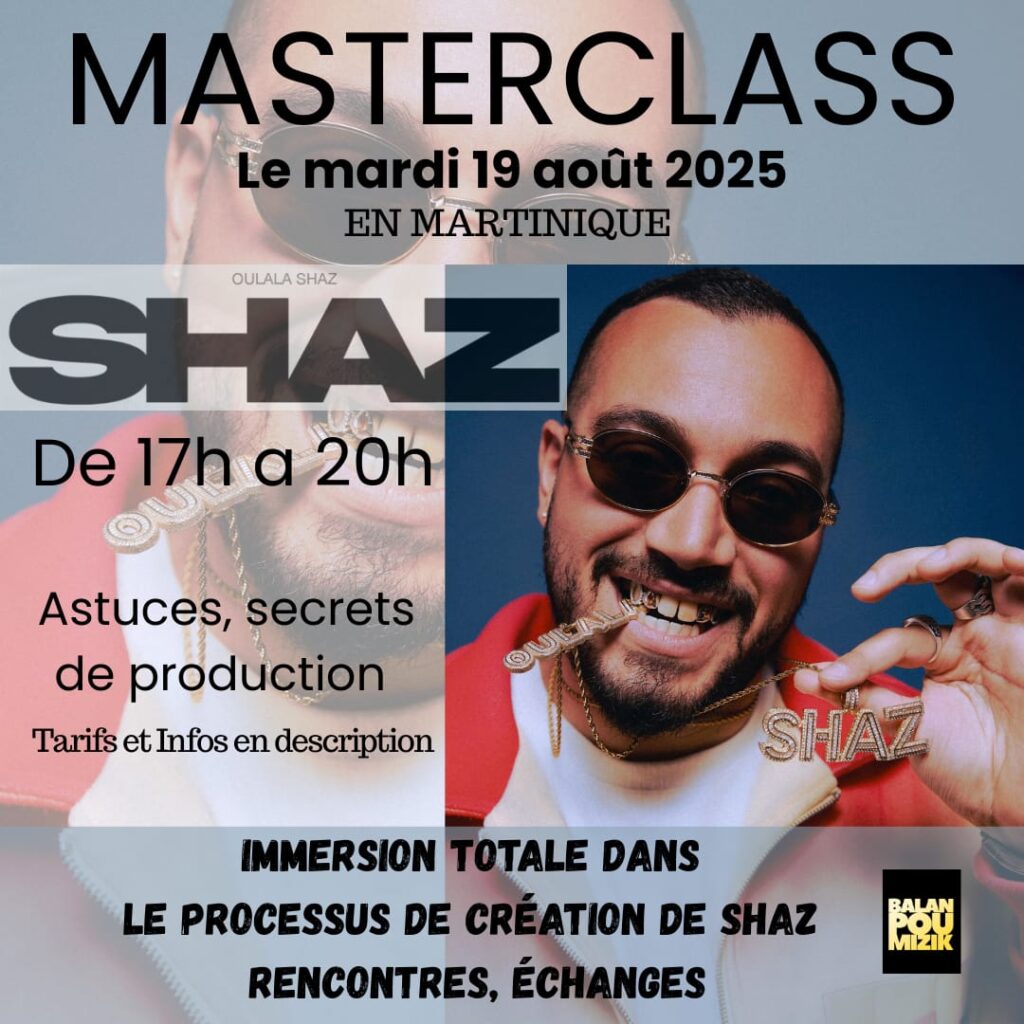
The masterclass scheduled in Martinique on August 19, 2025, from 5pm to 8pm in Le Vauclin, follows the same logic – and here’s what you need to know about participation:
- 🎟️ Single ticket (Masterclass only) : 80€ access to the three-hour workshop with SHAZ.
- 🎟️ Masterclass package + 1 video consulting session: 120€, including a one-to-one online meeting for further discussion after the workshop.
For three hours, SHAZ will share his working methods in detail: from the construction of a beat to the final arrangement, via sound choices, production software and collaboration management. The event is designed for a mixed audience – beginners and experienced beatmakers, singers, musicians – and includes a questions and answers for personalized feedback. This is not just a technical course, but also a immersion in the creative world of SHAZ with practical advice tailored to the demands of urban & Afro-Caribbean production.
An important event for the Caribbean
The value of this event goes beyond the educational framework. For the Caribbean, hosting SHAZ is a strong signal. The region abounds in talent – singers, musicians, sound engineers, emerging producers – but access to international networks and current production codes is often limited. The arrival of a producer renowned in Europe and the United States represents an unprecedented gateway.
For Caribbean artists, it’s an opportunity to observe at close quarters the working methods of a professional who has shaped contemporary hits. Understanding the structure of a track, refining the construction of a beat, analyzing technical and creative choices: these are all elements that can transform the way you approach a musical project. Local beatmakers, whether self-taught or already established, will find in this meeting concrete tools to perfect their art and increase their visibility.
Transmission and prospects
SHAZ’s masterclass is not just about technique. It carries a symbolic dimension: that of a Caribbean open to the world, capable of attracting figures from the international music scene and of valorizing its own creative forces. The initiative is aimed at all generations: from young enthusiasts keen to get started, to experienced producers wishing to enhance their skills and adapt their work to current standards.
This type of event also helps to break the isolation that some Caribbean artists may feel. By building bridges with established players in the global industry, it paves the way for new collaborations, promotes the circulation of knowledge and strengthens the local ecosystem. SHAZ’s presence in Martinique demonstrates that the Caribbean is not only a source of musical inspiration, but also a breeding ground for innovation and professionalization.


Consolidating momentum
Although the Caribbean has already seen the emergence of artists of international stature, the structuring of the music industry remains a major challenge. The SHAZ masterclass is part of this process, offering a framework where transmission and training go hand in hand with creation. It is part of a wider strategy to give Caribbean talent access to the tools, networks and knowledge that will enable them to compete on the world stage.
The context is favorable: music from the Caribbean – from dancehall to zouk, via bouyon and Afro-Caribbean sounds – is enjoying a resurgence of interest, largely driven by digital platforms and transatlantic collaborations. The arrival of SHAZ thus appears to be a catalyst, a moment when transmission feeds collective ambition.

By choosing Martinique to host a masterclass, SHAZ confirms his attachment to a territory that has already inspired him through his collaborations with Kalash . This August 19, 2025 goes beyond a simple meeting between producer and audience: it embodies a desire to build bridges between the Caribbean and the rest of the musical world. For artists, beatmakers, producers and sound enthusiasts, it’s an opportunity to tap into recognized expertise and join a professional dynamic.