Sint Maarten asserts its ability to combine gigantism and quality of welcome
Present at Seatrade Cruise Global 2025 in Miami, Sint Maarten highlighted one of its greatest strengths:
its unique ability to simultaneously welcome several of the world’s largest cruise ships, while offering a safe, smooth and welcoming experience to cruise passengers.
Through the testimony of Rensley Rollan, Port Facility Security Manager at the Port of Sint Maarten, the Dutch island affirms its ambition to combine operational excellence with Caribbean hospitality.

Impressive control over the flow of cruise passengers
For Rensley Rollan, Sint Maarten’s performance is based on meticulous organization.
The port can accommodate up to seven cruise ships simultaneously, including theIcon of the Seas, the world’s largest cruise liner.
” We are capable of handling over 30,000 passengers in a single day, which is more than the entire population of the Dutch side of the island,” he explains.
A challenge met thanks to close coordination between port teams, security forces and local authorities.

The system is reinforced on busy days:
Traffic control,
Creation of safe pedestrian zones,
Permanent patrols to guarantee passenger safety.
Even alcohol-related incidents or medical emergencies are handled with responsiveness and efficiency.
🎯 Rensley Rollan’s wish: to further expand the port in anticipation of market growth and continue to offer a seamless experience to visitors.
A lively destination, combining leisure and authenticity

Beyond its infrastructure, Sint Maarten seduces with its unique energy.
With its water sports, lively beaches, festivals, casinos and vibrant nightlife, the island is often described as a veritable “mini Las Vegas” of the Caribbean.
This diversity allows cruisers to enjoy a wide range of experiences:
Farniente on white sandy beaches,
Cultural exploration,
Creole and international cuisine,
Sports activities for all tastes.
Even during the low summer season, Sint Maarten maintains a regular cruise activity, welcoming several calls per week.
🎯 Rensley Rollan’s vision: to continue to offer a lively, rich and attractive destination, while managing the growing volumes of visitors.
Sint Maarten, the balance between power and hospitality
At Seatrade Cruise Global 2025, Sint Maarten reaffirmed its unique position as a port of excellence capable of welcoming the world’s largest ships, without ever sacrificing the human experience and quality of welcome.
With its world-class infrastructure and Caribbean energy, Sint Maarten embodies a powerful promise: to bring gigantism, fluidity and authenticity to the world of modern cruising.
The Caribbean guilder has officially become the currency of Sint Maarten, the Dutch part of the island of Saint-Martin, and Curaçao, as of April 1, 2025. It replaces the Netherlands Antillean guilder, in circulation since 1952, representing 73 years of monetary history. This change marks a major turning point on the road to economic and political independence for these two territories, which became constituent countries of the Kingdom of the Netherlands in 2010.
A historic turning point: from the Dutch Antillean guilder to the Caribbean guilder
The Caribbean guilder is the successor to a currency inherited from colonial times. Introduced in 1952 to unify economic exchanges in the former Dutch colonies of the Caribbean, the Netherlands Antillean Guilder until now symbolized the country’s economic anchorage in The Hague. The abandonment of this currency in favor of its own reflects a clear desire to emancipate itself from Dutch monetary influence.
This project follows on from the reforms undertaken since October 10, 2010, when Sint Maarten and Curaçao acquired the status of autonomous states within the Kingdom of the Netherlands. The Caribbean Guilder has thus become a tool of economic sovereignty, designed to reflect a unique identity.
A landmark launch ceremony
The Central Bank of Curaçao and Sint Maarten held a ceremony to mark the arrival of the Caribbean Guilder. During the event, Sint Maarten’s Minister of Finance, Marika Gumbs, symbolically exchanged the first denominations.
Richard Den Bosch, President of the European Central Bank, welcomed this transition, stressing that the Caribbean Guilder embodies “a symbol of confidence that will pave the way for a stable, inclusive and sustainable future”, while hailing the territories’ “lucid” choice in an uncertain global economic context.
A currency with a local design and enhanced security
The Caribbean Florin is distinguished by a design designed to represent the richness of the two territories. The range includes five banknotes (10, 20, 50, 100 and 200 guilders) illustrating the seabeds and emblematic landscapes of Sint Maarten and Curaçao. The seven coins (from 1 cent to 5 guilders) are reminiscent of ocean waves, a symbol of strength and movement.
Designed to high international standards, the new coin incorporates advanced anti-counterfeiting technologies. For production, the authorities called on service providers in Canada, Sweden and Malta, breaking with 230 years of production entrusted to the Royal Netherlands Mint.

A three-month transition phase
To ensure gradual adoption, a transitional period will run until June 30, 2025. During this phase, the old guilder can be exchanged for the new Caribbean guilder at the rate of 1 Caribbean guilder = 1.79 US dollars, the same as previously.
Information campaigns are underway to familiarize the population with the new bills and coins. The aim is to ensure a smooth transition, with no disruption to day-to-day transactions.
Economic consequences and strategic positioning
The introduction of the Caribbean guilder gives Curaçao and Sint Maarten greater control over their monetary policy, enabling them to adjust their strategy in line with regional realities, and reinforcing their economic credibility with partners and investors.
Politically, it sends a strong signal to the Caribbean and international community: that of an assertive desire to build an autonomous trajectory, without denying the historical ties with the Netherlands.
A choice that sets it apart from other Dutch Caribbean territories
While Sint Maarten and Curaçao are introducing the Caribbean guilder, other Dutch territories in the region – such as Bonaire, Saba and St. Eustatius – have opted for the US dollar. These choices reflect different economic orientations: guaranteed stability for some, monetary autonomy for others.
The positioning of Curaçao and Sint Maarten paves the way for regional reflection on the challenges of financial sovereignty in the Caribbean.
The Caribbean Florin is much more than a payment tool. It is the reflection of an ambition: that of two territories asserting their uniqueness in the Caribbean space and their ability to choose their monetary future.
Its introduction marks an important milestone in the autonomization process that began in 2010. The coming months will be crucial in measuring the real impact of this reform on local economies, but one thing is certain: this new currency marks a lasting turning point in the contemporary history of Curaçao and Sint Maarten.
NEW PERSPECTIVES
The Caribbean’s air connectivity has faced challenges with the closure of key regional airlines like AIR ANTILLES and LIAT.
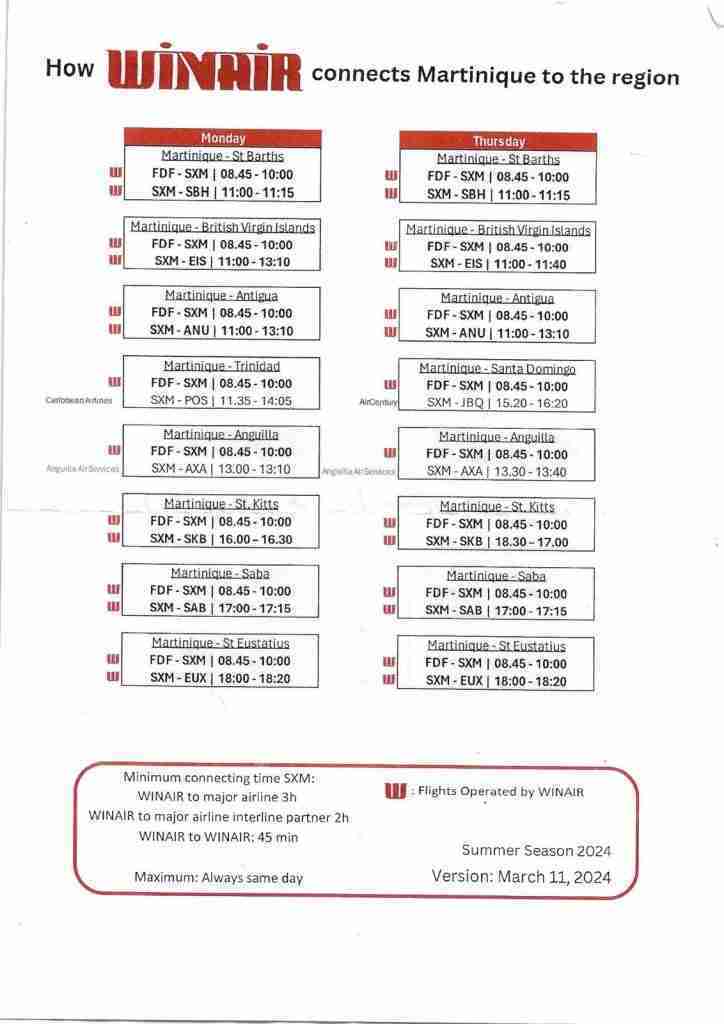
Yet, hope is on the horizon with Winair stepping in to bridge the gap. Starting April, Winair launches direct flights from Martinique to Saint Martin and Dominica, heralding a new era for regional travel.
Behind this breakthrough is a collective effort, blending vision with collaboration.
Nathalie Sébastien, of Samac, highlights the unity between the tourism board and aviation authorities in making this a reality.
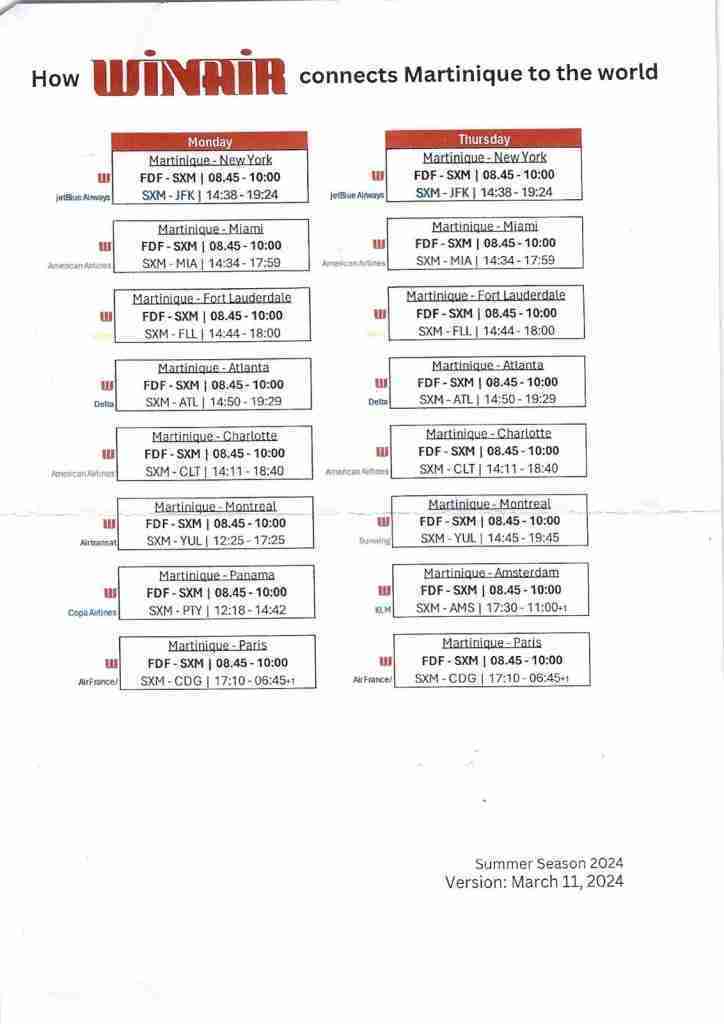
WINAIR’s CEO, Hans van de Velde, underlines the strategic alliances with major airlines like AIR FRANCE KLM, AMERICAN Airlines, JETBLUE Airways and more, ensuring a robust network that extends beyond island shores.
This expansion is not just about adding destinations; it’s about weaving a network that brings the Caribbean closer. With plans to further explore the southern arc and a commitment to seamless travel, Winair is on a mission to redefine Caribbean connectivity.
In the face of past disruptions, Winair’s initiative is a beacon of progress, signaling a brighter, more connected future for all Caribbean residents and visitors. Let’s embrace this new chapter as the skies above the Caribbean open once more.
SCHEDDULE FROM MARTINIQUE
CEO INTERVIEW: HANS VAN DE VELDE
What are your next projects to expand your air traffic ?
We are expecting the arrival of new aircraft in November of this year and the following year. We will then deploy towards the south of the region with connections to Barbados, St. Lucia, and probably St. Vincent. It is important to note that we do not only connect St. Martin to the other islands, but we also have many routes between these islands as well. We will soon open the Martinique – St. Martin connection, but why not consider, for example, a Martinique – Antigua route if it works well? The former LIAT airline actually operated this service in the past.