
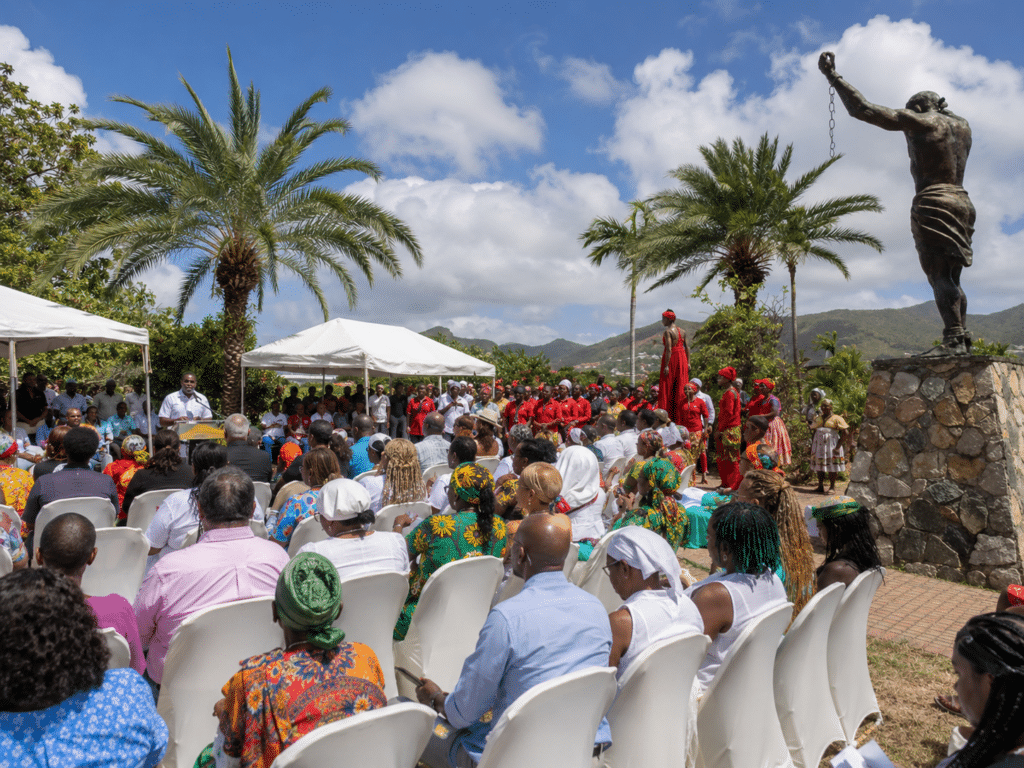
St. Maarten Emancipation Day takes on a special significance this year. On July 1, 2026, the official ceremony marking the 163rd anniversary of the abolition of slavery will be held at Belvedere Plantation, a site directly linked to the island’s history. More than just a commemoration, it is a reminder: freedom is conveyed not only through dates, but also through the places we choose to confront head-on.
St. Maarten Emancipation Day in Belvedere: More Than Just a Setting
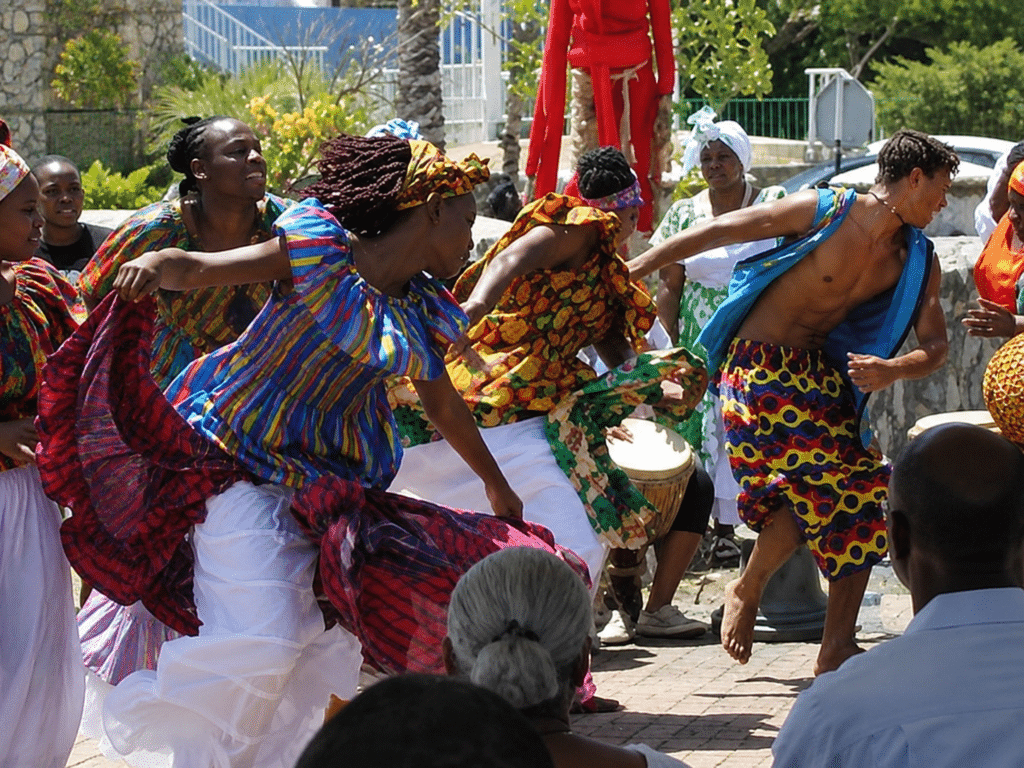
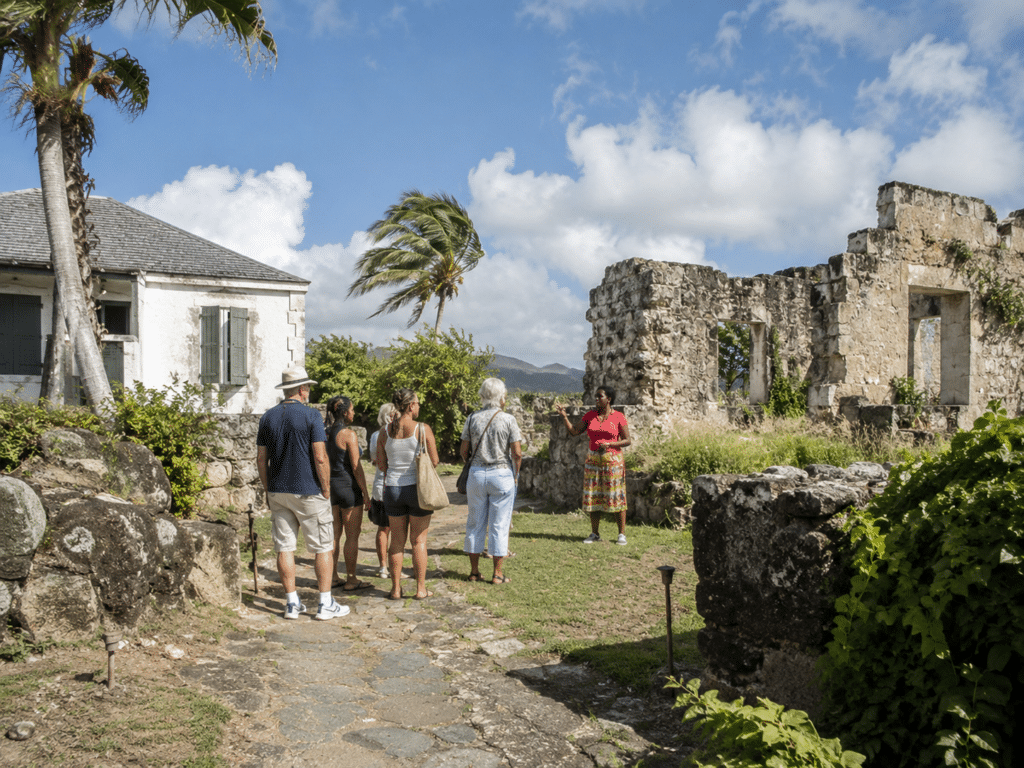
At Belvedere Plantation, this July 1st doesn’t feel like a ceremony held at a random location. The government of Sint Maarten has announced that the official event will take place at this site on Oyster Pond Road from 8 a.m. to 10 a.m., featuring speeches, poetry, songs, cultural dances, guided tours, and a historical presentation of the site. This choice speaks volumes. Belvedere is not just a historic site. It is listed on Sint Maarten’s official register of monuments. Its main house is estimated to date from around 1840, and on-site research indicates the existence of two former sugar mills on the plantation.
For St. Maarten Emancipation Day, this changes everything. Memory is no longer abstract. It returns to a specific place, to a landscape where the plantation economy, forced labor, the colonial hierarchy, and acts of human resistance have left their mark.
A date, but above all, a human story
July 1 marks the legal abolition of slavery in the Dutch colonies in 1863. Within the Kingdom of the Netherlands, this date specifically refers to Suriname and the Caribbean islands, which were under Dutch rule at the time. The Dutch government also notes that, for many people, the legal end of slavery did not immediately mean full and genuine freedom, particularly because of the forms of forced labor that followed in certain territories.
But Sint Maarten has an even more unique history. The island has been divided between two sovereign powers since the Treaty of Concordia: the Dutch part, Sint Maarten, and the French part, Saint-Martin. According to UNESCO, slavery was abolished on the French side on May 28, 1848, while it remained in effect on the Dutch side until July 1, 1863.
This border created a rare situation in the Caribbean. A single island territory had two opposing statuses: freedom on one side, slavery on the other. St. Maarten Emancipation Day therefore also tells the story of this geographical tension. On a small island, just a few kilometers could change a person’s life.
The 26 people at Diamond Estate
This is where the story takes on a deeply human dimension. On May 29, 1848, the day after slavery was abolished on the French side, twenty-six enslaved people from Diamond Estate Plantation on the Dutch side fled to Mount Fortune on the French side. There, they were recognized as free men and women.
The Dutch commander Johannes Willem van Romondt then asked the French commander to send them back. The French response was decisive: any enslaved person who reached French territory was to be considered free. This correspondence is now part of the “Route/Root to Freedom” collection, which was inscribed on UNESCO’s Memory of the World Register in 2017.
The story of St. Maarten Emancipation Day does not begin solely with a law passed far from the island. It also begins with people on the move, decisions made in haste, families crossing a border, authorities exchanging correspondence, and individuals who force history to move forward.
A memory that Sint Maarten is bringing back into the spotlight
St. Maarten Emancipation Day is also an important institutional milestone. The government notes that July 1 is commemorated every year and that it is the first public holiday established by the Parliament of Sint Maarten since the territory became a country within the Kingdom of the Netherlands on October 10, 2010.

St. Maarten Emancipation Day 2026 is part of this effort to pass on this legacy. The ceremony is organized by the Department of Culture, in collaboration with the Slavery Memorial Committee and the St. Maarten Development Fund. The announced theme, “Buss di chain & free your…,” invites the public to reflect on the impact of slavery on the past, present, and future. This is no small matter. In the Caribbean, where many societies are still grappling with how to name their wounds, Sint Maarten has chosen to make remembrance a public event—not merely a tribute, but a collective learning experience.

Belvedere, a site worth preserving to shape the future
The decision to choose Belvedere carries even more weight in light of recent developments at the site. In December 2025, Ministers Patrice Gumbs Jr. and Melissa D. Gumbs announced the completion of the purchase of “Belvedere Remainder,” a plot of land measuring 288,402 m², or 71.3 acres, or 28.8 hectares. A portion of the land, Belvedere Remainder South, covering 158,183 m², was allocated to the Ministry of Education, Culture, Youth, and Sports.
The issue, therefore, goes beyond today’s ceremony. It concerns how Sint Maarten intends to protect, restore, and pass on its historic sites. A plantation can remain a silent ruin. It can also become an open-air classroom, a place of reflection, a cultural resource, and an anchor for future generations.
This is what St. Maarten Emancipation Day 2026 reveals. Memory lives not only in official speeches. It lives in the paths we reopen, the names we repeat, the archives we revisit, the sites we protect, and the stories we finally agree to tell in full. On July 1, Sint Maarten therefore commemorates more than just the abolition of slavery. The island reminds us that freedom is a long story—sometimes incomplete, but always one to be passed on. And at Belvedere, this legacy finds a place, a depth, and a sense of responsibility.

St. Maarten Emancipation Day is a day of commemoration held every July 1 in Sint Maarten. It commemorates the abolition of slavery in the former Dutch colonies in 1863. In Sint Maarten, this date holds special significance, as the island has a unique history as a border territory divided between a French and a Dutch part.
Belvedere Plantation is significant because it links commemoration to a specific place of remembrance. In 2026, the official St. Maarten Emancipation Day ceremony will be held there to remind us that the history of abolition is not limited to a single date. It is also embedded in sites, landscapes, and physical traces that must be preserved.
July 1, 1863, marks the legal abolition of slavery in the Dutch colonies. For Sint Maarten, this date holds even greater significance, as the island shares a border with Saint Martin, where slavery had been abolished earlier on the French side. This difference created a unique historical situation: on the same island, freedom and slavery coexisted for several years.
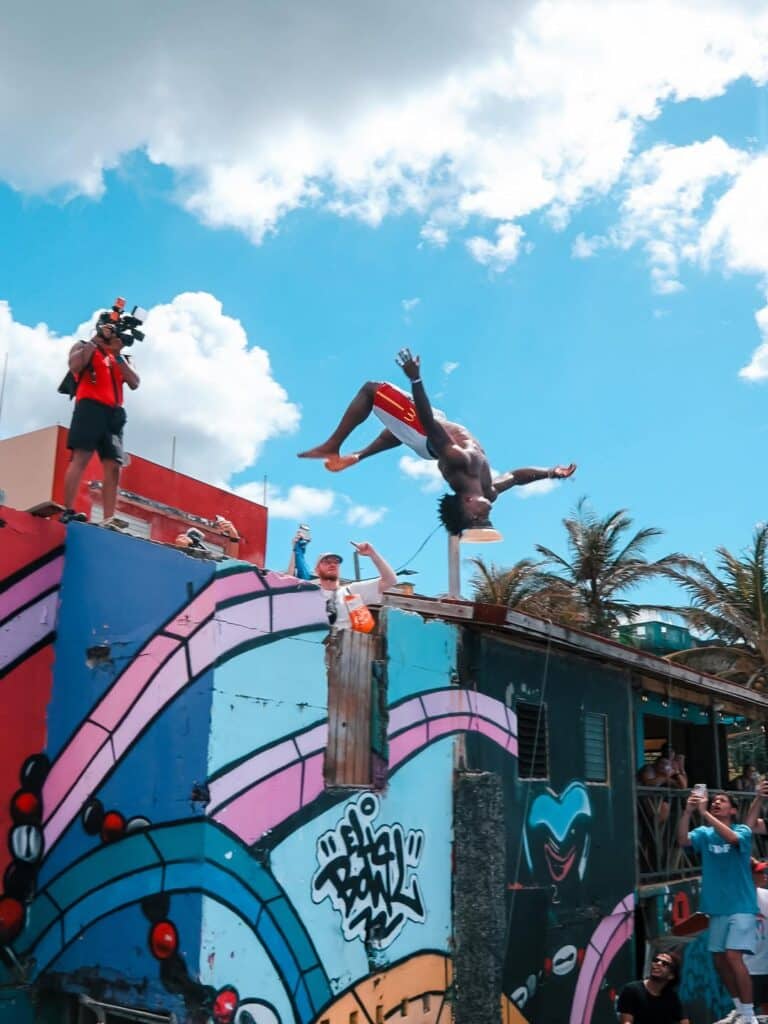
IShowSpeed Caribbean Tour transformed a livestream tour into a global showcase for several Caribbean territories. In just a few weeks, beaches, markets, carnivals, popular neighborhoods, natural sites and street scenes were seen by millions of young Internet users. The result goes far beyond entertainment: it raises a central question for the Caribbean. How can viral exposure be transformed into lasting benefits for the territories visited?
A tour conceived as a global digital event
Announced as a tour of 15 Caribbean destinations, the IShowSpeed Caribbean Tour included Antigua and Barbuda, the Bahamas, Barbados, Dominica, the Dominican Republic, Grenada, Guadeloupe, Jamaica, Puerto Rico, Sint Maarten, Saint Kitts and Nevis, Saint Lucia, Saint Vincent and the Grenadines, Trinidad and Tobago and the US Virgin Islands. From the outset, the project did not resemble a conventional tourism campaign. It was an ongoing, unpredictable live event, driven by a very young and responsive community.
The most telling figure comes from the analysis published after the tour: over the period studied, IShowSpeed Caribbean Tour generated some 1.4 million new subscribers, 12.6 million engagements and an estimated conversational reach of 305.9 million. In other words, the Caribbean wasn’t just watched. It was commented on, shared, replayed, discussed and turned into a global topic on social platforms.
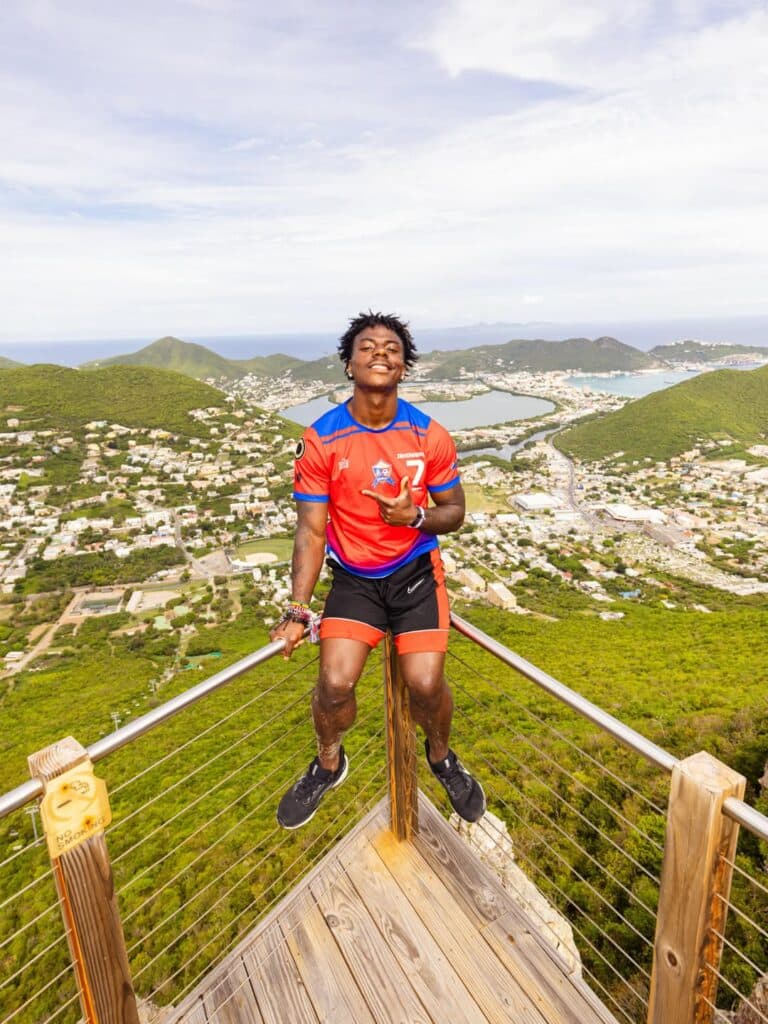
Territories propelled before a young audience
The livestream results show the scale of the phenomenon. The Dominican Republic leads the way with around 7.04 million views. The Dominica, Guadeloupe, Saint Kitts and Nevis and Sint Maarten block follows with around 6.87 million views. Trinidad and Tobago reached around 4.97 million, St. Lucia and St. Vincent and the Grenadines around 4.95 million, and Grenada around 4.32 million. These figures should be read with caution, particularly for the Dominican Republic, where warnings of artificial traffic have been mentioned. But even with this caveat, the order of magnitude remains exceptional for territories often absent from the world’s major digital narratives.
In Trinidad and Tobago, the tour got off to a highly popular start. The visit to Port-of-Spain reportedly attracted around 3,000 people and disrupted traffic around Tragarete Road. But the real impact came from the content on show: tassa, steelpan, cricket, mas, stickfighting, Queen’s Park Oval, Peter Minshall’s presence. Trinidad and Tobago was not reduced to a tropical setting. The territory was presented through its sounds, its gestures, its crowds and its lively relationship with the street.


Saint Lucia, the most measurable example
Saint Lucia offers one of the most interesting cases for measuring tourism impact. The Saint Lucia Tourism Authority reported that the livestream had attracted over 4.4 million viewers. Its General Manager, Louis Lewis, also reported an estimated return on investment of 77 to 1. This means that, for every dollar invested, the destination estimates that it has obtained media value equivalent to $77.
The passage showed Reduit Beach, Pigeon Island, Castries Market, Derek Walcott Square, the Pitons and Sulphur Springs. This choice of locations is important. It combines postcard, heritage, downtown, nature and local experience. In the IShowSpeed Caribbean Tour review, Saint Lucia thus appears as a territory that has tried to transform buzz into a structured visibility strategy.
Antigua and Barbuda: from direct to tourist route
Antigua and Barbuda also capitalized on the exhibition. The May 3 tour attracted over 2.5 million viewers on YouTube alone, according to data reported by the tourist board. The program featured Dickenson Bay, Hellsgate, stingrays, drag racing, Sir Vivian Richards Stadium, Carnival, Burning Flames, the Nyabinghi community, Ffryes Beach, the Antigua Black Pineapple and Barbuda.
Here again, the highlight is not just the number of views. It’s the way in which the region has been able to tell many different stories about itself: beach, sport, music, heritage, gastronomy, spirituality and sister island. IShowSpeed Caribbean Tour has shown that a livestream can become a tourist itinerary, provided that local players know how to transform it into legible, bookable and well-relayed offers.


Jamaica, between cultural power and Generation Z
Jamaica enjoyed massive exposure. The livestream from Kingston exceeded 2.8 million views, with a peak of 194,805 live viewers, 696,349 chat messages and 34,692 new subscribers. These figures are a measure of the attention generated by IShowSpeed’s visit to an area with an already strong cultural image.
The Jamaican challenge was different. The destination didn’t need to prove that it existed culturally. Reggae, dancehall, patois, athletics, gastronomy and street culture are already recognized the world over. But IShowSpeed Caribbean Tour put this power in front of a very young audience, used to consuming the world live, without waiting for institutional campaigns.


A turning point for Caribbean tourism
The partnership with Expedia confirms that this tour is more than just a creative phenomenon. The platform has named IShowSpeed “Official Travel Partner” and launched a space where fans can follow his travels, consult content and book stays, flights or activities inspired by his travels. This is probably one of the most important lessons to be learned from the review: livestreams are becoming a tool for inspiration, and then potentially for tourism conversion.
For the Caribbean, the results are clear. IShowSpeed Caribbean Tour offered visibility that few traditional campaigns can achieve with Generation Z. But visibility isn’t enough. But visibility is not enough. Territories will now have to capture this attention, improve their official content, make their experiences accessible online, better reference the places seen in the videos and involve local players in this new image economy.


The balance sheet is therefore powerful, but incomplete. The views are there. The conversations are there. The crowds were there. The question now is whether this exposure will generate travel, bookings, revenue for local communities and a stronger place for the Caribbean in the global digital imagination. Only then will IShowSpeed Caribbean Tour go from being a viral phenomenon to a useful moment for the Caribbean territories.
The results of the IShowSpeed Caribbean Tour are first and foremost digital. The tour gave several Caribbean territories worldwide exposure to a very young audience, very active on YouTube and social networks. The figures available speak of millions of views, millions of engagements and a very high conversational reach. For the Caribbean, the main impact is therefore in terms of visibility: places, street scenes, natural sites, markets, beaches and local cultural expressions have circulated massively online. On the other hand, the real economic impact must still be measured with caution, as there is as yet no complete official record of tourist bookings or revenue generated.
Several territories took advantage of the IShowSpeed Caribbean Tour, each in their own way. Saint Lucia stands out as one of the most structured examples, with official communication around the media ROI and locations shown during the live tour. Antigua and Barbuda also turned the visit into a tourist itinerary, highlighting beaches, culture, sport, gastronomy and heritage. Jamaica benefited from strong exposure to Generation Z, while Trinidad and Tobago made its mark with street culture, steelpan, carnival and cricket. The impact varies according to each region’s ability to follow up the buzz with a clear tourism strategy.
Yes, but only if Caribbean territories turn this visibility into concrete action. A livestream can create envy, give a more spontaneous image of a territory and reach audiences difficult to reach with traditional campaigns. But for the impact to last, the places seen in the videos need to be well referenced, the experiences easy to book, tourist offices need to publish appropriate content and local players need to be involved in the spin-offs. So the IShowSpeed Caribbean Tour has opened a door: it’s now up to Caribbean destinations to convert this global attention into travel, revenue and visible benefits for local communities.
In Philipsburg, carnival is about much more than costumes and concerts. It shows an island divided between two histories, two administrations and the same popular energy. For its 55th anniversary, St Maarten Carnival 2026 gives Sint Maarten the opportunity to show what the Caribbean does best: transforming a local festival into a marker of identity.
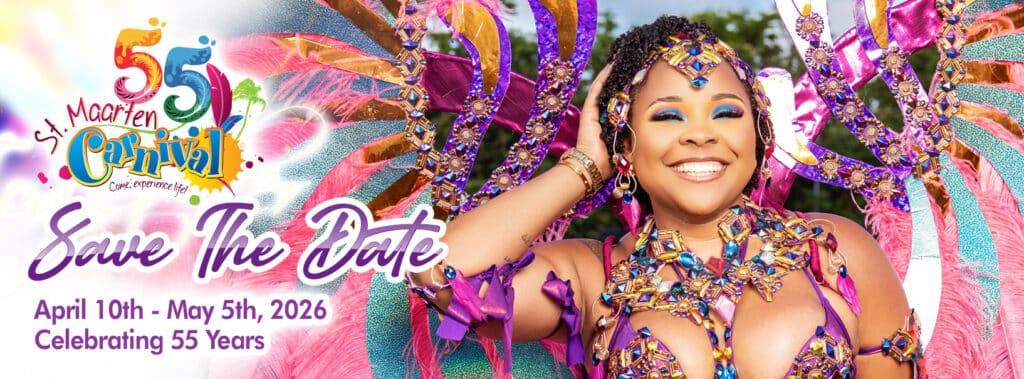
A carnival that's more than just a party
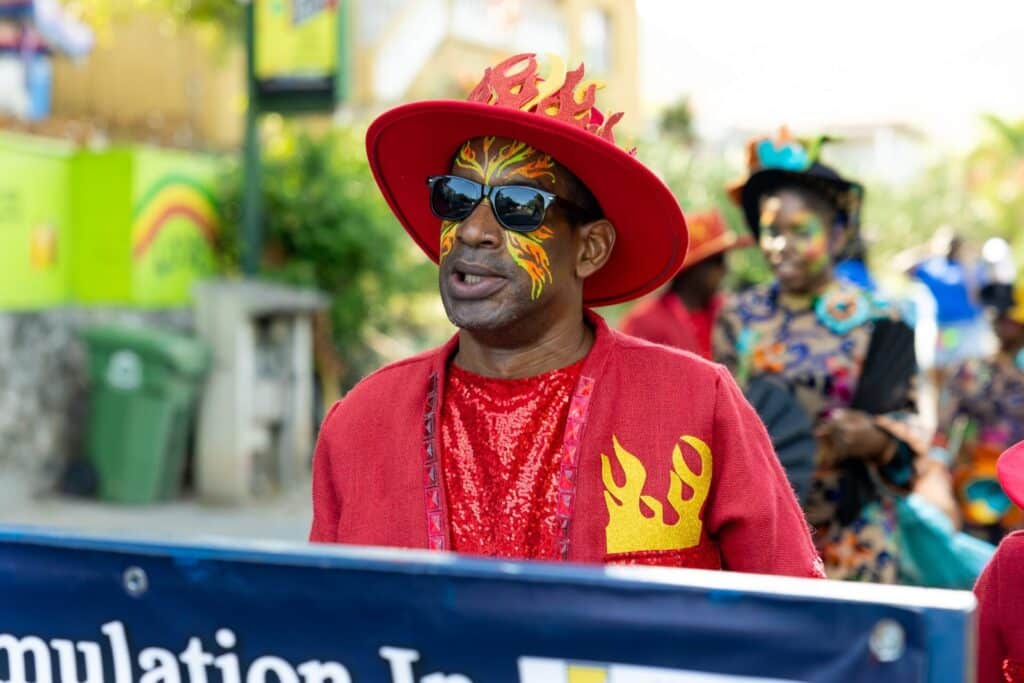
St Maarten Carnival 2026 began on April 10 and continues until May 5, with Philipsburg as the focal point. In the streets, locals aren’t just watching a parade go by. They recognize families, neighborhoods, groups, sounds, food stands, faces that have returned for the occasion. Carnival is not just a decoration. It’s part of the way Sint Maarten tells its story.
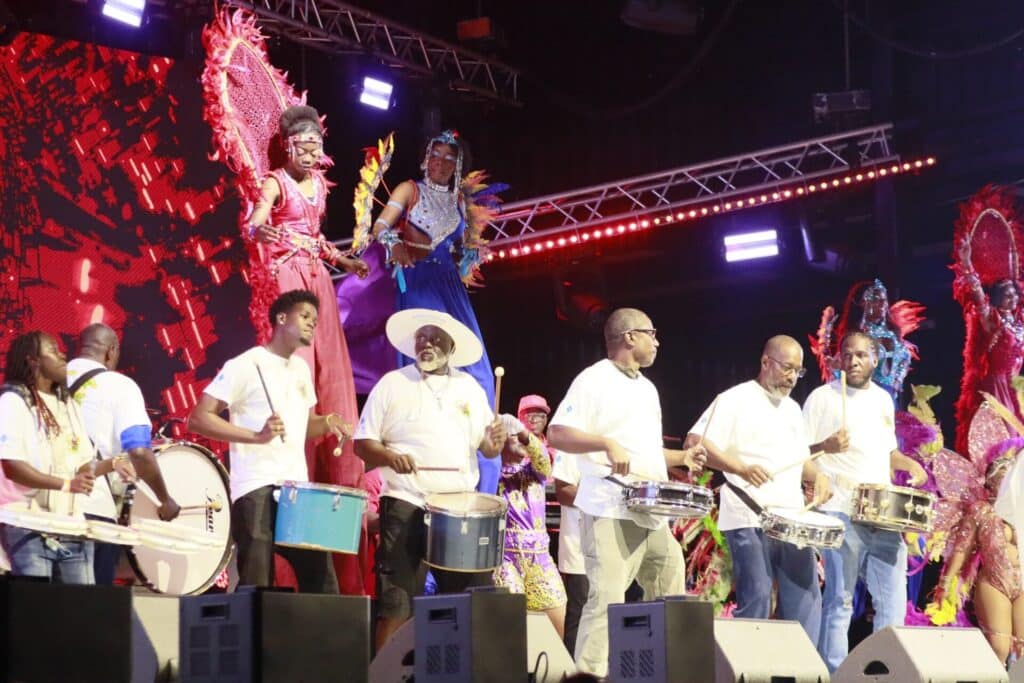
This year’s event carries a special weight. St. Maarten Carnival 2026 marks the 55th edition of the biggest cultural event on the Dutch part of the island. The St. Maarten Carnival Development Foundation, which organizes the carnival, has extended the calendar to meet strong local, regional and tourist demand. The festival now spans several weeks, with the Carnival Village opening, concerts, pageants, jump-ups, parades and a grand finale.
One island, two stories, many rhythms
The local roots of St Maarten Carnival 2026 are essential to understanding what’s at stake here. Sint Maarten occupies the southern part of the island of Saint-Martin, shared with the French collectivity of Saint-Martin to the north. This geography gives the carnival a uniqueness that is rare in the Caribbean. On the same island territory, traditions, calendars, languages and references intersect without merging. Carnival on the Dutch side does not seek to imitate that on the French side. It asserts its own temporality, its own rhythm and its own relationship to the street.
Carnival Village, the popular heart of Philipsburg
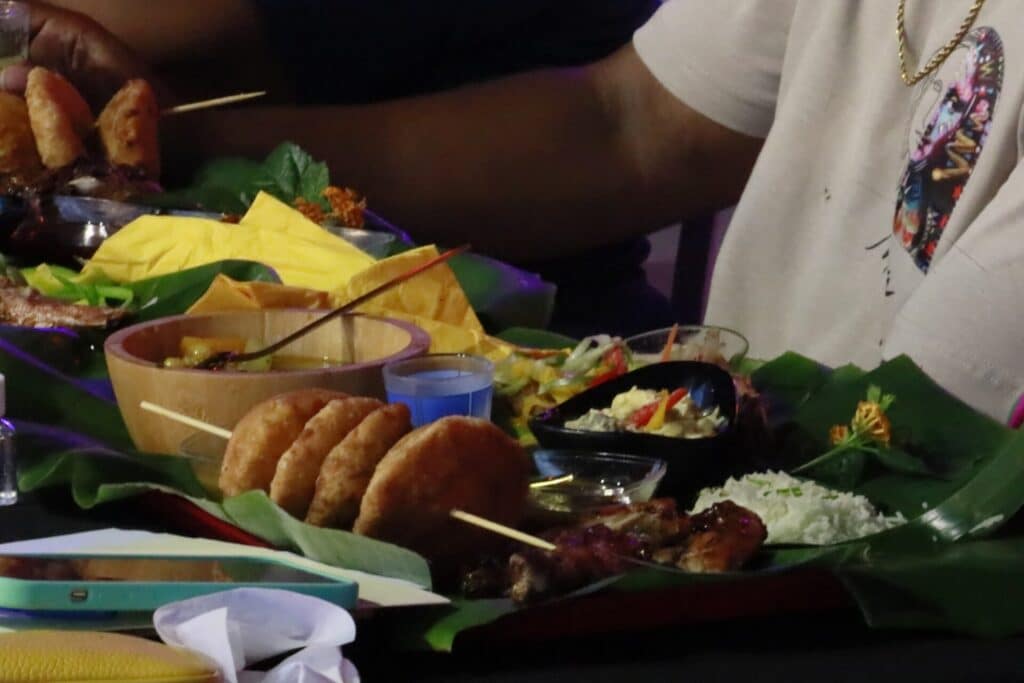
The heart of St Maarten Carnival 2026 beats at the Jocelyn Arndell Festival Village, in the Great Salt Pond area. This is where most of the parties, stalls, stages and reunions are concentrated. The St. Maarten Tourist Bureau presents the Village as one of the great culinary spaces of the Caribbean, with an offering that blends local dishes, street food and regional influences. This is an important detail. In Sint Maarten, Carnival isn’t just about the music. It’s also about plates, smells, family recipes and late-night conversation.


Parades, jump-ups and competitions: a lively cultural economy
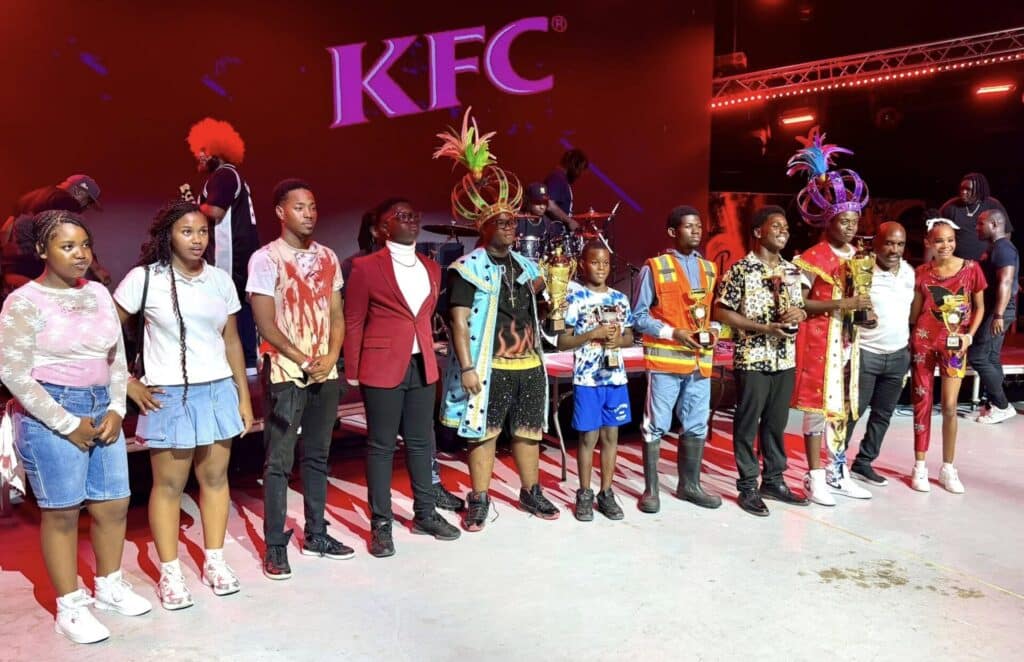
The program for St Maarten Carnival 2026 also shows that carnival is more than just a big concert. The edition includes several local cultural evenings, three parades, five jump-ups, four queen competitions and six international concerts. This diversity gives a more accurate reading of the carnival. Behind the feathers, floats and stages, there are competitions, dance schools, dressmakers, musicians, cooks, technicians, families and volunteers. Carnival is a cultural economy, but also a social organization.
The Grand Carnival Parade, the highlight of a long season
The Grand Carnival Parade on April 30 remains one of the most eagerly awaited events of the year. It falls on a key date in the local calendar and traditionally attracts large numbers of participants and spectators. But it would be a mistake to reduce the St Maarten Carnival 2026 to just this one day. What makes it so powerful is its duration. For several weeks, the island sets to the rhythm of preparations, reunions, returns from the diaspora and parties in the Village. Carnival becomes a common thread running through the generations.
Grow without losing your soul
This edition also raises an important question for Caribbean territories: how can we grow without losing our soul? Sint Maarten receives visitors from all over the world. Its airport, hotels, beaches and nightlife make it a highly exposed destination. The risk, for a carnival of this scale, would be to become merely a tourist product. But the 2026 edition reminds us of something else: carnival remains first and foremost a local cultural event. The locals are not mere extras in a festival sold to visitors. They are its authors, guardians and primary beneficiaries.
Youth at the heart of transmission
The presence of young people is the other challenge. A carnival that lasts 55 years doesn’t survive just because it attracts an audience. It survives because it transmits gestures. Wearing a costume, playing in a band, setting up a stand, learning a rhythm, taking part in a pageant, marching in a parade: all these actions build a practical memory. They give young people a way of inhabiting their island other than through tourism or the service economy.


A common language for a complex island
St Maarten Carnival 2026 is more than just an anniversary. It tells the story of an island that embraces its complexity. An island cut in two, but crossed by constant circulation. An island where English, Dutch, French, Creole and local languages meet in the streets. An island where carnival becomes a common language, without erasing differences.
One question remains for the coming years. How can Sint Maarten continue to make its carnival shine without detaching it from those who built it? The answer may lie in the Village, between a parade, a food stand and a song sung by an entire crowd. Where carnival isn’t just watched. It’s lived.
📸 Photo credit: Facebook @St. Maarten Carnival
St Maarten Carnival 2026 takes place from April 10 to May 5, 2026 in Sint Maarten. This edition marks the 55th anniversary of Carnival, with several weeks of parades, jump-ups, competitions, concerts, cultural evenings and events at Carnival Village.
St Maarten Carnival 2026 takes place mainly in Philipsburg, on the Dutch side of the island of St. Maarten. The heart of the event beats at the Jocelyn Arndell Festival Village, located in the Great Salt Pond area, where numerous parties, music stages, culinary stands and popular gatherings are held.
The St Maarten Carnival 2026 is important because it is more than just a festive event. It represents a strong cultural marker for Sint Maarten, an island divided between two histories, two administrations and several languages. Through its parades, cuisine, music and popular traditions, Carnival helps to transmit local identity across generations.
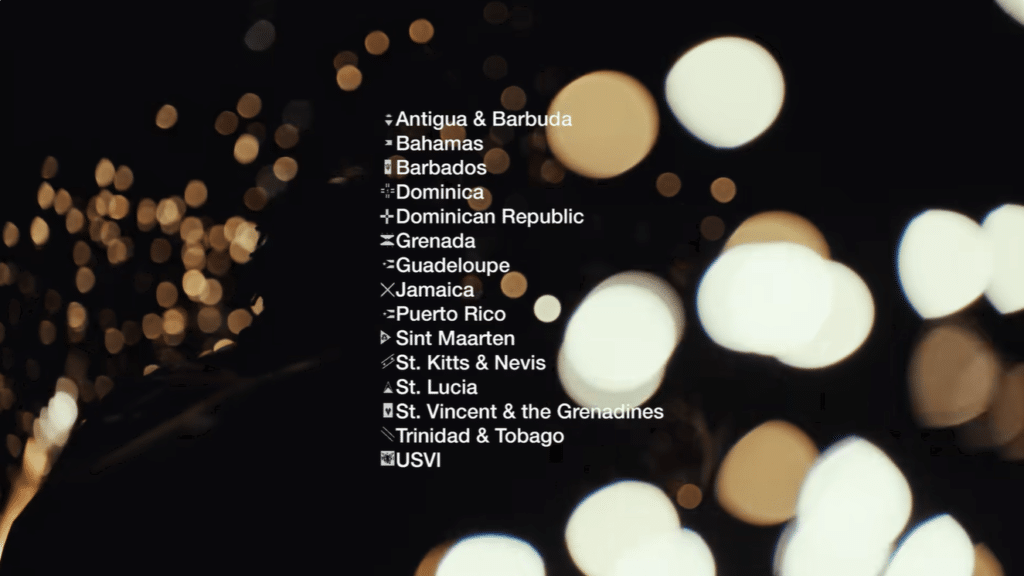
IShowSpeed Caribbean Tour opens a rare window on the Caribbean. The announcement was broadcast on April 20 on the American creator’s networks, with a live broadcast scheduled for April 25, 2026. The published list mentions fifteen destinations: Antigua and Barbuda, the Bahamas, Barbados, Dominica, the Dominican Republic, Grenada, Guadeloupe, Jamaica, Puerto Rico, Sint Maarten, Saint Kitts and Nevis, Saint Lucia, Saint Vincent and the Grenadines, Trinidad and Tobago and the US Virgin Islands. In the space of a few hours, this tour placed the region in an unusual position of global visibility.
IShowSpeed Caribbean Tour deserves attention for one simple reason: IShowSpeed gathers a gigantic audience. The Associated Press recalls that it surpassed 50 million subscribers on YouTube during its African tour in January 2026. At this scale, every move becomes a live event, picked up by other accounts and transformed into short sequences that circulate quickly. When an entire itinerary is devoted to the Caribbean, the territories, accents, landscapes and everyday customs enter the field of vision of an international audience.
The Caribbean as a whole
The first strength of the IShowSpeed Caribbean Tour lies in the overall picture it produces. The list combines independent states and territories, English-, French-, Spanish- and Dutch-speaking areas. This juxtaposition reminds us that the Caribbean is a multiple region, crossed by different languages and heritages, while retaining deep links.
This regional reading corresponds to a historical reality. Human, musical, commercial, religious and family circulations have existed for centuries from one island to another. Borders have shaped distinct administrations and statuses. They have never erased exchanges. In a single announcement, the Caribbean appears as a legible space for millions of people who often perceive it in a fragmented way.
Visibility through the codes of the present
The format counts almost as much as the list of destinations. IShowSpeed is all about live action, improvisation, immediate reaction and massive sharing. Its audience follows less a program than a presence. This way of filming changes the nature of the exhibition. The viewer watches streets, beaches, markets, journeys, encounters and crowd scenes as they happen.
For the Caribbean, this exhibition has a special significance. Many of the region’s territories suffer from uneven visibility in the major media circuits. The best-known benefit from a well-established image. Others remain absent from global narratives, or reduced to a few clichés. The IShowSpeed Caribbean Tour can therefore play a useful role: showing a diversity of places and atmospheres to a young public that is building its vision of the world through platforms.


An opportunity for cultural and media players
IShowSpeed Caribbean Tour is also of interest to artists, organizers, local media and creators based in the region. A tour of this scale can highlight a dancer, a musician, a culinary tradition, an urban setting, a popular event or a local personality. It can also create connections between territories that rarely communicate at this speed.
However, the added value of IShowSpeed Caribbean Tour will depend on how these moments are accompanied. A viral image attracts attention for a few hours. Serious editorial work extends this interest. It provides reference points, recalls history, clarifies political and cultural contexts, and helps us understand what we’re seeing. This is an opportunity for the Caribbean to tell the story of its plurality with greater mastery.
A visible symbolic impact
It would be premature to announce any quantified tourist effects or immediate economic spin-offs. However, one thing is clear: the Caribbean is gaining a global presence in one of today’s most popular formats.
This is where IShowSpeed Caribbean Tour really comes into its own. IShowSpeed Caribbean Tour brings together in a single movement territories that are often commented on separately. It reminds us that the region possesses a cultural, visual and social force capable of capturing attention on a grand scale. For audiences unfamiliar with the area, it can open a first door. For those who are already familiar with it, it confirms that the Caribbean remains a major hotbed of creation, circulation and energy in the contemporary world.
IShowSpeed Caribbean Tour is a tour announced by American creator IShowSpeed across several Caribbean territories. Beyond the announcement itself, this tour is attracting attention for its media scope and the visibility it can offer the region as a whole.
IShowSpeed Caribbean Tour is attracting a lot of interest because IShowSpeed is one of the most followed creators in the world. When he travels, his videos, live broadcasts and excerpts shared on the networks quickly reach an international audience, giving this tour a much wider reach than a series of stopovers.
IShowSpeed Caribbean Tour is important because it shows the Caribbean as a visible, vibrant and connected regional space. The tour links several territories in a single narrative and reminds us that the region possesses a cultural, linguistic and social richness capable of attracting attention on a large scale.
Yes, IShowSpeed Caribbean Tour can have a real cultural impact. This type of tour can highlight local landscapes, sounds, accents, lifestyles, artists and moods. It can also encourage a new way of looking at the Caribbean, particularly among a younger audience who follow world news via digital platforms.
It’s still too early to accurately measure the impact of the IShowSpeed Caribbean Tour on tourism. On the other hand, this tour can already raise the profile of the Caribbean and feed the curiosity of a global audience. This media exposure can then benefit the territories if it is intelligently relayed by cultural, tourism and media players.
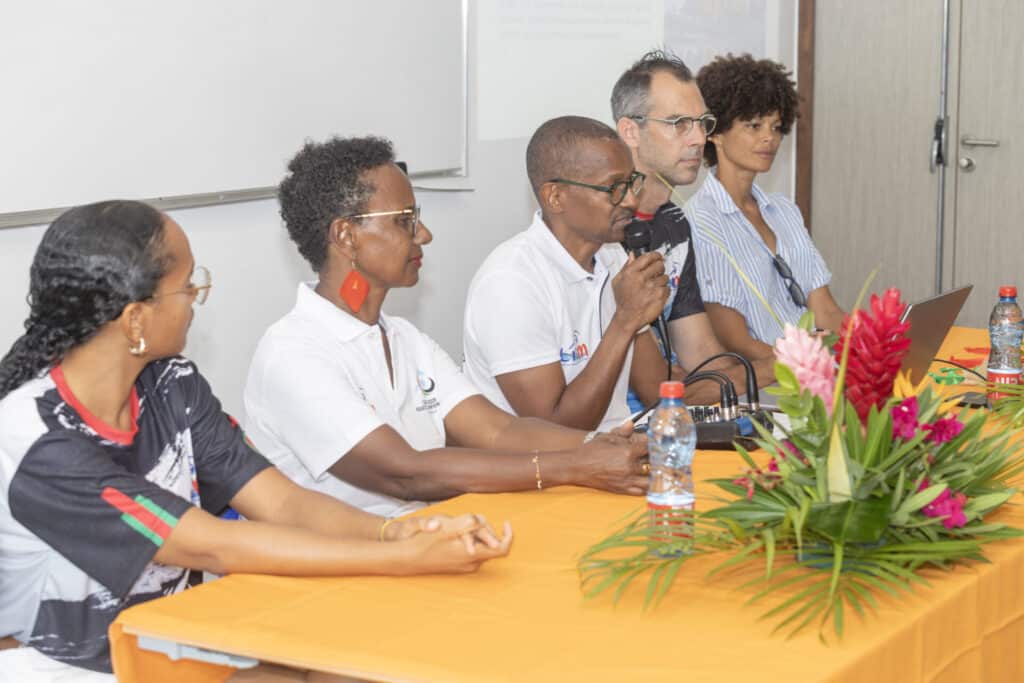
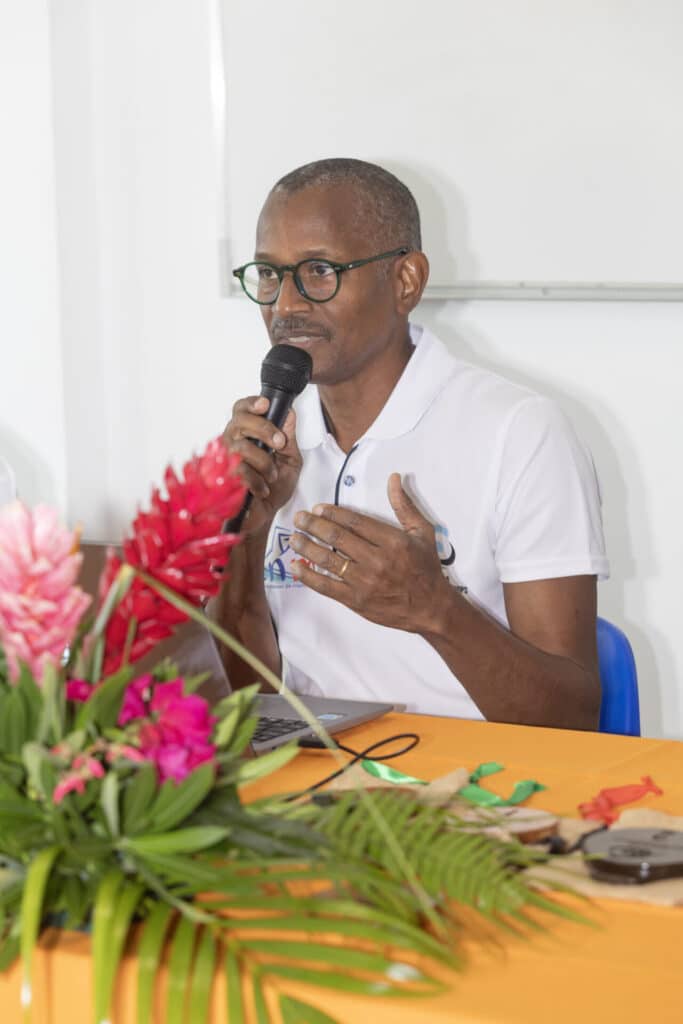
On Saturday March 28, at the Centre Aquatique Pierre Samot in Le Lamentin, the CARIFTA Aquatics Championships 2026 press conference was more than just an information meeting. Over the course of an hour and a half, organizers, athletes and partners presented much more than just the sporting program: from April 3 to 8, Martinique will host the 39th edition of the Caribbean’s leading junior aquatic event, ten years after the first edition was so memorable. Twenty-four nations. Three disciplines. A home territory that knows it.
A bid driven by collective memory
In 2024, at the Caribbean Aquatics Association Congress held in the Bahamas, two bids were put forward to host the 2026 CARIFTA Aquatics Championships: Saint Lucia and Martinique. The vote was clear-cut: some thirty votes for Martinique, ten for Saint Lucia.
Behind this result is a story. The 2016 edition, the first ever to be held on home soil, left its mark on the minds of all those who were there: coaches, delegation leaders, officials. In 2024, when it came time to vote, many still remembered that week.
"It was a beautiful edition, and one that will always be remembered."
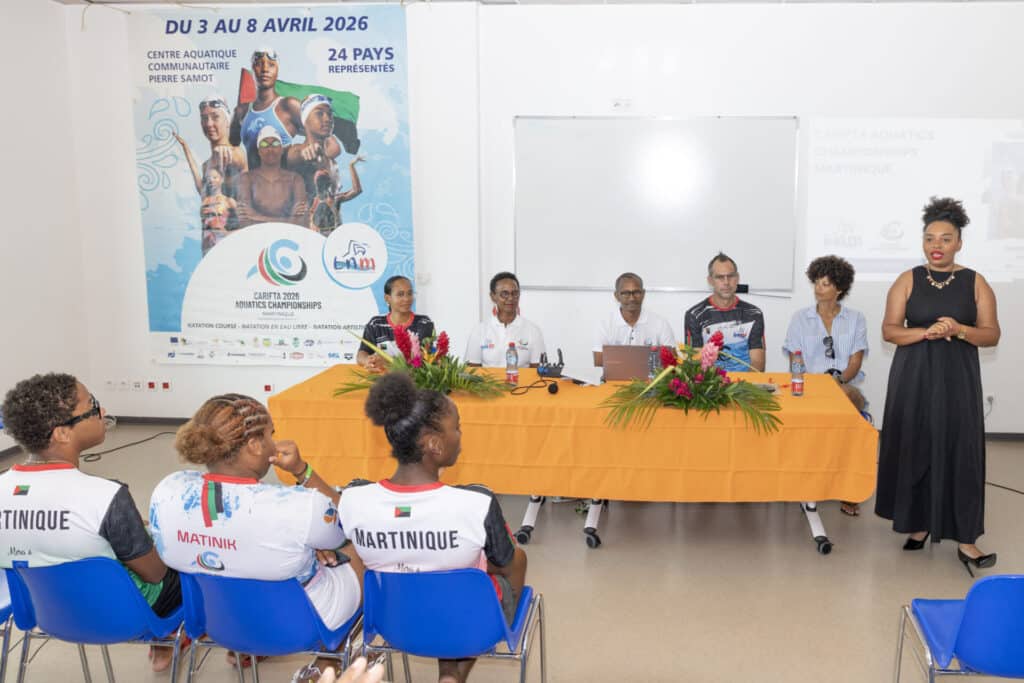
The other factor was more concrete: Sainte-Lucie did not yet have its own pool. Martinique, on the other hand, can count on the Centre Aquatique Pierre Samot in Le Lamentin, with its ten-lane Olympic pool, 800-seat grandstand and 25-meter warm-up pool. One of the best facilities in the Caribbean.
The organization also emphasized its capacity to welcome delegations from outside the basin, with several accommodation solutions mobilized in the south of the island, supplemented by other structures if necessary. This logistical aspect, rarely secondary in this type of event, reinforced the credibility of Martinique’s bid.
Three disciplines, 24 nations, a demanding format
The CARIFTA Aquatics Championships 2026 will bring together 24 countries: 21 English-speaking Caribbean nations, plus Martinique, Guadeloupe and Guyana. The swimming races will take place over four days: heats in the morning, finals in the afternoon, from Saturday April 5 to Tuesday April 8. Artistic swimming gets underway on Monday during the lunch break, with solos followed by technical events. The duets and teams round off the program on Wednesday morning. On the same Wednesday, the open water event takes place over five kilometers in the Anses d’Arlets.
Competitors: Benjamins (11-12 years), Minimes (13-14 years), Cadets (15-17 years) do not enter as individuals. They are national selections, with the best swimmers from each territory. To enter the Martinique selection, swimmers must satisfy a time grid established over the previous two seasons, which only selects swimmers capable of reaching the finals.
In the minds of the organizers, selection is based on a simple logic: to score points, you have to enter the final, and to enter the final, you have to be among the top eight times in the morning heats. In other words, the swimmers selected are supposed to have a level that enables them to play a real role in the competition, and not just participate.
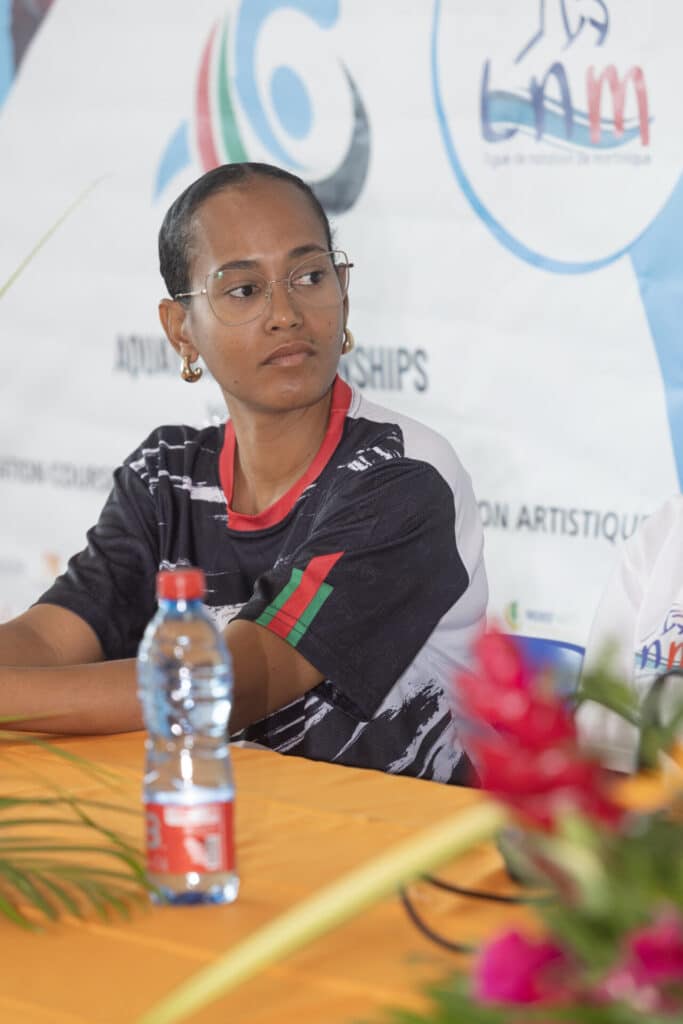
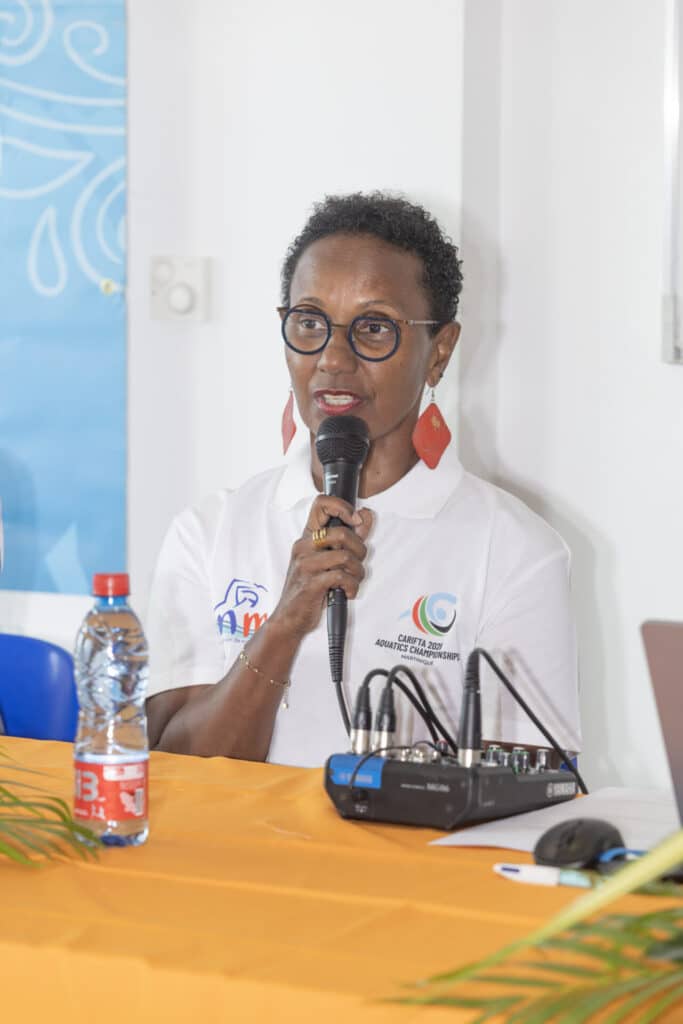
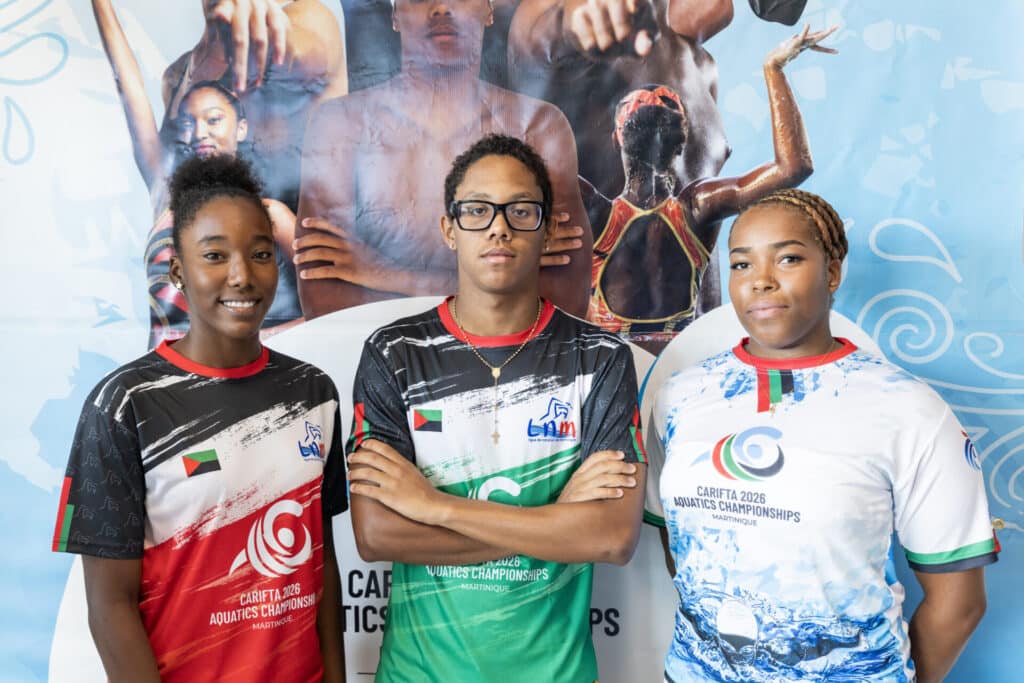
The Martinique delegation at the CARIFTA Aquatics Championships 2026 has 61 swimmers: 36 in racing, 12 in open water, five of whom also race, and 18 in artistic swimming. The team is led by five captains: Jean-Naël Zozime and Maxime Auguste-Charlery for boys’ racing (15-17 age group), Cyrielle Manin and Sayanne Guivissa for girls’ racing, and Nohemy Marajo for artistic swimming.
Water as starting point and destination
When asked how he got started, Jean-Naël Zozime, captain of the boys’ selection, answers straightforwardly: “I was introduced to swimming so that I wouldn’t drown. Cyrielle Manin, captain of the girls’ selection, tells much the same story: she almost drowned as a child, and that’s what led her to learn to swim.
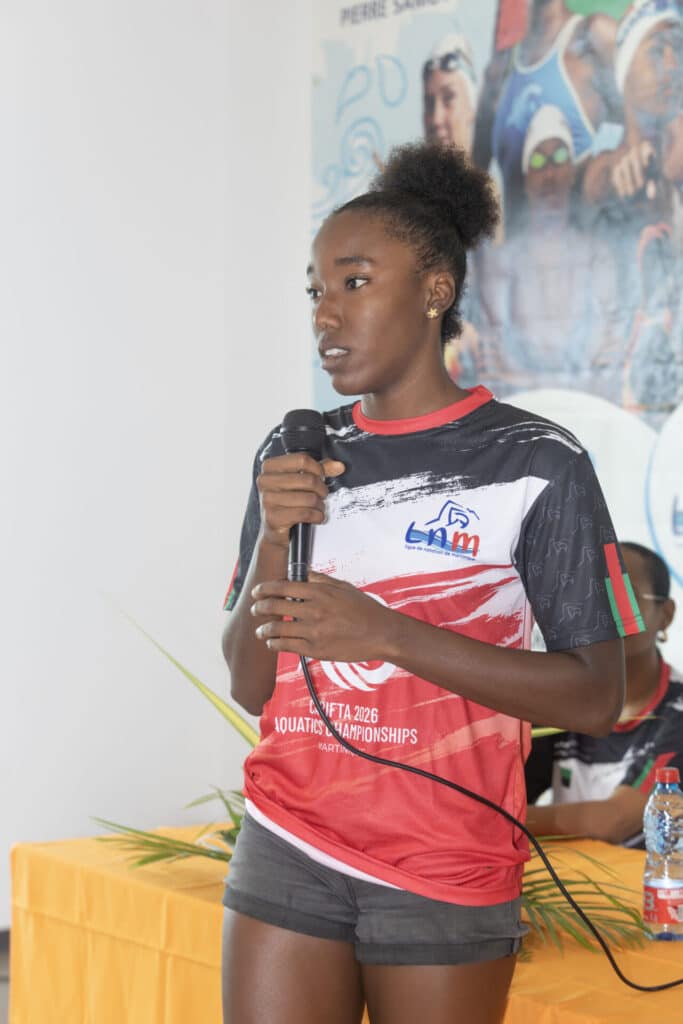
These two testimonies, heard just a few minutes apart, say something important about this territory. Two young Martiniquans, initially frightened by the sea, who are now representing their island against twenty-three Caribbean nations. This is more than just a sporting achievement.
"Swimming is a tough sport. You can't expect it to be easy, but with a lot of perseverance, anyone can do it."
— Jean-Naël Zozime
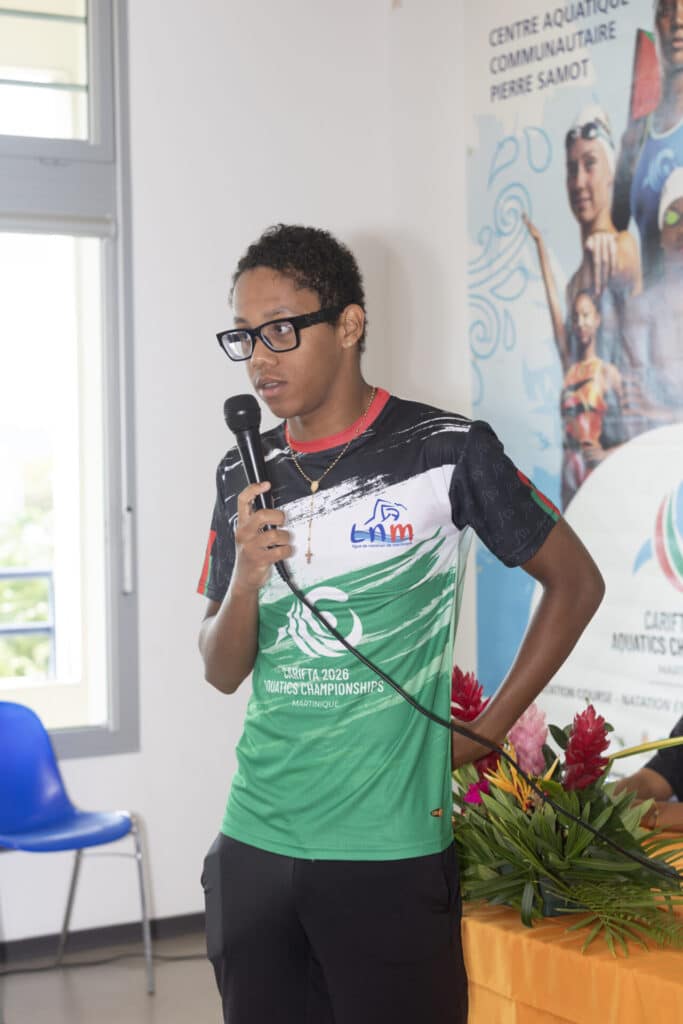
Nohemy Marajo, artistic swimming captain, has been practicing for ten years a discipline that the public still knows little about. She explains it concretely: learning choreographies on dry land, rehearsing them in the water, controlling your breathing under the surface while your legs draw figures above. It’s a sport that’s as technically demanding as it is physically demanding, and has as much to do with ballet as it does with endurance.
"You have to know how to endure, how to save every last breath to finish the choreography."
— Nohemy Marajo
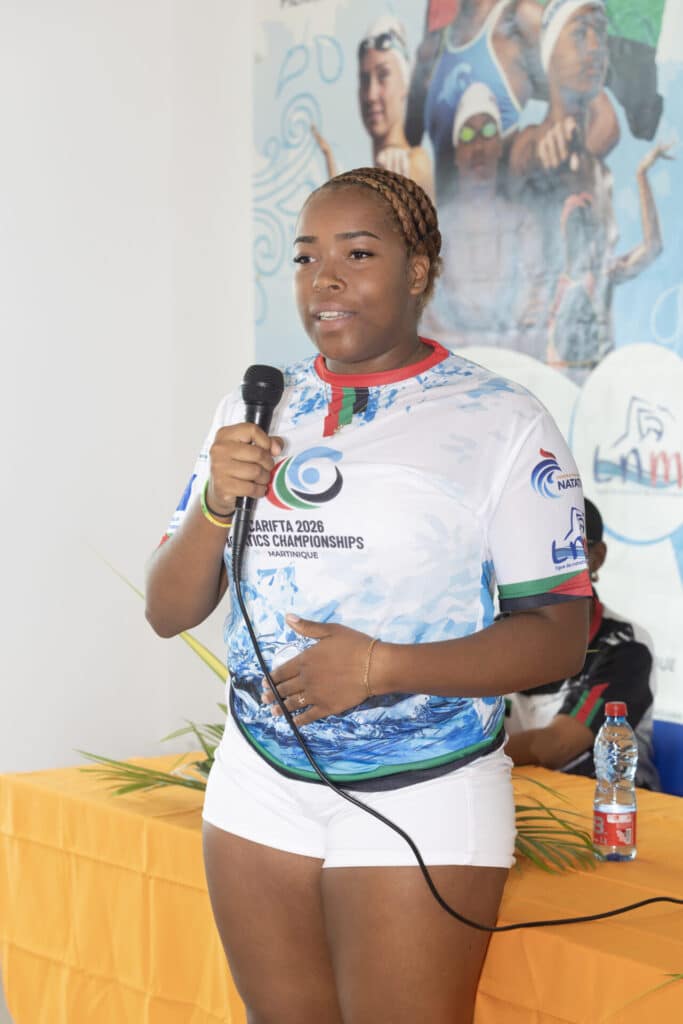
The conference of the CARIFTA Aquatics Championships 2026 also pointed out that artistic swimming is still a confidential discipline in the Caribbean, due to the infrastructure it requires and the level of preparation required. It requires three-dimensional work and very thorough technical preparation, as well as the support of outside professionals, particularly in dance and gymnastic preparation. For the supervisors, the challenge of CARIFTA is twofold: to support those who are already practising and to encourage new vocations.
What the coaching team observes in these youngsters is a constant: they train, take their exams, compete at weekends, and do it all over again. “Generally, swimmers perform well in their studies too, because they’ve worked on this rigor on a daily basis.” What you learn in the pool also applies elsewhere, and the organizers insist on this daily requirement: it’s not enough to qualify, you have to be able to show up on the day, in a sport where regularity and discipline count as much as talent.
Medals from the hands of the island
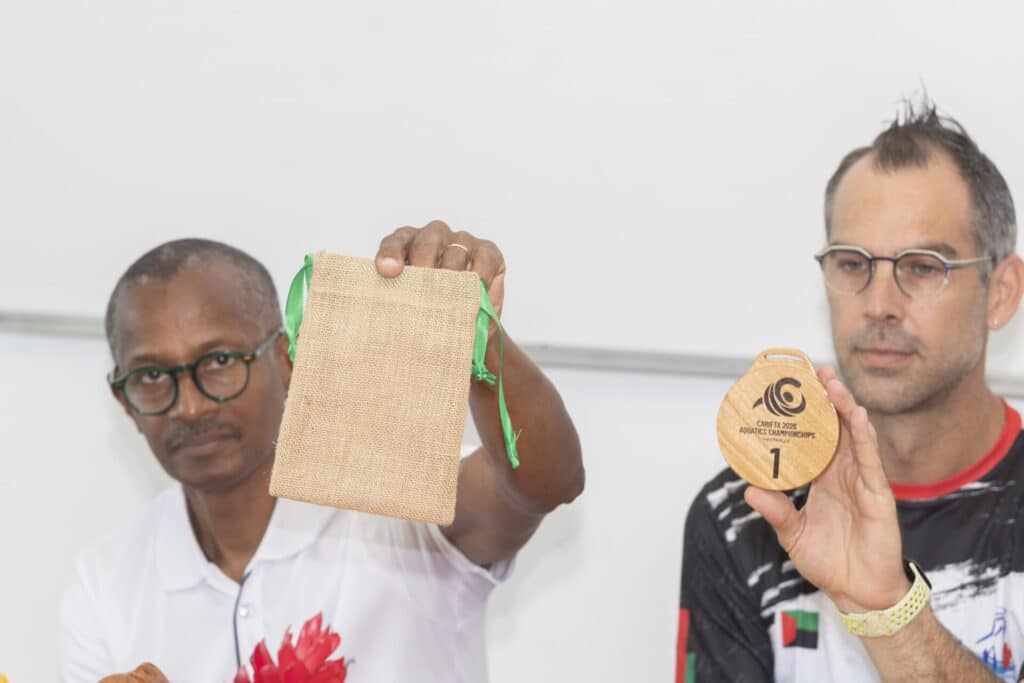
The way an event rewards its champions often says a lot about what it stands for. At the CARIFTA Aquatics Championships 2026, the medals were made in Martinique from noble woods: pearwood for gold, mao bleu for silver, mao ghani for bronze. A craftsman from the Nord-Atlantique region produced them, Joseph Galliard signed the engravings, and a local seamstress made the pouches in the three colors of the Martinican flag.
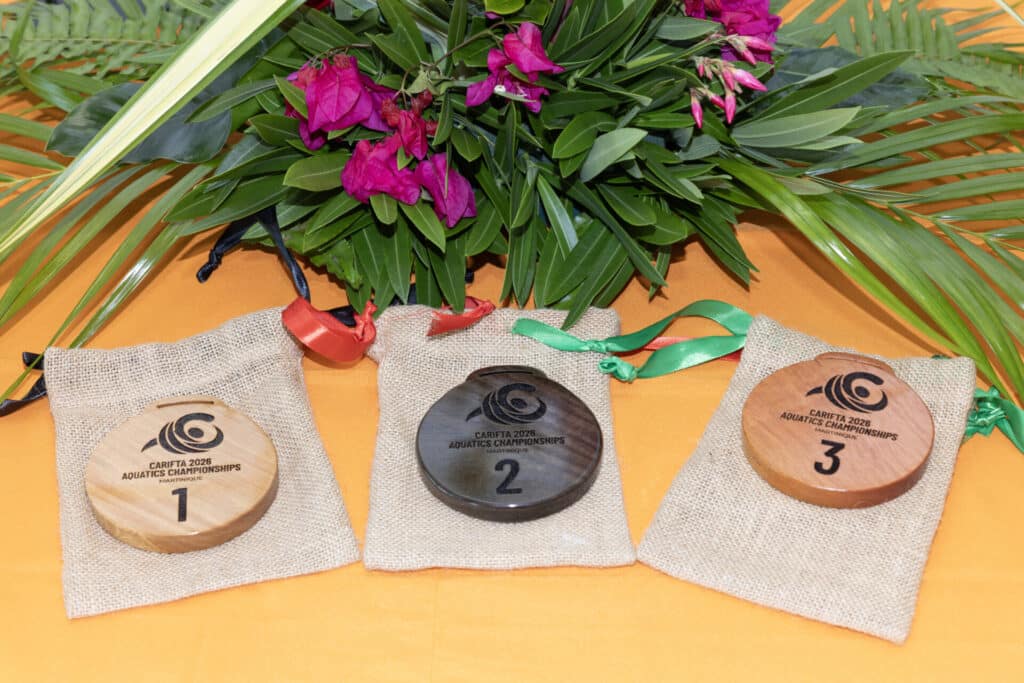
The initiative was spearheaded by the event’s godmother, Coralie Balmy, a former top-level swimmer who had taken part in the CARIFTA four times in her career. An eco-responsible and identity-affirming initiative, hailed as a first on the Caribbean scale.
Every Caribbean athlete who reaches the podium at the CARIFTA Aquatics Championships 2026 will leave with a piece of Martinique, a unique medal made by local craftsmen, unlike any other.
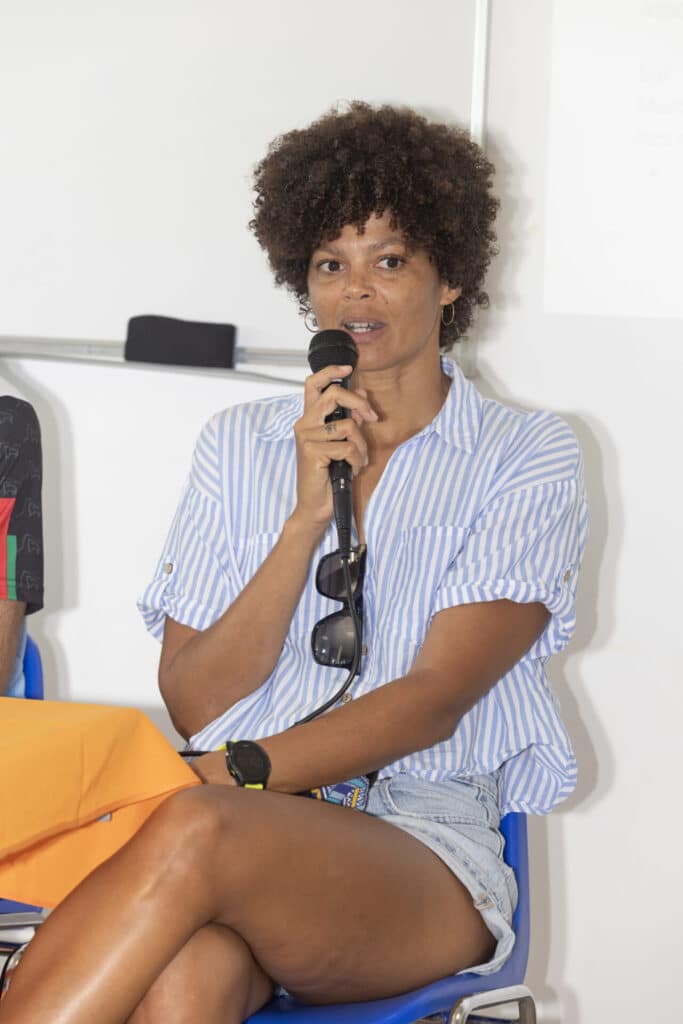
The conference also specified that trophies would accompany these awards, and that the medals had yet to receive their lanyards before the competition opened. Here too, the aim is clear: to make each award a sporting, local and symbolic object.
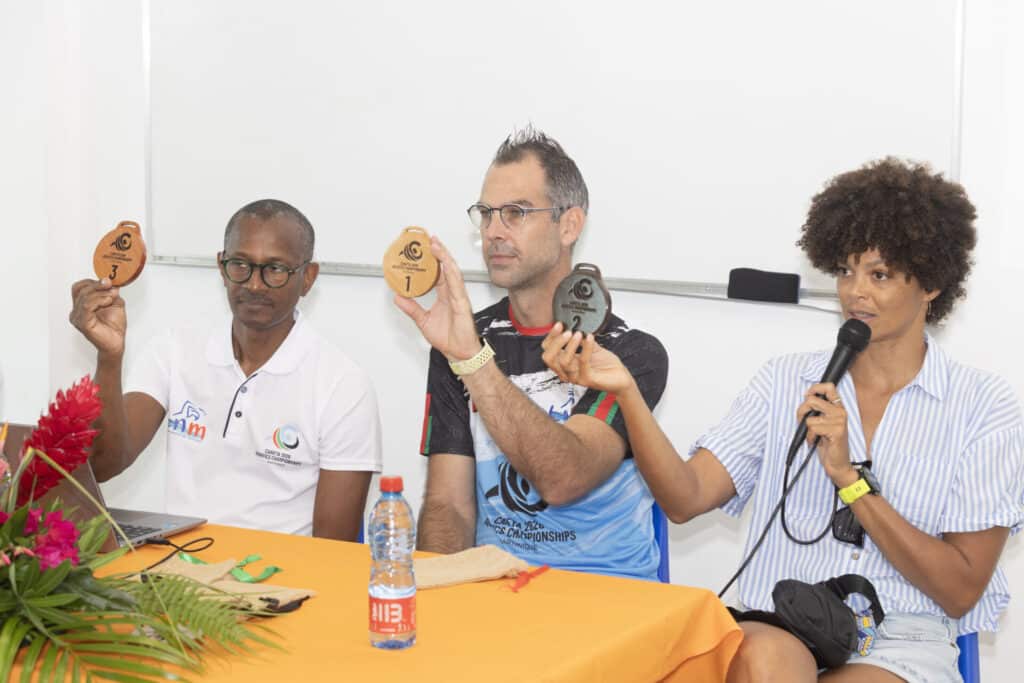
A week that mobilizes the whole territory
The CARIFTA Aquatics Championships 2026 won’t just be played out in the pools. Between 1,500 and 1,800 people are arriving in Martinique: swimmers, staff and families spread out over several hotels in the south of the island. Every day, around 150 volunteers ensure the smooth running of the event: former swimmers, parents, locals who sometimes have no direct connection with swimming, but who wanted to get involved.
Among them, the officials play a decisive role: some 26 officials from the Caribbean will reinforce the Martinique officials, bringing the number of people around the pool to around fifty for each morning and afternoon meeting. In addition, there will be first-aid attendants, reception teams, people in charge of awards, delegation escorts and areas open to the public.
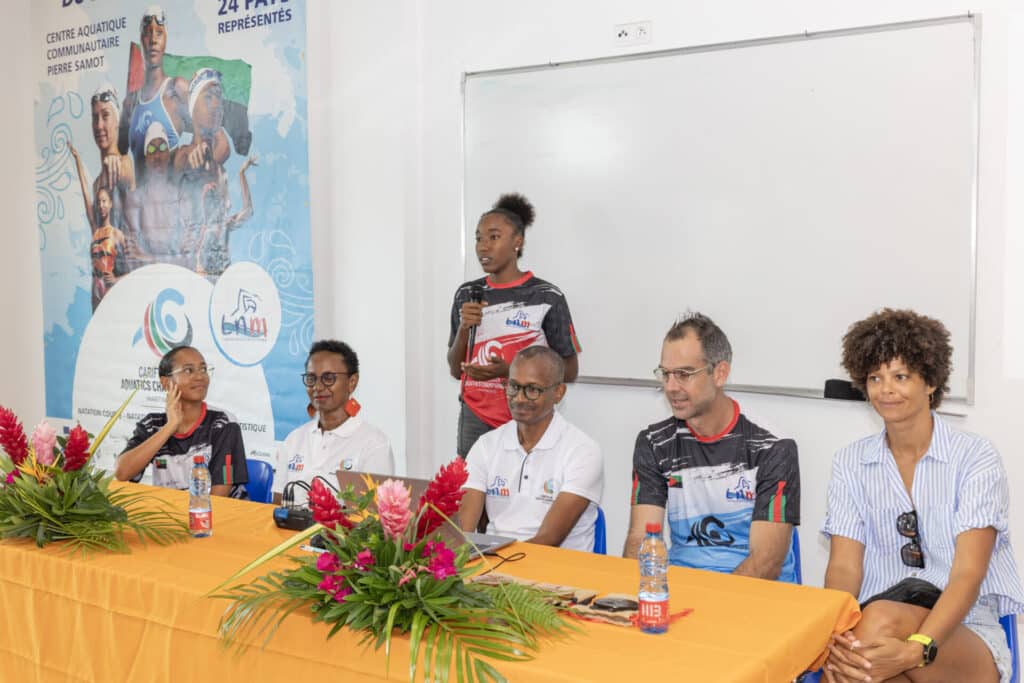
Welcoming delegations to the CARIFTA Aquatics Championships 2026 was also thought through in detail. They all had to arrive on April 2, at different times of the day, sometimes very early in the morning, sometimes late at night. In conjunction with the transport company and SAMAC, a precise plan was drawn up at the airport to ensure smooth exits, transfers to buses and settling into accommodation, with particular attention paid to meals depending on the time of arrival.
The opening ceremony of the CARIFTA Aquatics Championships 2026, on Friday April 3 at the Georges Gratiant stadium, is free and open to all: 2,800 seats to fill. The group “Nou Pa Sav” will accompany the parade of delegations. On Saturday, April 4, Les Hommes d’Argile will be on hand as the delegations arrive on site, offering a strong cultural backdrop intended as a symbolic first encounter with Martinican identity. Throughout the week, Martinican cultural groups will be on hand to ensure that visitors leave with a living image of the region, not just competition results.
The CARIFTA Aquatics Championships 2026 ceremony is scheduled to take place from 4 to 6 p.m., and will be broadcast on a giant screen, as well as relayed by media partners and via YouTube for wider distribution in the Caribbean. The ambition is clear: to make Martinique the center of the Caribbean for the duration of the event.
In addition to sport, the organizers of the CARIFTA Aquatics Championships 2026 also have an economic and cultural objective. Bringing in up to 1,800 people means filling accommodation, generating consumption, encouraging car rentals and putting the hotel and restaurant sectors to work. It’s also a way of showcasing Martinique’s culture, notably through the entertainment planned for the opening ceremony and the arrival of the delegations.
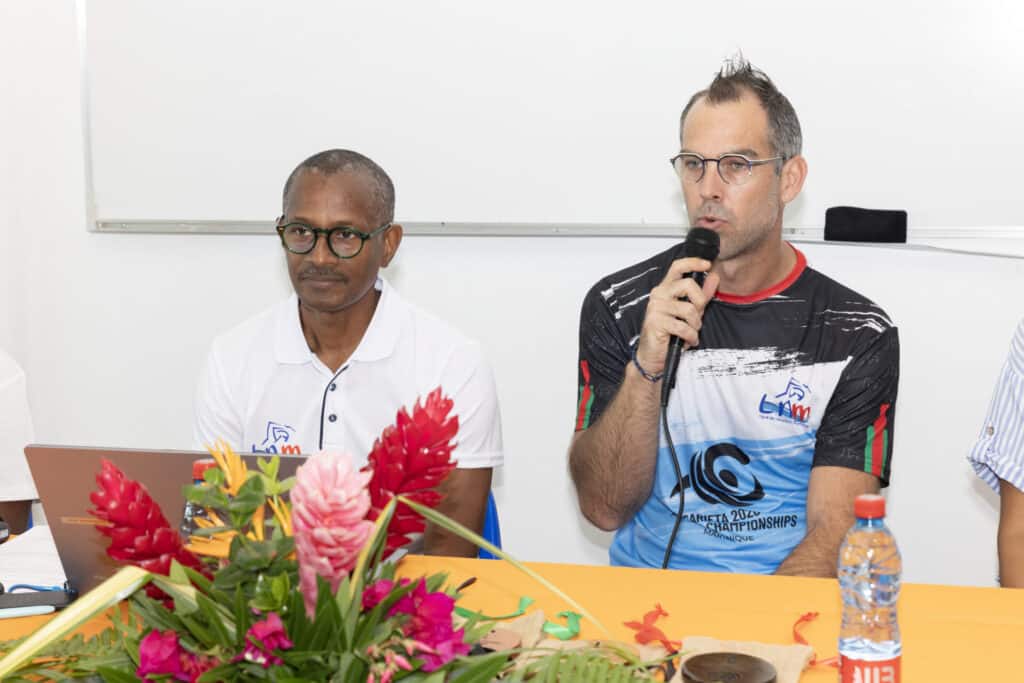
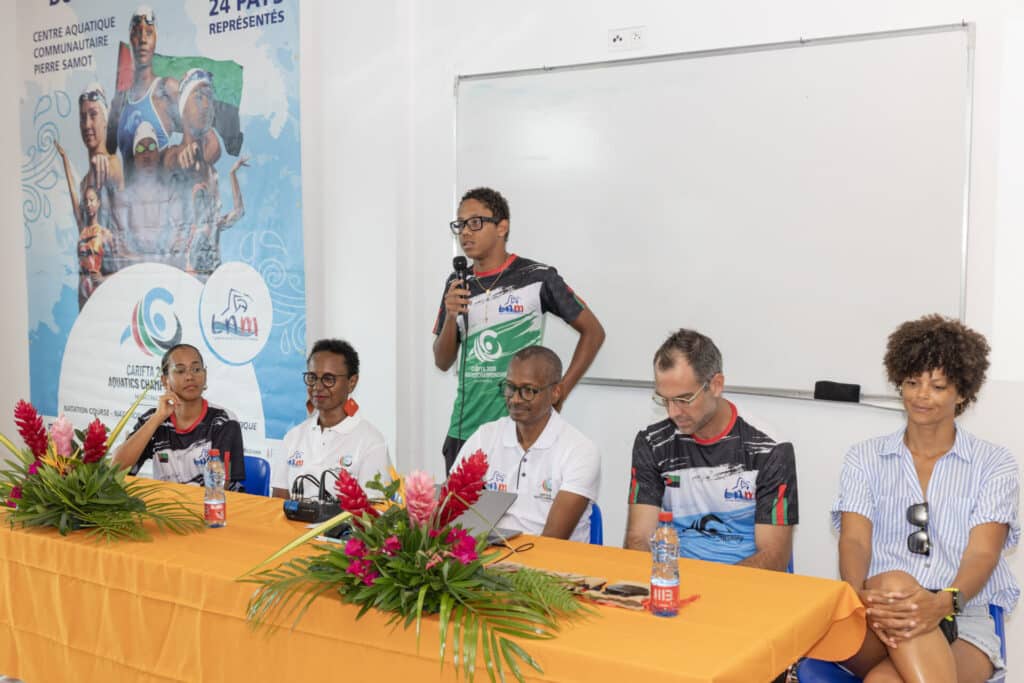
The open water event at Anses d’Arlets also serves as a reminder that the sea is a living, fragile environment that deserves protection. The association’s representative at the conference sums up its mission simply: “learn to swim to discover the seas and protect them.”
This educational dimension goes beyond drowning prevention. It also touches on the appropriation of water by the people of Martinique, the discovery of the discipline by the youngest and the broader desire to reinforce the region’s aquatic culture in the long term.
An assertive island
A phrase uttered at the end of the conference sums up the general mood: “We’re ready, and we’ll make the CARIFTA Aquatics Championships 2026 a collective success and a great source of pride for our region.”
What the delegations take away with them on the evening of April 8 is more than just a ranking. It’s an image of Martinique, a territory that knows how to welcome, organize and assert its identity. For six days, the whole Caribbean will be there. It’s up to Martinique to show what it can do.
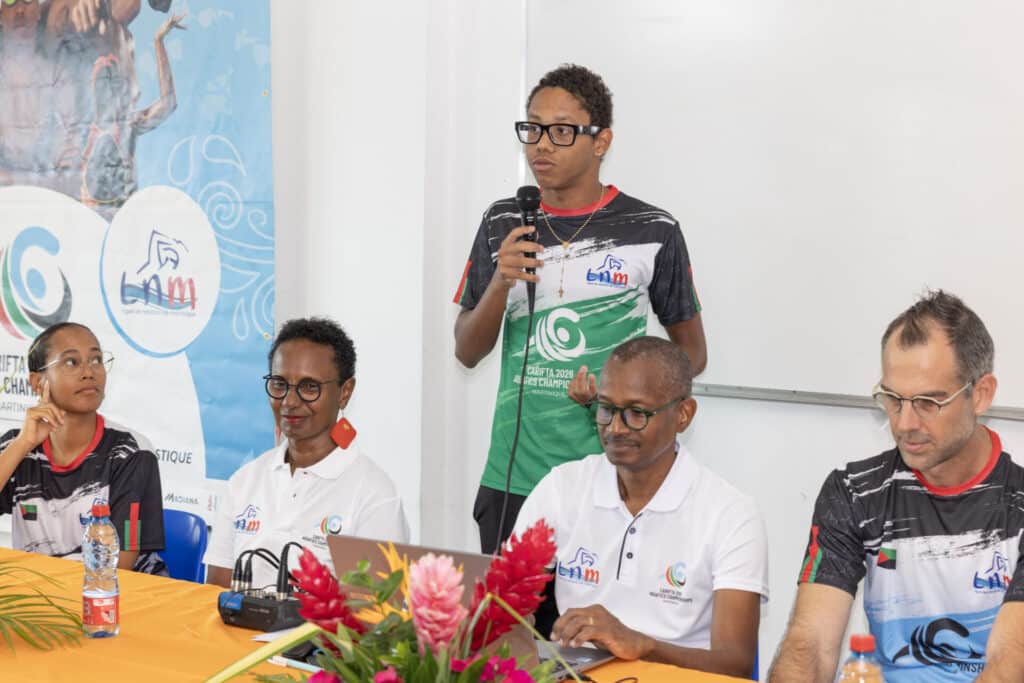
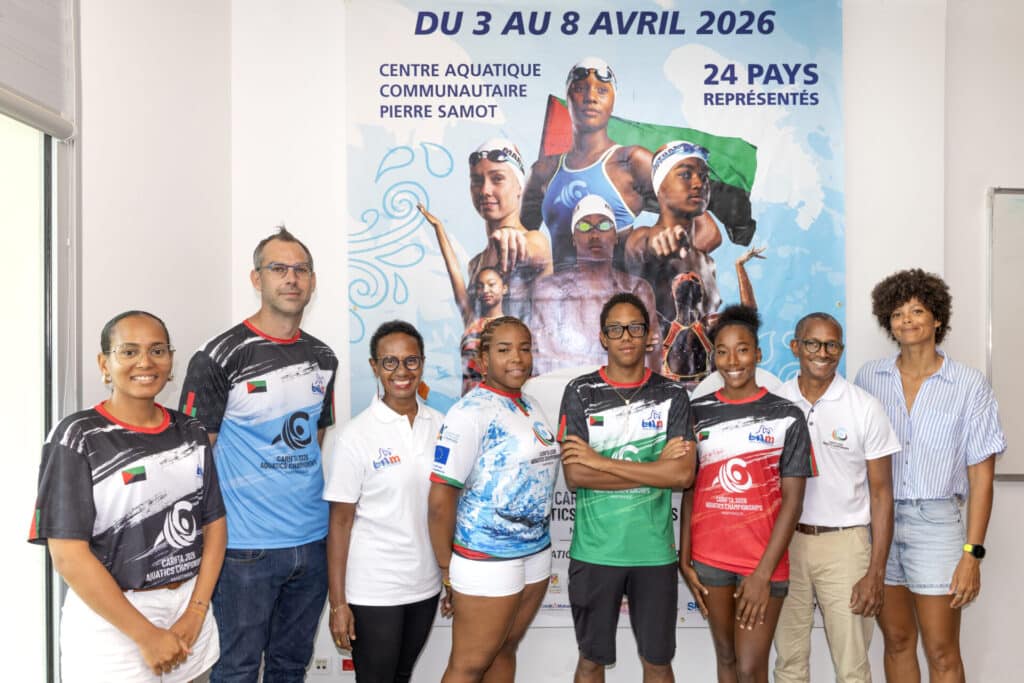
But the organizers of the CARIFTA Aquatics Championships 2026 also want to leave their mark after the event. The Ligue de Natation de Martinique ended the 2024-2025 season with some 2,540 members, around ten affiliated clubs and, generally speaking, 7 to 8 clubs involved in competition. With this in mind, the CARIFTAs are not intended as a parenthesis, but rather as a possible catalyst to encourage vocations, boost membership and establish swimming as a permanent fixture on the Martinique sports scene.
The organizers of the CARIFTA Aquatics Championships 2026 have also chosen not to reproduce the large village of 2016. In 2026, the activities surrounding the competition are to be more focused, with one day in particular being highlighted, in order to concentrate energy and attendance rather than scattering the highlights.
The CARIFTA Aquatics Championships 2026 is the 39th edition of the Caribbean’s leading junior aquatic event, held in Martinique from April 3 to 8. Twenty-four nations are taking part in racing, artistic and open water swimming, in categories ranging from 11 to 17 years of age.
The swimming race and artistic swimming events take place at the Centre Aquatique Pierre Samot in Le Lamentin. The 5-kilometer open water event takes place in Anses d’Arlets on Wednesday April 8.
Tickets are available on cariftamartinique2026.com and on the Ligue de Natation de Martinique social networks. Prices: €10 in the morning, €20 in the afternoon for adults, 4-day pass at €125. The opening ceremony at the Georges Gratiant stadium is free of charge.
Twenty-four countries are taking part: 21 English-speaking Caribbean nations, plus Martinique, Guadeloupe and Guyana.
The Martinique squad is led by five captains: Jean-Naël Zozime and Maxime Auguste-Charlery for boys’ racing, Cyrielle Manin and Sayanne Guivissa for girls’ racing, and Nohemy Marajo for artistic swimming.
Sint Maarten asserts its ability to combine gigantism and quality of welcome
Present at Seatrade Cruise Global 2025 in Miami, Sint Maarten highlighted one of its greatest strengths:
its unique ability to simultaneously welcome several of the world’s largest cruise ships, while offering a safe, smooth and welcoming experience to cruise passengers.
Through the testimony of Rensley Rollan, Port Facility Security Manager at the Port of Sint Maarten, the Dutch island affirms its ambition to combine operational excellence with Caribbean hospitality.

Impressive control over the flow of cruise passengers
For Rensley Rollan, Sint Maarten’s performance is based on meticulous organization.
The port can accommodate up to seven cruise ships simultaneously, including theIcon of the Seas, the world’s largest cruise liner.
” We are capable of handling over 30,000 passengers in a single day, which is more than the entire population of the Dutch side of the island,” he explains.
A challenge met thanks to close coordination between port teams, security forces and local authorities.

The system is reinforced on busy days:
Traffic control,
Creation of safe pedestrian zones,
Permanent patrols to guarantee passenger safety.
Even alcohol-related incidents or medical emergencies are handled with responsiveness and efficiency.
🎯 Rensley Rollan’s wish: to further expand the port in anticipation of market growth and continue to offer a seamless experience to visitors.
A lively destination, combining leisure and authenticity

Beyond its infrastructure, Sint Maarten seduces with its unique energy.
With its water sports, lively beaches, festivals, casinos and vibrant nightlife, the island is often described as a veritable “mini Las Vegas” of the Caribbean.
This diversity allows cruisers to enjoy a wide range of experiences:
Farniente on white sandy beaches,
Cultural exploration,
Creole and international cuisine,
Sports activities for all tastes.
Even during the low summer season, Sint Maarten maintains a regular cruise activity, welcoming several calls per week.
🎯 Rensley Rollan’s vision: to continue to offer a lively, rich and attractive destination, while managing the growing volumes of visitors.
Sint Maarten, the balance between power and hospitality
At Seatrade Cruise Global 2025, Sint Maarten reaffirmed its unique position as a port of excellence capable of welcoming the world’s largest ships, without ever sacrificing the human experience and quality of welcome.
With its world-class infrastructure and Caribbean energy, Sint Maarten embodies a powerful promise: to bring gigantism, fluidity and authenticity to the world of modern cruising.
The Caribbean guilder has officially become the currency of Sint Maarten, the Dutch part of the island of Saint-Martin, and Curaçao, as of April 1, 2025. It replaces the Netherlands Antillean guilder, in circulation since 1952, representing 73 years of monetary history. This change marks a major turning point on the road to economic and political independence for these two territories, which became constituent countries of the Kingdom of the Netherlands in 2010.
A historic turning point: from the Dutch Antillean guilder to the Caribbean guilder
The Caribbean guilder is the successor to a currency inherited from colonial times. Introduced in 1952 to unify economic exchanges in the former Dutch colonies of the Caribbean, the Netherlands Antillean Guilder until now symbolized the country’s economic anchorage in The Hague. The abandonment of this currency in favor of its own reflects a clear desire to emancipate itself from Dutch monetary influence.
This project follows on from the reforms undertaken since October 10, 2010, when Sint Maarten and Curaçao acquired the status of autonomous states within the Kingdom of the Netherlands. The Caribbean Guilder has thus become a tool of economic sovereignty, designed to reflect a unique identity.
A landmark launch ceremony
The Central Bank of Curaçao and Sint Maarten held a ceremony to mark the arrival of the Caribbean Guilder. During the event, Sint Maarten’s Minister of Finance, Marika Gumbs, symbolically exchanged the first denominations.
Richard Den Bosch, President of the European Central Bank, welcomed this transition, stressing that the Caribbean Guilder embodies “a symbol of confidence that will pave the way for a stable, inclusive and sustainable future”, while hailing the territories’ “lucid” choice in an uncertain global economic context.
A currency with a local design and enhanced security
The Caribbean Florin is distinguished by a design designed to represent the richness of the two territories. The range includes five banknotes (10, 20, 50, 100 and 200 guilders) illustrating the seabeds and emblematic landscapes of Sint Maarten and Curaçao. The seven coins (from 1 cent to 5 guilders) are reminiscent of ocean waves, a symbol of strength and movement.
Designed to high international standards, the new coin incorporates advanced anti-counterfeiting technologies. For production, the authorities called on service providers in Canada, Sweden and Malta, breaking with 230 years of production entrusted to the Royal Netherlands Mint.

A three-month transition phase
To ensure gradual adoption, a transitional period will run until June 30, 2025. During this phase, the old guilder can be exchanged for the new Caribbean guilder at the rate of 1 Caribbean guilder = 1.79 US dollars, the same as previously.
Information campaigns are underway to familiarize the population with the new bills and coins. The aim is to ensure a smooth transition, with no disruption to day-to-day transactions.
Economic consequences and strategic positioning
The introduction of the Caribbean guilder gives Curaçao and Sint Maarten greater control over their monetary policy, enabling them to adjust their strategy in line with regional realities, and reinforcing their economic credibility with partners and investors.
Politically, it sends a strong signal to the Caribbean and international community: that of an assertive desire to build an autonomous trajectory, without denying the historical ties with the Netherlands.
A choice that sets it apart from other Dutch Caribbean territories
While Sint Maarten and Curaçao are introducing the Caribbean guilder, other Dutch territories in the region – such as Bonaire, Saba and St. Eustatius – have opted for the US dollar. These choices reflect different economic orientations: guaranteed stability for some, monetary autonomy for others.
The positioning of Curaçao and Sint Maarten paves the way for regional reflection on the challenges of financial sovereignty in the Caribbean.
The Caribbean Florin is much more than a payment tool. It is the reflection of an ambition: that of two territories asserting their uniqueness in the Caribbean space and their ability to choose their monetary future.
Its introduction marks an important milestone in the autonomization process that began in 2010. The coming months will be crucial in measuring the real impact of this reform on local economies, but one thing is certain: this new currency marks a lasting turning point in the contemporary history of Curaçao and Sint Maarten.
NEW PERSPECTIVES
The Caribbean’s air connectivity has faced challenges with the closure of key regional airlines like AIR ANTILLES and LIAT.
Yet, hope is on the horizon with Winair stepping in to bridge the gap. Starting April, Winair launches direct flights from Martinique to Saint Martin and Dominica, heralding a new era for regional travel.
Behind this breakthrough is a collective effort, blending vision with collaboration.
Nathalie Sébastien, of Samac, highlights the unity between the tourism board and aviation authorities in making this a reality.
WINAIR’s CEO, Hans van de Velde, underlines the strategic alliances with major airlines like AIR FRANCE KLM, AMERICAN Airlines, JETBLUE Airways and more, ensuring a robust network that extends beyond island shores.
This expansion is not just about adding destinations; it’s about weaving a network that brings the Caribbean closer. With plans to further explore the southern arc and a commitment to seamless travel, Winair is on a mission to redefine Caribbean connectivity.
In the face of past disruptions, Winair’s initiative is a beacon of progress, signaling a brighter, more connected future for all Caribbean residents and visitors. Let’s embrace this new chapter as the skies above the Caribbean open once more.
SCHEDDULE FROM MARTINIQUE
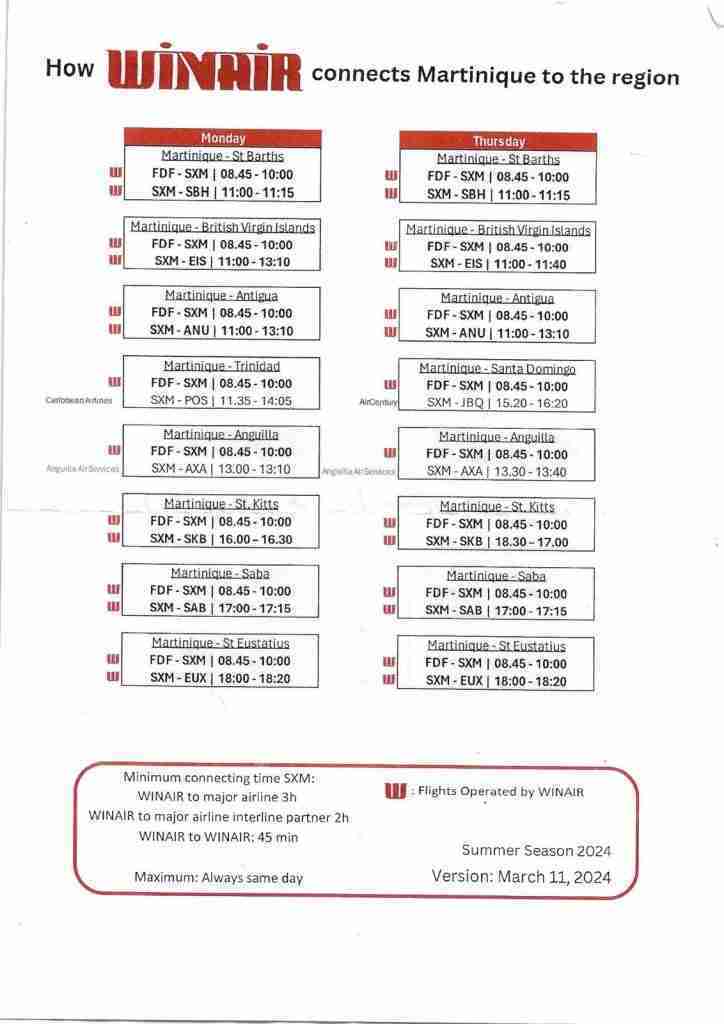
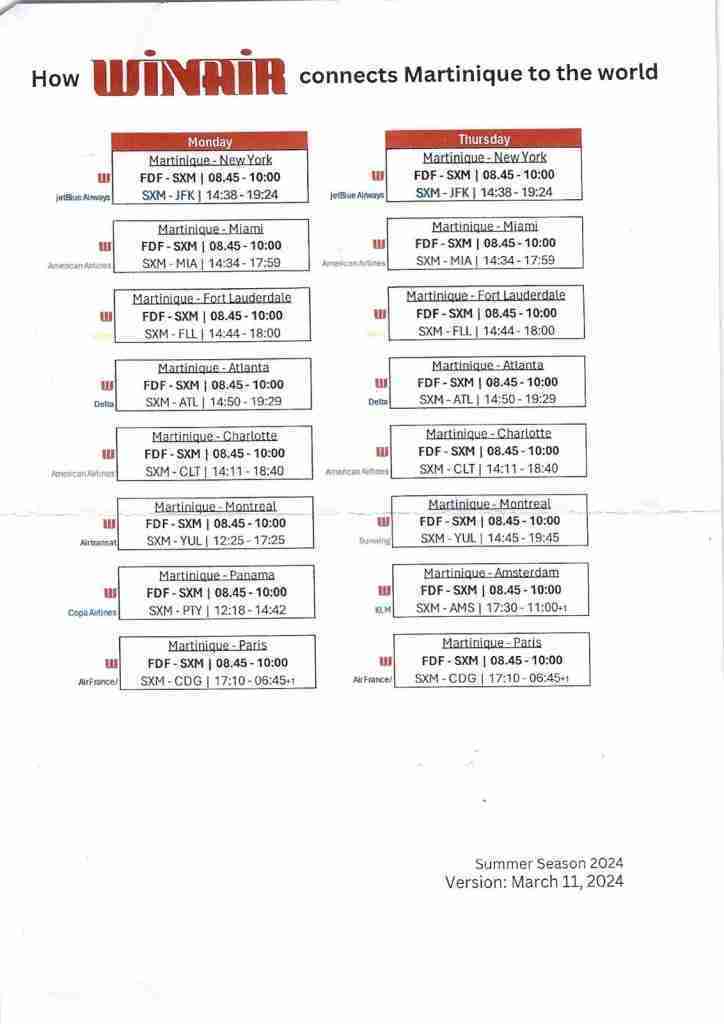
CEO INTERVIEW: HANS VAN DE VELDE
What are your next projects to expand your air traffic ?
We are expecting the arrival of new aircraft in November of this year and the following year. We will then deploy towards the south of the region with connections to Barbados, St. Lucia, and probably St. Vincent. It is important to note that we do not only connect St. Martin to the other islands, but we also have many routes between these islands as well. We will soon open the Martinique – St. Martin connection, but why not consider, for example, a Martinique – Antigua route if it works well? The former LIAT airline actually operated this service in the past.
