While the energy transition is often discussed from an economic perspective, it also raises major challenges for Caribbean territories, their natural heritage, and the future of their appeal to tourists.
Caribbean Energy Week 2026 marks a major turning point for the Caribbean economy. Long perceived as a region essentially dependent on tourism and services, the Caribbean is now establishing itself as a strategic territory in the global energy sector. The event, scheduled from March 30 to April 1, 2026 in Paramaribo, Suriname, brings together governments, investors, energy companies and financial institutions around a common goal: to transform the region’s energy potential into a sustainable economic driver.
This new edition takes place against a backdrop of profound transformation. Oil discoveries in Guyana and Suriname, the consolidation of Trinidad and Tobago’s energy role and the boom in renewable energy projects on several islands are repositioning the Caribbean on the global economic map. Caribbean Energy Week 2026 is thus a strategic platform for understanding how energy is redefining regional economic balances.
A regional platform for energy investments
Caribbean Energy Week 2026 is more than just an industry conference. The event is positioned as a genuine platform for investment and economic cooperation. Held at the Royal Torarica Hotel in Paramaribo, it will bring together heads of state, ministers, international investors, development banks and energy companies around concrete projects aimed at accelerating the region’s energy transformation.
The objective is clear: to connect Caribbean projects with international capital. The organizers hope to facilitate partnerships between states and investors, accelerate the implementation of energy infrastructures, and present projects deemed “bankable” and likely to attract international financing. This economic dimension makes Caribbean Energy Week 2026 a pivotal event for the region’s financial future.
Beyond technical discussions, the event aims to transform exchanges into real agreements and investments. Round tables will bring together governments and investors to identify concrete development opportunities, while networking sessions will help forge long-term strategic partnerships.
Caribbean Energy Week 2026 comes at a time when the economic geography of the Caribbean is being redrawn. Oil discoveries in Guyana and Suriname have already begun to transform financial flows and investment priorities in the region. Guyana, which has become one of the world’s fastest-growing countries thanks to offshore oil, is now attracting capital, business and skilled labor. Suriname, host of the 2026 edition, is preparing to follow a similar trajectory.
This trend is not limited to hydrocarbon-producing countries. It is influencing the entire region. Caribbean states are seeking to diversify their economies, strengthen their infrastructures and develop local skills in order to reap the economic benefits of this energy boom. Caribbean Energy Week 2026 provides an ideal opportunity to coordinate these regional strategies.
The Caribbean is no longer just a tourist destination. It is gradually asserting itself as an energy and industrial investment zone, capable of attracting international capital and developing regional value chains. This economic transformation is at the heart of the discussions scheduled for the event.
The official theme of Caribbean Energy Week 2026, “Leveraging Energy Diversity Across the Caribbean”, highlights the diversity of the region’s energy resources. The Caribbean boasts a range of energy sources, from offshore oil to renewable energies, natural gas and carbon credits. This diversity represents a strategic lever for regional economic growth.
Hydrocarbons remain an important pillar. Oil and gas continue to attract massive investment, notably in Guyana, Suriname and Trinidad & Tobago. However, the event also focuses on renewable energies, such as solar, wind and geothermal power. Several island territories are seeking to reduce their dependence on imported fuels by developing local energy infrastructures.
Caribbean Energy Week 2026 will also address carbon markets, energy storage and the critical minerals needed for the global energy transition. These sectors represent new economic opportunities for Caribbean countries, which can position themselves as resource suppliers or energy innovation hubs.
One of the major consequences of regional energy transformation concerns employment. Energy projects require specialized skills in engineering, logistics, maintenance and project management. Caribbean Energy Week 2026 will highlight the need to strengthen training and local skills development to enable Caribbean populations to benefit directly from these new opportunities.
Several sessions will be devoted to local capacity building and workforce training. The aim is to reduce dependence on foreign labor and promote the integration of Caribbean talent into energy projects. This social and economic dimension is essential to ensure that energy growth truly benefits local populations.
The rise of the energy sector could also stimulate other sectors, including construction, financial services, logistics and digital technologies. Caribbean Energy Week 2026 will highlight these multiplier effects on the regional economy.
Infrastructure and regional connectivity
Energy development also entails investment in infrastructure. Ports, power grids, pipelines and storage facilities are among the projects planned in several countries. These infrastructures are essential to support economic growth and improve regional connectivity.
Caribbean Energy Week 2026 will showcase a number of infrastructure projects aimed at strengthening the region’s energy integration. Cooperation between Caribbean states is seen as a key factor in optimizing resources and reducing costs. Discussions will focus on electricity interconnections, natural gas transport and the creation of regional logistics hubs.
These investments could transform the mobility of goods and services in the Caribbean, facilitating trade and strengthening regional competitiveness. Energy thus becomes a vector for economic integration.
One of the major challenges facing Caribbean Energy Week 2026 is its ability to attract international capital. The region is seeking to position itself as a reliable and stable investment destination. Development banks, investment funds and international financial institutions will be present to assess the opportunities offered by the Caribbean’s energy transformation.
The participation of international players strengthens the credibility of regional projects and facilitates access to financing. Caribbean Energy Week 2026 will serve as a showcase to present investment opportunities and demonstrate the economic viability of Caribbean energy projects. This international visibility is essential to attract the capital needed for infrastructure development.
The influx of financing could also help to diversify Caribbean economies and reduce their dependence on certain traditional sectors. Energy is becoming a lever for economic stability and long-term growth.
A transition to a more diversified economy
Caribbean Energy Week 2026 illustrates a broader transition towards a diversified Caribbean economy. While tourism remains an important pillar, energy is opening up new prospects. Countries in the region are looking to develop complementary industries, strengthen their technological capabilities and improve their economic resilience.
This diversification is essential to cope with external shocks, whether economic or climatic. By investing in energy and infrastructure, the Caribbean can reduce its vulnerability and strengthen its economic sovereignty. Caribbean Energy Week 2026 is part of this structural transformation process.
Caribbean Energy Week 2026 is more than just a gathering of experts and decision-makers. It symbolizes the Caribbean’s entry into a new economic era. The region, long dependent on traditional sectors, is now positioning itself as a strategic player in the global energy landscape.
The discussions and partnerships that emerge from this event could have a lasting impact on Caribbean economies. Investment, jobs, infrastructure and regional cooperation are at the heart of this transformation. Caribbean Energy Week 2026 thus offers a concrete vision of the region’s economic future.
At a time when the Caribbean is redefining itself on the international stage, this event appears to be a pivotal moment. It enables us to anticipate future economic developments and measure the scale of the transformations underway. For the region’s decision-makers, investors and populations, Caribbean Energy Week 2026 represents much more than a conference: it marks the emergence of a new Caribbean economic dynamic.
This event brings together governments, investors and businesses to accelerate energy projects, attract international capital and strengthen the regional economy.
It covers oil, gas, renewables, power infrastructure, carbon credits and critical minerals linked to the energy transition.
From November 22 to November 30, 2025, the Caribbean Film Days festival is underway online. For the first time, a space entirely dedicated to Caribbean cinema brings together more than forty works accessible anywhere in the world, at any time. The event, the result of a collaboration between Caribbean Creativity and the Caribbean Chamber of Commerce in Europe, transforms the month of November into a time of cultural sharing and solidarity, in aid of the populations affected by Hurricane Melissa.
Caribbean Film Days doesn’t just show films: it builds bridges. A link between the islands, between the diaspora and the territories of origin, between art and social reality, between memory and the future. For a public often far removed from traditional cinemas or deprived of access to Caribbean films, it’s a rare, almost unique opportunity to enter into stories that tell the region from the inside.
A festival designed to be seen everywhere
Unlike physical festivals, Caribbean Film Days requires no travel, no reservations and no set times.
A cinema that tells the story of the islands as they live
To appreciate a festival, you have to understand what it shows. Caribbean Film Days isn’t just a list of titles: it’s a mosaic of Caribbean realities, from its music to its struggles, from its creativity to its contradictions.
Here are just a few examples of the works on offer at Caribbean Film Days:
“Kanaval” (Haiti – Dominican Republic): a powerful feature film about identity, migration and memory.
“Jocelyne Béroard, At Heart”: a sensitive portrait of the zouk icon and her influence in the Caribbean.
“Joseph” (Barbados – Jamaica – Ghana): a quest for origins linking the Americas to Africa.
“Stones Have Laws” (Suriname): an immersion in Maroon traditions and their relationship with the land.
“Heart of Haiti”: a journey to the heart of Haitian artistic creation.
“Why Do Jamaicans Run So Fast?” an intimate look at Jamaican athletes and their heritage.
Documentaries, fiction, archives, independent projects, artistic experiments: this is a complete panorama of Caribbean cinema, too often absent from international platforms. The aim of this program is clear: to show a Caribbean that is not just beaches or tourist clichés, but one that expresses itself through voices, faces, struggles and dreams.
A festival in support of the islands affected by Hurricane Melissa
This first edition of Caribbean Film Days would not have the same scope without the context in which it takes place.
Hurricane Melissa left a devastating mark on the region, particularly in Jamaica, Cuba, Haiti and the Dominican Republic.
The rains, destruction and loss of life have left a deep mark on communities.
Caribbean Film Days has chosen to act on its own scale. Each film rental generates a donation, which goes entirely to reconstruction and support initiatives. Watching a film means :
– support affected families,
– contribute to infrastructure rehabilitation,
– a gesture of solidarity that goes beyond words.
It’s an ethical stance: the Caribbean, while contributing very little to global emissions, is exposed to the most violent consequences of climate change.
This festival reminds us of this injustice by giving a central role to culture.
A rendezvous for the diaspora and fans of Caribbean culture
For many, watching “a film from home” means reconnecting with a language, an accent, a landscape, a way of telling a story. The Caribbean diaspora in Europe and North America will find in the festival a way to reconnect with universes that are similar to their own. For non-Caribbean audiences, it’s an essential discovery: the Caribbean isn’t just a vacation zone, it’s a region with social, political and artistic dynamics that deserve to be understood.
The online format also makes it possible to engage a younger audience, often accustomed to streaming platforms, but with little exposure to Caribbean cinema.
Yes, all proceeds from film rentals during Caribbean Film Days are donated to Hurricane Melissa relief and reconstruction initiatives in Jamaica, Cuba, Haiti and the Dominican Republic.
On July 16, 2025, Jennifer Geerlings-Simons was sworn in as Suriname‘s first female president. This historic investiture is not simply a change of face at the head of the State: it marks a profound transformation of mentalities, in a country where cultural diversity is as vast as its primary forests. A woman of conviction, a doctor by training and a long-standing member of parliament, Jennifer Geerlings-Simons embodies a new type of leadership, based on listening, transmission and the universality of rights.
A woman doctor at the service of the common good
Born on September 5, 1953 in Paramaribo, Jennifer Geerlings-Simons first devoted her life to medicine, before even considering the public sphere. A graduate of Anton de Kom University, she worked for almost thirty years as a general practitioner in the public sector. Specialized in dermatology and involved in the fight against sexually transmitted infections from an early age, she has distinguished herself by her ability to build bridges between health, education and community development.
This on-the-ground experience is the foundation of her humanist vision. For her, running a country means understanding the day-to-day realities of its inhabitants. This proximity is one of the keys to her approach: putting people at the center, listening before acting, and drawing on local skills to build a collective future.
If Jennifer Geerlings-Simons is President today, it’s the fruit of a long journey, marked by consistency, discretion and high standards. First elected to the National Assembly in 1996, she won the confidence of her peers through hard work and integrity. She remained in office for 24 years, including ten as President of the Assembly, becoming a figure of stability in a sometimes turbulent institutional environment.
But she has never presented herself as a woman of power. What drives her is the idea of service. During her investiture speech, she declared: “I learned to care before leading. My profession has taught me to respect life, not to judge, and to think long term.” These words sum up the way she approaches her new position: not as a summit to be conquered, but as a mission to be accomplished.
The election of Jennifer Geerlings-Simons goes beyond the borders of Suriname. It sends out a powerful signal to all women in the Caribbean and South America: access to the highest office of the State is no longer an exception, it’s now an open path.
At 71, she has become a model of belated accomplishment, proving that it’s never too late to realize an ambition driven by the general interest. In a regional environment where women remain under-represented in decision-making positions, her presence at the head of the State fills a symbolic void.
Jennifer Geerlings-Simons makes no claim to gender-based leadership. But she does recognize the significance of her election for all those who don’t dare to break the barriers. “If my journey can inspire even one young girl to believe in herself, then this responsibility takes on its full meaning,” she confided recently.
Joining Mia Mottley in Barbados and Claudia Sheinbaum in Mexico, Jennifer Geerlings-Simons is part of a profound movement to reinvent governance in the Americas. But her uniqueness lies in the way she combines humility and determination.
It’s not so much authority that she embodies, but attentiveness. Not loud words, but active listening. Her mandate is based on the conviction that leadership is not measured in words, but in deeds. In a region often plagued by crises, this calm, resilient and structuring approach could set an example.
The election of Jennifer Geerlings-Simons as Suriname’s first female president represents more than just an institutional breakthrough. It represents a break in style, a reaffirmation of human values in the exercise of power, and a source of inspiration for all those who believe in governance based on care, equity and responsibility.
Through her journey, another path is opening up for the Caribbean : that of a calmer leadership, driven by life experience, local knowledge and an unshakeable faith in collective capacities. For Suriname, it’s a woman taking the lead. For the region, it’s a message for the future.
COP30: this name refers to the 30ᵉ Conference of the Parties to the United Nations Framework Convention on Climate Change, to be held from November 10 to 21, 2025 in Belém, Brazil. Held for the first time in the heart of the Amazon, this international conference will bring together more than 190 national delegations, heads of state, NGOs, scientists and representatives of civil society to negotiate urgent measures to deal with worsening climate disruption.
This geographic choice marks a turning point: the world’s largest tropical forest becomes both the backdrop and the focus of discussions. Faced with record levels of deforestation, loss of biodiversity and growing pressure from the extractive industries, COP30 aims to redefine the priorities in the fight against climate change by placing the protection of ecosystems at the heart of international commitments.
Curupira: an ancient spirit for the challenges of the future
To embody this decisive edition, Brazil has chosen a figure from indigenous legends: Curupira the mythical guardian of the Amazon rainforest. Far from being a consensual symbol, this character embodies a form of resistance. In Tupi-Guarani tradition, he is depicted as a small man with red hair and upturned feet, capable of outwitting intruders and fiercely defending his territory.
His name, formed from the words “curumin” (boy) and “pira” (body), evokes both childhood and vitality. Curupira is no mere folkloric character: he is deeply rooted in the collective memory of the forest peoples, and his influence extends beyond Brazil’s borders.
In French Guiana, it takes the name Makilili. In Colombia, it becomes Madre Monte. In Ecuador, it’s known as Sachamama, the mother of trees. In the Peruvian Amazon, it is known as Chullachaqui. In Suriname and Guyana, he is referred to as Winti-boskopu or Watramama. All these avatars fulfill the same mission: to protect the forest from predators.
A shared territory, a common emergency
The Amazon covers more than five million square kilometers and crosses nine countries: Brazil, Colombia, Peru, Bolivia, Ecuador, Venezuela, Suriname, Guyana and French Guiana. This vast territory is home to some 34 million inhabitants, including hundreds of indigenous peoples, often on the front line of the effects of extractivist policies and the climate crisis.
By choosing Curupira as its official mascot, COP30 is sending out a strong signal: the recognition of ancestral knowledge and local struggles, and the full involvement of Amazonian populations in global debates.
COP30 promises to be a strategic moment in international climate governance. Several crucial issues will be addressed in Belém:
✔️ Implementing a fair energy transition, with concrete support for the most vulnerable populations.
✔️ The creation of a global fund to preserve tropical forests, with announced support from China.
✔️ The aim is to mobilize $1,300 billion a year by 2035 to finance adaptation to climate change.
✔️ Sensitive negotiations around the reduction of fossil fuels, in a country like Brazil, a major oil producer.
These challenges are compounded by strong popular pressure. Brazilian civil society, researchers and indigenous organizations expect ambitious decisions. In this context, Curupira is not just a symbol: it has become the voice of an Amazon that is demanding its place at the negotiating table.
And what about the Caribbean?
The Caribbean territories are participating fully in COP30, as members of the Framework Convention and representatives of the Small Island Developing States. They include Barbados, Trinidad and Tobago, Haiti, Saint Lucia, Jamaica, Cuba, Antigua and Barbuda, Dominica, Saint Kitts and Nevis, Grenada and Saint Vincent and the Grenadines.
Why is their presence essential? Because these countries, although low emitters of greenhouse gases, are bearing the full brunt of climate change: increasingly violent cyclones, rising sea levels, water stress, coastal erosion and the collapse of marine biodiversity.
For the Caribbean, COP30 is an opportunity to advocate specific financing mechanisms tailored to their vulnerability, as well as to showcase their often innovative local initiatives in resilience, sustainable agriculture and risk management.
An educational and symbolic device around Curupira
Not every climate conference has had a mascot, but Curupira marks a breakthrough. At COP28, a sea turtle symbolized the fragility of marine ecosystems. But until now, no figure had embodied a protective force rooted in popular belief.
Curupira is to be presented in the form of educational and symbolic objects: posters, educational games, school events and workshops in the “citizens’ villages” running parallel to the official conference. This choice aims to raise awareness of global climate issues among a wider public, especially young people, through a figure from the collective imagination.
Curupira, the Amazon's red alert to the world
Through Curupira, COP30 is reminding us that the answers to ecological crises will not only come from laboratories or ministries. They will also require listening to local communities, recognizing local knowledge and redefining our relationship with living things.
By setting up its debates in the Amazon, COP30 is opening a new chapter. For the Caribbean, as for the Amazonian countries, it’s a question of transforming a long-marginalized voice into a lever for global decision-making. And perhaps by looking Curupira in the eye, leaders will understand that the forest is not asking for charity. It demands respect.
Strengthening sea turtle protection through regional ocean governance was one of the key issues at the 2025 annual meeting of the WIDECAST network, held in Saint Kitts and Nevis. Marine experts and conservationists from the Greater Caribbean, Australia and the Netherlands joined forces to deepen regional cooperation on marine turtle protection, with Suriname and the Guianas playing a central role.
A shared commitment to the Caribbean's sea turtles
Held in March at the St. Kitts Marriott Resort, WIDECAST’s AGM 2025 brought together over 80 participants committed to marine conservation. The event provided an opportunity to share update on national actions, share scientific data and make collective progress on flagship projects such as Blue Corridors for Sea Turtles, focused on preserving sea turtle migration routes and the Northwest Atlantic (NWA) Leatherback Regional Action Plan (RAP) for the Wider Caribbean, focused on protecting the leatherback in this region.
The workshops addressed fundamental themes: the fight against illegal trade, sea turtle autopsies, marine health, and the use of the EarthRanger platform for species monitoring. These exchanges illustrated WIDECAST’s key role as a network linking local actions and regional strategies.
Suriname and the Guianas in action
As Oceans Coordinator for WWF-Guianas and WIDECAST Country Coordinator in Suriname, the speaker presented a presentation entitled “Transforming regional ocean governance by combating IUU fishing and protecting marine turtles in the Guianas”.
Her presentation highlighted the one of the main challenges towards the decline of the leatherback which is illegal, unreported and unregulated (IUU) fishing, as well as the efforts undertaken to address them, including:
Strengthening fisheries governance frameworks ;
Enhanced surveillance and information sharing in the field;
Protecting spawning beaches and migration corridors;
Adapting to the impacts of climate change;
Updating Suriname’s Sea Turtle Recovery Plan (STRAP).
The Guianas are thus positioning themselves as a driving force for sustainable, concerted ocean governance on a Caribbean scale.
Local action for regional impact
Suriname’s contribution underlined the extent to which threats to marine biodiversity transcend national borders. The conservation of marine turtles, a migratory species par excellence, calls for coordinated, cross-functional responses.
This dynamic is illustrated by the Northwest Atlantic (NWA) Leatherback Regional Action Plan (RAP) for the Wider Caribbean and the Blue Corridors project and the commitments made collectively. Against a backdrop of increasing pressure on marine ecosystems, the future of conservation will require greater cooperation, science-based decisions and a genuine sense of the common good.
2024 was a pivotal year for connectivity in the Caribbean, marked by a series of initiatives that transformed the region’s aviation landscape. Airlines expanded their operations, introducing new routes and improving existing services. This review examines the advances made, the challenges encountered and the economic implications of these changes for the region.
New flights and connections
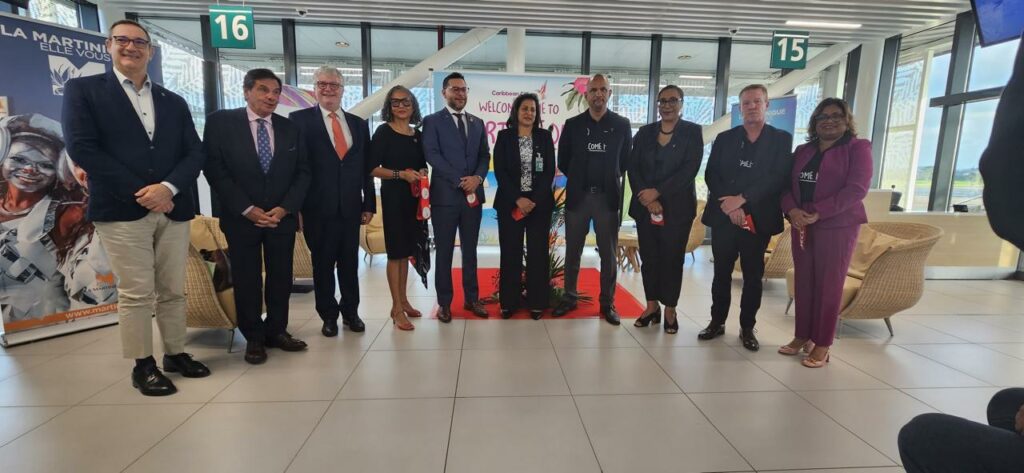
One of the most remarkable features of 2024 was the launch of several new flights, strengthening connectivity between the islands. These include Caribbean Airlines inaugurated direct services to Martinique, facilitating travel between the English- and French-speaking islands. Likewise LIAT Airlines has re-established routes to the British Virgin Islands, offering travelers additional options for exploring the region.
This expansion of the air network has met the growing demand for inter-island travel, stimulating tourism and trade. Passengers now enjoy greater choice, flexibility and convenience.
LIAT Airlines
Événement de bienvenue de Caribbean Airlines en Martinique Source : Caribbean Airlines
Economic impact
Increased connectivity has had a significant impact on the Caribbean economy. By making it easier for tourists to travel, airlines have helped to boost the hotel and restaurant sectors. For example, the increase in visitor numbers to Martinique and the Virgin Islands led to an increase in hotel bookings and restaurant spending, benefiting local businesses.
Statistics show that passenger numbers were up 15% on the previous year, testifying to the effectiveness of the new routes. Local governments have also benefited from this dynamic through increased tax revenues linked to the tourism sector.
Sustainability and Social Responsibility
Another important aspect of the 2024 review was the airlines’ commitment to sustainable practices. Royal Caribbean for example, has taken significant steps to reduce its carbon footprint. By using biofuels and investing in green technologies, airlines are striving to address environmental concerns while continuing to grow.
In addition, airlines have introduced social responsibility programs, supporting local communities and promoting sustainable development initiatives. This has helped to strengthen the relationship between the companies and the communities they serve.
Regional collaboration
Improved connectivity has also encouraged greater collaboration between countries and islands in the region. Governments have recognized the importance of working together to maximize the benefits of tourism. Initiatives such as the Caribbean Tourism Organization have been strengthened, enabling an exchange of ideas and best practices between industry players.
This cooperation has been essential in promoting events and festivals that attract visitors throughout the year, contributing to a more uniform and sustainable tourist season.
Challenges to overcome
Despite the progress made, connectivity in the Caribbean is not without its challenges. Airlines face issues such as increasing competition, fluctuating fuel prices and the need to modernize airport infrastructure. Continued investment is needed to ensure that the region’s airports can accommodate the growing volume of passengers.
Future prospects
Looking ahead, it’s clear that connectivity in the Caribbean will continue to evolve. Airlines plan to open new routes and improve existing services. Governments and local businesses must work together to ensure that this growth is sustainable and beneficial to all.
The overall picture of connectivity in the Caribbean in 2024 is positive. Thanks to initiatives to expand air links and promote sustainable practices, the region is well positioned for continued economic growth. By overcoming challenges and strengthening collaboration, the Caribbean can assert itself as a key destination on the global tourism scene.